



Places you should never burn a candle: 7 spots to avoid
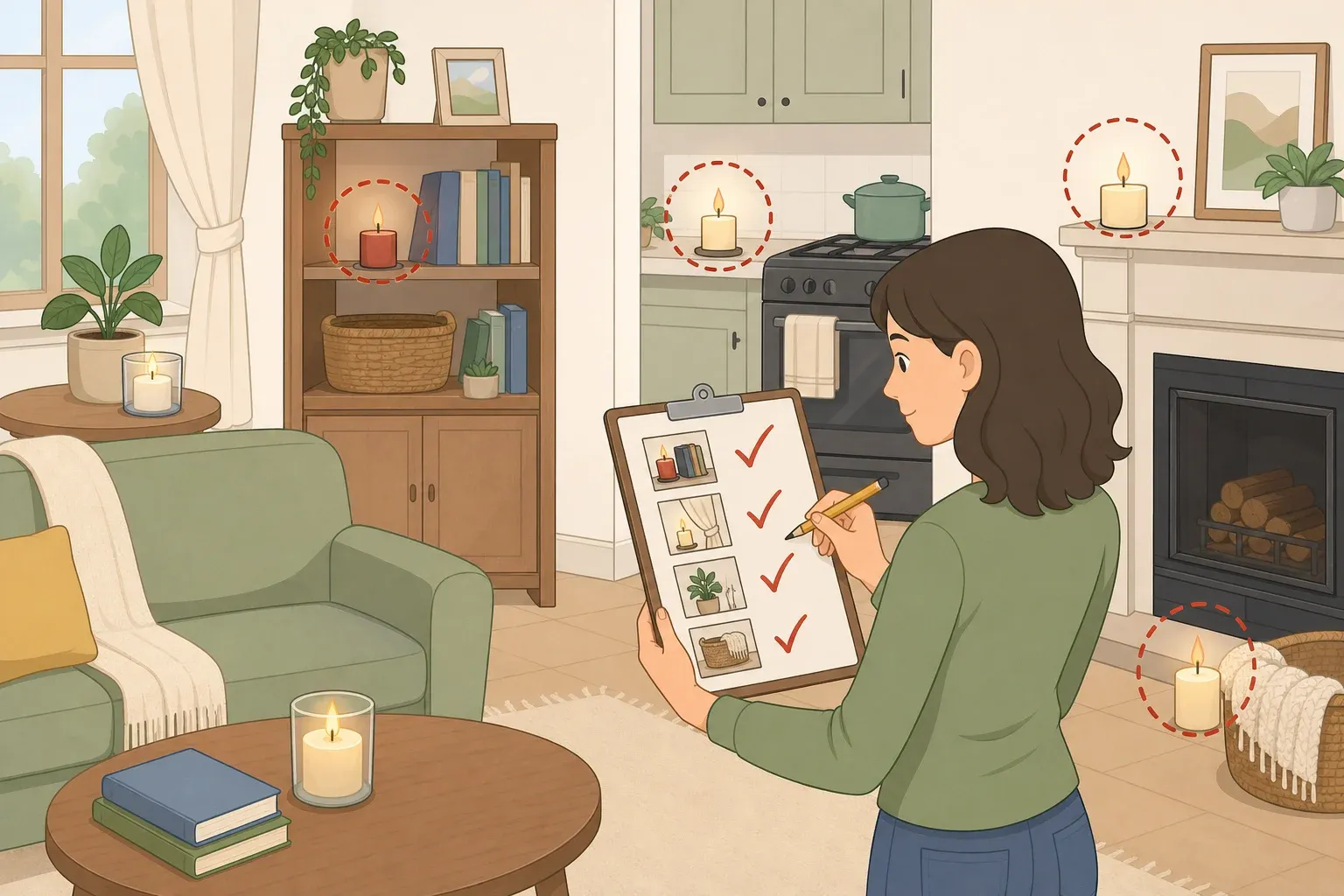
Walking through your home with a tape measure and a short checklist is enough to catch the places you should never burn a candle before the holiday season turns a cozy habit into a hazard. An average of 20 home candle fires are reported nationwide every day, according to the Washington State Fire Marshal's Office, which tracks the figure as part of its candle safety guidance. These aren't rare mishaps; they're the same handful of placement mistakes showing up again and again in ordinary homes.
The timing matters, too. Candle fires peak in December and January, accounting for 12% and 10% of the year's total respectively, according to NFPA. That makes now, before the tree goes up and the mantel candles come out, the right moment to run through some basic candle fire safety tips rather than after everything's already lit. Most homes can get through this in about 10 minutes, no lit flame required, and it works whether you rent or own.
The two-part test behind every call on this list
Every entry below lands on an unsafe spot for one of two reasons, and knowing which one applies helps fix the problem correctly. The first is a distance check: at least one foot of clearance from anything that can burn, measured around and above the flame, not just across the tabletop it's sitting on. The second is a situational check: someone alert is in the room, no medical oxygen is used anywhere in the home, and no unsupervised child can reach the flame.
The American Red Cross and the Washington State Fire Marshal both set the one-foot clearance rule as the baseline distance standard. CPSC guidance separately covers the situational side, urging people to extinguish candles before sleep and never leave them unattended.
A spot can pass the distance test and still fail the situational one. A candle sitting a clear foot from every piece of fabric in the room is still unsafe if everyone falls asleep or a toddler wanders in unsupervised. Keep both checks in mind while reading the list below; each entry notes which one it's failing.
Do the 10-minute candle check
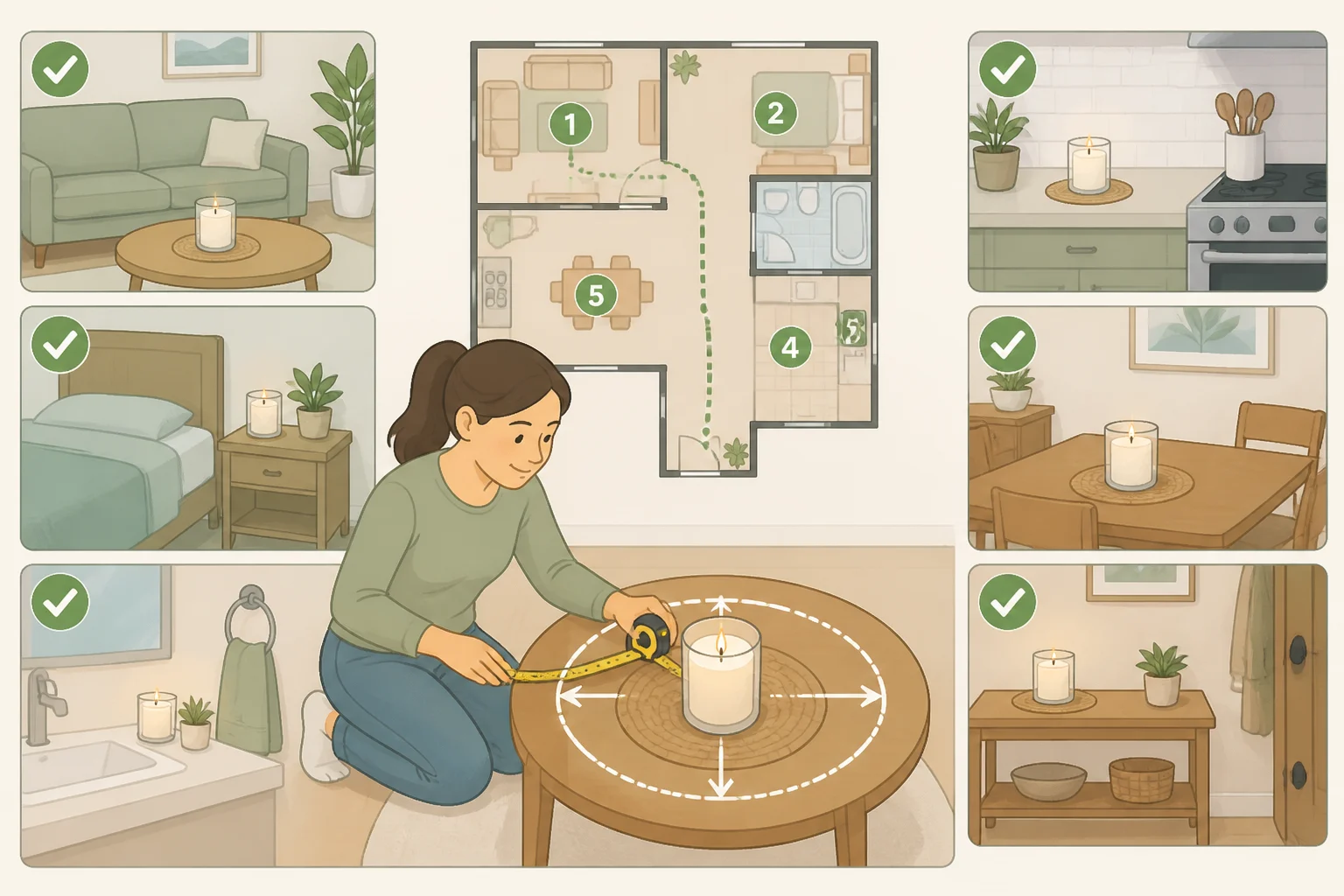
Work room by room, using the two checks above as the yardstick.
- List every spot where a candle currently burns or might burn. Walk the house and note mantels, bathroom ledges, dining tables, nightstands, windowsills, and any desk or shelf that holds a candle during the holidays.
- Measure one foot in every direction from each spot, including upward to a shelf or hanging decoration and sideways to curtains, drapes, or stacked paper. Anything closer than that counts as fuel under the clearance rule from the Red Cross and Washington State Fire Marshal.
- Check who's actually around. Is someone alert and staying in the room? Could a child wander in unsupervised? Is medical oxygen used anywhere in the home, even a room away from the candle?
- Sort each spot into one of three piles: keep it as is, clear the clutter or relocate the candle, or swap in a flameless candle. If a spot fails either check and can't be fixed in under a minute, send it straight to the flameless pile.
Once the usual spots are sorted, the seven categories below show where "flameless" or "relocate" is the only real answer, no matter how the measurements come out.
What you'll need
- A tape measure or ruler, plus about 10 minutes to walk the usual candle spots in your home
- A few flameless, battery-operated candles on hand as the default swap for any location that fails either check
- No special skill required: this is an ordinary homeowner or renter check, nothing involving wiring, gas lines, or structural work
The Red Cross notes that flameless candles can look and smell convincingly like real ones, which makes the swap an easy substitute rather than a downgrade.
Places you should never burn a candle: the 7-spot home check
Never burn a candle here
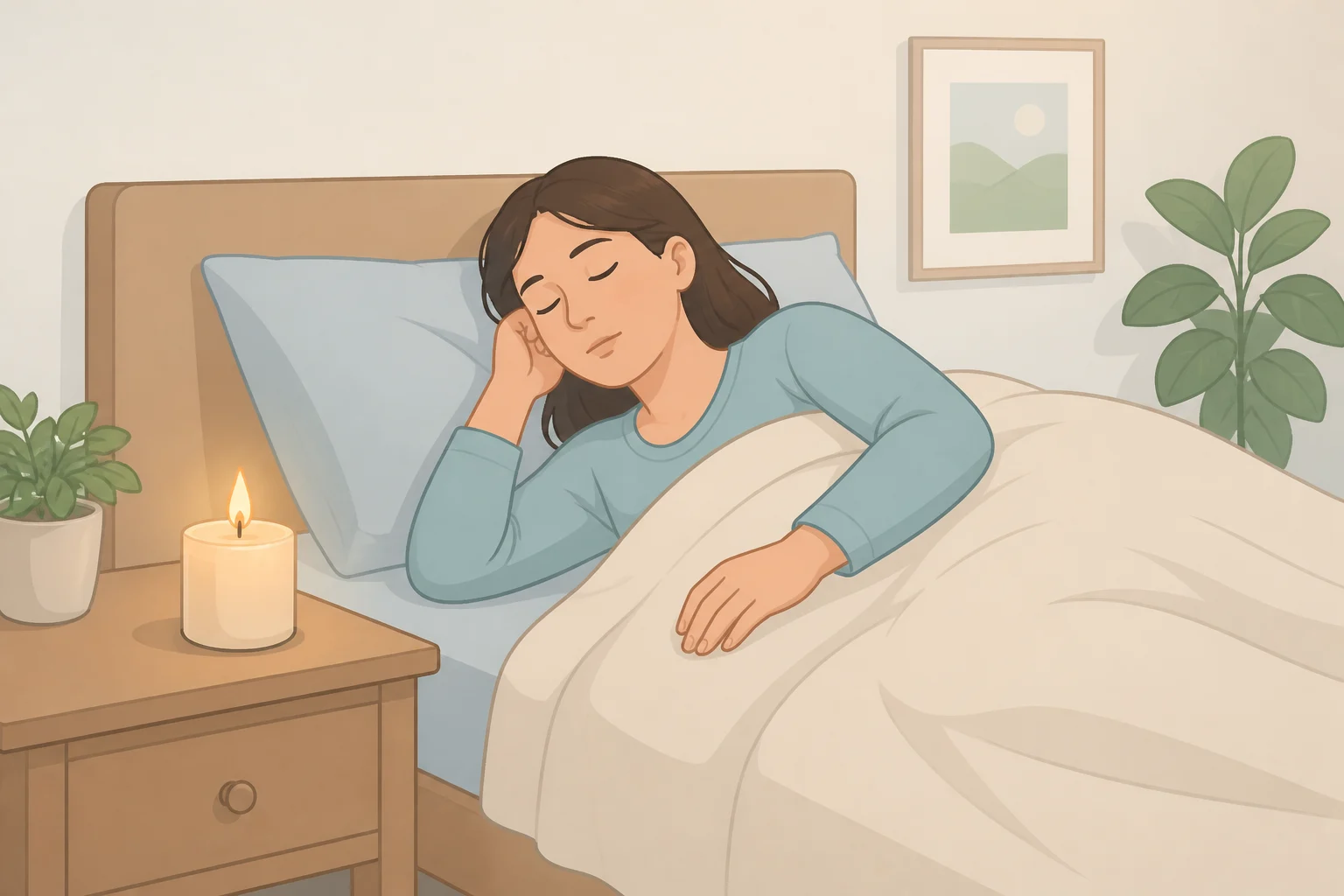
1. Bedrooms and anywhere someone might fall asleep. The Red Cross advises against candles in bedrooms or any area where a person could doze off, including a couch used for naps. This fails the situational check rather than the distance one. A candle can sit a measured foot from every flammable object in the room and still be dangerous the moment the person watching it falls asleep.
Swap in a flameless candle for bedroom ambiance, and make blowing out every flame part of the bedtime routine. CPSC guidance backs the same habit: extinguish candles when leaving a room and before sleeping, no exceptions.
2. Any home where medical oxygen is in use. Both the Red Cross and the Washington State Fire Marshal state this flatly: never use a candle if oxygen is used anywhere in the home. There's no case-by-case exception and no safe room to carve out around it.
Switch to flameless candles throughout the house instead. This isn't a spot to problem-solve around with extra distance or careful placement; the rule covers the whole home, not just the room where the equipment sits.
Flameless only: decorative spots where open flame doesn't belong
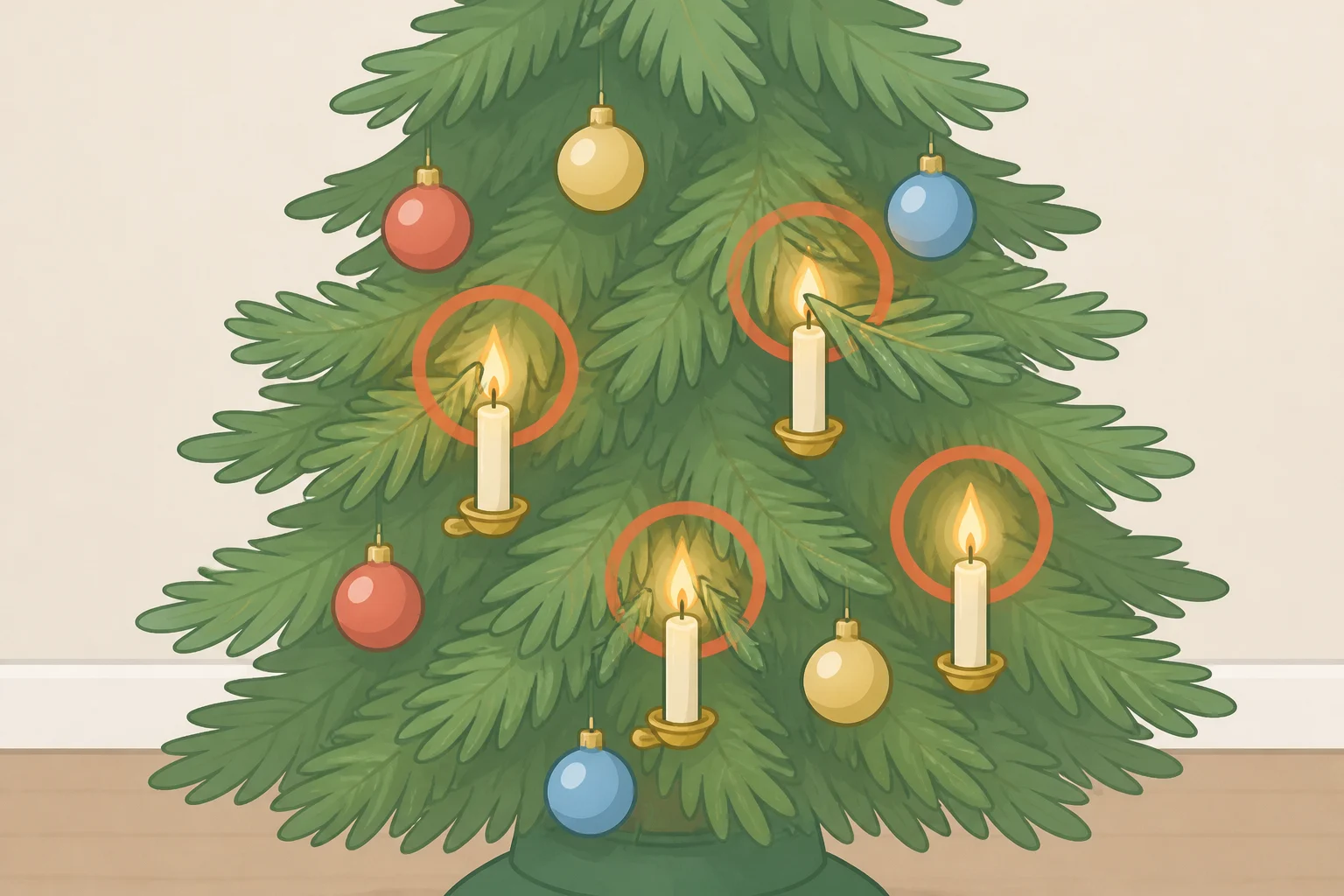
3. Christmas trees, wreaths, and other holiday greenery. U.S. fire departments respond to an average of 143 home fires started by Christmas trees each year, causing an estimated seven deaths, 13 injuries, and $15 million in property damage, according to NFPA. Candles caused 11% of those reported tree fires, per the same data, and the Red Cross states plainly to never use lit candles to decorate a tree.
Wreaths and other greenery aren't broken out separately in that data, but the one-foot clearance rule still applies: branches and needles routinely sit closer than a foot to any candle nested in them. String battery-operated flameless candles or LED lights through greenery instead, with no exception for a one-night party or holiday centerpiece.
4. Windowsills behind blinds or curtains. A lit candle in a window can ignite the blind or curtain framing it, according to the Washington State Fire Marshal, which treats window placement as its own rule, separate from general clearance guidance. The hazard is specifically fabric proximity. Window treatments routinely hang within inches of a sill-mounted candle, well under the one-foot minimum, and even a sill that technically clears a foot on the tabletop can still have a curtain swinging close enough to catch.
Relocate the candle to an interior shelf with a clear foot of open space on every side, or use a flameless version made for window display.
Clear the area or relocate first: fixable spots
5. Low tables and shelves within a child's reach. The Washington State Fire Marshal advises never leaving a child alone in a room with a burning candle, and keeping matches and lighters well out of reach. The stakes are real: among all consumer-product burn injuries treated in U.S. emergency rooms in 2021, children under 10 accounted for 26% of cases, according to CPSC data.
Move the candle to a higher surface children can't reach, and treat continuous adult presence as a requirement rather than a nice-to-have. In any room where kids play without an adult watching, default to flameless candles.
6. Cluttered desks, dressers, and bookshelves. Stacked mail, loose papers, and folded laundry all count as fuel under the same one-foot clearance rule cited by the Red Cross and Washington State Fire Marshal. Check clearance in every direction, including above the flame; a shelf edge or hanging item can sit close enough to catch even when the tabletop itself looks clear.
Clear a full foot of open space on all sides before lighting, or skip the rearranging altogether and move the candle to a surface that's already clean.
7. Doorways and other high-traffic walkways. The Washington State Fire Marshal recommends a sturdy, stable holder and advises against passing lit candles hand to hand. Neither guidance names doorways specifically, but the logic applies directly: a candle gets bumped more easily where people and swinging doors pass through, and whatever it tips onto becomes the next problem, exactly the scenario CPSC warns against when it comes to burning candles near anything combustible.
Relocate to a stationary surface away from foot traffic and swinging doors, or use a flameless candle anywhere people pass through regularly.
Special circumstance: religious observance
Some services call for a continuously burning candle, and the Washington State Fire Marshal allows this only under a narrow set of conditions. An adult must directly supervise the flame, the candle must be enclosed in glass, and it must sit in a sink, on a metal tray, or in a deep basin filled with water.
This exception applies specifically to that guidance and doesn't extend to ordinary household candle use. It also doesn't apply in a home where oxygen is in use; both the Red Cross and the Washington State Fire Marshal treat that rule as having no exceptions, religious or otherwise.
Universal candle safety rules at home
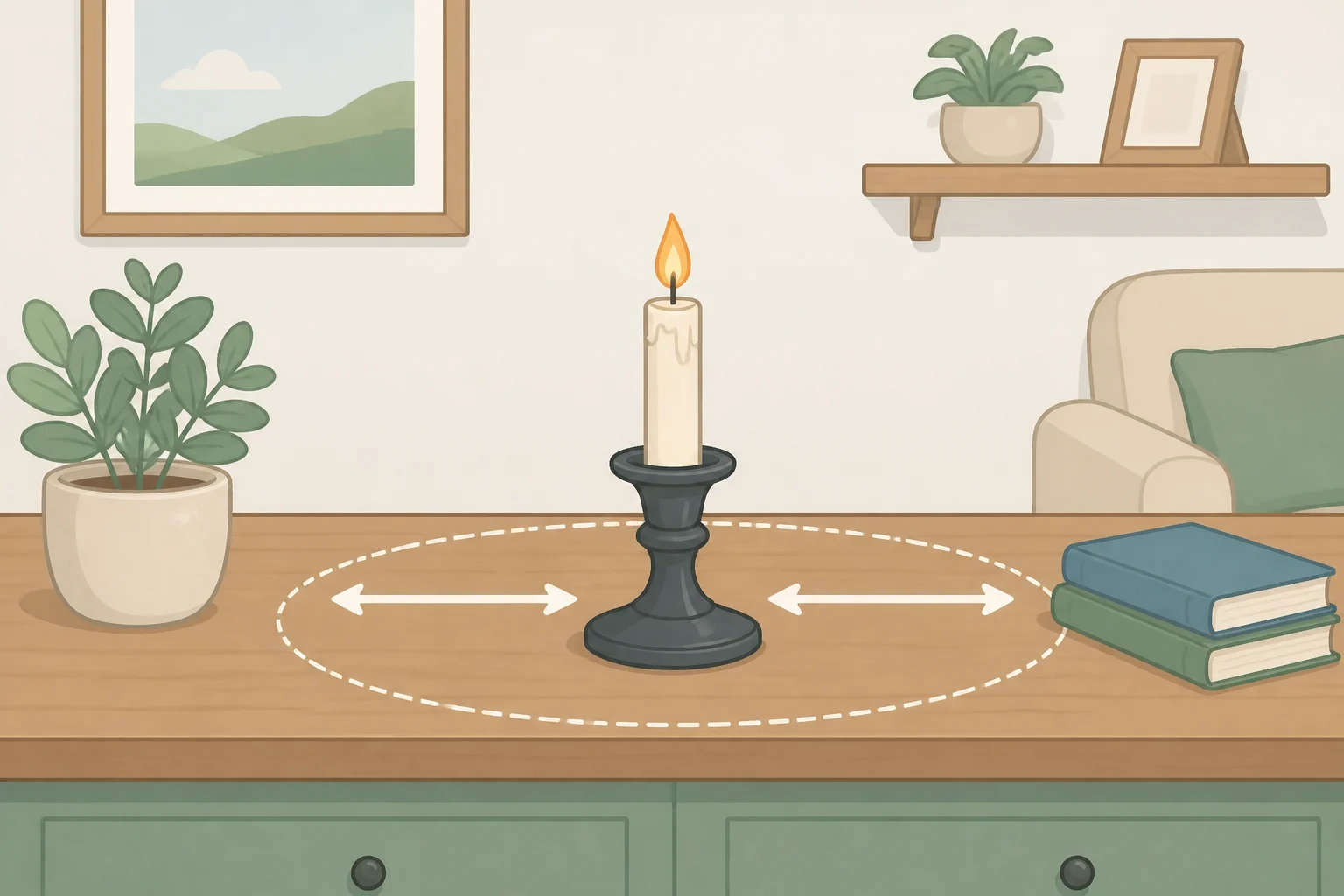
A few baseline rules apply no matter where in the home a candle ends up:
- The Washington State Fire Marshal recommends a sturdy, stable holder on a flat surface, and advises against passing a lit candle from one person to another.
- The Red Cross calls for at least one foot of clearance in every direction, not just across the surface the candle is sitting on.
- CPSC guidance calls for extinguishing a candle when leaving the room or before sleep, not just before leaving the house, and never walking away while it's still burning.
- The Red Cross recommends stopping a candle before it burns all the way down, rather than letting the flame get close to the bottom of its holder or container.
Finish-line guidance
Success looks like this: every lit candle in the home sits in a stable holder, a measured foot from anything flammable in every direction, in a room with someone actually present, with no oxygen equipment anywhere in the house and no unsupervised child within reach. If a spot can't meet all four conditions, it's not a candle spot.
A working smoke alarm is a backup for when something goes wrong, not a reason to accept a risky placement. CPSC guidance calls for testing alarms monthly on every level of the home and inside bedrooms, regardless of whether candles get burned at all.
During a power outage, reach for a flashlight or battery-powered candle instead of an open flame, a precaution CPSC repeated in its 2026 winter-storm safety guidance. The same logic applies everywhere else on this list: an open flame in an unstable or unsupervised situation rarely earns its keep.
Don't overthink the borderline spots. If a location fails either the distance check or the situational check, and clearing clutter or relocating won't fix it in under a minute, grab a flameless candle instead of talking yourself into "probably fine." That's especially true heading into the December-to-January stretch when candle fires peak nationwide, according to NFPA data. If the space can't be cleared, no one can stay and watch it, or oxygen or kids are anywhere nearby, the flameless version is the right call, not a compromise.



Comments
Be the first, drop a comment!