



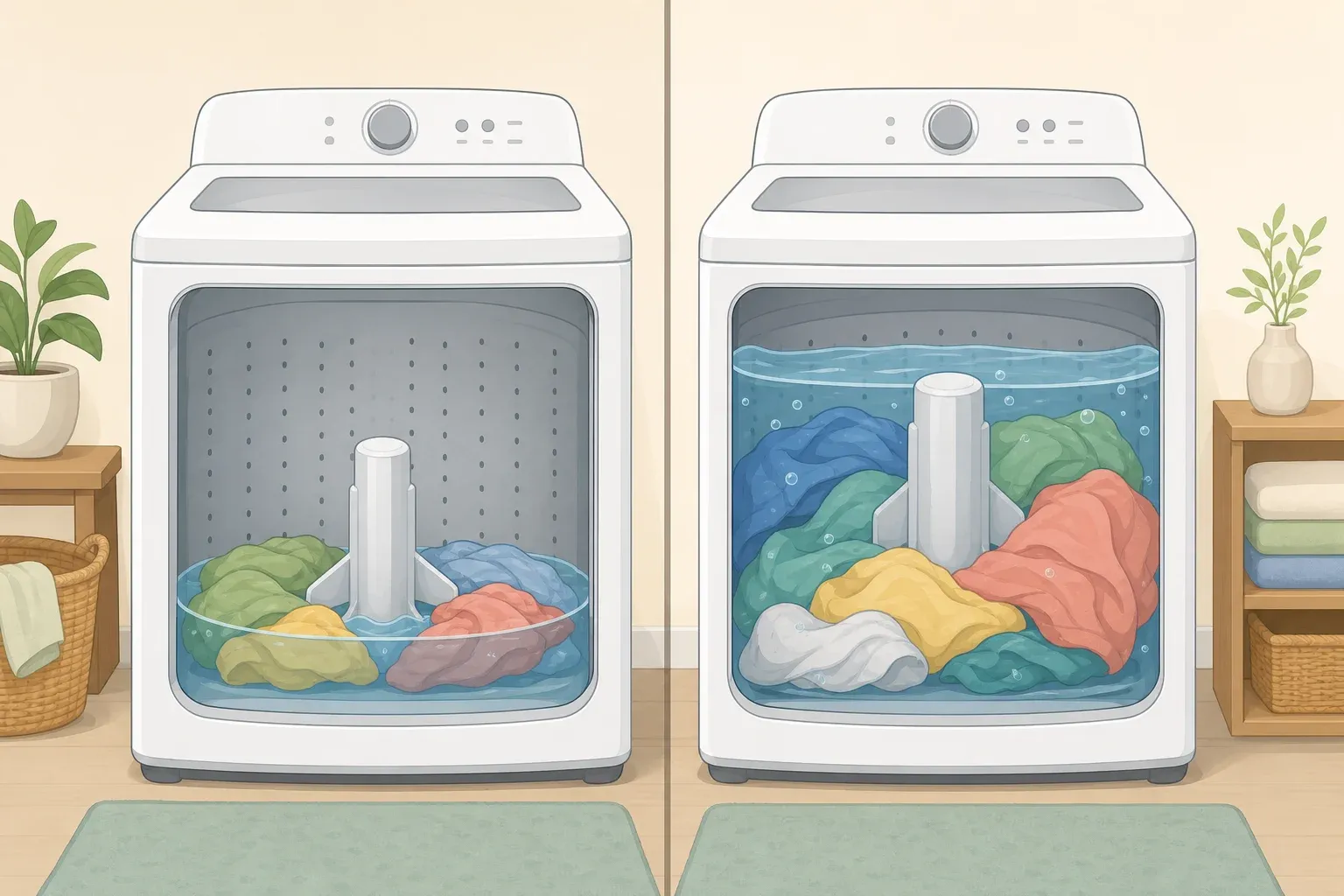
An "HE" badge on a washer's control panel doesn't mean the government ranked that machine above every other option on the sales floor. It marks a low-water wash design, and "regular" is just the term shoppers use for older-style top-loaders with a center-post agitator that fill deep enough to submerge the whole load. That's the real dividing line in the high-efficiency vs. regular washing machine question: how much water the machine uses to move clothes through a cycle, not whether the door sits on top or up front.
Manufacturers have had to meet Department of Energy conservation standards for clothes washers since 1988, and they must follow DOE's prescribed test procedures when certifying a model as compliant. Across the industry, washers now use about 70% less energy than 1990-era machines while holding roughly 50% more laundry per load, according to DOE.
Below is what "HE" actually describes, how an HE cycle runs differently, what to check before buying one, and how to get good results from a machine you already own.
What "HE" and "regular" actually mean
Federal clothes washer rules don't use "HE" as a category at all. The regulations that set water-use limits are organized by loading style and size instead, into groups like top-loading standard, front-loading standard, and compact, defined as under 1.6 cubic feet. "HE" is the term you'll find on packaging, marketing copy, and owner's manuals; the federal rules only care about those size and loading categories.
The one federal metric that does apply is the water factor, a compliance number where a lower figure means less water used per cycle relative to the machine's rated capacity. Meeting a federal minimum doesn't automatically make a machine "HE."
"Regular" isn't a formal product category either. For this guide, it means the older-style top-loader with a center-post agitator that submerges the whole load, the design most people picture when they say "regular washer." Don't assume a machine is HE just because of how it loads. Check the packaging, spec sheet, or manual for the actual designation.
Do HE washers use less water than regular washers?
Generally, yes, since a lower water factor is the point of the design. But the more accurate answer is "check the specific model" rather than "always." Water factor ceilings are regulatory floors that differ by category, not a scoreboard of real retail models, so two machines can both carry an efficient reputation and still use meaningfully different amounts of water depending on size and loading type.
The reliable way to compare is to look up the water factor or the manufacturer's stated water-use figure for the specific models you're considering, within the same size and loading category, rather than letting the word "HE" settle the question on its own.
What changes when you run an HE cycle
Some habits from an old top-loader don't carry over cleanly. Here's what tends to be different, and what's worth checking against your own machine rather than assuming.
Water level. A lower water factor means less standing water by design, so seeing less water in the drum than you'd expect from an old agitator machine isn't a sign of a fill problem on its own. If you're unsure whether a fill level looks right for your specific model, the manual's troubleshooting section is the place to check.
Cycle length. DOE's own rulemaking record on compact washers found that efficiency standards tended to lengthen how long it takes to wash a load. That's documented for compact models specifically. Cycle times vary by brand and model, so check the estimated time listed for the machine you're actually comparing rather than assuming every HE washer runs long.
Spin speed and drying time. Spin options and how much moisture gets left in the load differ by brand and model. Check your washer's manual for its rated spin settings if faster drying or gentler handling for delicate fabrics matters to you.
Capacity. A low-water cycle doesn't automatically mean a smaller load. Capacity varies model to model rather than by design type, so check the rated capacity for the specific washer you're looking at instead of assuming HE means a downsized drum.
Cleaning performance and detergent for HE machines
Low water doesn't mean clothes are just getting dampened instead of cleaned. HE washers are built to run without fully submerging the load, which is the point of a lower water-factor design, not a shortcut manufacturers are cutting corners on.
Whether that gets a specific load as clean as you want depends on the load and the model's cycle options. If your machine offers a dedicated bulky-item, bedding, or deep-water cycle, that's the setting to use for comforters or heavily soiled laundry. Check your model's cycle guide before assuming one default cycle handles everything you throw at it.
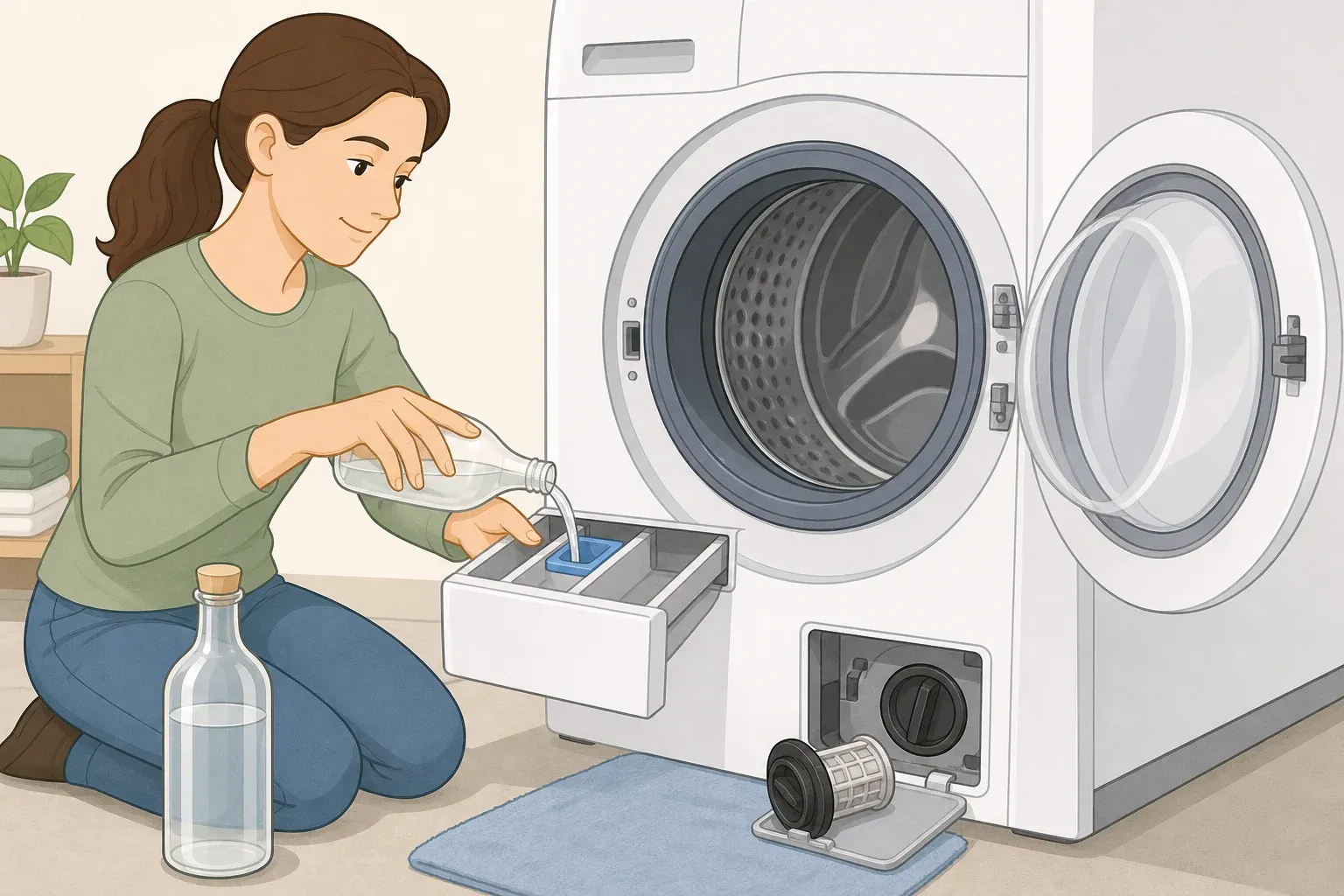
Detergent is where habits from an old machine cause trouble. Many owners' manuals specify a low-sudsing detergent formula for machines built around a shallow fill, since there's less water available to rinse away excess suds. Check your specific model's manual for its detergent type and dose rather than carrying over what worked in a previous washer. Using more detergent than the manual recommends, or a regular high-sudsing formula, can leave suds and residue behind because the water simply isn't there to flush it out.
HE vs regular washing machines at a glance
HE washer
Water use: Runs on a shallow fill; check the model's rated water factor.
Wash action: Moves clothes through less water without full submersion.
Cycle time: Varies by model; efficiency-focused cycles can run longer.
Detergent: Usually needs a low-suds formula per the manual.
Bulky loads: Check for a dedicated bulky-item or deep-water cycle.
Best fit for: Households prioritizing water savings that will follow manual guidance.
Regular (conventional) washer
Water use: Fills deep enough to submerge the whole load.
Wash action: Fully submerges and agitates the load.
Cycle time: Often has simpler, shorter default cycles.
Detergent: Standard detergent generally works fine.
Bulky loads: Full-submersion design handles bulky items by default.
Best fit for: Households wanting simpler controls or a fully submerged wash.
Why model-to-model comparisons matter
Comparing an HE and a regular washer side by side only makes sense within the same size and loading category. Federal water-factor ceilings differ by configuration: for machines built after 2018, the limits are 12 for top-loading compact, 6.5 for standard top-loaders, 8.3 for front-loading compact, and 4.7 for standard front-loaders. A lower number means better efficiency, so front-loaders as a category sit under a tighter standard than top-loaders regardless of marketing labels. These are regulatory floors, useful as background, not a ranking of the specific machines in a showroom.
In May 2025, DOE proposed rescinding the water-use standard for standard-size washers, which would return the requirement to the older statutory ceiling of a water factor of 9.5 if finalized, and separately proposed dropping efficiency standards for compact washers entirely. Public comment on both proposals closed over a year ago, and whether either was finalized isn't something confirmed here. Treat any specific water-factor ceiling as something that can shift, and lean on the model's current listed specs rather than a fixed number.
What to check before you buy
For real numbers on a specific model, check the manufacturer's spec sheet and owner's manual. That's where capacity, estimated cycle time, and water-use figures for that particular washer actually live. DOE's certification testing happens behind the scenes as a compliance step and won't show up as a simple number on a retail page.
A practical checklist:
Confirm the manufacturer specifically labels the model "HE" rather than assuming it from loading style.
Compare rated capacity and listed cycle times within the same size and loading category.
Check whether a deep-fill, bulky-item, or bedding cycle is offered if you regularly wash comforters or heavily soiled loads.
Confirm detergent type and dose in the model's manual before you buy detergent.
Note the install dimensions, since HE and regular machines vary in depth and width model to model.
Using and maintaining an HE washer you already own
Follow your manual's specified detergent type and dose rather than habits carried over from a previous machine. A shallow-fill design generally needs a low-sudsing formula to avoid leaving residue behind.
Check your manual's listed load capacity and don't pack the drum past it. HE machines need open space to move clothes through the water that's present, and an overstuffed load risks leaving some fabric dirtier or damper than the rest.
Many HE models set water level and cycle length automatically based on load size and soil level. Check your manual before manually extending a cycle or adding extra detergent to try to improve results; that combination often leaves more residue behind rather than a cleaner load.
A lower water level and a somewhat longer cycle than you're used to are both expected. Persistent odor or visible residue after using the correct detergent dose and running a routine cleaning cycle is worth checking against your manual's troubleshooting section. Unusual leaking, grinding noises, or a failure to drain are different signs entirely: stop using the machine and contact the manufacturer or a repair technician rather than opening it up yourself.
High efficiency vs regular washing machine: which is better for you?
If a shallower fill, manual-specified detergent, and possibly a longer cycle in exchange for lower water use don't bother you, an HE machine, top-loading or front-loading, is a reasonable fit. If you'd rather have a fully submerged wash, simpler agitator-style controls, or don't want to track down a specific detergent formula, a conventional top-loader is a reasonable choice too, but confirm that specific model's own water-factor and capacity figures instead of assuming every conventional machine performs the same.
Follow the manual for detergent, load size, and cleaning-cycle guidance either way. If wash results still aren't right after that, or if the machine starts leaking, grinding, or failing to drain, stop running it and call the manufacturer or a repair technician rather than continuing to tinker with settings on your own.



Comments
Be the first, drop a comment!