



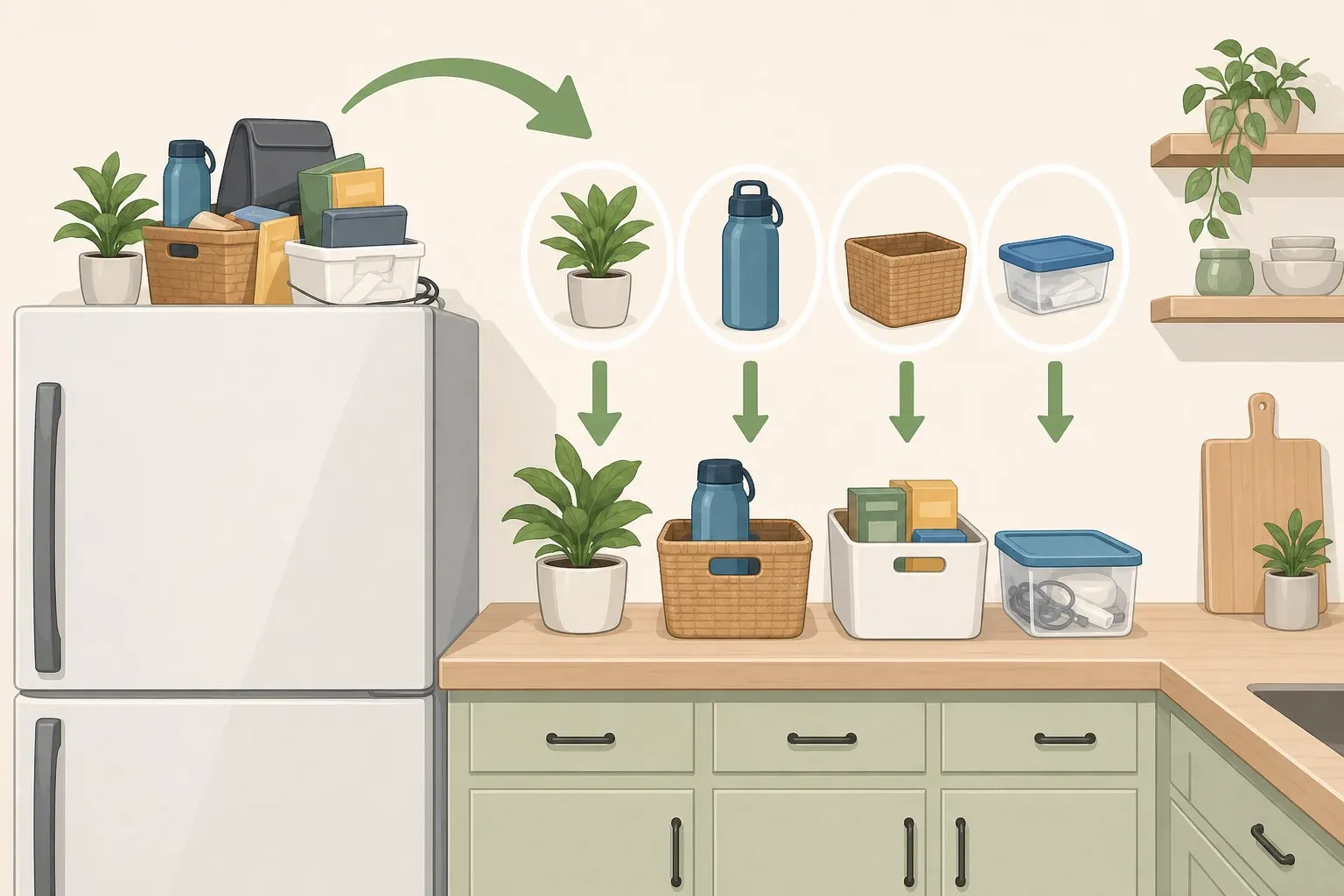
Clear the exposed top of the refrigerator, then sort what comes off it into items that need a cooler, lower, steadier, or more reachable home. Experts advise keeping that surface clear because anything stored there can obstruct ventilation and affect how well the appliance cools, not just how the kitchen looks.
Not every kitchen works the same way, though. A cabinet mounted above the fridge follows different rules than the open appliance top, since it's usually built with a gap behind it rather than sitting flush against the appliance. This guide sorts nine items that commonly land in the wrong spot above a fridge. The first seven should not live on the exposed top of the fridge. The last two are cabinet-specific, since they're about lifting and daily access rather than heat or vibration. It's a beginner-friendly reorganizing job: no tools, wiring, or appliance work, just clearing a surface, sorting items into better homes, and resetting a cabinet if you have one.
What not to store above the refrigerator: open top vs. cabinet
Most refrigerators need roughly half an inch of clearance on the top, sides, and back so the machinery inside can vent properly. However, that's a general baseline, not a spec sheet for your exact model, so check the owner's manual for your fridge's required clearances before assuming the space above it is fair game. In any case, overloading the top with weight could potentially damage the appliance or block ventilation, leading to inefficient cooling. That's the reasoning behind keeping the open top clear, whether or not your kitchen also has a cabinet above it.
When a cabinet sits above the fridge, it's usually built shallower than the appliance itself, leaving a gap behind it for airflow. That gap is meant to stay open, and there's no reliable way to confirm from a glance whether your specific cabinet preserves it. If you can't confirm the installation from the manual or the installer, don't modify the gap or use it for storage.
If there is no cabinet above your fridge, it is recommended to keep the entire exposed top clear. If you do have a cabinet, it follows a different set of rules, covered further down.
Before you organize the space above the fridge
Before moving anything, spend thirty seconds figuring out what you're working with: an open top, an enclosed cabinet, or both, if the cabinet doesn't run the full width of the appliance. If you have a model number or manual for your fridge, keep it nearby, since a couple of the steps below send you right back to it.
What you'll need:
A stable step stool or small ladder
A few bins, baskets, or boxes for sorting
A marker and labels
A second person on hand for anything heavy or awkward to carry down
Before you start:
Skip the refrigerator door, handle, or top shelf as a step; use the stool or ladder instead.
Line up your bins before you start pulling items down, so nothing sits half-sorted on the counter mid-project.
Plan to get help lifting anything heavy or bulky rather than balancing it solo while you climb. That matters most for cookware, which comes up again below.
How to organize the space above the fridge: sort the 9 problem items
Step 1: Remove everything currently on the exposed top of the fridge. Pull items off one at a time, heaviest first, so you're not juggling weight and balance at the same time.
Step 2: Sort what you removed by the problem it creates. Each item below carries a different kind of risk, so the fix looks different too.
Small countertop appliances, toasters being the classic example: compressor heat and poor ventilation can cause overheating and long-term damage, which raises fire risk over time. This is a heat and fire problem, so open counter space away from the stove is one option, and a pantry shelf works if the counter's already crowded. The item should feel cool to the touch and sit somewhere with normal airflow around it.
Cleaning products: heat can cause volatile chemicals to evaporate, and a leaking container could contaminate the fridge's interior, meaning food stored inside might need to be thrown out. This is a chemical and food-safety risk. A cabinet away from the oven, stove, microwave, and fridge is a reasonable spot. Containers should stay sealed and out of reach of any heat source.
Flammable paper or fabric items like paper towels, cookbooks, and cloth bags: these raise fire risk in a kitchen where heat and sparks are already common. This is a fire risk, plain and simple. A drawer or closed cabinet away from the oven, stove, and microwave solves it. Nothing paper or cloth should sit within easy reach of a heat source.
Electronics such as routers, laptops, phones, chargers, and gaming consoles: ambient fridge heat can cause these to overheat or malfunction over time. Phones and chargers specifically can overheat and get damaged. This is a heat and malfunction risk. Place the device in a cooler, dry spot elsewhere in the kitchen that still meets its power and connection needs. It should stay cool to the touch during normal use.
Fragile glass items and wine bottles: ordinary refrigerator vibration can cause these to topple and shatter. This is a breakage risk. For wine, a tall wine rack built into a run of cabinets is recommended. Other glassware generally does better on a low, stable shelf than balanced on a vibrating appliance. Check that the item sits flat and doesn't wobble when you tap the surface it's on.
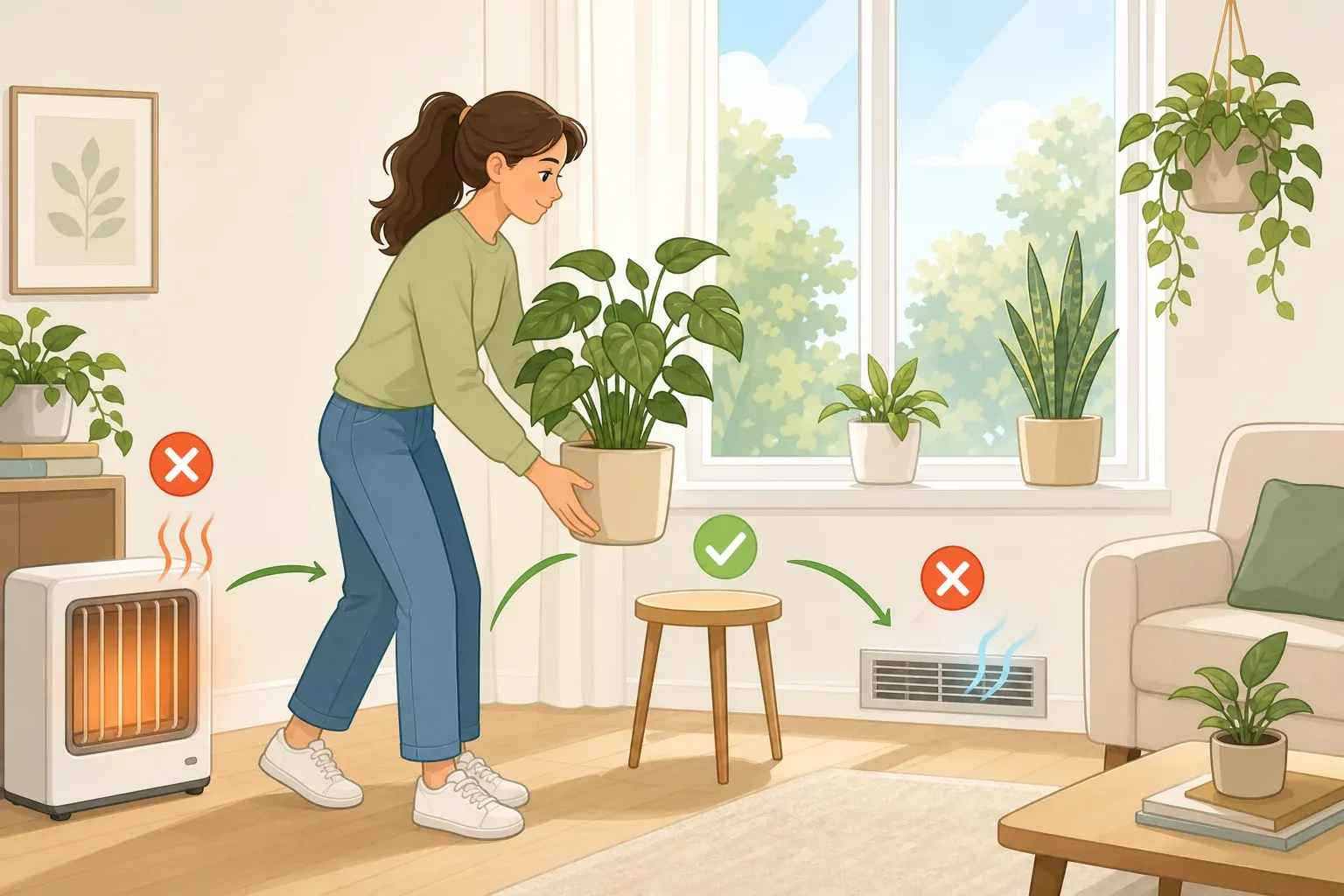
Plants: fridge heat dries them out, and compressor vibration can shift the soil enough to spill water or dirt onto the appliance. This is a heat and vibration problem. Moving the plant anywhere else in the kitchen, away from the fridge, addresses both issues. Soil should stay evenly moist rather than drying out fast.
Bread and other baked goods: warmth speeds up staling and spoilage, and food left out may attract pests that gnaw on wiring. This is a food-quality risk. Everett recommends a fridge or pantry, wherever the item actually gets eaten quickly. Success here just means it gets used up before it goes stale.
With those seven cleared, look at the top again. If there's no cabinet above it, that bare surface is where this part of the job ends. If there is a cabinet, the next two items determine what belongs inside it.
Heavy cookware or large appliances like Dutch ovens and slow cookers: even when they technically fit in a cabinet above the fridge, lifting them down repeatedly isn't practical or safe. This is an access problem, not a heat or vibration one. These belong at waist or counter height instead, somewhere you're not straining to lift them overhead.
Anything used regularly: needing a step stool every time you cook means the cabinet is working against you rather than for you, the same organizer notes. Move daily-use items to a shelf or drawer you can reach without climbing. If you can grab it one-handed without the stool, it's in the right spot.
What to store above the refrigerator: cabinet storage ideas
Step 3: Load the cabinet only with lightweight, occasional-use items. Good candidates include seasonal serving pieces, specialty entertaining dishes, festive linens, party supplies that come out a few times a year, and lightweight bulk goods you don't need daily. In smaller kitchens, this space can also hold special-occasion crockery and baking supplies kept in matching baskets or boxes.
Step 4: Follow three loading rules. Keep items only one item deep, keep them visible from below, and label containers in large, readable text, per the organizer's guidance. The goal is knowing exactly what's in that cabinet before you climb the stool, not after.
Check the shelf from floor level once it's loaded. Can you name every item without touching anything? If not, there's too much crammed in, or the labels need to be bigger.
Step 5: Apply the hesitation test. If you pause before pulling something down because it feels heavy or unstable, that's a signal to move it lower rather than push through, the organizer suggests.
Already have a cabinet crammed with mismatched items? Pull everything out and re-sort using the steps above rather than trying to edit around what's already jammed in there.
Troubleshooting the cabinet above the fridge
Cabinet feels shallow, or the gap behind it looks tight: check the installation manual or call the installer or manufacturer before loading anything. If you can't confirm the clearance, treat the gap as off-limits for storage.
You can't identify items without touching them: swap in smaller or clear bins and rewrite labels bigger. If you still can't tell what's inside from the floor, the cabinet has too much in it.
Cabinet already holds heavy dishes or small appliances: move them down to a counter-height cabinet or shelf, even if they've lived up there for years. The lifting problem doesn't go away just because something's always been stored that way.
Manual gives a different clearance number than the half-inch baseline: follow the manual. The half-inch figure is a general expert guideline, not a spec for your exact model.
Finish line: what success looks like
The exposed top of the fridge should be completely bare. If you have a cabinet above it, it should hold only labeled, one-item-deep, occasional-use pieces you can identify without climbing up to check. Run through this before you call it done:
Keep in the cabinet: seasonal serving pieces, entertaining dishes, linens, party supplies, and lightweight bulk goods, one item deep and clearly labeled.
Move off the exposed top: toasters and other small appliances, cleaning products, flammable paper or fabric, electronics, fragile glass, plants, and bread.
Move out of the cabinet: heavy cookware and anything you reach for daily, since those belong at waist or counter height regardless of how much room is up there.
Check the manual: if you're not sure what clearance your specific model needs, look it up before loading anything back on top.
Reassess the cabinet once a year, especially right after the holidays, and reconsider anything that hasn't been touched in a year or more, the organizer recommends. If an item keeps failing the hesitation test or nobody can remember the last time it came down, that's the answer.


Comments
Be the first, drop a comment!