



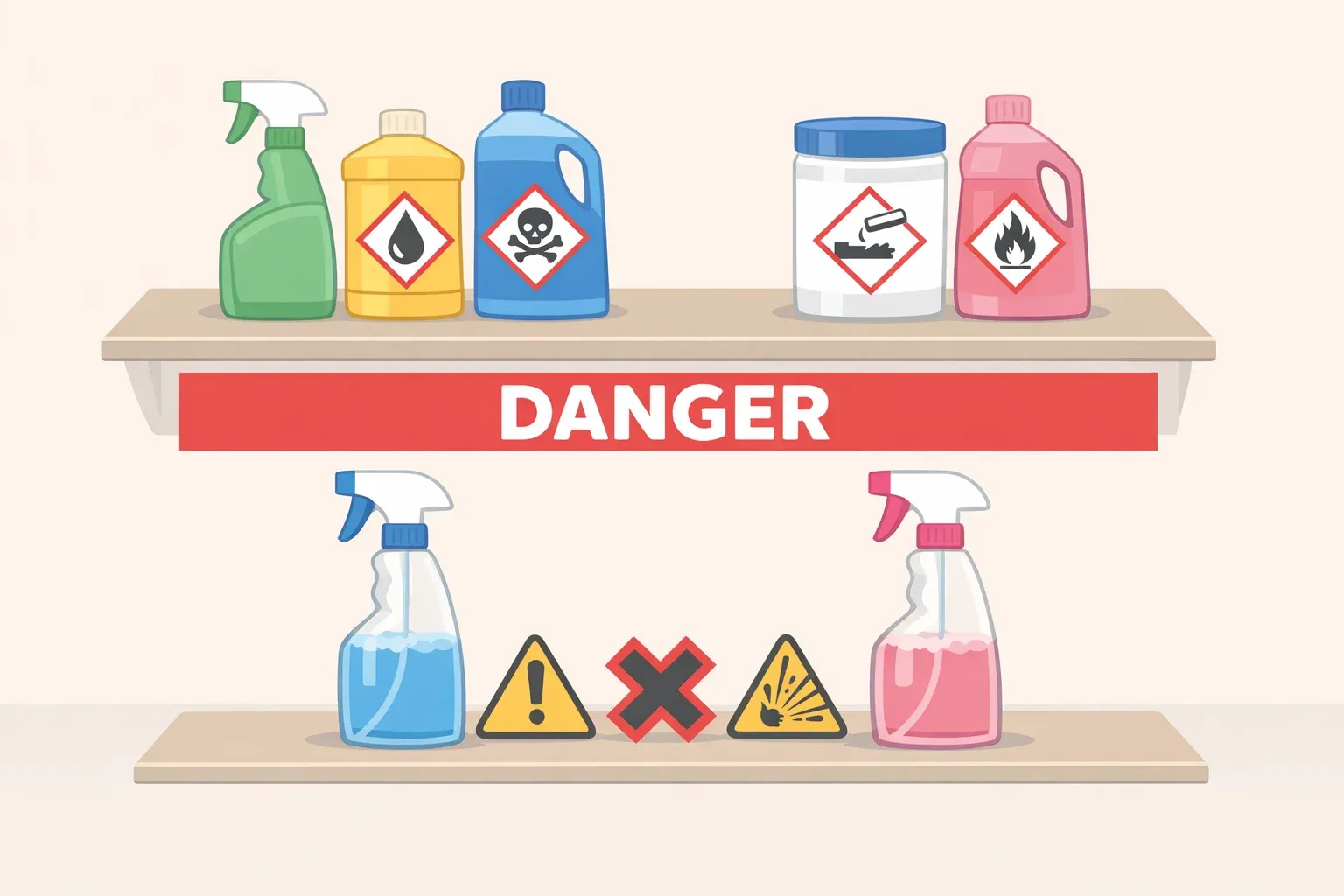
Most warnings about cleaning products you should never mix boil down to one rule with government backing: don't combine household cleaners unless the label specifically says it's fine to do so.
The EPA puts it plainly, "never mix household care products unless directed on the label," and CDC's chemical-emergency guidance says the same thing more bluntly: "Do not mix household cleaners!" The EPA's flood-cleanup guidance adds one detail worth remembering on its own: never add bleach to other chemicals.
This guide covers the two combinations with a documented paper trail behind them: bleach mixed with ammonia and bleach mixed with an acid like vinegar, what actually happens when they react, what to do if a mixture has already occurred, and how to use more than one cleaner on the same job without accidentally combining them.
The two cleaning products you should never mix
CDC infection-control guidance draws the clearest line on what cleaning chemicals should not be mixed: products containing chlorine compounds, the kind found in household bleach, release toxic gas when combined with either ammonia or an acid, and that includes ordinary household cleaning agents, not just industrial disinfectants. CDC's ammonia fact sheet backs up the same warning from the other side: household ammonia can release gas if it's mixed with certain other cleaning products.
Few people set out to deliberately combine these two chemicals. It usually happens by accident, adding bleach to a toilet-bowl cleaner or descaler that contains acid, following bleach with an ammonia-based glass or floor cleaner on the same surface, or reusing a bucket, mop, or spray bottle that still holds residue from something else. EPA's flood-cleanup guidance calls out exactly that kind of cross-contamination: don't mix cleaning products together, and don't add bleach to other chemicals.
Why bleach and ammonia create toxic fumes when mixed
Bleach gets its disinfecting power from chlorine compounds, and that's also where the danger comes from. Those compounds react when they meet ammonia or an acid, and CDC's guidance on chemical disinfectants groups both reactions, bleach with ammonia and bleach with acid, under the same warning about toxic gas release. The two reactions aren't identical, but neither is a chemical experiment worth running in a bathroom or kitchen sink.
CDC's ammonia fact sheet offers the clearest documented picture of what that kind of exposure can do, even though it describes ammonia specifically rather than every possible bleach reaction. High exposure can hurt the skin, eyes, throat, and lungs, causing coughing and burns, and very high exposure can cause lung damage or death.
The damage isn't always immediate, either. Survivors who breathed in large amounts of ammonia have gone on to develop lasting lung damage, and ammonia contact with the eyes has been linked to ulcerations, perforations, cataracts, and glaucoma that can surface weeks or months after the original exposure. Repeated exposure, mostly documented in workplace settings, has also been tied to chronic coughing, asthma, and lung scarring known as fibrosis.
Whatever the exact chemical involved, the practical response doesn't change. Trouble breathing, chest pain, persistent coughing, faintness, or severe eye pain are reasons to leave the area immediately, not signs to wait out.
If you've already mixed two cleaners
The steps below come from CDC's ammonia fact sheet, so treat them as the protocol for that chemical specifically. If it's unclear exactly what was combined, the safe response holds anyway: leave the area, get to fresh air, and contact Poison Control or emergency services.
Leave the area and get to fresh air. CDC's guidance is direct: get away from where the release happened and breathe fresh air.
Get clean. Take off any clothing, jewelry, or accessories that may have been exposed, then shower.
Flush affected eyes. If eyes are burning or vision seems off, rinse with lukewarm water for 10 to 15 minutes and skip the eye drops.
Call for help. Call 911, get to a hospital if local officials say it's safe to leave the area, or call Poison Control at 1-800-222-1222.
CDC says no known cure exists for ammonia exposure. Treatment focuses on removing the person from exposure and providing supportive medical care.
Don't go back into the area to move containers, pour out the mixture, or start cleaning up while fumes linger. Once the air has cleared, let a responder or Poison Control decide what happens to the containers instead of handling it alone.
The safer way to use more than one cleaning product
Most accidental mixing doesn't come from someone deliberately pouring two bottles together. It comes from reused buckets, layered products, or a label that doesn't spell out what's inside. A short list of habits closes off most of that risk:
Use one product at a time and follow the label exactly. That's the only place a manufacturer confirms whether combining products is safe.
Never add a second product to a bucket, spray bottle, or bit of standing water that already holds a different cleaner, and never add bleach to anything already in use. EPA's flood-cleanup guidance covers this directly: don't mix cleaning products together, and don't add bleach to other chemicals.
Treat an unclear label as a stop sign. If it isn't obvious whether a product contains bleach, ammonia, or an acid, don't use it to test compatibility. Use it alone, and the question never comes up.
Keep containers closed between uses. EPA notes that gases can leak even from closed containers, and keeping them sealed can help lower everyday chemical exposure in a home.
If a job genuinely needs two different products on the same surface, finish with one, rinse thoroughly with plain water, and let the surface dry before switching to the next. Neither the EPA nor CDC guidance cited here spells out an exact wait time or drying requirement for every product, so check the label or safety data sheet before assuming a quick rinse clears all residue.
Ventilation is a smaller, separate habit worth keeping regardless of what's in the bucket. EPA data shows concentrations of many VOCs, the volatile organic compounds released by paints, solvents, and many cleaning and disinfecting products, run consistently higher indoors than outdoors, up to ten times higher in some cases, and levels can stay elevated in a room well after the activity that produced them has ended. That's a different hazard than a bleach reaction, and airflow doesn't make an unsafe mixture safe, but cracking a window during and after cleaning cuts down on that everyday buildup.
What to do now
Two combinations carry a documented record of danger: bleach with ammonia, and bleach with an acidic cleaner. Everything above — the label-reading, the separate buckets, the sealed containers — exists to keep those two pairings from happening by accident. This isn't a full compatibility chart for every product under the sink, just the pairings backed by the CDC and EPA guidance cited throughout this piece.
Before the next cleaning job, pick the one product it actually needs and use it exactly as the label directs. Don't test whether two products get along by combining them, whether that's on a surface, in a bucket, or in a spray bottle. Save Poison Control's number, 1-800-222-1222, in your phone now, so it's already there if an accidental mixture happens later.

Comments
Be the first, drop a comment!