



Clothes sent for dry cleaning don't stay dry. They're submerged in a liquid chemical solvent, not run through some waterless chamber. So how does dry cleaning work, exactly? The name only refers to the absence of water, not the absence of liquid entirely.
Luxury dry cleaners Jerry and Zach Pozniak confirm this from the counter side. "I think that most people would be surprised to understand that their clothes are actually getting wet because it's called dry cleaning [but] it is a waterless solvent," Jerry told Nine.com.au.
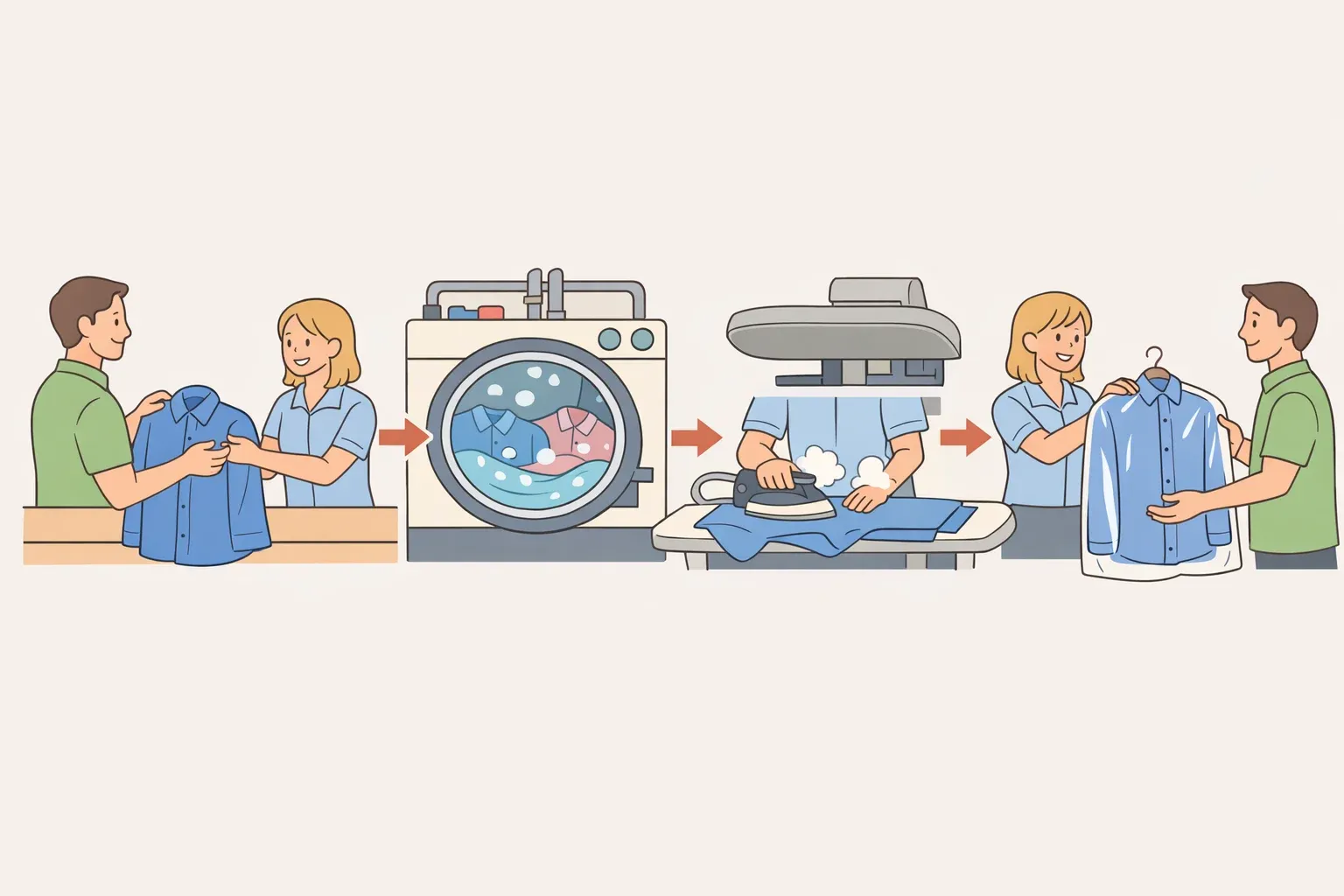
A garment's actual trip through a cleaner runs through a series of stages: intake and inspection, pretreatment, a solvent-based machine cycle, and hand-finishing. The pressed, reshaped look you pick up at the counter comes largely from that finishing work, not the machine alone.
Below is what happens to clothes at the dry cleaner at each stage, why solvent works on fabrics that water would ruin, and how to tell whether a specific piece really needs professional care or is safe to wash at home.
What happens to clothes at the dry cleaner, step by step
Here's how our clothes are dry cleaned, from the moment they cross the counter to the moment they're bagged for pickup.
1. Intake and inspection. Commercial shops record the customer's contact information and garment details as soon as an item arrives, then the cleaner examines fabric type, construction, and existing condition. Stains get noted along with a likely cause if the customer can identify one, and structural details like lining type or existing damage get logged too.
2. Tagging. Each garment is tagged individually so it stays connected to its order record through every later stage.
3. Pretreatment. Problem spots get treated before the garment goes anywhere near the machine, and the treatment agent depends on what caused the stain. Oil and grease stains need one class of treatment, tannin stains like wine or coffee need another, and protein stains like blood or sweat need something else entirely. Pretreatment happens up front because a stubborn stain left untreated can cause discoloration or damage once it hits the solvent bath.
4. Solvent cleaning and recovery. The cleaning machine looks like an oversized front-loading washer, but it works on a different principle. Its rotating drum moves garments through a solvent bath instead of water and detergent, and the solvent penetrates the fiber to lift embedded oils, residue, and soil. Once the cycle finishes, the solvent is extracted, filtered, and distilled to remove the soil it picked up, then reconditioned for reuse.
5. Reinspection and additional treatment. Every garment gets checked again once it comes out of the machine. Any stain that didn't fully release earlier gets another round of spot treatment, sometimes by hand. Shaffer says that if a stain hasn't responded after two treatment passes, the cleaner tells the customer honestly rather than hand back a garment that isn't right. That's a practice worth asking about at any shop, since it's not a guarantee every cleaner makes.
6. Pressing and reshaping. This is where the visible transformation actually happens, and it's more involved than running a hot iron over flat fabric. A structured blazer gets steamed and reshaped on a form matching its silhouette. Dress trousers get their crease set with pressing equipment that applies more even heat than anything at home. A formal dress has its drape restored so it hangs the way it was designed to.
7. Final quality check and pickup. Commercial shops typically follow finishing with a last pressing pass to smooth remaining wrinkles, then a final inspection before bagging the item.
Jerry Pozniak put it plainly: the machine cycle itself doesn't remove most common stains. "The problem with dry cleaning is that most people don't understand that the dry cleaning machine itself, the wash and dry cycle, does not remove the most common stains. Dry cleaning does not remove food stains... It's all about labour," he told Nine.com.au. The Pozniaks' experience points to a simple takeaway: the machine cycle cleans the garment with solvent, while stains that remain get handled separately, by hand, before and after it.
What solvent is used in dry cleaning, and why it works
Solvent penetrates fabric and lifts oils, residue, and embedded soil from the fiber, then evaporates cleanly without triggering the swelling, shrinking, or bleeding that water causes in certain fabrics. That's one major reason a "dry clean only" category exists at all.
Some fabrics simply don't tolerate water and agitation, and the damage happens at lower agitation than most people expect:
Wool and cashmere can felt, meaning heat and agitation cause microscopic fiber scales to interlock permanently. Cashmere is especially prone to this because its fibers are finer.
Silk can watermark or bleed color from even a small splash.
Velvet's pile crushes flat under moisture, and steaming rarely restores it fully.
Acetate is extremely prone to shrinkage even in cool water, and since it's often used as lining, one wash can warp an entire garment.
Rayon loses structural integrity when wet, and the fibers stretch and distort in ways that rarely return to their original shape after washing.
In a structured blazer, the outer shell, internal canvas, and lining can absorb moisture at different rates. That mismatch can bubble the front of the jacket or separate the lining permanently, a construction problem as much as a fabric one.
The solvent historically used most often in the U.S. is perchloroethylene, known in the industry as perc. The EPA finalized a rule in December 2024 linking perc to several cancers along with kidney, liver, immune, and reproductive harm, and published compliance guidance for the rule in January 2025.
The rule phases perc out of U.S. dry cleaning over the next decade. Newly acquired machines are barred from using it after a six-month window, and timelines for machines already in service vary by equipment type. Many dry cleaners have already begun shifting to alternative solvents ahead of those deadlines.
Why do some clothes need dry cleaning?
The care label is the right place to start, but it's not the whole answer. U.S. manufacturers are legally required to have a "reasonable basis" for the care instructions they print on a garment, which makes the label a credible default. That requirement doesn't mean your exact garment was individually tested, just that the manufacturer had some grounds for the claim.
Jerry Pozniak noted that some high-end designers put "dry clean only" on plain cotton shirts partly to project a sense of luxury, and that he'd feel confident washing a plain white cotton shirt at home even with that label. A multicolor blended dress is a different story; a black-and-white houndstooth blend, he said, carries a real risk of dye bleeding that's much harder to judge from home.
Construction matters as much as fiber content. Unstructured, unlined linen can often tolerate a gentle cold hand wash, but a tailored linen blazer generally shouldn't go anywhere near water. A wool sweater with a hand-wash label can sometimes handle careful cold water, but any heat or agitation triggers felting. A polyester piece that's normally machine washable becomes a bad DIY candidate the moment it picks up a lining, tailoring detail, or embellishment.
Treat the care label as the default rather than a suggestion to override. If the garment is a simple, unlined cotton or linen piece and the label permits hand washing, follow those instructions. If the label says dry clean only, or the item has tailoring, lining, embellishment, unstable dye, or real sentimental value, ask a cleaner before you wash it yourself. This guidance on fabric behavior applies broadly, but the EPA and FTC rules discussed here are U.S.-specific; readers elsewhere should check their own country's labeling and solvent regulations.
Even professional cleaning has a ceiling. Stains that were "designed to be permanent," like permanent marker, super glue, or hair dye, are unlikely to come out fully no matter the method. Zach Pozniak summed it up simply: "It's just like in anything in life, there's a limit and not everything is coming out." A cleaner may be able to reduce a stain like that, but shouldn't promise full removal, and a result like that reflects the stain's nature rather than a failed job.
It's also worth asking a shop what solvent or process it uses, since the EPA's phaseout rule is actively changing what U.S. cleaners use over the next decade. A shop marketing itself as "green" or "eco-friendly" isn't necessarily telling you which solvent it switched to. Marketing language on its own doesn't answer that; asking directly does.
What to do before you leave the counter
The intake conversation shapes everything that happens to a garment after it leaves your hands, and a few minutes of specifics at drop-off make the rest of the process work in your favor.
Before handing a garment over:
Point out every stain, and mention the likely cause if you know it.
Flag any existing damage, like loose buttons or worn seams.
Say so if you've already tried a home stain treatment.
Keep your claim ticket; intake records are what tie your garment to its order through the whole process.
At pickup, check before you leave the counter:
Look for remaining stains or discoloration.
Count buttons and check embellishments against what you dropped off.
For structured pieces, check that shoulders, lapels, or a trouser crease actually look reshaped, not just pressed flat.
If the garment has a strong or unusual chemical odor, ask the cleaner about it before you leave; it's a fair question to raise, not necessarily a sign something went wrong.
If a stain is still visible, ask what treatment was attempted and whether another pass risks damaging the fabric. That's more useful than guessing whether the shop skipped a step, since a remaining stain can come from several causes, including the "designed to be permanent" category Zach and Jerry Pozniak described.
If the care label is missing, the fabric blend is unclear, the stain's cause is a mystery, or the piece carries real sentimental or monetary value, skip the home experiment. Bring it in, say so at drop-off, and ask what the shop can realistically promise before it starts work.




Comments
Be the first, drop a comment!