



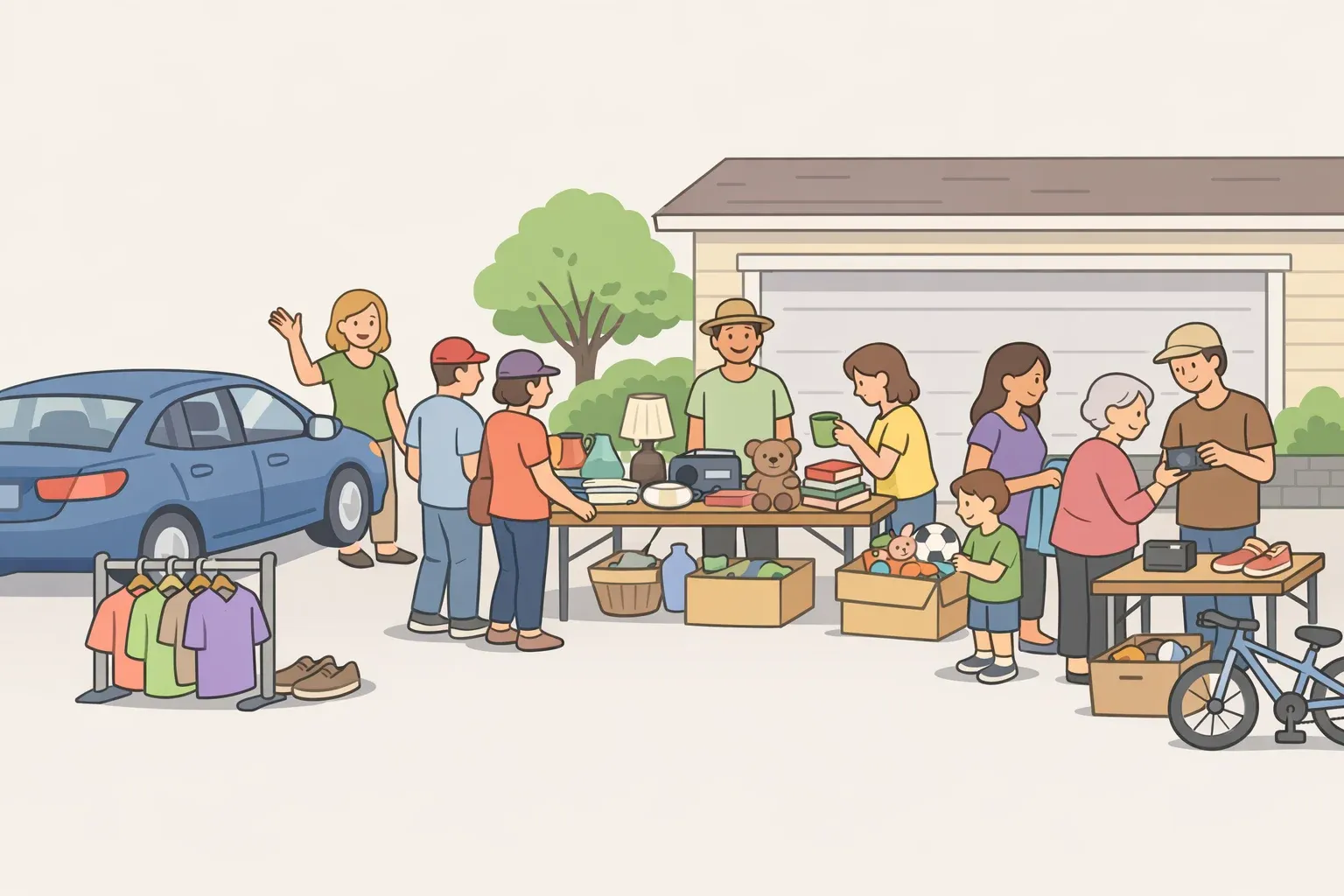
Most yard sale guides start with the wrong problem. They tell you what to sell and how to price it, then leave you wondering why cars keep driving past. The stop decision happens before anyone reads a price tag, checks a category, or picks up a single item. Get that part wrong, and the rest doesn't matter.
Yard sales still hold a real advantage over Facebook Marketplace and Nextdoor: volume and immediacy. No waiting on online buyers to materialize, no coordinating pickups, no listing and relisting. But the format punishes unforced errors. The same four avoidable mistakes, overpricing, disorganization, poor signage, and damaged merchandise, reliably send shoppers to the next driveway.
These seven yard sale tips to attract buyers are ordered the way a shopper actually experiences your sale: road, then driveway, then table, then transaction.
Trick 1: Advertise so the right people already know to come
Foot traffic doesn't just wander past. Serious shoppers plan their route in advance.
Post on Facebook, Craigslist, Nextdoor, and Instagram at least two to three days before the sale day. Include your ZIP code, clear photos of standout items, and a list of notable categories, such as tools, baby gear, and vintage items, so shoppers with specific interests know the trip is worth making. Vague addresses, missing start times, and absent item categories are among the most common reasons a sale gets skipped before anyone shows up. Double-check every detail before going live.
On timing: Saturday draws the most traffic, Friday works well as an opening day, particularly in vacation-area towns, and Sunday typically runs slow. Single-day sale? Make it Saturday.
Under-advertising is the most invisible mistake you can make; you'll never know how many people would have come. Posting on only one platform cuts your potential audience significantly, and Martha Stewart notes that multi-platform advertising is one of the simplest levers for boosting foot traffic.
Trick 2: Build signage that works from a moving car
Physical signs are doing a different job than online listings. They have almost no time to work, so every element has to pull its weight.
Bold, high-contrast lettering large enough to read from a moving car, a directional arrow, the address, and the date. That's it. Small text, too many words, and hand-lettering that fades in morning light all produce the same outcome: drivers pass without processing anything. Place signs at major nearby intersections and along the logical approach routes to your home, not just at the end of your street. A shopper who can't quickly locate the sale will move on.
Attach a balloon to each sign. It registers faster than text at a glance, particularly at busy intersections.
How to get more people to stop at your yard sale: the curbside view
Before anyone gets out of the car, they're already deciding whether it's worth the effort. That judgment has nothing to do with your prices.
The first visual impression must communicate organization and range. Items visible from the curb should be your best or most interesting pieces: a small piece of furniture, a colorful display, something that reads as "there's good stuff here." Keep clear walk-through pathways between display areas. Browsers need to see a route through your sale, not a wall of tables to squeeze past. Clear sightlines from the street signal space and ease of access.
A clean, organized setup also affects what people are willing to pay before any negotiation begins. Shoppers are more willing to meet asking prices at a sale that looks curated rather than dumped.
One specific thing to avoid: anything on the ground near the entrance. Ground-level items read as overflow or discard, and they pull down the impression of everything around them.
Trick 4: Curate what you sell the best items to sell at a yard sale move fast
The edit happens before the sale, not during it. What you choose to put out signals the quality of everything on your table.
The fastest-moving categories are consistent across sources: small furniture like side tables and accent chairs, kitchenware, garden décor, hand tools, vintage linens, and home accessories priced under $10. Stock toward those first.
Apply the $5 test to everything else: if you wouldn't pay $5 for it at someone else's sale, it belongs in the trash, not on your table. Junk items erode trust in your whole display, as one expert put it, if it feels like junk, buyers will think so too.
Clean everything before it goes out. Wipe down household items, wash and de-hair clothing, and test electronics. One dirty or broken item next to clean merchandise raises doubts about the entire table. For items with minor flaws you still want to sell, mark them down and note the issue clearly. Something like "works perfectly, scratch on the back" lets buyers make informed decisions and keeps them from feeling misled.
Trick 5: Display items like a pop-up shop, not a rummage pile
Layout determines how long people stay. The rummage-sale approach, everything tossed in boxes or piled on surfaces, forces shoppers to dig through chaos. Most won't bother.
Tables at browsing height are non-negotiable. Items on the ground get ignored; items buried in boxes get ignored. Shoppers scan, they don't excavate. Keep surfaces evenly spaced: not so crowded it looks chaotic, not so sparse it signals a sale that's nearly over.
Hang all clothing rather than folding it on a table or piling it in a box. Clothes hung and sorted by size and type communicate value and browseability; clothes in a box communicate "grab bag," which invites aggressive haggling.
Group related items together: cooking tools with cookbooks, a camera with photo frames. Shoppers perceive bundled items as higher value and haggle less on grouped sets than on individual pieces. Place a table of 25–50 cent items near the entrance. It pulls hesitant browsers in with an easy win and moves them into your layout.
Trick 6: Yard sale pricing tips that help items actually move
Pricing is where most sellers either leave money on the table or leave items unsold entirely.
Good-condition items sell for roughly 25–30% of original retail at a yard sale; anything showing wear should go lower. Items priced at 70–80% of retail tell shoppers you're not serious about selling, and most won't bother asking. Check eBay's completed "sold" listings and Facebook Marketplace for real secondhand benchmarks before tagging anything.
Use whole numbers: $1, $2, $5, $10. Odd pricing, like $1.75, slows transactions and invites more negotiation. Clean numbers are faster and friendlier.
Price every item visibly, tag positioned on the front or top so it's readable without picking the item up. Use painter's tape and a permanent marker: easy to read, won't damage the surface, survives wind. An unpriced item is almost always a lost sale; most shoppers won't ask. Build a small buffer into prices to allow for the haggling buyers expect, then stay flexible and friendly when it happens.
The most common pricing mistake is anchoring to sentimental value or original cost. What an item meant to you has no bearing on what a stranger will pay. Worse, overpriced items don't just sit; they make buyers walk away from your other items too.
Trick 7: Run the day like a retailer, not a homeowner having a clearance
The setup earns the foot traffic. Execution converts it.
Be ready 30 minutes before your posted start time. Serious shoppers, the ones who arrive with a list of what they're hunting for, show up early and will leave if you're still organizing. Keep a cash float in small bills and coins. Running out of change kills transactions, and paying $20 for a $1 item is a common scenario. Have plastic bags on hand for purchases.
Decide what happens to unsold items before the sale starts. Whether it's a thrift-store drop-off, an online listing, or a donation run, having a plan prevents the default outcome: everything goes back in the garage for another year.
The through-line: make it easy
Every technique above points to the same thing. Buyers respond to ease. Easy to spot from the road, easy to navigate once they stop, easy to trust the condition of what's on the table, and easy to hand over money without friction. Friction at any of those stages is a sign they can't read, a table they can't browse, a price tag that isn't there breaks the chain.
The unpredictability is still part of it. The funky lamp you almost trashed goes in the first hour. The thing you were sure would sell sits there all day. What you can control is removing every obstacle between a passing shopper and an open wallet.




Comments
Be the first, drop a comment!