



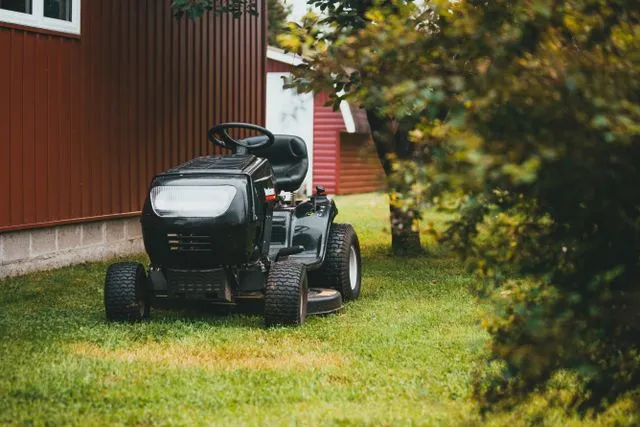
Whether you can hose down a riding lawn mower depends primarily on whether your specific model documents a way to keep water out of the engine, transmission, and electrical components while you rinse it. Some models, including the Cub Cadet Yanmar example detailed below, come with a deck wash system built for that exact purpose. Other manuals only address a full exterior rinse if you cover the engine and transmission first. If neither shows up in your documentation, the manufacturer guidance reviewed for this article points to dry cleaning instead.
Husqvarna's support guidance states that water reaching the engine or transmission will shorten the tractor's useful life. A ManualsLib summary of the Cub Cadet Yanmar 59A40009727 manual, also published earlier this summer, warns that a pressure washer or unrestricted hose spray may damage electrical components, spindles, pulleys, and bearings on that model specifically. Neither source treats a garden hose as automatically safe or off-limits across the board. Both treat it as something to use only where the manual spells out a path for it.
This guide draws on official Husqvarna support pages and a third-party summary of one Cub Cadet Yanmar model's manual. It's meant to help you read your own owner's manual correctly, not replace it, and your manual overrides anything written here. By the end, you'll know how to clean a riding lawn mower using whichever of three documented paths fits your machine, and where routine cleaning ends and a call to a small-engine technician begins.
What you'll need before you start
Your owner's manual, print or digital. Husqvarna's own cleaning instructions assume you're working from model-specific documentation, not general steps.
A garden hose that reaches a water spigot from a level, clear parking spot. Husqvarna's deck-cleaning instructions call for this exact setup.
Compressed air or a leaf blower, for the dry-cleaning path.
The inspection and dry-cleaning paths are beginner-accessible. Any wash procedure that involves starting the engine has to follow your model's manual exactly, not a general script. How long the job takes depends on how much buildup has caked onto the deck and which procedure your model calls for; there's no fixed timer to plan around.
Before you open the manual, know what you're searching for. Check the index or maintenance section for "deck wash," "washout," "nozzle adapter," or "wash system." If none of those terms show up anywhere in your documentation, stop there. Dry cleaning is your path, and there's no need to keep hunting for a workaround.
Can you hose down a riding lawn mower safely?
There's no single answer that covers every riding mower. Husqvarna's support page states that, except for a washout port if the tractor has one, a garden hose or pressure washer isn't recommended for cleaning the exterior unless the engine and transmission are covered to keep water out. That guidance breaks down into three practical paths:
Washout port or nozzle adapter, intact
Cleaning method: Follow your manual's hose procedure for that fitting.
Avoid: Don't use a pressure washer unless your manual rates the fitting for it.
No port, but a documented method for covering the engine and transmission
Cleaning method: Use a full exterior rinse with the covering method specified in the manual.
Avoid: Don't improvise a covering method that isn't in your manual.
Neither a port nor a covering method documented
Cleaning method: Dry clean with compressed air or a leaf blower.
Avoid: Don't spray water at the engine, transmission, or electrical components.
In the Cub Cadet Yanmar example, the deck comes with what the manufacturer describes as "a specific wash system designed to clean the underside of the housing safely and efficiently," built around two nozzles, one on each end of the deck. That's one documented setup, not a standard you can assume applies to your brand or model year. Cleaning a riding lawn mower with a garden hose only makes sense once you've confirmed what's actually built into your own deck.
How to use a riding lawn mower deck wash port
The sequence below is a Cub Cadet Yanmar 59A40009727 example. Don't copy its nozzle locations, PTO controls, or disconnect method onto another mower. Use it to see the general shape of a port-based wash, then follow your own manual's version step by step.
Position the mower. Drive it to a level, clear spot on the lawn, close enough to a spigot for your hose to reach without stretching.
Recheck the area before restarting the engine. Husqvarna's instructions call for confirming no children are nearby before you start the mower for cleaning. This step runs the engine, so the recheck happens first.
Connect the hose to the fitting. On the Cub Cadet Yanmar, that means attaching a standard garden hose to the deck's nozzle adapter and connecting it to the Deck Wash Nozzle on the left side.
Start the engine from the operator's seat and set the throttle to fast. Husqvarna's deck-cleaning steps call for doing this from the operator's position with the throttle lever moved to fast. On the Cub Cadet Yanmar, the next move is engaging the mid-PTO from that same seated position. Follow whatever parking-brake, throttle, and PTO settings your own manual requires rather than assuming this order.
Run the deck until debris clears. The Cub Cadet Yanmar guide describes running the deck as needed to clear debris. Don't invent a fixed run time; follow whatever your manual says.
Shut off the water and disconnect the hose. On the Cub Cadet Yanmar, that's done by turning off the water supply and pulling back the lock collar to release the fitting. Confirm your own manual describes the same disconnect method before relying on it.
Repeat on any additional ports. The Cub Cadet Yanmar guide has the owner move the hose to the second nozzle on the right side and run the process again. Not every model has a second port, so check your manual rather than assuming symmetry.
Once the wash is finished, shut the engine off, wait for the blades and PTO to stop completely, and pull the key before approaching the deck, belts, or pulleys for any follow-up cleaning. That shutdown happens after the whole rinse is done, separate from disconnecting the hose between ports.
If the port doesn't seem to be clearing debris, stop and recheck your model's manual and fitting procedure rather than running the deck longer than the manual directs or improvising a fix.
Stop entirely if the fitting looks cracked or is missing. Husqvarna warns that a broken or missing washout fitting can expose you or bystanders to thrown debris from blade contact, and it should be replaced immediately, before the mower is used again. Husqvarna's stopgap advice is to plug any resulting holes with bolts and locknuts, but that's a temporary measure, not a repair. Get the correct replacement fitting for your model, or follow your manual's parts procedure, before you use the mower again.
Covered exterior rinse or dry cleaning
If your manual doesn't have a washout port but does explain how to cover the engine and transmission, a full exterior rinse may be an option under that documented method. Husqvarna's support material doesn't spell out how to build that covering for any particular model, so this is a spot where your printed manual's exact instructions matter more than a general workaround.
When neither a port nor a covering method shows up anywhere in your documentation, dry cleaning is the option identified in the Husqvarna guidance reviewed here. Use compressed air or a leaf blower to clear grass, leaves, and loose debris off the mower's exterior.
Belts and pulleys get handled separately from water entirely, at least in the Cub Cadet Yanmar example. With the engine off, blades fully stopped, and key removed, that guide describes removing belt covers and clearing debris from the spindle pulleys and belt area by hand. That process is model-specific. Don't remove covers or fasteners you haven't seen instructions for just because this guide describes them for a different mower.
Can you pressure wash a riding lawn mower?
A pressure washer is the tool these sources caution against most directly. Husqvarna groups pressure washers with unrestricted hose spraying in its "not recommended" guidance, with the washout port as the only named exception. The Cub Cadet Yanmar guide explains why on that model: high-pressure water can force past the seals in bearings and spindles, leading to rust and shortened service life. That same guide states plainly that a pressure washer isn't recommended for general cleaning of that model, port or no port.
Skip one unless your owner's manual expressly permits it for your fitting. None of the sources reviewed here confirm that any washout port is rated for pressure-washer use, so a standard garden hose connected as your manual directs is the right tool even on a mower with a confirmed port.
After cleaning: what to check and when to stop
Before you put the mower away, inspect the washout fitting, if your model has one, for cracks or looseness. A broken or missing fitting should be replaced immediately, before you use the mower again, following your model's parts procedure.
If the mower runs abnormally, hesitates, or won't start after cleaning, stop using it. Check your manual for model-specific troubleshooting, and if the issue doesn't clear up, consult a qualified small-engine technician before running the mower again. Husqvarna's warning that water in the engine or transmission shortens the tractor's useful life is reason enough to take a change in how the mower runs seriously rather than testing it further on your own.
If you've gone through your manual and can't find a washout port or a documented covering method, put the hose away and reach for compressed air or a leaf blower instead. Inspect any fitting you do have before your next mow, complete only the procedure your manual actually documents, and treat dry cleaning as the finish line rather than a stopgap when nothing else is written down.









Comments
Be the first, drop a comment!