




How to avoid cleaning gutters: choosing the right guard
If you're searching for how to avoid cleaning gutters, the honest answer is that you won't skip maintenance entirely, but the right gutter guard can turn a dreaded twice-a-year ladder chore into a once-a-year glance from the ground. This guide walks through matching a guard type to your roof, trees, and climate, deciding whether a DIY kit or a professional crew makes more sense for your house, and knowing exactly what light checkup still has to happen after installation.
Start with the baseline. This Old House surveyed 1,000 homeowners earlier this year and found that 58% cleaned their gutters twice a year or more before installing guards. After installation, 41% dropped to cleaning once a year, and 17% said they stopped cleaning altogether.
The cost math matters too. This Old House found that professional gutter guard installation for a typical 200-linear-foot home averages $4,653. Professional cleaning alone, without guards, runs about $162 a visit, and most homes near trees need it two to four times a year, which adds up to $1,600 to $15,600 over a decade depending on how often your specific home needs it.
That upside comes with a catch worth stating up front. Even a well-matched guard still needs occasional light upkeep, not zero maintenance forever, according to This Old House.
Do gutter guards eliminate gutter cleaning, or just reduce it?

Gutter guards are covers or inserts that sit over or inside the gutter channel. They block leaves, needles, and grit while letting water pass through, so debris never builds up inside the trough in the first place, as This Old House explains it.
That mechanism shows up in the time savings homeowners report. A regional cost guide from This Old House found that nearly 43% of guard owners save 4 to 8 hours of cleaning time a year, and 20% save eight hours or more.
Here's where the numbers get messier, and it's worth flagging rather than glossing over. That same regional survey put the "never clean again" share at 44% nationwide, noticeably higher than the 17% figure cited above. These come from two different surveys of different homeowner groups, not one study tracking the same households over time, so treat either percentage as a general direction for what's possible rather than a guarantee for your specific home.
Product testing adds useful detail on what "light cleaning" actually involves. When This Old House tested LeafFilter's stainless steel micro-mesh system, plain water flow alone cleared 70% of debris applied during the test, and the remaining 30% needed light brushing. That result describes one product's performance in a controlled test, not a blanket claim about every micro-mesh guard on the market, since mesh tightness and frame support vary by manufacturer.
Check your gutters and identify your debris before you buy
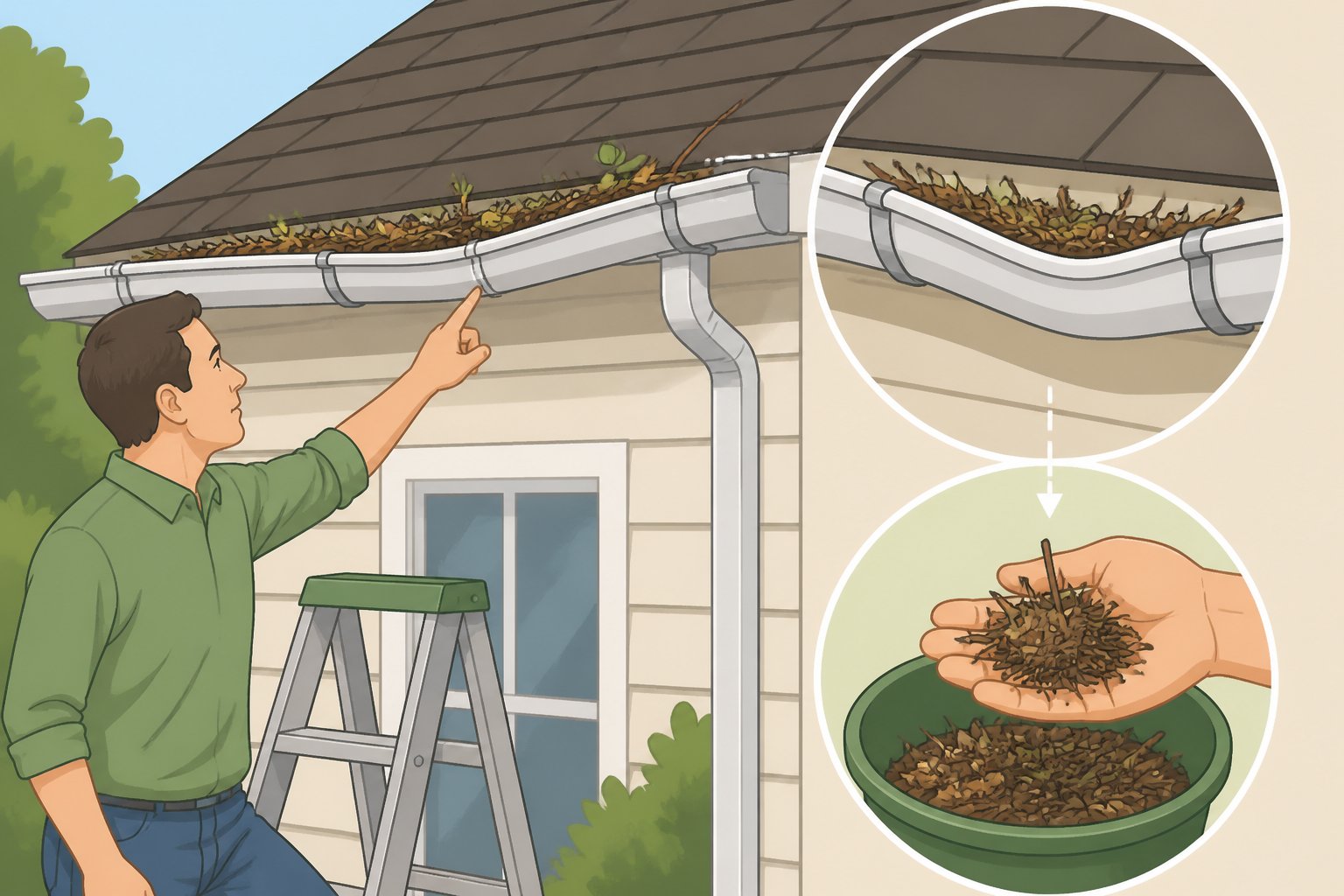
Covering a gutter that already sags, drains poorly, or pulls away from the fascia just hides the problem instead of fixing it. This Old House notes that debris left unchecked in a struggling gutter system leads to clogs, overflow, and erosion around a home's perimeter, and a guard installed over that kind of damage won't change the outcome. Have sagging, damaged, or poorly draining gutters assessed and repaired first.
Next, figure out what's actually falling into your gutters, since identifying it early is the surest way to keep gutters from clogging once guards go on. A survey from This Old House found leaves topped the list at 86% of homeowners, followed by dirt or dust at 62%, insect debris at 53%, pine needles at 33%, and shingle grit at 22%.
Weather exposure matters just as much as debris type. Heavy rain, snow and ice, and coastal humidity each push toward different materials and designs, according to This Old House's regional guide.
Measure your linear footage and take stock of roof access: how many stories, how steep the pitch, how close the nearest tree limbs hang. That number and that assessment are what you'll hand to installers for quotes, and they're what determine whether DIY installation is even on the table.
One mistake to avoid here: installing guards over a known drainage problem and hoping the guard fixes it. LeafFilter's warranty, for example, excludes overflow caused by insufficient downspout capacity, as This Old House found in its review. Fixing drainage issues before installation may affect whether a future claim is covered, and warranty terms vary by provider, so don't assume every brand handles this the same way.
Best gutter guards for leaves, pine needles, and your climate
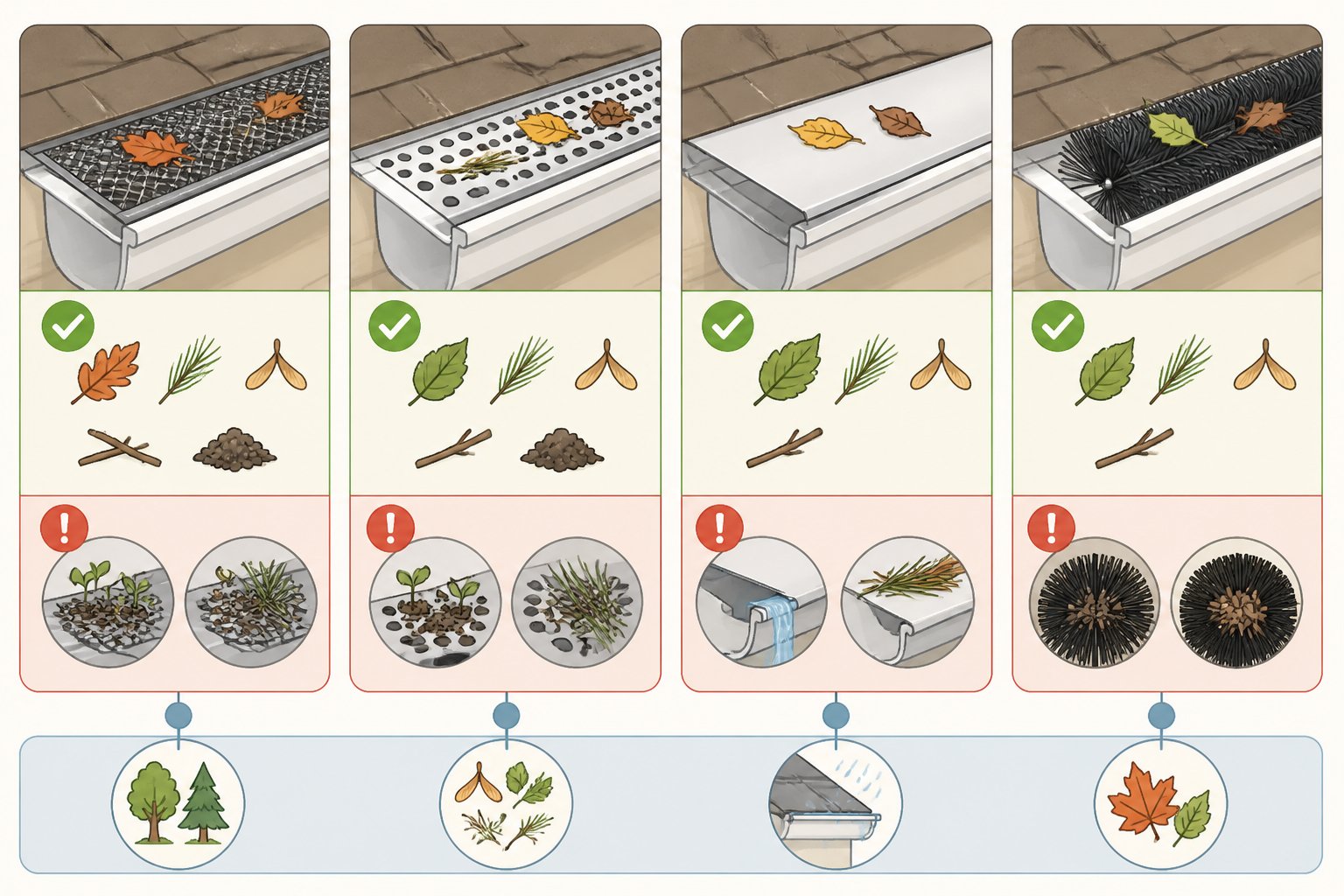
There's no single "best" guard. There's a best match for your debris, your rainfall, and your region. Here's how the main categories stack up, based on testing and analysis from This Old House:
| Guard type | Works well for | Watch out for |
|---|---|---|
| Screen guards | Affordable, easy to install, works well in most climates | Not designed for fine debris like grit or pollen |
| Foam guards | Inexpensive, simple install, suited to moderate-rainfall areas | Clogs easily where pine needles or heavy leaf fall are common |
| Reverse-curve (surface-tension) | Channels heavy rain effectively | Narrow opening lets fine grit or pine needles slip through |
| Brush guards | Snow rests on bristles while meltwater drains below | Doesn't prevent ice dams, which form independently of debris |
| Micro-mesh | Blocks fine debris like pine needles and ash; fits nearly every climate | DIY kits need a supportive anodized aluminum frame or the mesh can sag |
A note on brush guards and ice: ice dams form when heat escaping from the attic warms the roof deck, melts snow higher up, and that meltwater refreezes once it reaches the colder eaves. Brush guards don't address that heat-loss problem, so don't expect any gutter guard to solve ice dam issues on its own.
Micro-mesh tends to be the broadest-fit default because stainless steel and aluminum mesh resist corrosion better than plastic or foam in humid or coastal conditions, per This Old House. If you're eyeing a DIY micro-mesh kit, look specifically for an anodized aluminum support frame. Without it, the mesh can sag over time and start collecting the exact debris it's supposed to block.
One last note: don't pick a guard on brand name or price alone. In the This Old House survey, 20% of homeowners chose a provider mainly on brand reputation and 16% on price. Neither of those tells you whether the product actually matches your debris load and rainfall pattern, which is the thing that determines whether you're cleaning gutters once a year or four times.
DIY installation vs. hiring a pro
This section covers choosing and comparing installers, not a tutorial for climbing onto your roof. That boundary matters: working near a roof edge carries real fall risk, and this guide stops short of walking you through ladder work or roof-edge installation.
Most surveyed homeowners went with professional installation rather than DIY. Among those who hired a pro, This Old House found 38% wanted the job done correctly and 31% cited safety as their main concern. If your home is multi-story, has a steep pitch, sits on a hard-to-access lot, or already has gutter damage or drainage problems, a professional installer is the right call rather than a DIY kit from a ladder.
When you do compare quotes, make sure you're comparing the same thing. A survey of gutter guard customers conducted this year found a national average of $39.71 per linear foot, with LeafFilter running slightly higher at $41.72 per linear foot, according to This Old House's testing. That per-foot figure isn't directly comparable to the $4,653 full-project average for 200 feet cited by This Old House elsewhere, since the two numbers come from different samples and scopes. Ask every installer for an itemized quote in both dollars-per-linear-foot and total project cost so you're actually comparing apples to apples.
Bring this short list to any quote conversation:
- Linear footage measured
- Primary debris type identified
- Rain or snow exposure noted
- Current gutters confirmed to be in good repair
- Downspout capacity asked about directly
- Warranty exclusions compared, not just warranty length
That last point matters more than it sounds. Many gutter guard systems carry warranties of 20 years or more, per This Old House, but a long warranty term means little if it excludes the failure points most likely to actually happen. LeafFilter's warranty, specifically, doesn't cover overflow from insufficient downspout capacity, damage from storms or acts of nature, or problems caused by nearby trees, as This Old House documented in its review. Other providers set different terms, so read the exclusions, not just the headline coverage length.
Low-maintenance gutter guard options still need an annual check
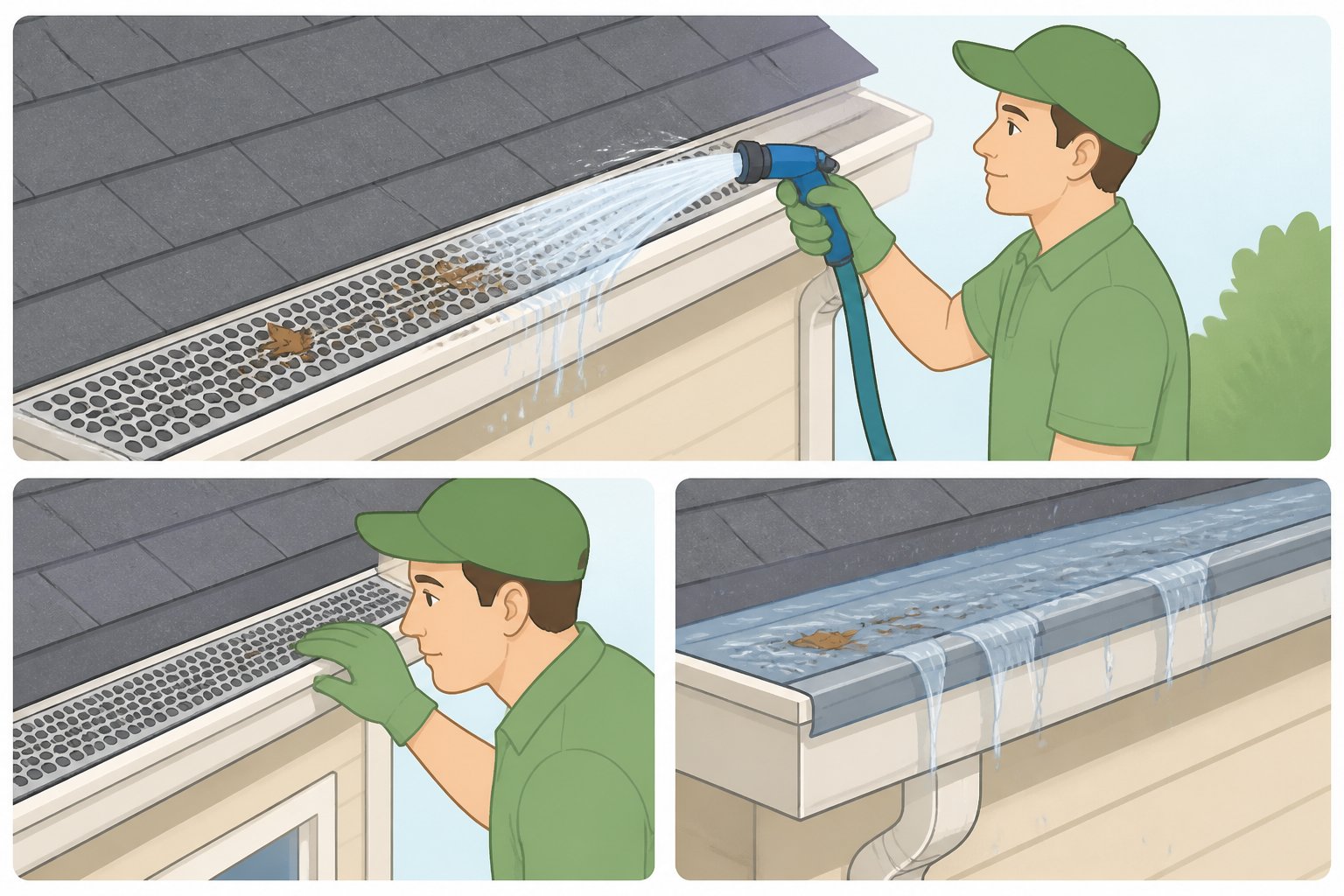
Even the best-matched guard isn't a "forget it forever" purchase. Here's what the light maintenance actually looks like once guards are on.
Put one inspection on your calendar every year, ideally during or right after a heavy rain, when leaks, overflow, and drainage problems are easiest to spot. Checking while water is actively moving through the system shows you exactly where it's failing, rather than guessing once the ground has already dried out.
Clear any debris sitting on top of the guard with a hose or brush, done safely from the ground whenever possible, or by a qualified professional if your roofline doesn't allow ground-level access. This Old House's testing found this kind of surface clearing is the light maintenance most guard owners still do, rather than digging debris out of the channel itself.
Watch for two warning signs. Repeated overflow during heavy rain can point to insufficient downspout capacity, restricted water flow, or an installation issue, rather than a simple cleaning problem, so don't assume a quick brush-off will fix it. Debris piling up on a poorly secured guard can also become a nesting spot for insects, rodents, or birds, according to This Old House, which is its own reason not to let buildup sit for too long between checks.
If overflow, sagging, or standing water near the foundation continues after installation, that's a problem for your installer or a qualified gutter professional, not something to troubleshoot yourself. Check your warranty's downspout-capacity exclusion before assuming any repair is automatically covered.
Success looks like this: water exits cleanly through the downspouts during a hard rain, little to no debris sits visible on top of the guard between annual checks, and nothing is pooling near your foundation afterward. If that's what you're seeing, your guard choice is doing its job. If it isn't, go back to the debris and drainage check in the earlier sections before assuming the product is defective, and don't hesitate to call the installer in if sagging or overflow sticks around past one storm cycle.









Comments
Be the first, drop a comment!