



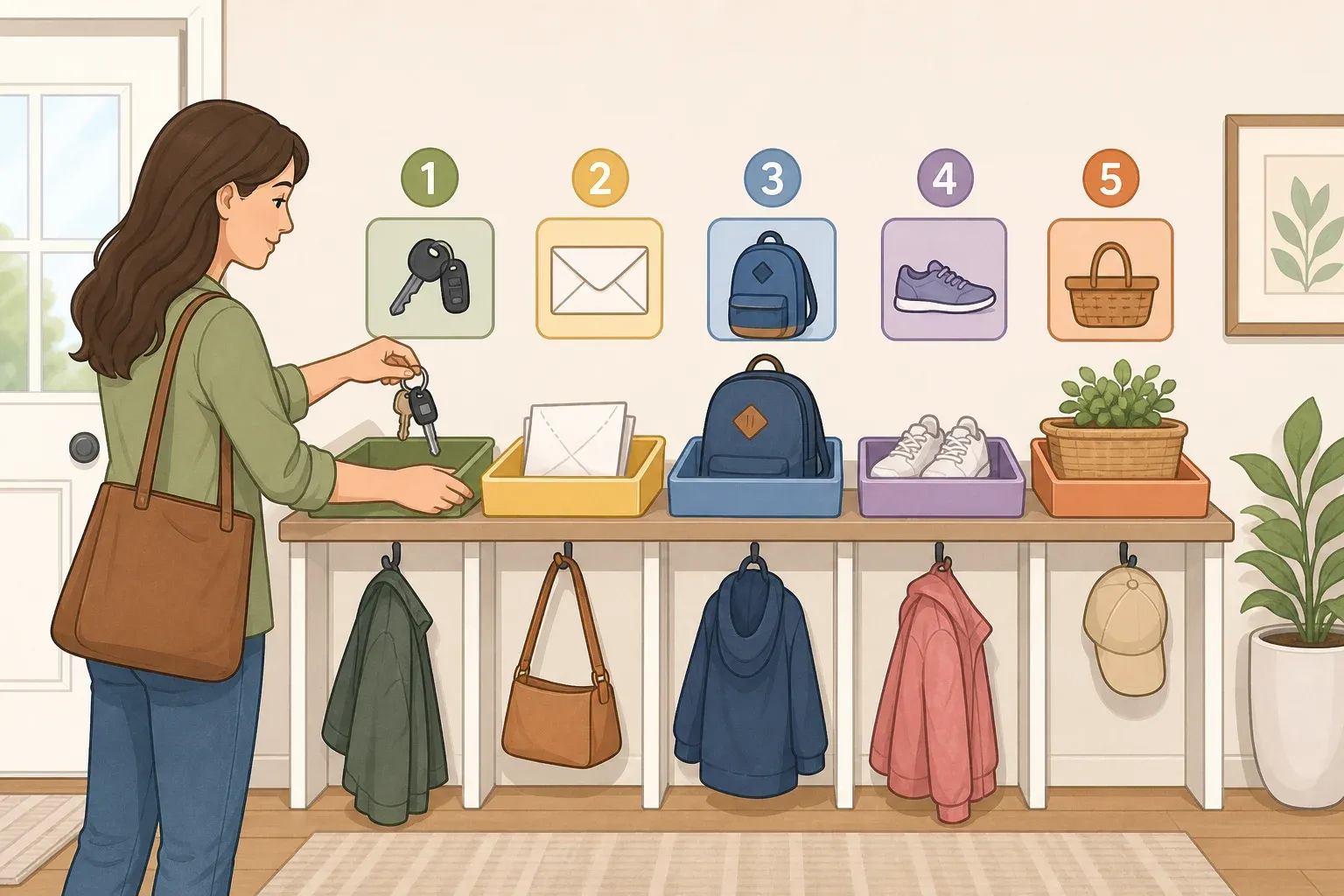
Most entryway organization ideas point you toward buying more baskets. What actually works is simpler: every item that crosses the threshold gets exactly one home, so the decision about where something goes gets made once instead of scattered through the house. Clutter therapist Helen Sanderson describes to Good Housekeeping UK that tidy homes are places with a deliberate landing point just inside the front door, one where keys, bags, shoes, and post all have a place.
This guide walks through how to organize an entryway using a five-step system: Hang, Park, Drop, Process, Reset. Each step gives one specific home to coats, bags, shoes, keys, mail, and packages, then keeps that system running day to day instead of collapsing the first busy week. It works on a single wall, a bench, or a full mudroom.
Designer Burcu Ercetin points out that historic and in-town homes often have limited footprints and were not designed with mudrooms in mind, so the workaround is starting with existing wall or floor space, corners, wall pockets, and under-stair areas, rather than assuming you need to add square footage.
Skip the designated spot and the pattern is predictable: mail migrates to the kitchen island, shoes pile up by the door, and coats end up draped over dining chairs, according to Michelle Yorke Design. Professional organizer Angela Evans recommends exactly this kind of intentional drop zone for mail, packages, shoes, and backpacks, since a contained landing spot keeps paper clutter from spreading straight to the counter.
Before you start: audit what actually piles up
Stand at your entry and pay attention to what accumulates there over a normal week: coats, shoes, bags, keys, mail, packages. Don't guess. The point isn't a catch-all for anything carried through the door; it's a landing point for a specific, short list of items.
From there, set a starting limit for each category before you buy anything. A reasonable place to begin: one hook per person who uses the door daily, current-season shoes only (not the whole closet), and a single mail intake point. Treat these as starting numbers, not fixed rules, and adjust once you see what your household actually needs.
Before buying a bench or console, measure the available wall width and depth, and check where the door swings open and where the main walking path runs. Furniture that blocks either one creates a new problem instead of solving the clutter.
Designer Alexa Kingery puts wall hooks first when she plans any entry, because they hold coats, hats, keys, or a hanging basket for mail without taking up any floor space. From there, choose whatever fits your space and budget: a bench with storage underneath, or a narrow console table with a drawer. Wall hooks require installation. A bench or console mostly needs assembly, and the installation details for hooks are covered in the Hang step below.
Set expectations honestly before diving in. Organizer Angela Evans frames good organization as less about perfection and more about reducing friction in daily routines. In practice, that means the household should be able to put away the day's shoes, bag, and keys without opening a cabinet or walking to another room, not that everything has to look magazine-ready every day.
What you'll need
Wall hooks, one per household member, plus anchors matched to the wall type
A shoe basket, tray, or bench with storage underneath
A bowl, tray, or small basket for keys and daily-carry items
A mail tray, basket, or lidded bin for incoming mail
A recycling container near the door for junk mail
A shredder or another secure disposal method for anything with personal information
A box cutter or letter opener kept at the package drop spot, stored out of reach of kids and pets
Hang: give coats, bags, and umbrellas a home
Before mounting anything, check the hook's rated weight limit and choose anchors that match your wall material, drywall, plaster, or brick. Follow the instructions that come with the hardware, and stop if you can't confidently identify a solid mounting point; a hook that's only half-anchored will eventually pull loose once a coat's actual weight is hanging on it.
Mount hooks at a height each person can reach without stretching or ducking, and add a lower row if kids use the entry too. Hooks aren't just for coats: they can hold hats, keys, or a hanging basket for smaller items and mail. If a hook sits empty and coats keep landing on a chair instead, height is often the reason; lower or reposition it before assuming the household won't use the system.
Renting? Use only removable hardware whose rated load and surface requirements match what you're hanging. A hook meant for a scarf isn't rated for a soaked winter coat, so check the packaging before trusting one with anything heavy.
For shopping bags, fold reusable totes into one bundle and hang it on its own hook so it's grabbed automatically on the way out the door, a habit that also keeps loose bags off the floor.
Park: Contain shoes without blocking the walkway
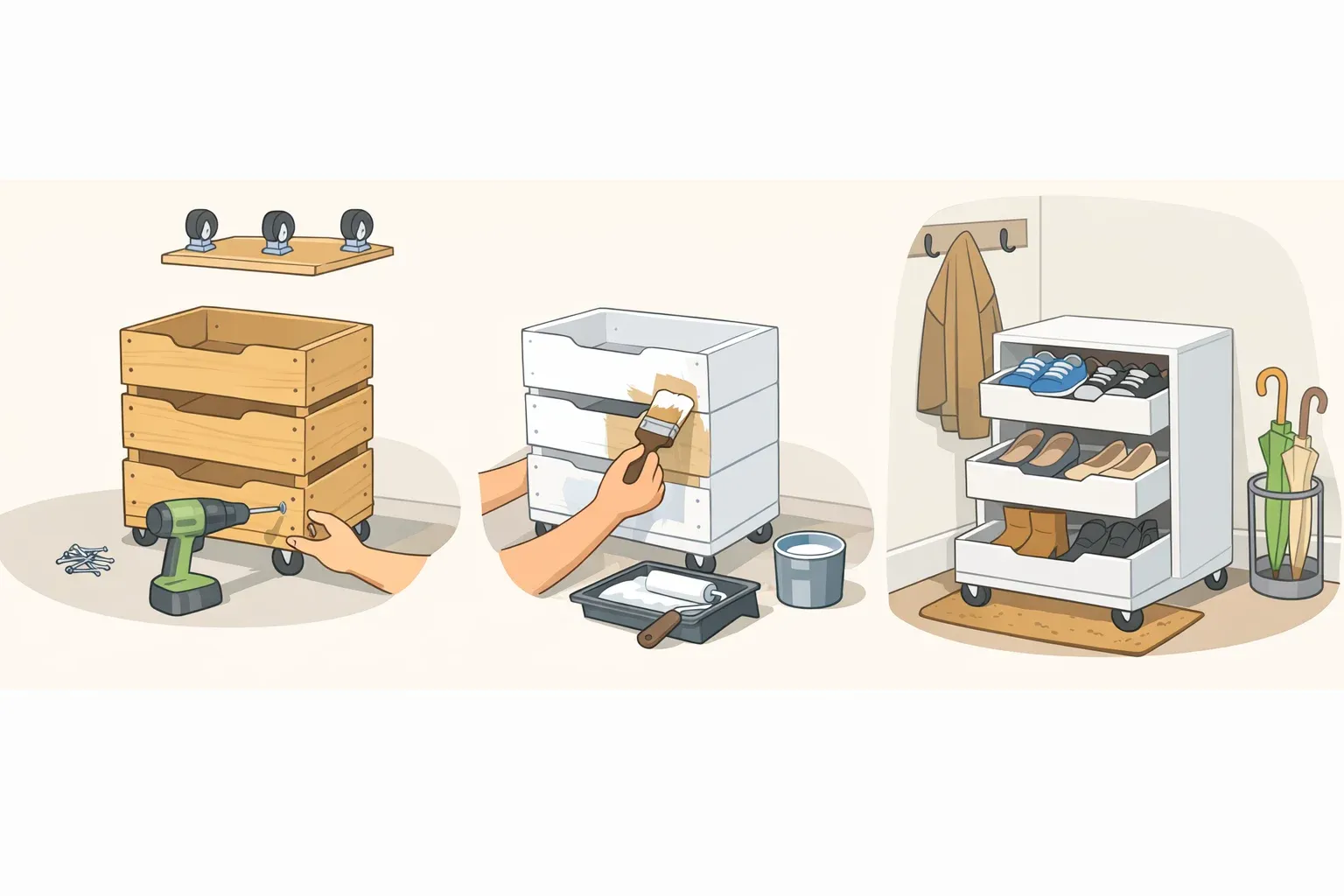
Give shoes one contained spot: a basket, a bench with storage underneath, or under-stair space if you have it. Tucking shoe storage under a staircase hides the clutter without disrupting the room's visual flow. A bench does double duty, since it also gives you somewhere to sit while putting shoes on.
Wherever the container lands, keep it clear of the door's swing path and the main walking route, not just tucked partway out of the way.
If the container overflows every week, don't assume the answer is a bigger bin. Sometimes off-season pairs are eating up the space, sometimes the household simply owns more shoes than the container was sized for, and sometimes shoes that belong in a bedroom closet have drifted to the entry out of habit. Figure out which one applies before adding capacity.
Drop: One container for keys, and a spot for packages
Give keys, wallets, and other small daily items one container: a bowl, tray, or small basket on a bench end or console. Placement matters more than style here. Keep it away from windows and glass near the door. Keys near a window or letterbox can give someone an opportunity to steal them, whether by breaking the glass or fishing through the letterbox. If your entry has sidelights or a mail slot, skip the open bowl near the door and use an inside drawer, a small cabinet, or a wall-mounted organizer positioned somewhere less visible and harder to reach from outside.
Give packages a spot too, ideally near this same container. Organizer Angela Evans keeps a box cutter permanently stationed at her own drop zone, since having the tool on hand means unboxing actually happens instead of piling up, per LinkedIn. That setup works for her household, but it isn't a universal safety rule.
If there are kids or pets in the house, skip the open bowl and store a retractable box cutter in a closed drawer or a container out of easy reach, keeping it in the same spot every time so it's still quick to grab. A letter opener, or opening boxes at a supervised kitchen counter instead of the entry, works just as well if a blade near the door doesn't sit right for your home.
Process: Build an entryway mail organization routine
Handle mail the moment it arrives, not later. Pick it up and immediately toss obvious junk, flyers, catalogs you don't need, into a recycling bin near the door. Everything else goes into your one designated mail spot, not the kitchen counter.
Professional organizer Charlotte Slankard recommends dealing with mail daily because postponing it just lets the pile grow: what could have taken a couple of minutes turns into a bigger project once the next day's mail lands on top. If you'd rather not see the pile at all, organizer Wendy Trunz suggests a lidded bin or basket instead of an open tray. Cut down what arrives in the first place. Switching to paperless statements and unsubscribing from catalogs and mailers you don't read reduces the sorting job before it starts.
When you do sort, organizer Kimberly Savel recommends separating action mail, anything that needs a response, from paperwork that only needs filing, using a labeled "action" tray or folder so bills and time-sensitive items don't get buried. Shred anything with personal or account information rather than tossing it whole. Papers you need to keep long-term belong wherever your household actually files documents: a drawer, a home office, a filing box, not stacked at the entry. The entryway's job is intake and short-term action, not permanent storage.
Packages get the same treatment: open boxes at the designated spot, break them down for recycling right away, and carry the contents to the room they belong in instead of leaving them staged by the door.
If the mail spot starts holding more than a day or two's worth, that's usually a sign processing has slipped, not that the tray is too small. A daily calendar reminder fixes it faster than waiting until sorting feels manageable.
Reset: The daily and weekly habit that keeps it running
On arrival, hang the bag, put shoes in their spot, and drop keys in the bowl. That pause takes about ten seconds and can keep small piles from building up. Before heading back out, give the zone another ten-second glance to confirm everything's where it belongs or on track to be dealt with.
Review the action-mail tray once a week, ideally over the weekend, so nothing time-sensitive slips through. While you're at it, empty the tray fully, return any stray items to their spot, and clear overflow shoes so containers don't creep past the limits set during the audit.
If a week gets away from you, don't try to overhaul the whole system at once. Reset one thing first. Tidy homes aren't about staying perfect; they're about knowing where to start again.
Small entryway organization ideas: choosing your layout by footprint
The right layout depends on how much space you're working with. These entryway storage ideas scale from a bare wall to a full console, so pick the one that matches your actual footprint rather than the one that looks best in photos.
Wall only, no floor space: hooks alone, one per person, plus a hanging basket for mail, per Good Housekeeping.
Bench-width space: a bench with a bowl at one end for small items and hooks mounted above for coats, covering shoes, keys, and coats in one footprint, per the same source.
Console-width hallway: a narrow console with drawers or doors for concealed storage, with a basket or ottoman tucked underneath for shoes.
Closet, under-stair, or a spare three-foot corner: turn the space into what designer Burcu Ercetin calls a functional "hot spot." She has converted small corners into what she describes as a "mom command station" for mail and daily essentials, in homes never built with a mudroom. A bench with baskets, a few hooks, and hidden storage may be enough for a small household; add capacity when a category repeatedly overflows.
Troubleshooting after the system is running
If items keep landing beside a container instead of inside it, move the container closer to the door. A home that's a few extra steps out of the way gets skipped even when it's the right size.
If shoes, mail, or coats overflow again after you've already resized once, check whether the category itself has grown — more shoes, more mail volume, more people using the door — before adding another container. Matching the setup to the current load usually beats expanding everything at once.
What a working drop zone looks like
Use the setup for several days before deciding whether it's working, then check three things: is the floor by the door clear, can keys be found without a search, and does the mail tray hold only items with a clear next step. If all three hold up, the system fits the household.
If one category keeps overflowing, resize or relocate that category instead of adding storage everywhere else. That's usually a sizing problem, not a discipline problem.
Hold off on built-ins, lockers, or a full mudroom conversion until the simple version has shown exactly what the household needs. A mismatched hook and a plastic bin can work fine if they fit the load, the space, and the household's routine; upgrade when the basic setup is consistently full, not because it isn't picture-perfect.
Comments
Be the first, drop a comment!