



Fridge organization hacks: how to use crisper drawers right
The best fridge organization hacks cost nothing and require no new equipment. No clear bins, no label makers, no tiered shelf risers. The change that actually moves the needle is simpler: assign produce to the right humidity zone, keep incompatible items apart, and put everything in dry. The mechanism that makes it work is a small vent on each crisper drawer that most people have never touched.
What ends up in the trash is more often a function of how produce is stored than what gets purchased, as AP News reported three months ago. Moisture, temperature, and airflow are the primary variables driving spoilage, and crisper drawers are specifically built to manage all three. This guide covers how to use them correctly: vent settings, produce placement, and the loading habits that separate herbs that last a week from herbs you're pitching on day two.
Before you start: Check whether your fridge has two crisper drawers with adjustable vents or dials. If you have one drawer or fixed vents, the compatibility and moisture rules in Steps 3 and 4 still apply. Note what you're working with before reading on.
Step 1: Understand why produce doesn't belong in the main compartment
A standard refrigerator's main compartment is engineered to stay cold and keep ambient humidity low. That combination works well for dairy, condiments, and packaged foods, per AOL. It's deliberate design, not a flaw. Fresh produce is just a different problem.
As Mattia Sala, product manager at SMEG USA, explains, certain fresh items "require more humidity and cooler temperatures than what is found in the larger compartment" AOL. Leafy greens, herbs, and soft vegetables stored in dry ambient air lose moisture from their cell walls and wilt faster than they should. Think of it this way: the main compartment is built for shelf-stable items that need to stay cold; the crisper is built for living plant tissue that needs to stay hydrated.
Crisper drawers solve the produce problem by creating a separate microclimate. Brit Angelesco, executive vice president at ZLINE, describes them as specifically designed to control humidity in a way that slows how quickly produce deteriorates AOL. Without adjusting the vent, you're not really using the drawer you're just using a lower shelf.
Step 2: Set each vent correctly this is the core of fridge storage for produce
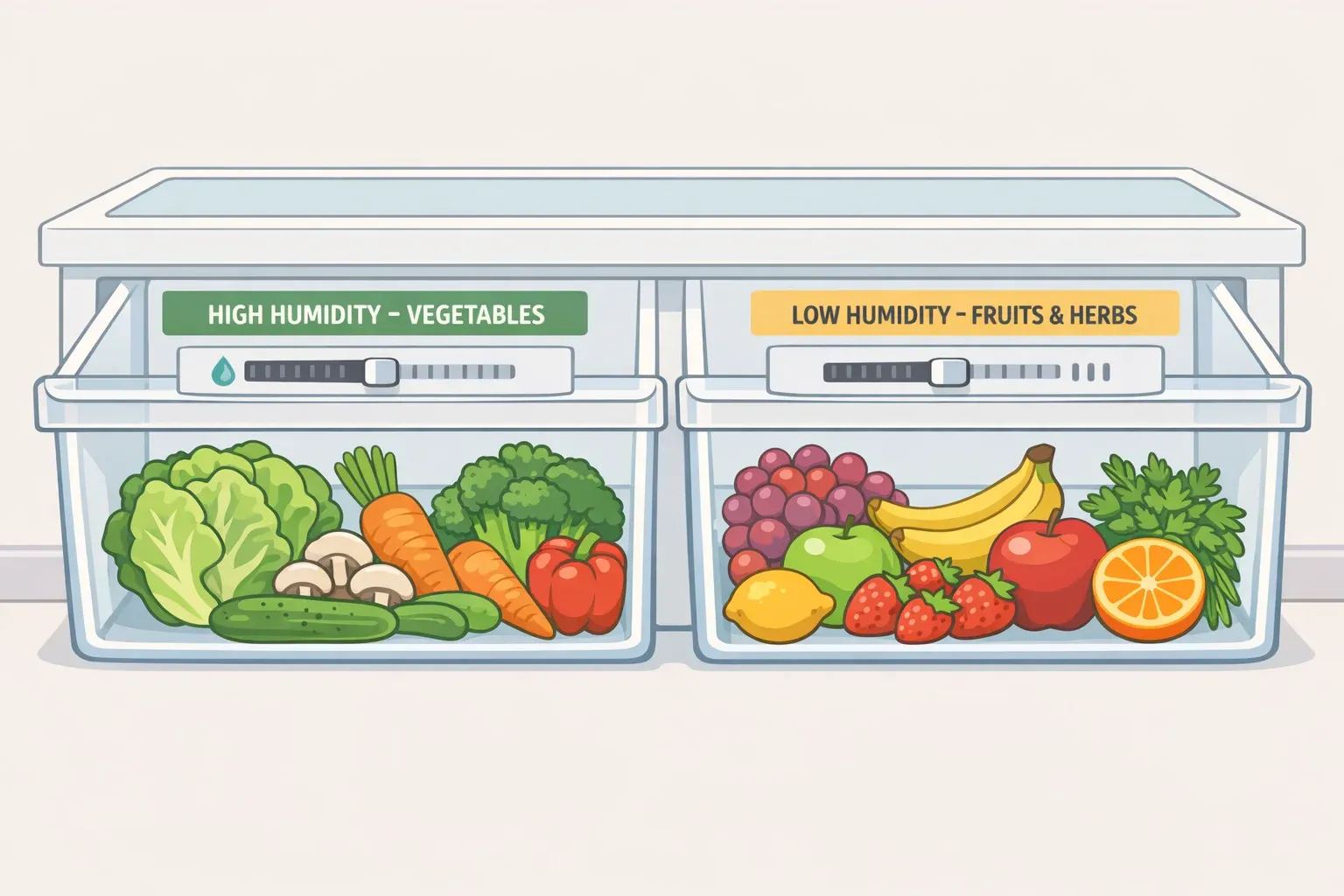
Each crisper drawer has a vent that shifts the humidity inside that compartment. Closing it traps moisture; opening it lets moisture escape. Angelesco states the rule plainly: "Closed vent equals high humidity, good for produce that wilts easily. Open vent equals low humidity, better for produce that emits ethylene gas or prefers a drier setting" AOL.
High-humidity drawer (vent closed): Anything that wilts or dries out easily belongs here. The closed vent holds the moisture these items need to stay crisp, per Angelesco AOL. Leafy greens, herbs, asparagus, broccoli, and celery are the clearest examples. Buy spinach and apples in the same grocery run? Spinach goes here, apples go elsewhere.
Low-humidity drawer (vent open): This is for fruits that emit ethylene gas as they ripen. Sala notes that ethylene-producing items stored in a high-humidity setting are prone to "ripening or rotting too quickly" AOL. The open vent lets that gas disperse before it accelerates everything in the drawer. Apples, pears, and stone fruit are the primary candidates.
Produce assignment by drawer:
| High-humidity drawer (vent closed) | Low-humidity drawer (vent open) |
|---|---|
| Leafy greens, herbs | Apples, pears, stone fruit |
| Asparagus, broccoli, celery | Other ethylene-emitting fruits |
| Anything that wilts or dries out quickly | Fruits prone to overripening in humid conditions |
The table reflects what appliance experts at SMEG and ZLINE specifically cited AOL. Other produce peppers, mushrooms, grapes, cucumbers may fit these categories based on general produce-storage principles, but the verified examples are the ones listed.
Single-drawer fridges: Default to the high-humidity setting and prioritize greens and herbs. They spoil fastest when humidity drops. Ethylene-producing fruits do better on a main shelf where airflow is less restricted not ideal, but better than losing herbs in two days because they're sharing space with ripening apples.
If the vent on your drawer isn't obvious, look for a small slider on the front face. If vents are absent entirely, the drawer defaults to moderate humidity; the compatibility rules in the next step still apply.
Step 3: How to organize a fridge drawer keep incompatible produce apart and stack correctly
Getting vent settings right only goes so far if what's inside the drawer is working against itself.
Ethylene-sensitive vegetables deteriorate faster when stored near high-ethylene fruits, even in a well-ventilated drawer. The gas diffuses regardless of vent setting; physical separation is the reliable fix. Angelesco gives a concrete example of what happens when incompatible items share space: onions and potatoes cause "mutual sprouting and softening" when stored together AOL. The broader principle holds: produce that releases strong gases affects its neighbors. When in doubt, separate rather than consolidate.
Within each drawer, stack by weight. Sala is direct: heavy and hard vegetables go at the bottom, lightweight and soft produce goes on top AOL. Heavier items bruise softer ones, and bruised produce deteriorates faster and can spread mold to everything around it. Picture a bunch of herbs sitting under a head of broccoli for three days that's the scenario this rule prevents.
Pull anything that's turning before it affects the rest. Decomposing produce releases additional gases and spreads mold spores to neighboring items. A two-minute check every two or three days remove anything softening or discolored keeps the surrounding produce in better shape. As Angelesco puts it, removing items "starting to turn helps keep the rest of your produce fresher for longer" AOL. This is the maintenance habit that makes the rest of the system self-correcting.
Step 4: Get the loading habits right on grocery day
Vent settings and placement only work if what goes into the drawer isn't already compromised. Three habits matter here, and each takes under a minute.
Dry produce before it goes in. Moisture left on produce from washing, store misting, or outdoor humidity creates the conditions mold needs to establish quickly. Angelesco is direct: "Ensure everything is dry before it goes into the fridge, since excess moisture is the enemy of freshness" AOL. Pat things dry or let them air briefly before loading. Anything leafy or soft should always go in dry.
Remove vegetables from sealed plastic bags. Store bags trap ethylene and surface moisture against each item the opposite of what crisper drawers are designed to create. Sala is explicit: "Never leave vegetables inside the crisper in their bags as this will cause them to decompose prematurely" AOL. If you need to keep items separated, perforated paper bags or a loose wrap that allows some airflow are the right alternative.
Don't overpack. A full drawer sounds efficient. It isn't. Cramming produce together cuts airflow around each item, and reduced airflow speeds spoilage. Angelesco notes an overpacked drawer can shorten produce life "by days, sometimes even weeks" AOL. If the drawer is too full after a big shop, move anything tolerant of drier conditions to a main shelf and keep the crisper space for the items that need humidity most.
One more variable worth checking if produce still spoils unusually fast after applying these steps: the fridge itself may be running too warm. A study of 123 home refrigerators found that only about 30-40% consistently held temperatures at or below 5°C on the upper and middle shelves over a five-day monitoring period ScienceDirect. An inexpensive thermometer on the middle shelf will tell you whether the problem is storage habits or an appliance that isn't holding temperature.
Three rules that hold up when everything else is imperfect
Real life means mixed shopping trips, one-drawer fridges, and vents that haven't moved since the fridge was delivered. These three rules work across all of those situations.
Separate ethylene producers from everything else. Fruits prone to rapid ripening go in their own drawer or on the main shelf. Greens and herbs go somewhere else. This single separation prevents the most common category of premature spoilage.
Dry before storing, and don't overload. Both habits address the most common causes of early spoilage without any hardware changes. Do them on grocery day, every time.
Check the drawers every two to three days. Remove anything softening or discolored. One bad item left in place shortens the life of everything around it.
AP News reported three months ago that small adjustments to produce storage carry meaningful benefits for both food waste and household spending. The crisper drawer's humidity control is a feature most people already own and have never used correctly. That's a genuinely free upgrade.
Where to start tonight
Check the vent on each drawer before the next grocery run. That one check applied consistently, before anything goes in is where most of the gains come from. The placement rules and the two-minute weekly pull build on top of it, but the vent is the foundation. Everything else is maintenance.







Comments
Be the first, drop a comment!