



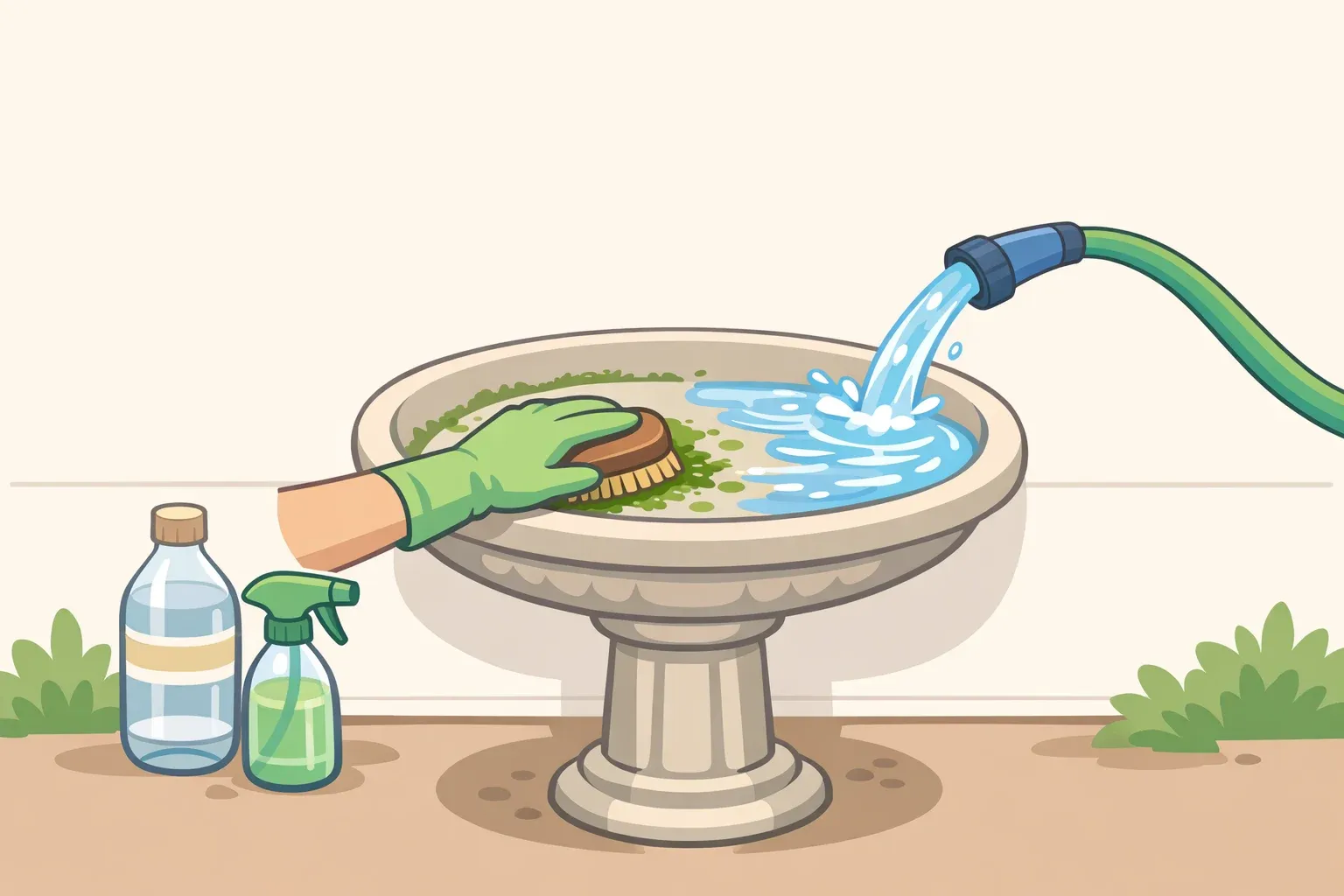
The riskiest part of cleaning a bird bath with vinegar isn't the vinegar. It's what gets left behind afterward. Wildlife experts say a vinegar-and-water solution works well for scrubbing algae off an empty bath, but pouring vinegar into standing water can strip the natural oils birds rely on to stay waterproof.
That distinction, cleaning an empty basin versus treating the water itself, is the whole safety story behind how to clean a bird bath with vinegar. Get it right and vinegar is a cheap, effective algae killer. Get it backward, and the bath ends up worse off than before you touched it.
Bird baths also need more attention than most people assume. Audubon recommends refilling every other day, while wildlife expert Sunny Kellner suggests a full cleaning and water change every two to four days. In summer heat, check the bath daily, since warm water turns into a bacteria breeding ground fast. What follows is a step-by-step method for removing algae from a bird bath safely, along with how often to repeat the whole process.
Step 1: Empty the bath and clear out debris
Start by dumping every drop of standing water. It sounds obvious, but the rest of the process depends on it, since scrubbing algae into water that's still sitting in the basin just redistributes the mess.
Algae isn't the only thing fouling the water. Bird droppings, shed feathers, food scraps left behind by crows or raccoons, and ordinary yard debris like leaves all build up over time. Tip the basin, knock loose anything stuck to the bottom, and give it a quick once-over before moving to the next step.
Placement affects how fast this grime accumulates. Audubon advises setting baths near, but not directly beneath, brush or feeders, since falling seed and debris muck up water quickly. If a bath seems to need cleaning constantly, moving it a few feet from an overhanging feeder is often the simplest fix.
Step 2: Mix a vinegar and water bird bath cleaning solution
Can you use vinegar to clean a bird bath? Yes, but only once the basin is empty, never as something poured into water birds will drink or bathe in.
The sources don't fully agree on ratios, and that's worth saying plainly rather than picking a side. The Spruce recommends a 1:1 mix of vinegar and water for scrubbing, while Audubon suggests a much weaker nine parts water to one part vinegar. Both come from credible sources, so treat neither as gospel. A light film calls for Audubon's gentler mix; caked-on algae calls for the stronger 1:1 ratio.
Kellner confirms vinegar kills algae effectively during routine maintenance between refills, but stresses it should never go into water already sitting in the bath. Apply the mixture with a soft cloth, sponge, or sturdy plastic brush, matching the tool to what the surface can handle without scratching. Concrete or stone basins tolerate a firmer brush; glazed ceramic and plastic do better with something softer.
Step 3: Rinse a bird bath after cleaning, thoroughly
This is the step that actually protects the birds. Wild bird expert Tracy Hill says the bath needs to be rinsed "very thoroughly" so no residue lingers once fresh water goes back in.
The concern is feather oil. Kellner warns that vinegar left sitting in bath water can strip the natural oils that keep feathers waterproof, the same reason Audubon advises skipping synthetic soaps and cleansers entirely. The fix for both problems is identical: rinse until nothing but water remains, whether the leftover is vinegar or soap residue.
Fresh water matters for more than hydration. Hill points out that it supports preening, and birds depend on clean feathers to fly well. A bath that still carries a faint vinegar smell hasn't been rinsed enough, no matter how clean it looks.
Let the basin air-dry before refilling. Run a hand along the bottom and sides as a final check, since a rinse that looks thorough by eye can still leave a thin film behind.
Step 4: Alternatives if you'd rather skip the vinegar
Vinegar isn't the only option, and for light buildup it may not be necessary at all. Hill suggests letting the bath dry out completely in full sun until the algae flakes off on its own, then brushing away the flakes with a soft-bristle brush, no chemicals involved.
For routine grime that isn't dried-on algae, plain scrubbing often does the job. Hill calls it "elbow grease," just a soft-bristle brush and some effort. It's slower than a vinegar solution, but it sidesteps the rinse-thoroughness question entirely, since there's no residue to chase.
For buildup that won't budge, bleach is the stronger option, though sources differ slightly on strength here too. The Spruce cites a 1:10 bleach-to-water ratio, while Audubon points to National Wildlife Health Center guidance of 1:9 bleach-to-water for both baths and feeders. Treat bleach as a last resort for grime that sun-drying and scrubbing can't touch, and rinse it out even more thoroughly than vinegar before letting the bath dry and refilling.
How often to clean a bird bath and change the water
A deep clean does little good if the water sits stagnant afterward. Kellner's baseline is a full cleaning and water swap every two to four days; Audubon's is refilling every other day. Either schedule beats letting a bath go untouched for a week, which is easy to do without a reminder.
Summer changes the math. Warm water breeds bacteria and illness that spreads easily between birds sharing a bath, which is why Kellner recommends daily checks once temperatures climb.
The disease risk isn't abstract. Audubon notes that crowded baths during migration raise the odds of spreading house finch eye disease, salmonellosis, and avian pox, since more birds packed into one water source means more contact between healthy and sick individuals. Neglect carries a second risk: a bath left to go stagnant can turn into a mosquito nursery, since mosquitoes avoid laying eggs in moving water. A small fountain or stream feature keeps the water circulating and handles both problems, the boredom of a still bath and the mosquitoes, in one move.
Building the habit
The safe way to clean a bird bath with vinegar comes down to order rather than exact measurements: empty the basin, scrub with a vinegar solution, rinse until nothing remains, then refill. Never add vinegar directly to standing water.
Beyond that sequence, the schedule is what actually keeps a bath safe over time. Pick a refill cadence of two to four days as a baseline, tighten it during hot stretches, and treat cloudy water or visible algae as a signal to clean early rather than wait out the calendar. A bath that gets attention on a predictable rhythm does more for the birds using it than any single deep clean ever will.






Comments
Be the first, drop a comment!