



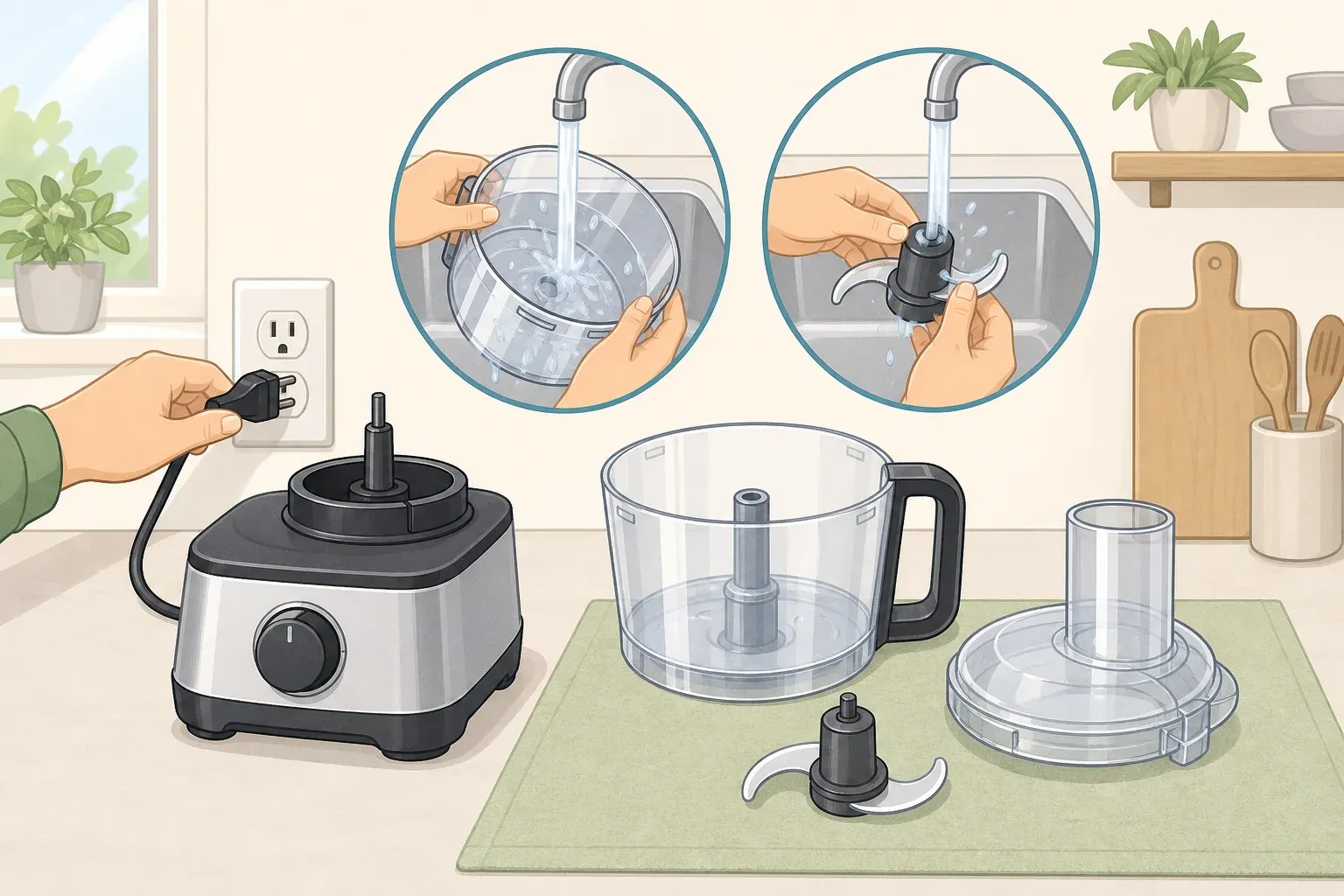
Cleaning a food processor sounds like a chore, but most of the dread has nothing to do with the appliance itself. It comes from letting tomato sauce, hummus, or shredded cheese dry onto the bowl and blade until it turns into a scraping project. KitchenAid recommends cleaning the appliance and its parts immediately after every use, and Black+Decker's FP4150 manual goes a step further, specifically calling for rinsing parts right after processing so food doesn't get the chance to bond to the plastic.
Here's how to clean a food processor without turning it into a scraping project: unplug and take it apart, rinse the removable pieces right away, run a quick soap-and-water rinse if your model allows it, wash the bowl, lid, and blade the rest of the way, wipe the base separately, then dry everything before it goes back together. This is a beginner-friendly job that doesn't need special equipment, but two things deserve extra care.
Blade handling is one, since Kenwood warns to take care with sharp blades and cutting discs during removal. Knowing which parts your specific model allows in the dishwasher is the other, and that's worth checking in your manual before you get started, since it governs several steps below. This guide covers the full sequence, how to clean food processor blades without getting cut, whether your parts belong in the dishwasher, and how to clean the base without scratching or clouding it.
Before you start: what you'll need
Gather these before touching the appliance:
Dish soap and warm water
A soft cloth or sponge
A small brush, like an old toothbrush, for the blade shaft and tight crevices
White vinegar (optional, for stubborn stains)
Kenwood and KitchenAid both recommend cleaning the appliance after every use to keep it performing well over time. Before touching anything, confirm the machine is switched off and unplugged. This step comes up in Black+Decker's manual, KitchenAid, and Kenwood alike. Do not handle removable parts until the processor is switched off and unplugged.
How to clean a food processor step by step
Switch off, unplug, and disassemble completely. Remove the lid, blade, and bowl. On some models, you'll need to rotate the bowl to unlock it from the base before it separates. Black+Decker's manual calls for full disassembly before washing any part. Handle the blade carefully here; Kenwood specifically warns to take care with sharp blades and cutting discs during removal.
Rinse removable parts immediately. Rinsing right after processing, before residue dries, is what makes the rest of cleanup easier.
If your manual explicitly permits it, run a quick soap-and-water rinse. This is optional and only applies if your model's manual describes it. Reassemble the bowl, blade, and lid, add water and a bit of dish soap, and run the machine briefly according to your manual's instructions. KitchenAid's version calls for filling the bowl about a third full with water, adding a few drops of dish soap, covering, and running on high for 30 seconds. Black+Decker's version uses 1 cup of warm water and a single drop of dish soap, processed on low for about 30 seconds. Follow your own model's stated water amount, speed, and run time rather than splitting the difference between the two. When it's done, switch off and unplug the machine again before removing the lid or touching any part; then discard the liquid, remove the parts, and rinse the bowl and blade thoroughly.
Hand-wash or dishwasher-wash the bowl, lid, and blade. The full breakdown, including which parts are safe for the dishwasher, is below.
Wipe the base separately with a damp cloth. Never submerge it; details on why and how are in the base section further down.
Dry every part thoroughly before reassembling or storing. Both KitchenAid and Kenwood stress this specifically before parts go back into the machine or into a cabinet.
Kenwood's guidance is a good reminder that step 3 isn't a universal method: it states that full blade assemblies should never be immersed in water at all, which is part of why that step stays optional and model-dependent. Once parts are rinsed and drying, the finicky part of the job is over. What's left is handling the blade without a nick and knowing which pieces are actually safe to hand off to the dishwasher.
How to clean food processor blades safely
The blade hub and shaft are easy spots to miss with a quick sponge wipe, and they need careful handling since the cutting edges stay sharp even when wet. Before touching the blade, hold it by its plastic hub, keep fingers away from the cutting edges, and use a brush rather than a finger to clear anything stuck in the shaft.
Use a small cleaning brush to dig out food trapped inside the blade hub and shaft. Both KitchenAid and Black+Decker's manual call this spot out specifically because it's easy to miss with just a sponge. Kenwood recommends the same small-brush approach for blade assemblies, followed by a rinse under warm running water.
Wash the blade separately from the rest of the load, somewhere you can see it clearly, rather than letting it sink into a pile of soapy dishes where the edge is hard to spot.
Two mistakes to avoid here. Don't let the blade or disc soak for long stretches: Black+Decker's manual warns against extended soaking, and Kenwood goes further, saying full blade assemblies should never be immersed in water at all. And skip stiff-bristled brushes and abrasive pads: KitchenAid and Black+Decker warn that scouring pads and abrasive cleansers can scratch or cloud the plastic bowl and lid, and Kenwood separately cautions against hard bristles that can scratch components.
Can food processor parts go in the dishwasher?
Many bowls, lids, and blades are dishwasher-safe, but this varies by model, so check your owner's manual before assuming yours is one of them, as KitchenAid advises. If your manual confirms it, stick to the top rack with gentle or normal cycles, and avoid high-heat cycles, according to KitchenAid's product help page. Load the bowl upside down rather than on its side.
Here's where it's worth slowing down: Kenwood lists its bowl, lid, pusher, knife blades, and discs as dishwasher-safe, but separately warns that full blade assemblies should never be immersed in water. A knife blade on its own may be fine on the top rack, while the assembled unit with its housing may not be. Check your manual for the exact blade or assembly in question rather than assuming "dishwasher-safe" on one part means every version of that part can be soaked or submerged.
Prefer to wash a food processor by hand instead? Use warm soapy water and a soft cloth or sponge on the bowl, lid, and blade. Black+Decker's manual confirms removable parts can go on the dishwasher's top rack or be hand-washed in hot soapy water, and adds that hand-washing does a better job of maintaining the plastic's appearance over time. Kenwood points owners back to the manual for extra attachments like grinders or juicers, which sometimes carry different rules than the standard bowl and blade.
If your model's manual doesn't confirm dishwasher safety for a given part, hand-wash it instead. Don't guess based on what a similar-looking appliance allows.
How to clean a food processor base without damaging it
Never immerse the motor base or power cord in water; wipe them with a warm, damp cloth instead, then dry thoroughly with a soft cloth. This rule holds across Black+Decker's manual, KitchenAid, and Kenwood.
Pay close attention to the interlock area on the base, a spot Kenwood specifically flags as a place where food debris tends to build up unnoticed. KitchenAid points to the same kind of problem area, noting the crevices around the handle and locking mechanism as commonly missed spots.
Skip abrasive cleansers and scouring pads on the base too. KitchenAid and Black+Decker both warn these can scratch or cloud the surface, and Kenwood advises against abrasive cleaning products for the same reason.
For stains that discolor the plastic, KitchenAid suggests a vinegar-dampened cloth, and Kenwood suggests rubbing the spot with a cloth dipped in vegetable oil. Treat both as optional cosmetic fixes rather than a required part of the routine or a sanitizing step; they're for appearance, not disinfecting.
Food processor cleaning tips for dried-on residue and other snags
These situations don't fit neatly into the routine above, but they come up often enough to plan for.
Dried-on food: If something's already crusted onto the bowl or lid, hand-wash with warm soapy water rather than reaching for the quick soap-and-water rinse above. That shortcut is meant for light residue, not caked-on food, and Black+Decker's manual still warns against letting parts soak for long periods.
Food stuck in the blade hub: Work the small brush along the shaft under warm running water instead of checking it with a finger. A brush reaches the residue KitchenAid and Kenwood both flag as easy to miss with a sponge alone, without putting a finger anywhere near the edge.
Cloudy or discolored plastic: These are two different problems. Abrasive cleansers or scouring pads may scratch or cloud plastic, something KitchenAid and Black+Decker both warn against, so switch to a soft cloth or sponge if clouding shows up. Discoloration from certain foods is cosmetic, according to Kenwood, and doesn't affect performance. A vinegar-dampened cloth or a cloth dipped in vegetable oil can help lift it, but treat that as a nice-to-have, not something to chase down every time.
Extra attachments: Dough blades, slicing discs, citrus juicers, and grinders don't always follow the standard bowl-and-blade rules. Kenwood directs owners back to the manual for attachments like a chopper/grinder or citrus juicer, since their care instructions can differ from the main parts.
Drying, storing, and keeping your food processor ready to use
A part is ready to put away when it's rinsed, free of visible residue, and dry to the touch, with the blade shaft checked with a brush rather than a finger for anything trapped inside. Dry the parts thoroughly before storage, as KitchenAid and Kenwood both instruct. Some models let you store the blades, discs, and drive adapter inside the work bowl using a storage caddy, so check whether yours has that feature before hunting for extra drawer space.
Keep the three care rules for this appliance separate rather than treating them as one: a dishwasher-safe bowl or lid follows its own rule, a blade assembly that some manufacturers say should never be fully immersed follows another, and a motor base that only ever gets a damp cloth follows a third. Do not apply one part's cleaning instructions to another. If a part's care instructions aren't clear in your manual, hand-wash it rather than guessing.
Next time, rinse the bowl and blade before the food has a chance to dry instead of scraping it off after. That single habit, done right after unplugging the machine, is what actually keeps this chore from turning into a project.











Comments
Be the first, drop a comment!