



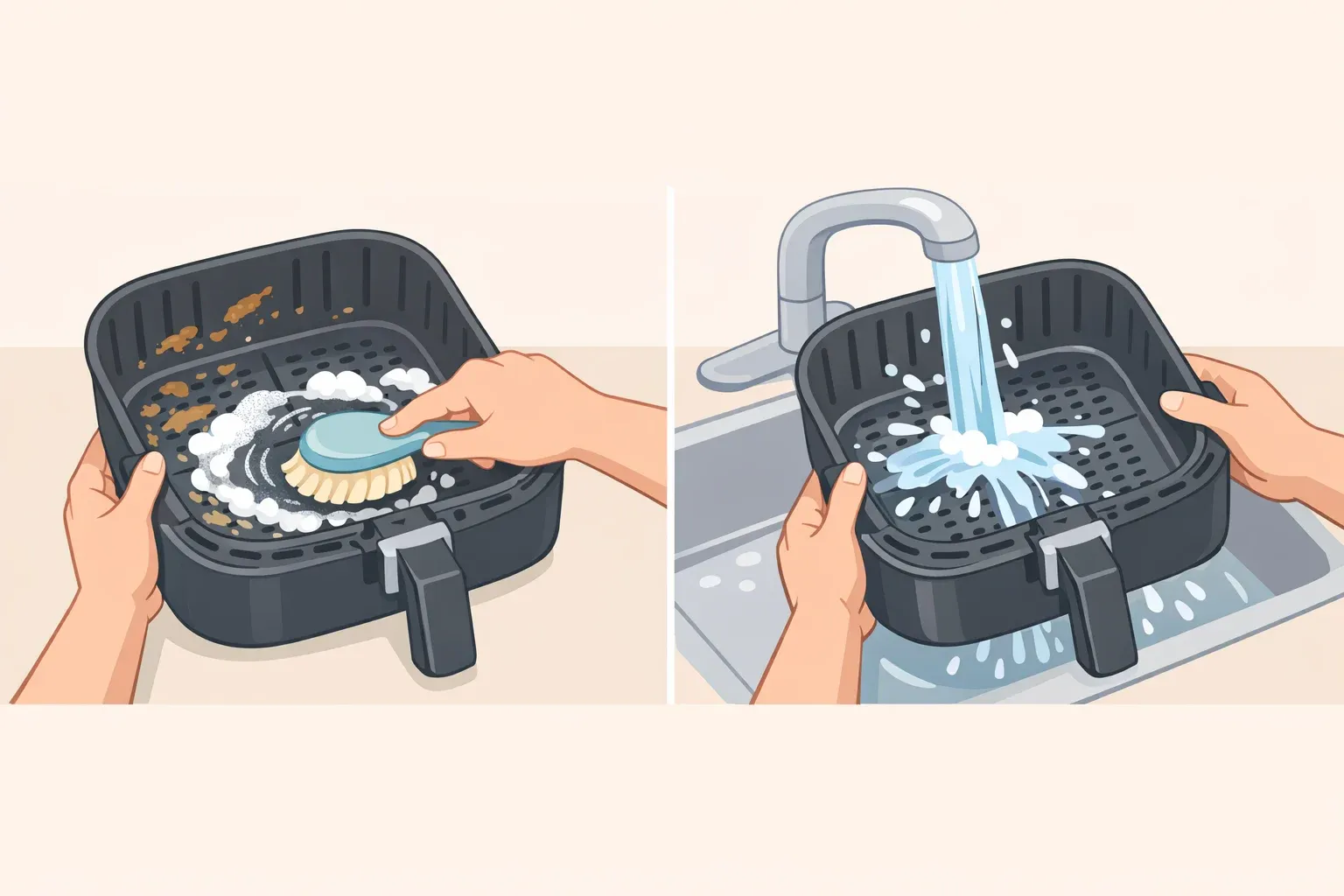
How to Clean a Greasy Air Fryer Basket and Protect the Coating
Most greasy baskets need less scrubbing than people think. The real problem isn't baked-on grease it's the aggressive cleaning that follows. Harsh pads, strong chemicals, and skipped post-cook rinses destroy nonstick coatings long before grease ever does.
The consequences are concrete: a basket that's harder to clean every time, smoke and bad odors during cooking, and a shortened coating life that ends with flaking nonstick and a basket that needs replacing. All of it is avoidable.
What you need before starting:
- Mild dish soap
- Soft sponge or non-scratch pad labeled safe for nonstick cookware
- Soft-bristle brush or old toothbrush (for crevices and perforations)
- Wooden toothpick or bamboo skewer (for food stuck in basket holes)
- Microfiber cloths
- Clean towel for drying
What you don't need: oven cleaner, bleach, ammonia, steel wool, metal scrapers, or abrasive scouring pads. These don't belong anywhere near an air fryer basket.
One thing worth understanding before starting: air fryers move hot air rapidly around food, which bakes oil, breading, meat juices, and crumbs directly onto the basket surface. Thin residue layers accumulate into sticky brown film if not cleared consistently, according to The Clean Atlas. Both PTFE (Teflon-type) and ceramic nonstick coatings are highly vulnerable to mechanical abrasion, high-alkaline detergents, and thermal shock, meaning the cleaning method determines how long the basket stays usable, Linea notes. Of 64 air fryer models tested by Consumer Reports, only five earn top marks for ease of cleaning, which makes a grease-minimizing routine more valuable than any deep-clean technique.
Step 1: The routine that prevents baked-on grease in the first place
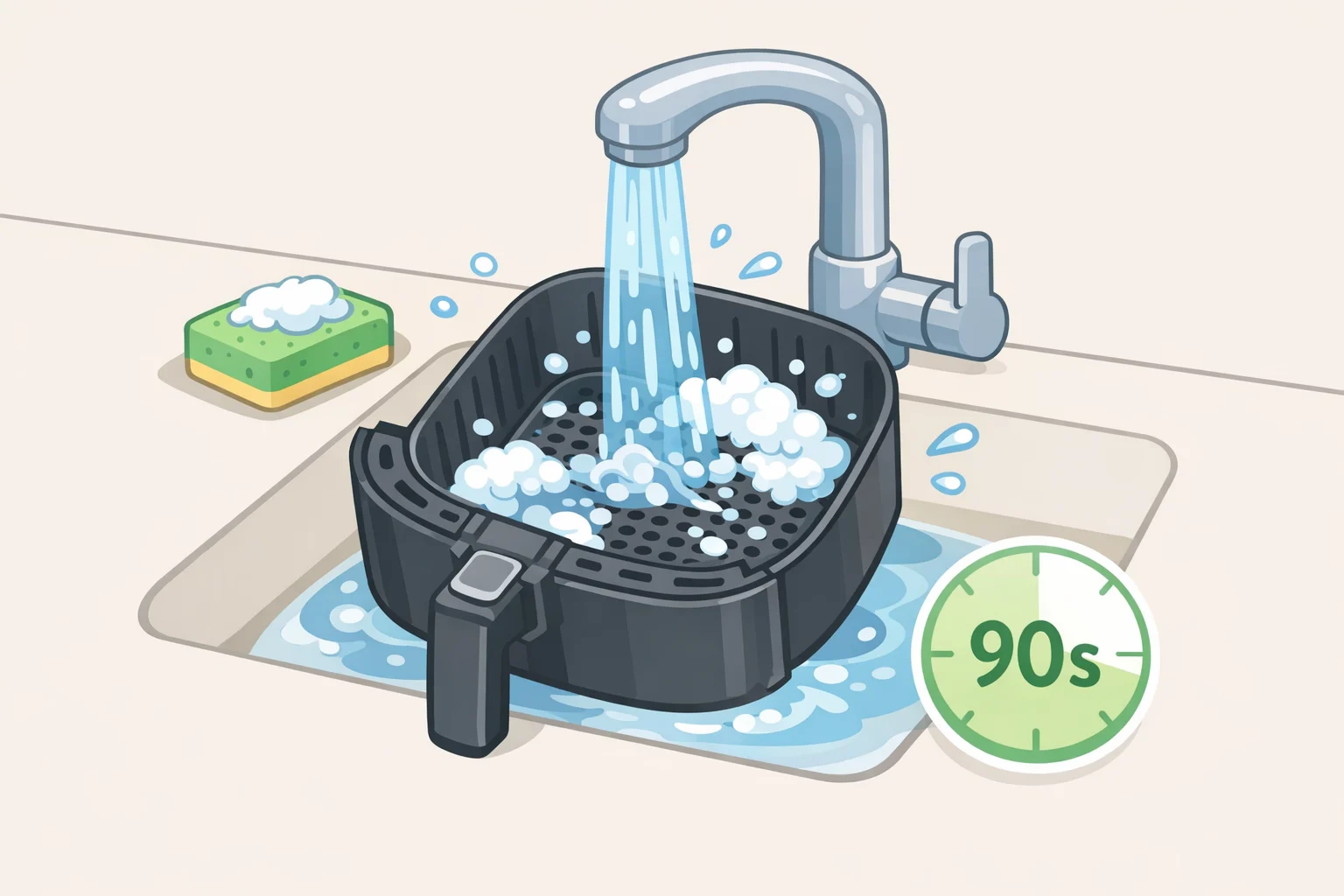
This is the section most cleaning guides skip, and it's the most important one. A 90-second rinse after every cook prevents the buildup that eventually requires aggressive cleaning, and aggressive cleaning is what destroys nonstick coatings over time, according to Linea. The baked-on method in the next section is what to do when this routine was skipped.
1. Turn off, unplug, and let the basket cool completely at least 30 minutes.
Running cold water over a hot basket causes thermal shock, which can warp or crack the nonstick coating. Cleaning while hot also causes soap to dry too fast and leave residue, per The Clean Atlas and COSORI UK. For sticky sauces or marinades marinated ribs, glazed wings slightly warm is fine; scalding is not.
2. Remove the basket and crisper plate. Empty pooled oil from the drawer.
Pour cooking oil into a small jar or container for disposal. Don't flush it down the sink.
3. Rinse with warm water, a few drops of dish soap, and a soft sponge.
This takes about 90 seconds for a basket with light residue, per Linea. Rinse until the surface no longer feels slippery or tacky. Dry with a clean towel, then air-dry fully before reassembling moisture trapped in seams and under the crisper plate causes musty odors, The Clean Atlas notes.
Frequency that matters:
- Basket and crisper plate: After every use without exception, especially after greasy, breaded, saucy, or crumbly foods, per Linea and COSORI UK
- Interior chamber: Every 3–5 uses, or immediately when you notice smoke or odors
- Heating element: Every 3–5 uses; more often after high-fat foods like bacon or sausages
Ginny Lui, who tests air fryers for Consumer Reports, is direct about the cost of skipping this step: let crumbs and food residue sit overnight and the basket becomes significantly harder to clean, Consumer Reports reports.
Step 2: How to remove grease from an air fryer basket with baked-on residue
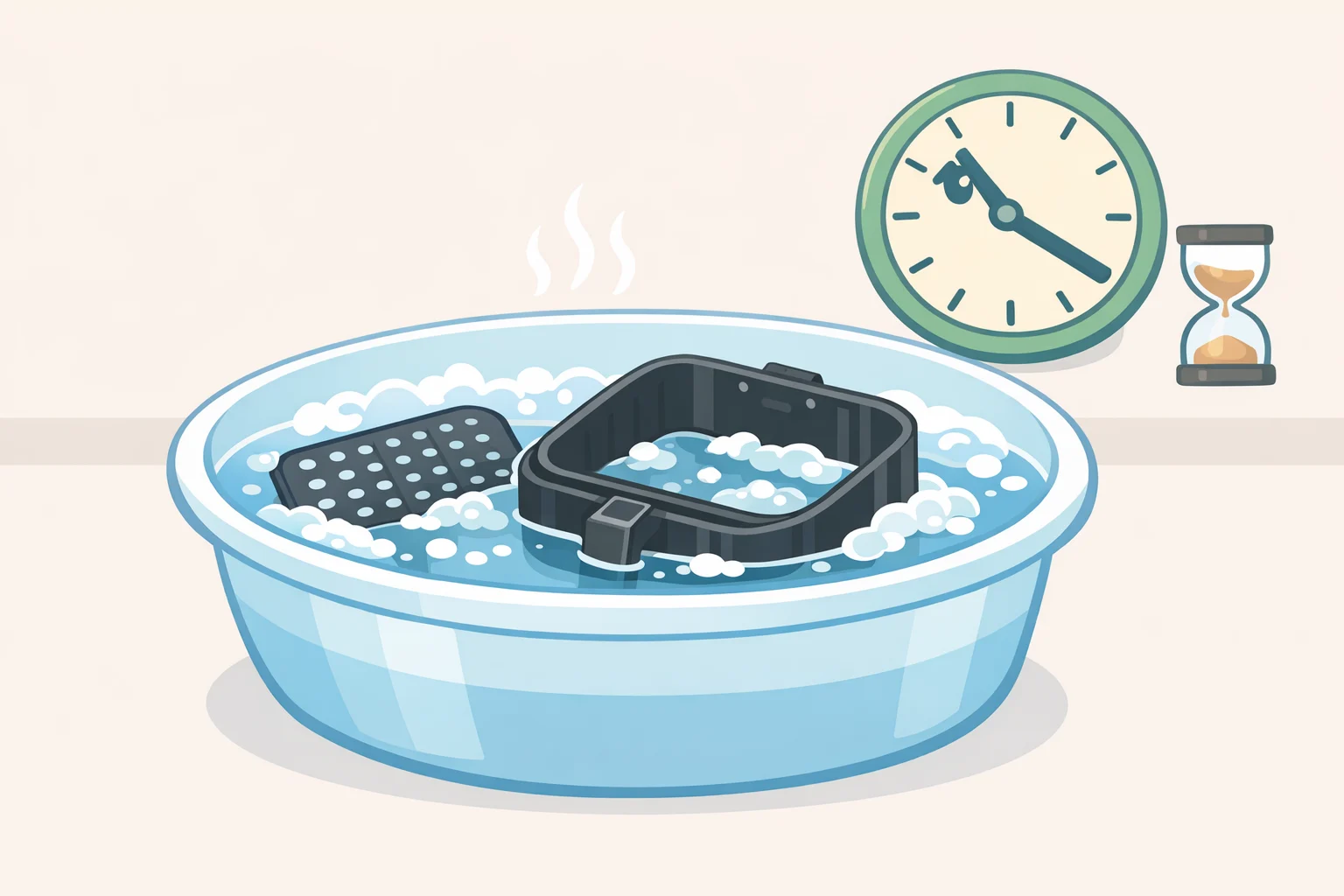
If grease has already hardened, the method is still gentle. It just requires more time. Soften the grease before any scrubbing, not after that's the only principle that matters here.
1. Soak in warm, soapy water for 10–20 minutes.
Fill the sink or a basin with warm water and a few drops of dish soap. Fully submerge the basket and crisper plate. This is the step most people rush, and it's the one that does most of the actual work. Warm water and dish soap handle the majority of baked-on grease when given enough time, The Clean Atlas and COSORI UK both confirm. If the surface still feels gummy after soaking, give it more time, not more force. Don't soak beyond 30 minutes; extended water exposure can weaken the bond between the coating and the metal substrate, Linea cautions.
2. Scrub with a soft sponge or non-scratch pad.
Work in small circles. Hold the basket under warm running water while scrubbing so loosened grease washes away rather than collecting in the perforations. For crevices and the underside of the crisper plate, use a soft-bristle brush or old toothbrush. For food lodged in basket holes, use a wooden toothpick or bamboo skewer never metal, per Consumer Reports.
⚠️ Do not use the abrasive side of a sponge, steel wool, metal scouring pads, or any scraping tool. PTFE coatings degrade primarily through repeated mechanical abrasion the damage accumulates across cleaning sessions before it becomes visible, Linea explains.
3. Rinse thoroughly, then dry completely before reassembling.
The surface should feel neither soapy nor tacky. Soap residue left behind burns and smells during the next cook.
If grease remains after one round: escalate to baking soda paste.
Mix three parts baking soda to one part water into a thick paste. Apply it to the affected area, leave for 15–20 minutes, then wipe away with a soft cloth and rinse thoroughly. Both COSORI UK and Good Housekeeping's Cleaning Lab recommend baking soda for stubborn residue; the 3:1 ratio comes from Linea. Baking soda is mildly abrasive use a soft applicator only, and rinse completely afterward so residue doesn't burn during the next cook. It's an occasional escalation, not a default method.
On dishwashers: If your manual says the basket is dishwasher-safe, it can survive the machine. That's not the same as being coating-safe long term. Standard dishwasher detergents operate at pH 10–13, and the cumulative damage to nonstick coatings shows up not at wash one, but at wash 30 or 60 though that timeline depends on detergent and water hardness, according to Linea. COSORI recommends hand washing as the default even for models with dishwasher-safe baskets, COSORI UK notes. If you do use the dishwasher, Good Housekeeping's Cleaning Lab advises top-rack placement, where heat and water pressure are lower.
Step 3: If the basket is clean but the fryer still smokes, check here
A clean basket doesn't always mean a clean air fryer.
Grease and food splatter collect in the interior chamber and on or near the heating element over time. That residue reheats every time you cook. COSORI identifies the heating element as the most overlooked part of the appliance and the most common source of smoke and persistent odors, per COSORI UK. Overfilling the basket is a direct cause too much food pushes fat upward toward the heating zone, Good Housekeeping notes.
If smoke smells electrical or the appliance sparks, stop using it immediately. That's beyond a cleaning problem.
Cleaning the interior chamber:
With the unit fully cooled and unplugged, wipe the interior walls and drawer area with a barely damp microfiber cloth and a small drop of dish soap. Follow with a clean damp cloth to remove soap residue. Do not pour water into the air fryer body. Do not spray anything directly into vents, fan openings, or near electrical components, per The Clean Atlas and COSORI UK.
Cleaning the heating element:
Once cooled, tilt or invert the unit as your manual allows. Wipe only reachable surfaces with a barely damp cloth. A soft brush not wire can dislodge stuck food if your manufacturer permits it. If heavy grease buildup near the element is out of reach, don't force it. Baking soda paste applied with a soft damp cloth works for accessible residue on the element itself, per Good Housekeeping.
Quick diagnostic:
- Basket feels sticky after rinsing: Residual oil film soak again for 10 minutes with fresh soapy water, then re-rinse
- Still smoking after basket is clean: Check under the crisper plate, in the drawer, and near the heating element for baked-on residue, per The Clean Atlas
- Coating is peeling, flaking, or exposing bare metal: Stop scrubbing the basket needs replacing, not more cleaning
How to clean an air fryer basket without damaging the nonstick coating and when to replace it
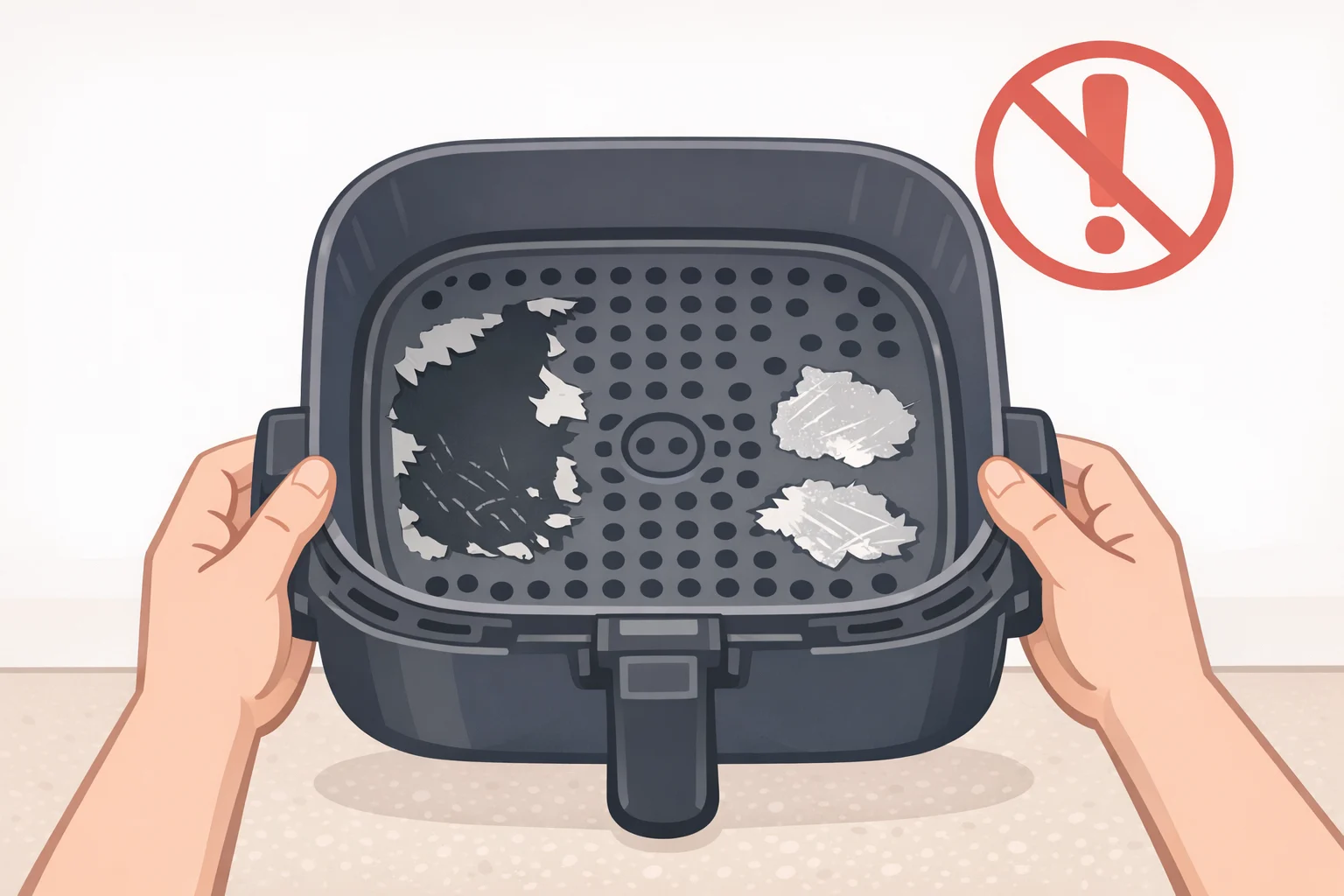
Visible peeling, flaking, bubbling, or exposed metal are the end of the road for a nonstick coating. It won't recover. A heavily damaged nonstick surface can introduce coating particles into food during cooking, Linea notes. Consumer Reports is unambiguous on what to do next: stop using the air fryer and contact the manufacturer for a replacement basket, or file a return with the retailer. Many models have replacement baskets available worth checking before assuming the whole unit needs replacing. If you're already seeing peeling, stop troubleshooting cleaning methods and price a replacement basket first.
What protects the coating long term:
- The consistent after-every-use rinse is more protective than any deep-clean method, Linea notes
- Don't overcrowd the basket excess food traps fat and sends splatter toward the heating element, per Good Housekeeping
- Perforated parchment liners or reusable silicone liners catch grease before it reaches the basket surface check your manual first to confirm compatibility with your model, per Linea
- Hand-wash over dishwasher whenever possible the coating doesn't fail on cycle one, but the cumulative damage is real, Linea confirms
Keep the basket clean consistently and it stays manageable. Skip the rinse regularly and the cleanup eventually becomes the kind that wears the coating down which is the only cleaning problem that can't be fixed.





Comments
Be the first, drop a comment!