



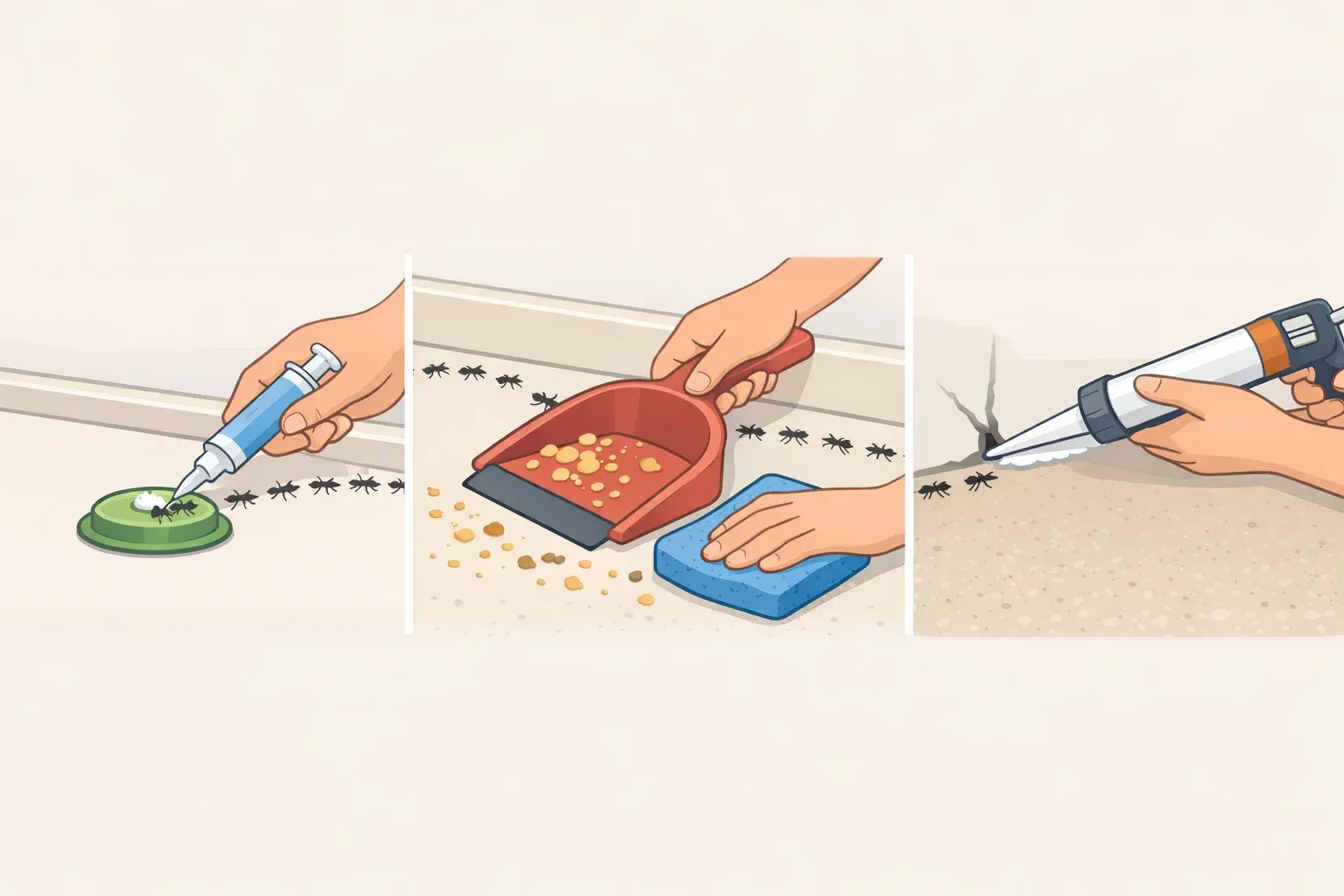
Most household ant problems can be resolved through cleanup, exclusion, and targeted bait. This guide walks through safe ant removal using those methods in sequence, then covers the three species where standard approaches either take longer or need to change entirely. If you need to get rid of ants inside and outside the house without broad pesticide application, you're in the right place.
The diagnosis matters before anything else. Using the wrong approach, particularly spraying a colony that responds to stress by splitting, can turn a manageable problem into a building-wide one.
Route yourself to the right section:
Ants appear seasonally, mostly in the kitchen or near entry points: start at Step 1
Ants persist despite cleaning and a week of correct baiting, or trails emerge from wall voids: jump to When bait isn't working
Large black ants, especially with year-round indoor presence or piles of coarse sawdust in crawl spaces: go directly to Carpenter ants
Most ants found indoors nest outdoors and enter only to forage for food or water. A small number of species, primarily pharaoh ants and occasionally pavement ants or carpenter ants, do establish nests inside structures. Heavy rain, flooding, and sharp temperature swings can push colonies indoors through any gap they can find.
Swarming, a sudden burst of ants, sometimes including winged forms, reflects reproductive activity and does not by itself confirm indoor nesting. For carpenter ants specifically, winged forms emerging inside a structure signal a mature colony with considerable damage potential. Winged ants are sometimes confused with winged termites; ants have elbowed antennae and a pinched waist, while termites have straight antennae and no waist constriction.
"Safely" here means sanitation, exclusion, and slow-acting bait, not broad indoor pesticide application. Sprays kill foragers without reaching the colony and, in the case of pharaoh ants, actively spread the problem.
Step 1: Remove attractants room by room
Cleaning alone rarely ends an infestation, but it makes bait far more likely to work by eliminating food competition. Start here regardless of species.
Kitchen
Store all food, including dry goods, fruit, and pet food, in airtight containers or the refrigerator. Rinse containers thoroughly before putting them in the trash or recycling bin. Wipe counters and sweep floors daily while activity is ongoing. Ants forage for sweets, fats, proteins, and oils in addition to visible crumbs, so surfaces that look clean may not be from an ant's perspective.
Fix leaking faucets under the sink. Ants need moisture as well as food, and a slow drip is enough to sustain a foraging trail. Remove sources of standing water, including pet water bowls, when not in use.
Bathroom and laundry areas
These rooms attract ants through moisture, not food. Check around pipe chases, under sinks, and behind washing machines for standing water or persistent damp. Ants also enter homes to escape flooding and will use any gap around a water line as a route in. Caulk those gaps in the wall.
Basement, crawl space, and utility areas
Two risk factors converge here: moisture and structural wood. Inspect for pipe leaks, foundation seepage, and clogged gutters draining against the wall. Wood in contact with soil, including deck posts and porch columns, is a common starting point for carpenter ants. Reducing moisture here is both an ant-control and a basic structural maintenance step.
Exterior foundation and yard
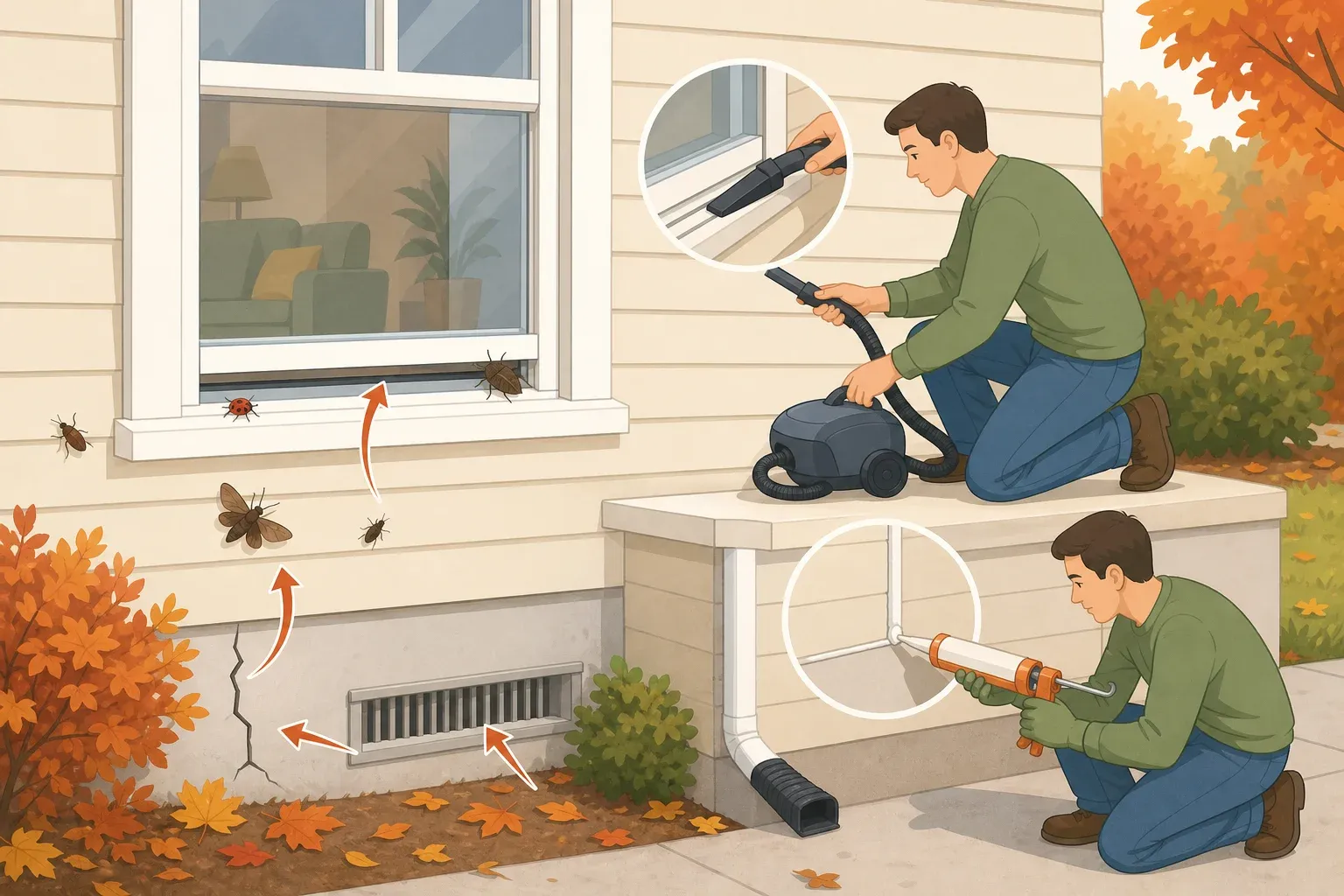
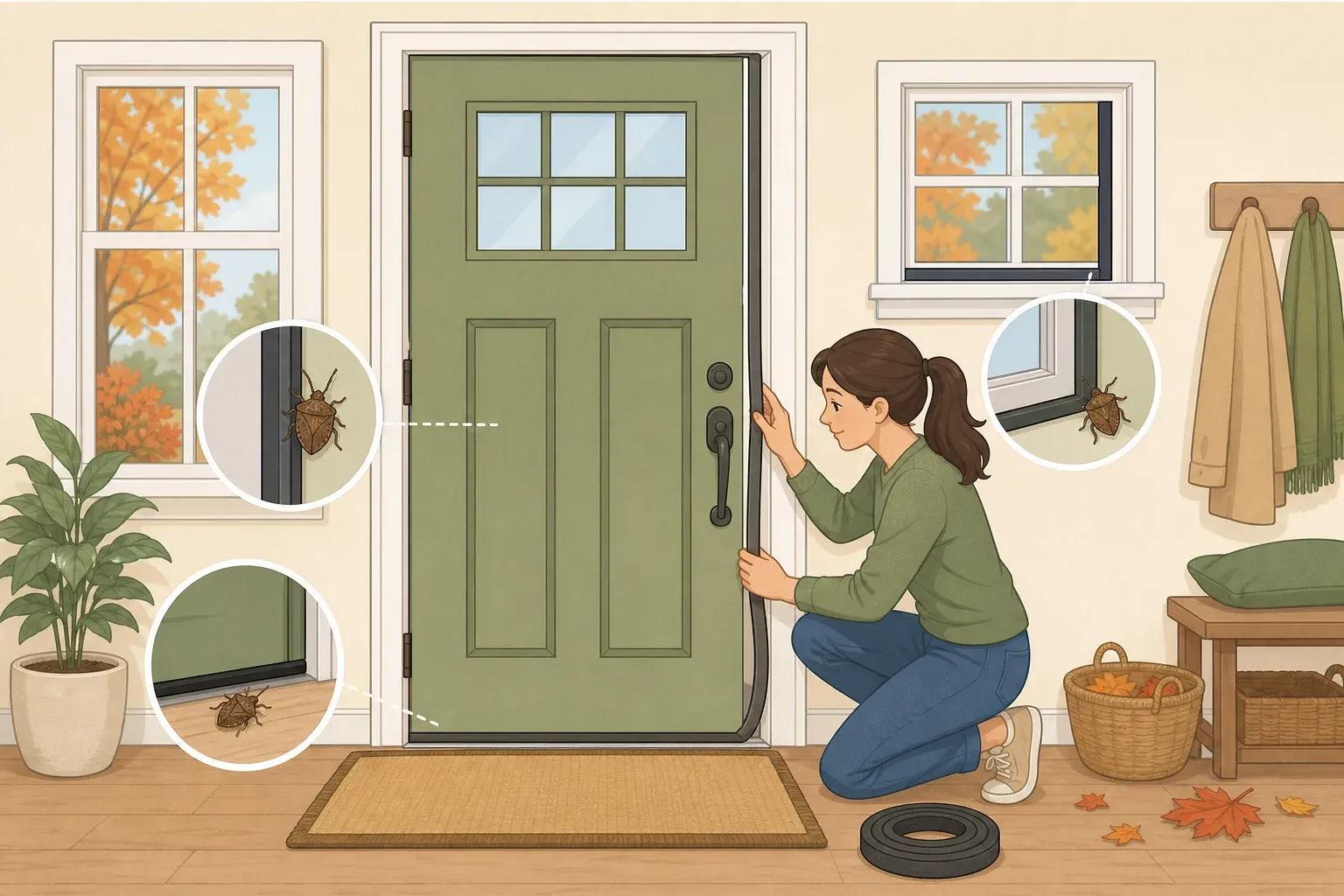
Move firewood off the ground and at least a few feet from the exterior wall. Store it under cover. Carpenter ants nest in stumps, logs, and woodpiles and use those as base camps for indoor satellite colonies. Clear damp mulch and leaf litter from against the foundation. Seal cracks around doors, windows, and where utility lines enter the structure.
Knowing how to prevent ants from coming into your home partly means recognizing what doesn't need treatment. Ants away from the structure are part of the natural environment; address only what's creating pressure on the building.
How to get rid of ants safely with bait, not spray
Slow-acting insecticide bait is designed to be carried back to the colony by foraging workers, reaching the queen and the nest population that never come into open view. Killing visible workers with a contact spray removes scouts but leaves the colony intact, and for certain species triggers fragmentation into subcolonies. Bait-type traps allow control of most ants without applying insecticides broadly across the home, if used correctly.
1. Watch the trail before placing bait. Follow ant traffic to identify active trails and the direction they lead. If ants disappear through a gap in the baseboard, wall, or pipe chase, the nest may be inside. If the trail leads toward a door, window frame, or foundation gap, the nest is more likely outdoors. That distinction shapes where bait goes and whether sealing the entry point might reduce the problem on its own.
2. Place stations along active trails. Set bait stations along the trail path, near confirmed entry points, and in corners where activity concentrates: behind appliances, inside cabinet hinges, and along baseboards. Put them where ants are already traveling. Keep stations low and against walls rather than on open countertops, particularly where children or pets have access.
3. Clean before placement, not after. Clean surfaces and active areas before setting out stations. After placement, avoid cleaning immediately around the traps. Disrupting the bait zone reduces ant contact and interferes with feeding. These two instructions apply at different stages; they aren't in conflict.
4. Use enough stations, and try both bait types. Larger species need more placements. Carpenter ants may require twice as many stations as small house ants. Ants shift between sugar and protein preferences depending on colony stage and nutritional needs, so if one formulation produces no activity, switch. Start with a low-toxicity bait such as boric acid with a sweetener; if that doesn't draw activity, try a gel formulation.
5. Wait before judging the results. Bait traps can take 24 to 48 hours or longer to begin working. Workers feeding at stations and carrying bait back to the nest are functioning as intended. Don't disturb or replace stations before they've had time to work.
If trails are fading and station activity is tapering off after a few days, stay the course. If nothing has changed after a week of correctly placed bait and thorough sanitation, read on.
When bait isn't working: persistent indoor activity
Persistent activity after a week of correct baiting and sanitation is a different problem than seasonal foraging. Outdoor nesters generally respond within that window. When they don't, the colony is likely not leaving at all.
Stop assuming outdoor origin and start looking for the nest. Follow trails to their source. If ants disappear into a wall gap, pipe chase, or baseboard, the colony may be in that wall cavity, though it's not always possible to determine the exact location without professional tools.
If multiple weeks of correct baiting have produced no reduction, suspect pharaoh ants and get them identified before doing anything else. This is the species where the standard escalation, switching to a stronger product or applying a spray, causes direct harm. Pharaoh ant colonies break apart and form subcolonies when stressed by repellent liquid or dust insecticides, spreading throughout the structure rather than dying off. Bait only, never spray.
A licensed pest professional can confirm the species, locate nest sites, and treat wall voids or other inaccessible areas that homeowner-grade stations cannot reach.
Three species that change the approach
Most household ants respond to the steps above. These three are exceptions, not because they're exotic, but because their biology makes standard methods either slower or counterproductive.
Odorous house ants and pavement ants
In the Pacific Northwest, these are the most common household ant species. Both are small and dark brown to black, which is why they're regularly confused. The fastest field test: crush one. A rotten-coconut smell means odorous house ant. No smell, and two clearly visible nodes between the thorax and abdomen when viewed from the side, means pavement ant.
Control methods are similar for both, but odorous house ants are harder to eliminate. They maintain multiple queens, reproduce by budding into cooperative subcolonies, and can form supercolonies with hundreds of thousands of workers spanning large areas, per Utah State University Extension. Baiting works, but expect it to take longer and require more consistent habitat reduction around the structure.
Pharaoh ants
If activity persists after multiple weeks of correct baiting, suspect pharaoh ants and get them identified before taking further action. When stressed by repellent liquids or dust insecticides, pharaoh ant colonies don't die. They fragment and spread to new locations throughout the structure. Bait is the only appropriate approach, and applying anything else makes the infestation physically larger.
Carpenter ants: a structural problem, not a nuisance
Carpenter ants are not in the same category as the species above. They excavate wood to nest, not to eat it, and that tunneling can cause serious structural damage if the colony is left in place.
Identify them by size: roughly one-quarter to five-eighths of an inch, black or black-and-red, with a smooth arched thorax profile. Warning signs of structural nesting include winged carpenter ants emerging indoors, wingless workers present year-round, small piles of coarse sawdust in crawl spaces or closets, and faint rustling in walls.
Seasonal presence is a different situation. Carpenter ants seen only in spring and summer, following a trail that leads clearly to an outdoor stump or woodpile, likely mean an outdoor nest using the home as a foraging route, less urgent than a structural infestation. Address it by removing the outdoor nest source and sealing the entry point.
For inspections, focus on areas with past moisture problems: leaky roofs, clogged gutters, badly fitted chimney flashing, wood touching soil, and crawl space beams. Many carpenter ant species are nocturnal, so inspecting after dark improves the odds of spotting activity. Tap suspect structural members: hollow sound or audible movement warrants closer examination.
Finding one nest is not the end. Indoor nests are often satellites of larger outdoor colonies, and treating only one location allows reinfestation.
What to do based on what you're seeing
If trails are fading and station activity is tapering off, stay the course and hold off on cleaning around the bait. Some infestations clear gradually over several days rather than all at once.
If activity is unchanged after a week of correctly placed bait and thorough sanitation, shift from cleanup mode to identification mode. Follow trails to their source and look for the signs of indoor nesting described above. Professional identification becomes the faster path when trails lead into walls, when the colony can't be located, or when any of the carpenter ant warning signs appear: winged forms emerging indoors, frass in crawl spaces, workers present year-round.
That's the point where there's no benefit in waiting. Problems develop slowly, which means there's time to plan the response, but the clock is running once those signs are present.

Comments
Be the first, drop a comment!