



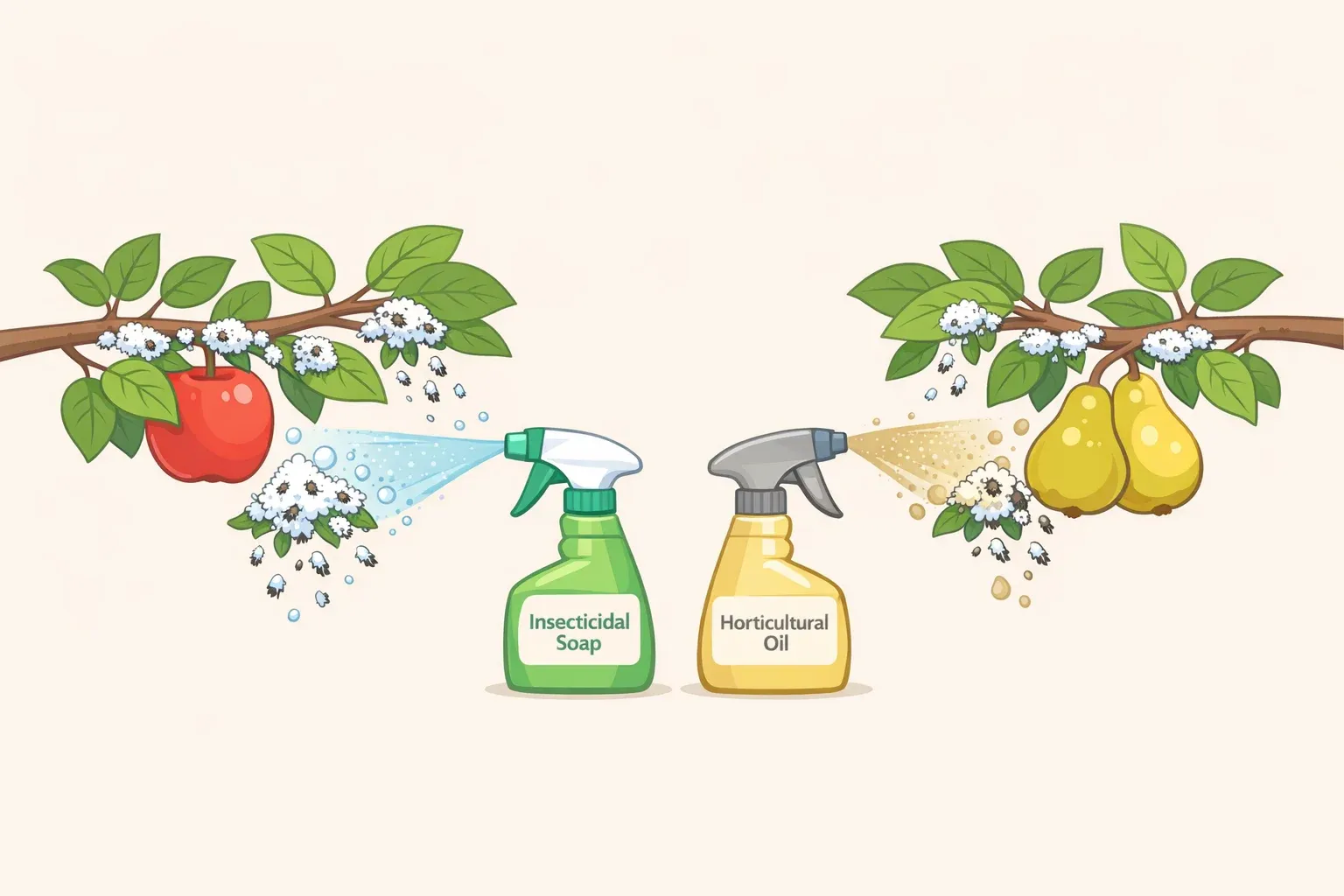
The white fluff on your apple tree is not the same pest as the white fluff on your silver maple. That distinction determines whether you need to act at all. This guide walks through how to get rid of woolly aphids on apple, pear, hawthorn, and mountain ash using pruning, water, soap, and oil, and explains the one situation where no spray will help.
Quick diagnosis:
Woolly aphids on silver maple or alder: treatment is usually unnecessary. Leave them.
Woolly aphids on apple, pear, hawthorn, or mountain ash: inspect for live colonies and treat promptly.
Yellowing foliage or a young tree that seems loose in the ground: surface sprays won't reach the root problem. Read the rootstock section before deciding anything.
What you'll need: A garden hose; insecticidal soap; horticultural oil. If the tree is young or declining, read the full guide before buying anything.
Start with the host tree
Woolly aphid species tend to be host-specific, and the tree they're on is a faster ID shortcut than any field guide. Penn State Extension notes that woolly aphid species typically cycle between two particular host plants, which makes the host a reliable starting point for identification.
For woolly alder aphid on silver maple and alder: control is not warranted, and tolerating the insects supports beneficial predators, including lacewings, lady beetles, and parasitic wasps. On those hosts, treatment isn't just unnecessary; it removes insects that help manage other pests.
Woolly apple aphid is a different situation. Utah State University IPM advises treating it promptly when found, even on trees that have already lost their fruit, because the pest can weaken the tree itself. It is widely distributed on apple, pear, hawthorn, and mountain ash, capable of producing gall formations on both shoots and roots that grow larger each season and invite fungal infection.
On silver maple or alder, treatment is usually unnecessary. On the fruit tree relatives listed above, inspect and act.
What the woolly apple aphid does to a tree, and where it hides
Unlike most aphids, woolly apple aphid feeds on bark, twigs, and roots rather than leaf surfaces, and it shelters under a dense waxy coating that blocks light spray contact. The key inspection points are: pruning scars, old wound sites, bark cracks and crevices, the tree crown just above the soil line, and root suckers growing at the base. Check under the white residue before treating. Waxy residue can persist after insects have died or moved, so confirm live bodies are present.
Above-ground colonies cause relatively minor damage to established trees, mainly by preventing wounded bark from healing and creating entry points for fungi. The underground colonies are the serious concern. Root infestations produce gall-like enlargements that expand year over year, impairing root function. In young trees, the structural damage can be severe enough that the tree pulls easily from the ground. Yellowing foliage is the key visible symptom of root involvement.
No chemical control options exist for the underground woolly apple aphid. Everything below applies to exposed, above-ground colonies only. If a young fruit tree is yellowing and showing general decline alongside visible woolly aphid activity, treat the surface colonies, then read the rootstock section before committing to a long-term plan.
How to get rid of woolly aphids naturally: five methods for exposed colonies
The goal for most homeowners is suppression of exposed colonies and protection of tree vigor, not total eradication. A tree can carry surface colonies without developing root infestation, and keeping populations low enough that the tree stays healthy is a realistic outcome. Here are five methods, from simplest to more involved.
Step 1: Prune out contained colonies. If woolly aphid activity is limited to a discrete section of branch or stem, cut it out and remove it from the yard entirely. Targeted pruning is a primary mechanical control. This works best early in the season before colonies expand. Make clean cuts back to healthy wood.
Step 2: Dislodge colonies with a strong jet of water. Direct a forceful hose stream at accessible surface colonies. Aphids dislodged from the ground rarely find their way back to the host plant. Woolly apple aphid's bark-crevice habitat makes it harder to dislodge than aphids on smooth leaf surfaces, so treat this as a reduction step. A solid pass with the hose before applying soap or oil reduces colony density and improves penetration.
Step 3: Apply insecticidal soap with 1% horticultural oil, and spray to runoff. For most backyard growers, this is the most practical spray option. Spray until the product is dripping off the treated area. The waxy coating protects the insects from light misting. The spray has to penetrate the fluff to contact the aphid bodies underneath. Insecticidal soap works only on direct contact with no residual effect, so thorough coverage is everything.
Step 4: Apply dormant-season horticultural oil before bud break. If the woolly apple aphid has been a recurring problem on the same tree, a dormant oil application in late winter targets overwintering eggs before they hatch. Horticultural oils work by smothering and are most effective when applied before buds open in spring. For trees with a pattern of infestation, treating early rather than waiting for colonies to build. The overwintering egg and early spring crawler stages are peak vulnerability windows.
Step 5: Protect natural enemies, and know when escalation backfires. Broad-spectrum insecticides are not a logical next step when soap and oil aren't enough. Carbamates and pyrethroids, specifically as pesticide classes known to trigger woolly apple aphid outbreaks by eliminating the parasitic wasps and predatory syrphid flies that naturally suppress the population.
The tiny parasitic wasp Aphelinus mali is one of the most effective biological controls for this pest. Broad-spectrum applications remove it. If stronger products seem necessary, timing any chemical use to the least-damaging window: overwintering eggs, early spring crawlers, or the late-summer alternate-host stage. Never apply persistent or systemic insecticides to trees in bloom. Bloom-time applications pose serious risks to pollinators.
When surface treatment isn't enough: the rootstock option for recurring problems
If woolly apple aphid shows up on the same tree every year, especially with yellowing foliage, poor growth, or a young tree that's easy to rock in the ground, seasonal sprays alone won't solve it.
There are no chemical controls for underground infestations. The most reliable long-term control is genetic resistance, specifically recommending rootstocks such as M.111 and the Malling Merton series, which were bred with woolly apple aphid resistance as a primary design criterion. For a young tree that's declining, replacing it on a resistant rootstock is a more practical path than annual retreatment. Some apple varieties carry inherent resistance as well, with Northern Spy cited as an example.
If the symptoms are ambiguous, getting a professional assessment before committing to a spray program or replacement is worth the time. The visible signs of root infestation overlap with other causes of tree decline, and a wrong diagnosis leads to wasted effort either way.
Monitoring schedule
Spring, before bud break: Inspect pruning scars, wound sites, and bark crevices. Apply dormant oil if woolly aphid was present the previous season.
Late spring through summer: Check the same locations plus root suckers and the crown above the soil line. Apply soap-and-oil combination to any active colonies, spraying to runoff.
Late summer and fall: Spring and fall as the periods when crawler populations are highest. Inspect again and treat exposed colonies before the season ends.
Ongoing: Yellowing foliage on a previously healthy tree, combined with visible woolly aphid activity, is the signal to reassess. Surface treatment can reduce exposed populations, but recurring decline points to a deeper problem that sprays won't solve. At that point, resistant rootstock replacement becomes the more durable answer for the next planting cycle.




Comments
Be the first, drop a comment!