



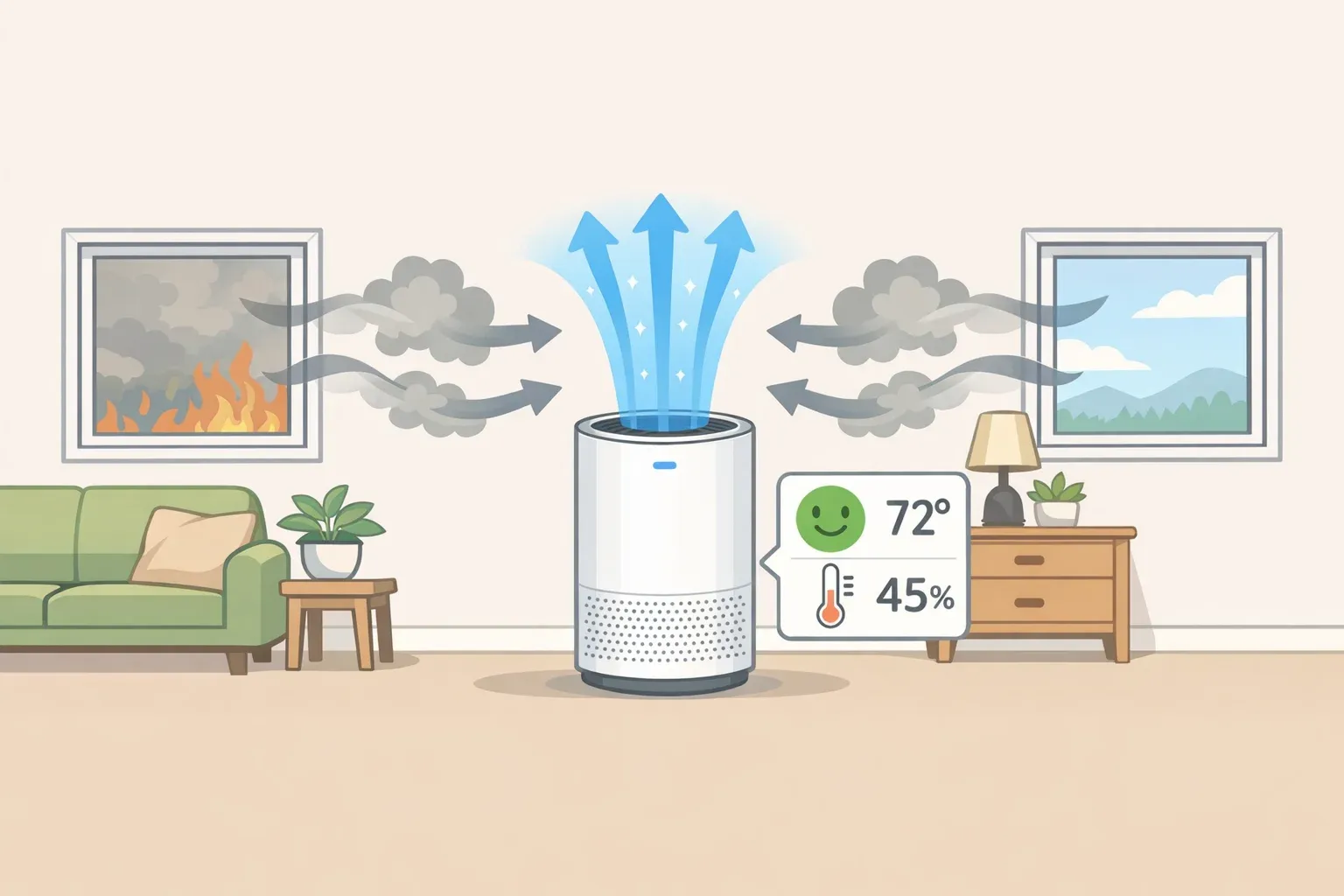
Wildfire smoke can degrade air quality far from an active fire, and closing your windows does not stop every particle from entering your home. Smoke can move through ventilation systems, gaps around doors and windows, and other small openings.
The most effective response combines four measures: limiting the amount of outdoor air entering the home, filtering indoor air continuously, creating one cleaner-air room, and avoiding activities that generate additional pollution.
Wildfire smoke contains gases and microscopic particles, including PM2.5, that can irritate the eyes and airways and worsen respiratory or cardiovascular conditions. Children, pregnant people, older adults, and people with asthma, chronic obstructive pulmonary disease, heart disease, diabetes, kidney disease, or other chronic conditions may face greater health risks, according to the Centers for Disease Control and Prevention.
Always follow evacuation orders and instructions from local emergency officials. These indoor-air measures apply only when authorities say it is safe to remain home. Seek medical help for severe or worsening breathing difficulty, chest pain, confusion, fainting, or other concerning symptoms.
Before you start: Check local emergency alerts and current smoke conditions on AirNow's Fire and Smoke Map. Air quality can change within hours, so check again before opening windows, exercising outdoors, or leaving your cleaner-air space.
Step 1: Close the house without trapping dangerous heat
Close exterior windows and doors while outdoor smoke levels are high. This reduces infiltration but does not eliminate it, particularly in older or leakier homes.
Check for obvious gaps around windows, exterior doors, fireplace dampers, mail slots, and window air conditioners. Tighten removable seals where practical, but never block emergency exits, required combustion vents, or permanently installed safety ventilation.
Do not remain in a dangerously hot house simply to keep the windows closed. Use air conditioning that does not draw in outdoor air. If the home cannot remain safely cool, move to a designated cleaner-air shelter or another air-conditioned building with effective filtration.
The Environmental Protection Agency's current wildfire indoor-air guidance includes separate instructions for central HVAC systems, window units, portable air conditioners, and evaporative coolers.
Single-hose portable air conditioners
A single-hose portable air conditioner can lower indoor air pressure and pull outdoor air through gaps elsewhere in the home. Use it sparingly during smoky conditions, and seal the window panel as tightly as possible.
A two-hose unit is generally less likely to pull smoky air through other openings, but the connection between its vent panel and the window still needs a tight seal.
Evaporative coolers
Evaporative coolers, also called swamp coolers, bring outdoor air into the building. If the intake can be reached safely, completely cover it with a 4-inch-thick MERV 13 filter. Check the filter frequently because wind and rain can damage an exterior filter.
If the intake cannot be filtered safely, use the cooler sparingly while outdoor smoke levels are elevated.
Step 2: Set your HVAC or air conditioner to recirculate
Follow the directions that match your cooling system.
If you have central HVAC
Close the system's outdoor-air intake or select its recirculation setting, if available. Controls vary, so consult the equipment manual or an HVAC professional if you are unsure which setting to use.
Install a MERV 13 filter, or the highest-efficiency filter the system's fan and filter slot can accommodate. A filter that is too restrictive or does not fit properly can reduce airflow, so check the system documentation before upgrading.
If the system supports continuous fan operation, change the fan setting from "Auto" to "On" while smoke levels are high. This sends air through the filter even when the system is not actively heating or cooling.
Smoke can load filters faster than ordinary household use. Inspect them frequently and replace them when they are visibly dirty, begin releasing smoke odors, or noticeably restrict airflow. Keep spare filters available during prolonged smoke events.
If you have a window air conditioner
Close the unit's outdoor-air damper and check that the seal around the window is tight. Many window units can continue cooling while recirculating indoor air.
If the outdoor-air damper cannot be closed, do not use the unit during smoky conditions. Choose another cooling method that does not bring in outdoor air, or move to a safely cooled location.
If you do not have air conditioning
Do not allow the home to become dangerously hot. If outdoor conditions temporarily improve, briefly open the windows to release heat and then close them again before smoke levels rise.
When the home cannot remain both cool and adequately filtered, relocate to an air-conditioned cleaner-air shelter or another building with effective filtration.
Step 3: Set up one cleaner-air room
A cleaner-air room concentrates filtration in the part of the home where household members spend the most time. It is particularly useful for renters and households that cannot modify a central HVAC system.
Choose a room large enough for everyone to use comfortably, preferably one with few windows and doors and no fireplace. A bedroom with an attached bathroom can work well because occupants can remain there for longer periods without repeatedly opening the door.
Keep the room's windows and doors closed as much as practical. Higher-risk household members should spend most of their time there while smoke levels remain elevated.
EPA's instructions for creating a cleaner-air room at home also emphasize maintaining a safe temperature and limiting activities that add particles to the room.
Choose an air cleaner by its smoke CADR
Place a portable air cleaner in the room and choose one with a smoke Clean Air Delivery Rate, or CADR, appropriate for the space.
For rooms with 8-foot ceilings, the EPA provides these minimum estimates:
A 100-square-foot room: CADR of 65 or higher
A 200-square-foot room: CADR of 130 or higher
A 300-square-foot room: CADR of 195 or higher
A 400-square-foot room: CADR of 260 or higher
A 500-square-foot room: CADR of 325 or higher
Choose a more powerful unit for higher ceilings or open floor plans. In an open layout, calculate the size of the entire area the cleaner must serve rather than treating each section as a separate room.
Run the cleaner continuously at the highest speed household members can tolerate. Keep its intake and outlet clear, and place it away from curtains, walls, and furniture that could restrict airflow. EPA's Guide to Air Cleaners in the Home explains how CADR, room size, runtime, and fan speed affect particle removal.
Avoid devices that intentionally produce ozone. Ozone is a lung irritant, not a safe way to remove wildfire smoke.
HEPA and MERV filters primarily capture particles. They do not remove every gas in wildfire smoke and do not protect against carbon monoxide. Never operate a generator, grill, camp stove, or other fuel-burning equipment inside a home, garage, or enclosed space.
Build a temporary DIY air cleaner
If a commercial air cleaner is unavailable or unaffordable, a box fan fitted with one or more MERV 13 filters can provide temporary particle filtration.
For a basic unit:
Use a 20-inch box fan manufactured in 2012 or later with a UL or ETL safety marking.
Place a matching MERV 13 filter against the fan's intake side.
Align the filter's airflow arrow with the direction air moves through the fan.
Secure the filter with duct tape, clamps, or bungee cords.
Seal the edges so air passes through the filter rather than around it.
Add a cardboard shroud to the front of the fan, leaving a circular opening over the blades.
Designs with thicker filters or multiple filters generally move more filtered air than a basic single-filter setup. EPA's DIY air-cleaner instructions explain single-filter, wedge, and cube-style designs.
Keep the fan away from curtains and other obstructions. Do not use a damaged fan or extension cord, and do not leave children unattended near the unit. Make sure the home has working smoke alarms.
Replace the filter when it becomes visibly dirty or begins releasing smoke odors.
Step 4: Stop creating more indoor pollution
Filtration is less effective when the household is also generating particles or fumes.
While outdoor smoke remains elevated, avoid:
Smoking or vaping
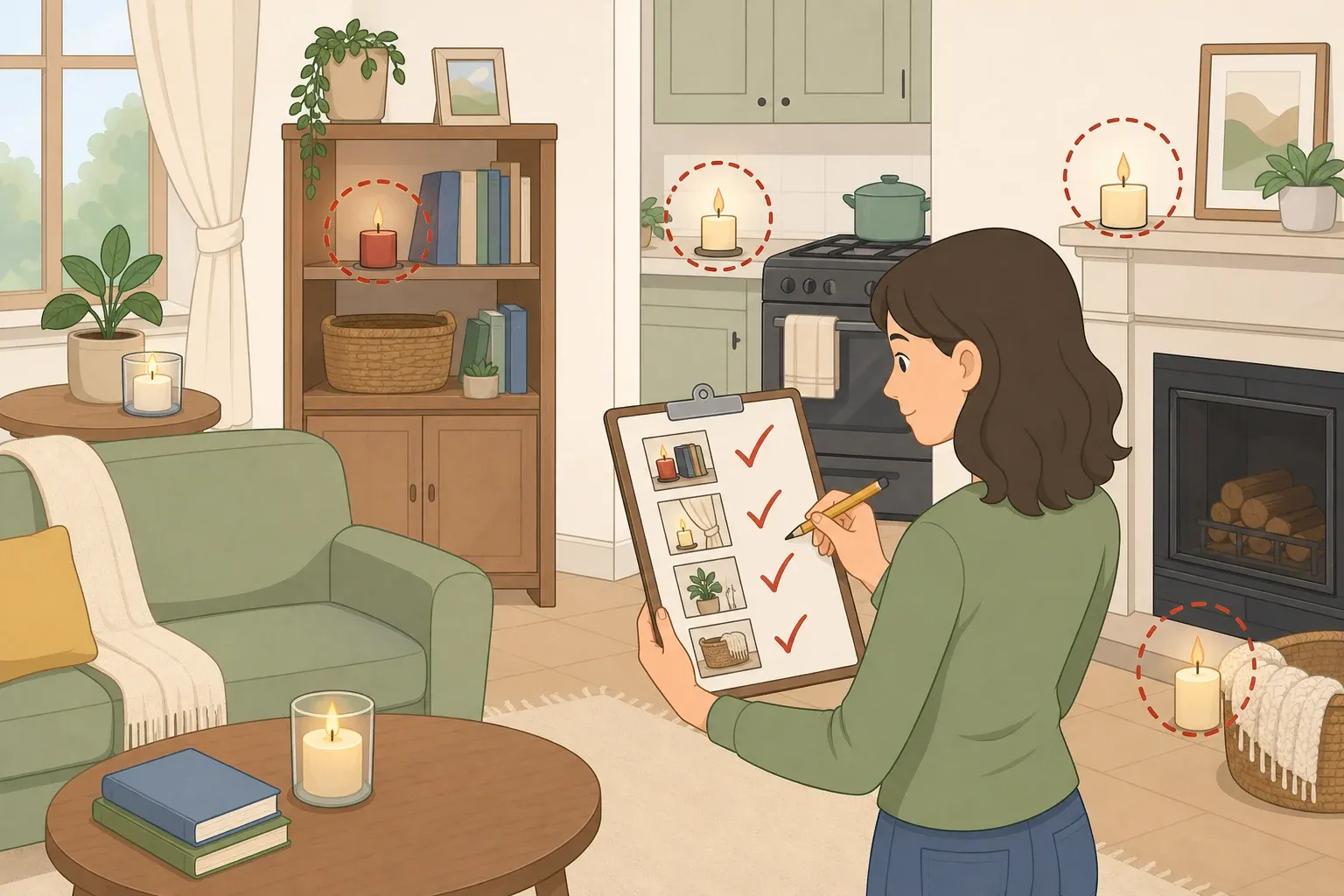
Burning candles or incense
Using fireplaces or wood-burning appliances
Spraying aerosol cleaners or air fresheners
Frying, broiling, grilling, or other high-heat cooking
Vacuuming without a sealed HEPA filter
Dry sweeping or dusting
Do not try to hide smoke odors with candles, incense, or scented sprays. These products can add pollutants to an already enclosed space.
Choose meals that require little cooking, or use a microwave or another lower-emission method. If cleaning cannot wait, damp-wipe hard surfaces and use a sealed HEPA-filtered vacuum instead of dry sweeping.
Check the air and reopen carefully
A consumer PM2.5 monitor can help show whether particle levels are rising or falling and whether filtration is improving conditions in a particular room.
Treat the readings as estimates rather than regulatory measurements. Humidity, temperature, smoke composition, sensor quality, and placement can affect the result. Keep the monitor away from cooking appliances, open windows, and the direct airflow from an air cleaner.
Wear a fitted respirator outdoors
When outdoor exposure cannot be avoided, wear a properly fitted, NIOSH-approved N95 or P100 respirator.
The respirator must seal closely around the nose and mouth. Facial hair, loose straps, and an improperly shaped nose clip can allow particles to leak around its edges. Perform a user seal check each time you put it on.
Respirators filter particles but do not protect against smoke gases, vapors, or carbon monoxide. Cloth masks, surgical masks, bandannas, and wet cloths do not provide comparable protection against fine smoke particles.
Postpone running, yardwork, and other strenuous outdoor activity until air quality improves.
Reopen when outdoor air improves
Check outdoor conditions before opening windows. When particle levels improve, air out the home and continue monitoring conditions. Close the windows and return the HVAC system to recirculation if smoke returns.
After the smoke event, inspect HVAC and portable-air-cleaner filters and replace them if they are dirty or saturated with smoke odors. Damp-wipe surfaces and use a HEPA-filtered vacuum to remove settled particles without stirring them back into the air.
The three-step minimum
If time, money, or equipment is limited, focus on three actions:
Close windows and doors while outdoor smoke is elevated, unless the home becomes dangerously hot.
Run compatible HVAC filtration or a properly sized portable or DIY air cleaner continuously.
Avoid smoking, candles, high-heat cooking, ordinary vacuuming, and other indoor particle sources.
Preparing before smoke arrives makes these steps easier. Keep spare filters, fitted respirators, necessary medications, and food that requires little cooking where household members can find them quickly.

Comments
Be the first, drop a comment!