



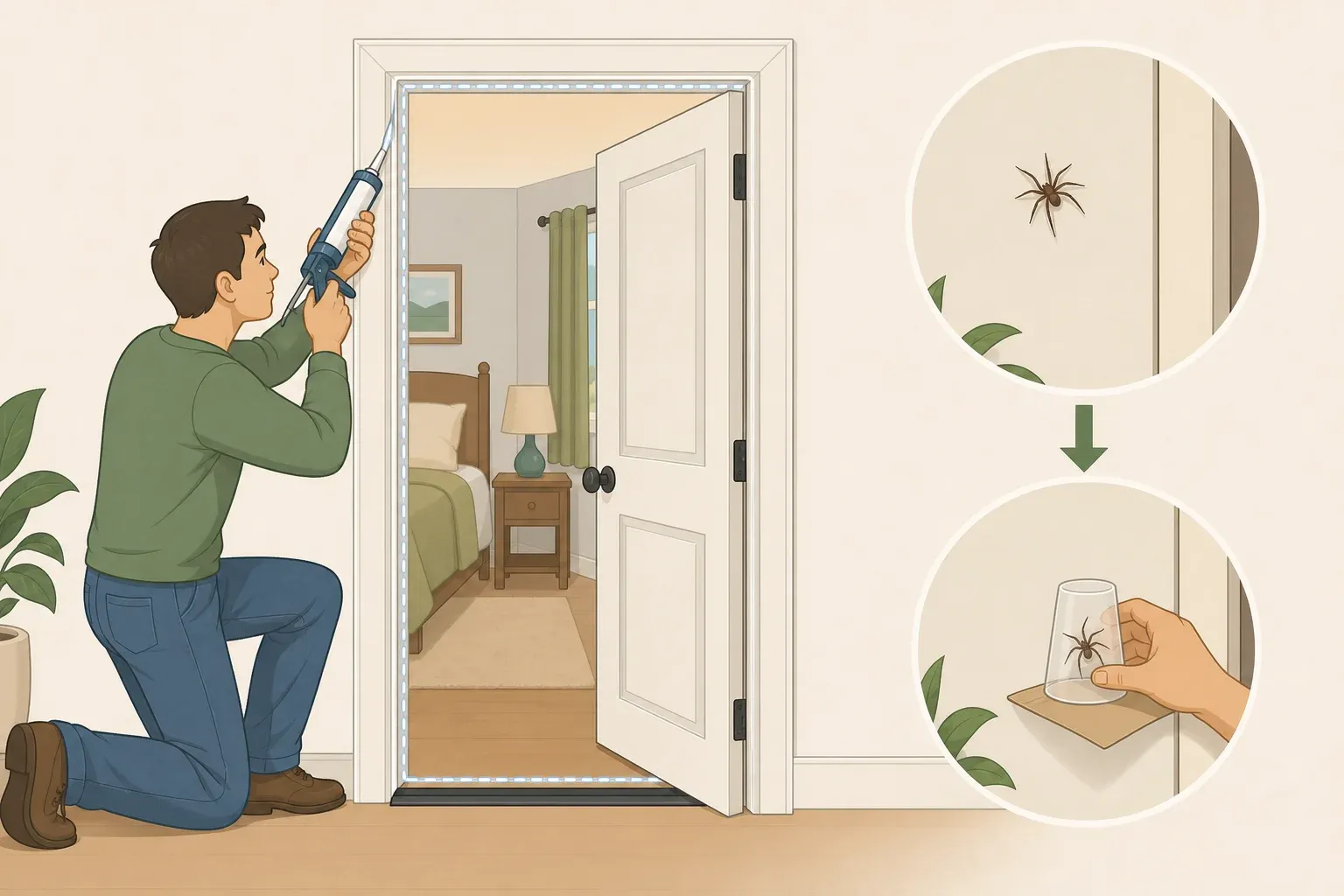
How to Keep Spiders Out of Your Bedroom: 5 Key Fixes
If you've spotted a spider in your bedroom this week, you're probably wondering what's drawing it there and whether it's something you did wrong. This guide walks through five fixable physical conditions that can pull spiders into a bedroom, shows you how to remove the one you're dealing with right now, and explains when the real answer is simply timing rather than anything you did.
Spiders don't target bedrooms specifically. They may enter bedrooms for the same reasons they enter any other part of a home: shelter, prey, moisture, or an open access point. Matching the fix to whatever condition you're actually seeing, rather than treating all five as equally likely, is how you keep spiders out of your bedroom without guessing. Some spiders also move indoors as outdoor temperatures drop in early fall, with funnel-web and sac spiders the most common wanderers during that stretch, according to Colorado State University Extension. That seasonal push is something to plan around, not a condition you can eliminate.
Most spiders found indoors aren't aggressive, and they bite only when trapped against skin. From a biological standpoint, control is rarely even necessary, CSU Extension notes. This is ordinary-homeowner work: no fogging the room, no assuming every home deals with the exact species Colorado researchers describe.
Why are there spiders in my bedroom?
Worth knowing before you touch anything: the species examples and the late-summer/early-fall pattern referenced throughout this guide come from CSU Extension's research on Colorado spiders. If you live elsewhere, the same broad categories, prey insects, dark clutter, gaps, moisture, and outdoor shelter, still apply, but the exact species behind your sighting may differ. Check your own state's extension service if you want a locally accurate ID or seasonal pattern.
What you'll need before you start
Gather a few basic supplies before doing anything else: a vacuum with a crevice attachment or a jar and stiff paper for catch-and-release, work gloves, a flashlight, caulk for gaps, and sticky traps for monitoring.
A single spider sighting doesn't automatically call for action. General pest-management practice sets an action threshold before treating anything at all, and one sighting rarely clears that bar, according to the EPA's IPM principles. Treat one spider as a normal household occurrence. Repeated sightings in the same spot, webbing that rebuilds after you clear it, or an egg sac are practical signs that a spot deserves direct attention, not proof of an infestation.
Resist the urge to identify a spider by looks before handling it. Species and risk vary by region. The common funnel-web spider, for example, is frequently mistaken for the brown recluse, a medically significant species that doesn't naturally occur in Colorado, CSU Extension points out. Rather than leaning in for a closer look, use a vacuum or a container to remove any spider without direct hand contact. Check your local extension office's resources if you want a confirmed ID.
How to get rid of spiders in your bedroom right now
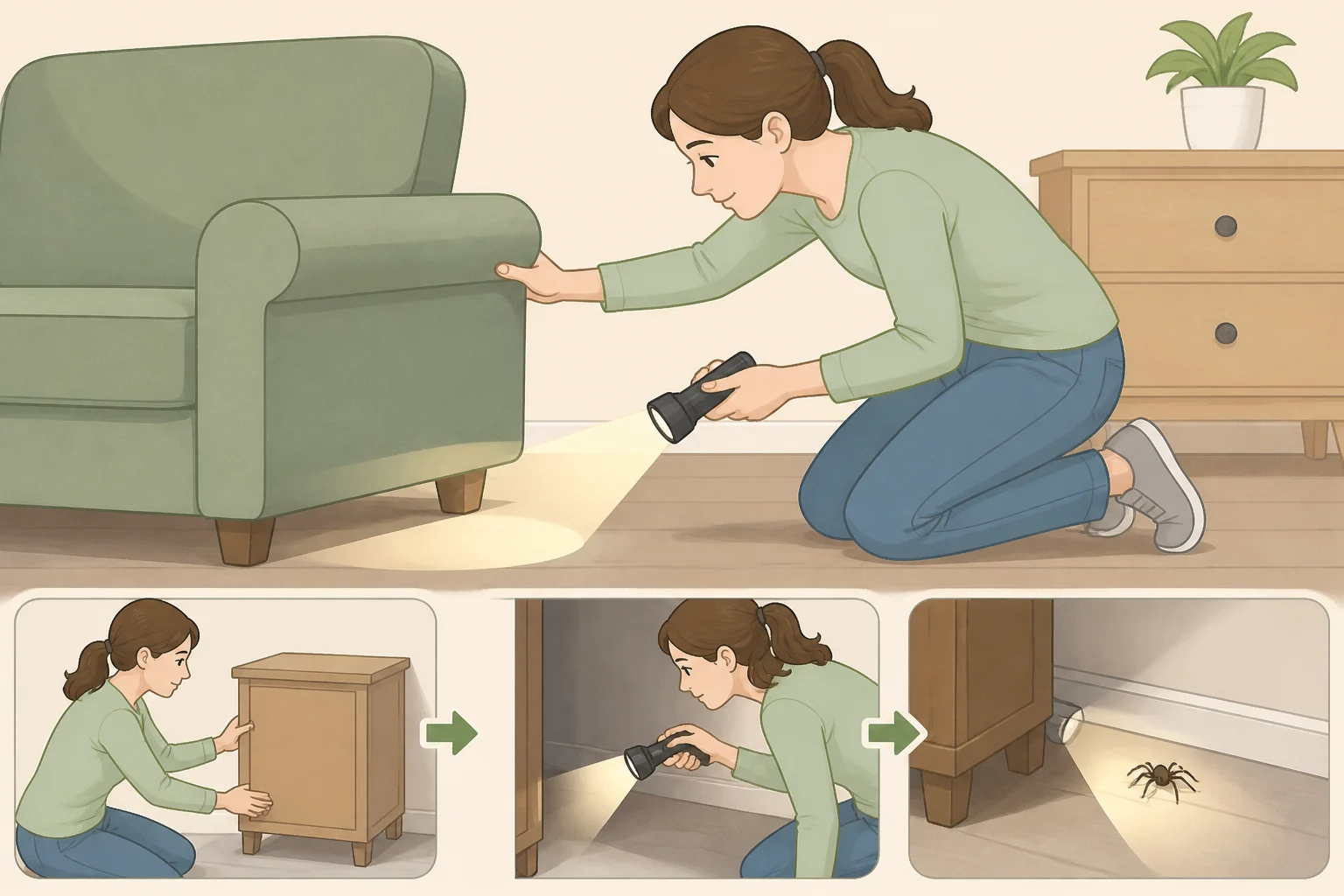
Handle the spider that's actually in the room before worrying about anything else.
- Check hiding spots with a flashlight before reaching in. Look behind furniture, under desks, in closet corners, and along baseboards before grabbing a vacuum or jar.
- Avoid direct hand contact with any spider or web you haven't identified. Gloves plus a vacuum or the jar-and-paper method keep you at a safe distance.
- Remove the spider and its web together. Vacuuming or trapping and releasing outdoors works well for wandering spiders. For widow spiders specifically, physical removal is described as the most effective treatment, since insecticides work poorly on egg sacs, according to CSU Extension's widow spider guide.
- Clear the web, not just the spider. Regularly vacuuming or brushing away webs is the routine CSU Extension recommends for keeping corners clear.
- Skip the fogger. Total-release foggers containing pyrethrins are unlikely to have much effect on spiders, so don't reach for one even if it's already under the sink.
Once the corner is web-free, place a sticky trap nearby and check it on a regular basis. An empty trap over time is a reasonable practical sign the visit was isolated, though traps can miss spiders and shouldn't be treated as proof either way. Keep traps away from young children and pets.
How to keep spiders out of your bedroom: check these five conditions
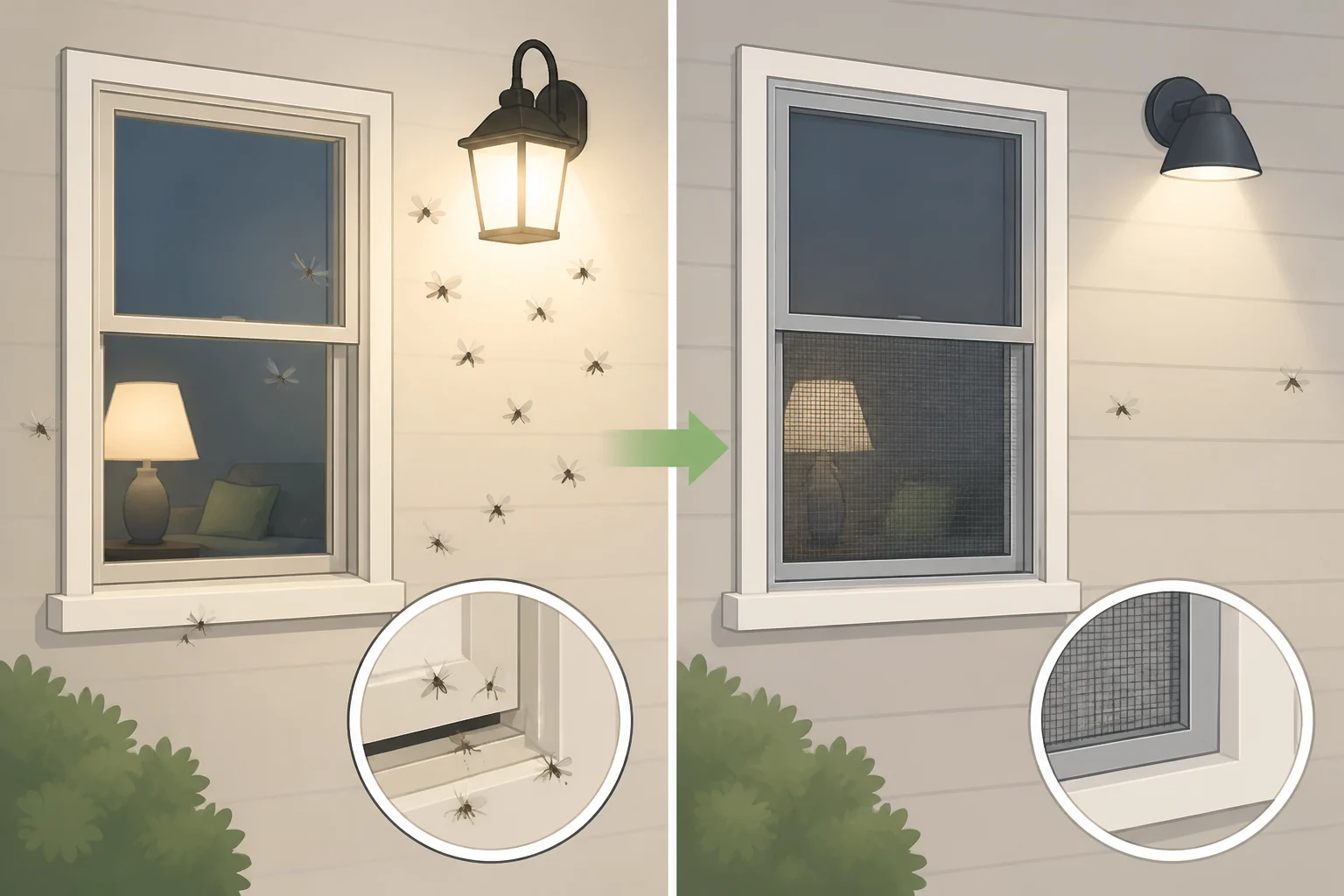
Not every condition below applies to every home. Diagnose which one matches what you're actually seeing rather than acting on all five at once. Each fix targets a specific thing that attracts spiders to your bedroom.
-
Prey insects in or near the room. Look for webs near a window, a light fixture, or anywhere insects gather at night. Check screens and door sweeps for gaps, address other insect activity in the room, and if exterior lights near the window stay on after dark, switch to yellow or sodium-vapor bulbs or cut back on use. Spiders build webs where insects are available to catch, and reducing other insects limits spider development, CSU Extension explains.
-
Dark, undisturbed corners and clutter. Look for webs in upper corners, behind furniture, or inside closets and under the bed. Clear boxes and storage clutter from under the bed and closets, and vacuum those corners on a schedule instead of only after spotting a web. Cobweb spiders favor dark corners, and sac spiders shelter in silk retreats in upper room corners or wall cracks during the day, CSU Extension notes.
-
Cracks, gaps, and loose seals. Look for repeated captures along a baseboard or near a door or window frame. Caulk visible cracks near the bedroom's exterior wall and confirm screens and door seals close tightly. Spiders migrate indoors through unsealed foundation cracks and gaps around screens and doors, according to CSU Extension.
-
Moisture nearby. Look for sightings concentrated near a wall shared with a bathroom, kitchen, or basement. Check that shared wall for an active leak or condensation. Spiders are most often found in kitchens, bathrooms, and basements where moisture is present, CSU Extension reports; that's a possible contributing factor if your bedroom sits next to one of those rooms, not proof that ordinary bedroom humidity is drawing spiders on its own. If you find a persistent leak, hidden dampness, or mold, that's a repair issue beyond spider control. Bring in a plumber or contractor rather than continuing to treat it as a pest problem.
-
Outdoor shelter near the house. Look for woodpiles, compost, rocks, or boards stacked against the exterior wall nearest the bedroom. Relocate these materials away from the foundation. Woodpiles, compost, rocks, and boards next to the exterior wall provide outdoor shelter near the home, CSU Extension explains.
Match the clue you're seeing to the fix above instead of working through all five:
- Webs rebuilding in a high corner → condition 2, clutter and dark corners
- A spider found near a window → condition 1, prey insects
- Sightings near a bathroom-shared wall → condition 4, moisture
- Repeated captures along a baseboard → condition 3, gaps and seals
- Outdoor clutter against the bedroom-side wall → condition 5, outdoor shelter
All five fixes above are natural ways to keep spiders out of your room: sealing, decluttering, controlling moisture, and clearing outdoor shelter, no chemicals required. The biggest mistake is reaching for pesticide before addressing the condition itself. Pesticides alone, without removing or modifying favorable habitat, aren't effective, CSU Extension reports. Skip chemical repellents like garlic or mock orange sprays and ultrasonic devices too. Spiders don't perceive either one, and marketing such products as spider control is considered fraudulent under Colorado law, CSU Extension's widow spider guide notes.
If you still want a targeted insecticide after working through the fixes above, treat it as a last resort. Use only a product labeled for indoor spider control, apply it to specific corners, baseboards, or entry points, and follow its label exactly. Keep treated areas away from children and pets.
How to prevent spiders in the bedroom before fall
Even a well-maintained bedroom will see more spider activity at certain times of year, and that's not a sign your prevention failed. Funnel-web spiders are especially common indoors during late summer and early fall in Colorado, and sac spiders are typically the most frequent nighttime wanderers indoors during that same window, CSU Extension reports. Readers in other regions should expect a similar cool-weather shift, though the exact timing and species will vary; a local extension office can confirm what's typical in your area.
Cooler outdoor temperatures in early fall push some spiders to seek indoor shelter. That's a normal seasonal shift, not a sign that your home's conditions got worse. Work through the five fixes above before late summer arrives if you can, since prevention works better ahead of the seasonal push than after sightings have already started.
When to escalate beyond DIY
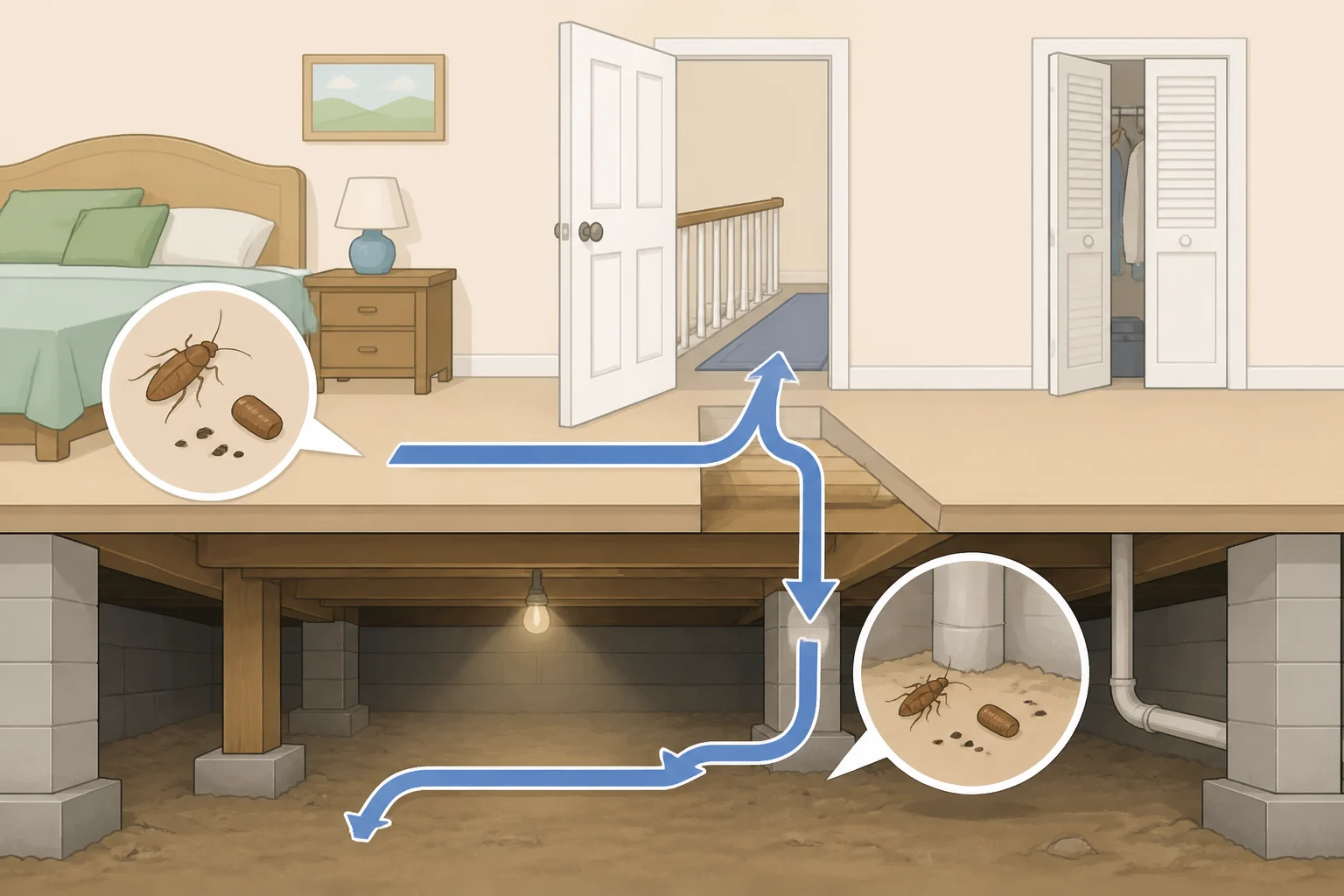
Some situations call for more than a vacuum and a tube of caulk.
If you catch multiple spiders in the same area, find an egg sac, or see activity spreading beyond the bedroom into adjoining storage, a basement, or a crawl space, inspect those connected spaces directly rather than continuing to treat the bedroom in isolation, according to CSU Extension's widow spider guide. If sightings continue after you've sealed gaps, decluttered, and removed nearby outdoor shelter, call a licensed pest control professional instead of increasing pesticide use on your own.
If a bite causes severe or worsening symptoms, seek medical care right away. You don't need to identify the spider first: describe the symptoms and let a medical provider guide next steps. CSU Extension notes that widow spider bites are painful and potentially dangerous because they carry a nerve venom, while sac spider bites, though painful, usually fade within a few minutes without other symptoms. That gap between the two outcomes is exactly why anything beyond brief, localized pain deserves a medical opinion rather than a guess.
Finish-line guidance
Once you've cleared the current spider and matched a fix to the condition behind it, keep a short routine going: check door and window seals each season, vacuum the corners and under-bed areas where webs tend to form, and glance at your sticky traps whenever you pass them.
Success looks like no fresh webs and traps that stay empty, not the complete absence of spiders indefinitely. Spiders disperse easily and can recolonize even a well-maintained home, CSU Extension notes, so don't chase a permanent zero. An occasional single spider doesn't call for a room-wide response, and most are harmless enough that, biologically, they don't require control at all.
Save the real escalation for what actually warrants it: sightings that keep returning after you've sealed gaps and cleared clutter, an egg sac, activity spreading into connected spaces, or bite symptoms beyond brief localized pain. Those go to a pest control professional or a medical provider, not more DIY spray.










Comments
Be the first, drop a comment!