



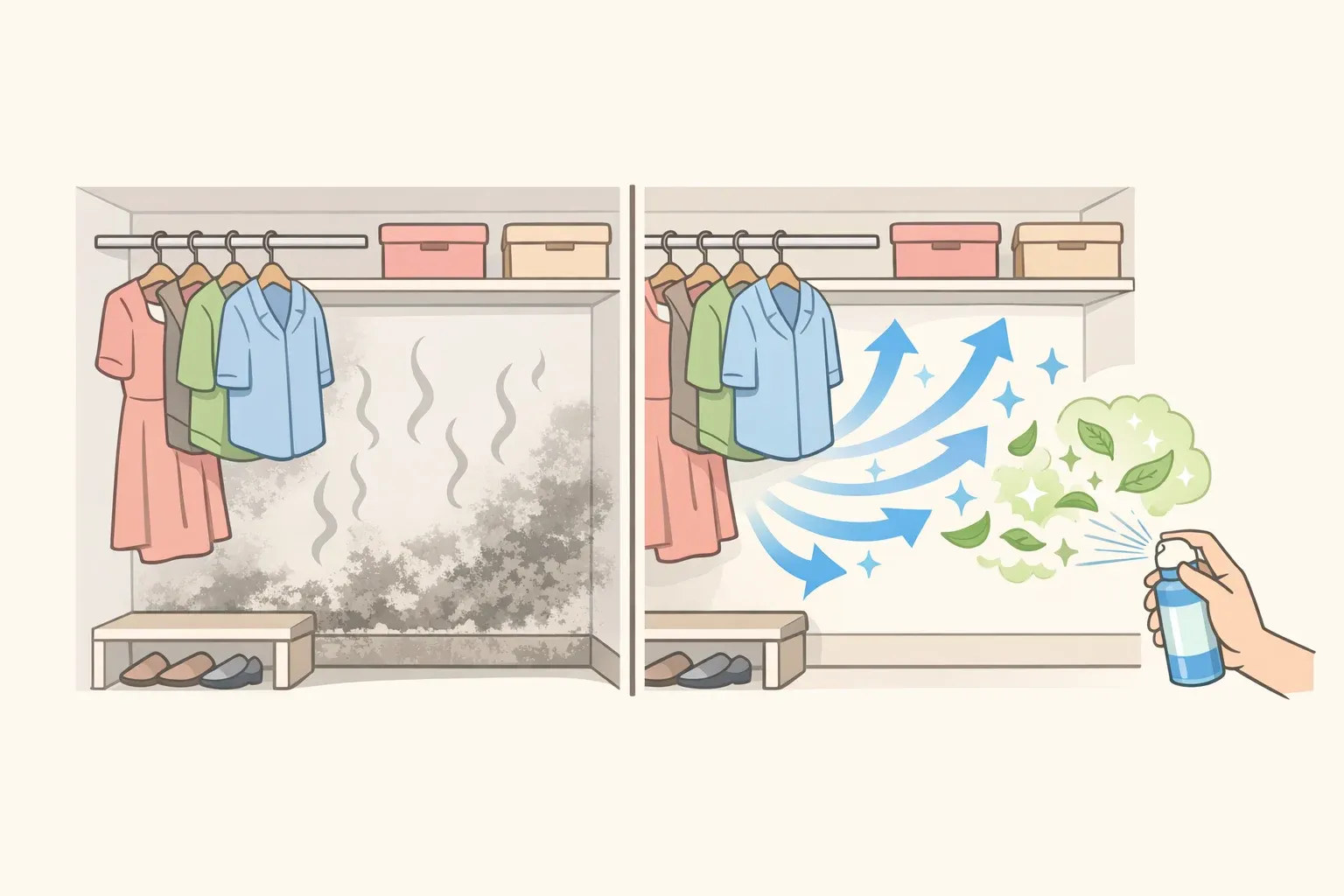
Most closet odor advice starts with candles, sachets, and cedar blocks. The agencies that study indoor air for a living start somewhere less fragrant: moisture. "The key to mold control is moisture control," according to the EPA, which updated its mold guidance earlier this year, and no mold grows without water. Learning how to keep your closet smelling fresh means dealing with that fact first.
Closets are a common trouble spot because they're enclosed and get almost no airflow. The University of Florida IFAS extension flags "stagnant air spaces such as closets" as a specific concern when relative humidity stays above 70% for extended stretches. Leather shoes stored in the back are often the first items to show it, per the same source.
This guide moves through four steps in order: find the moisture, dry the space, clean what's already growing, then add scent last. Skipping to the last step first is usually why fragrance-only fixes stop working after a few weeks.
Find the moisture source before you try to get the musty smell out of a closet
Before wiping anything down or spraying anything on, figure out where the water is coming from. A musty odor can have several causes, but checking for moisture first is the step supported directly by EPA guidance.
Check for condensation. Look at exterior-facing walls, closet pipes, and window frames near the closet. Condensation is a sign of high humidity, and the EPA recommends drying the surface right away while also addressing whatever's causing the moisture.
Inspect the back corner. Leather shoes and other items stored deep in the closet are typically "the first things to start to mold" when humidity climbs, according to IFAS. Checking them periodically is a low-effort way to catch a humidity problem early.
Rule out a hidden leak. The EPA is blunt about this one: clean up mold without fixing the water problem behind it, and the mold will most likely come back.
This turns a musty closet into a diagnostic problem instead of a fragrance one. A smell can also show up before any mold is visible, so it's worth running through these checks even when nothing looks obviously wrong yet.
Dry it out to keep a closet dry and fresh
Once dampness turns up, speed matters more than technique. The EPA notes that wet or damp materials dried within 24 to 48 hours of a leak or spill generally will not grow mold. That timeline is worth building a habit around.
Dry damp areas fast. Remove any standing water first, then use a fan, dehumidifier, or air conditioning to speed drying. Open doors and windows only if outdoor humidity allows it.
Get relative humidity under control. The EPA recommends staying below 60%, ideally between 30% and 50%. IFAS offers a slightly wider band, 45% to 60%, as an energy-conscious alternative, and notes that brief spikes above 70% aren't a problem as long as they don't linger for days. A cheap hygrometer left inside the closet is the easiest way to know which range applies to your space.
Keep air moving inside the closet itself, not just the room around it. Closets lack the natural airflow a bedroom or hallway gets, which is exactly why IFAS singles them out as stagnant-air risks. Propping the door open periodically or aiming a small fan inside for an hour after humid days offsets that at almost no cost.
This is the part that determines whether clothes stay smelling fresh in a closet over months, not just right after a cleaning. A reed diffuser doesn't fix a closet sitting at 65% relative humidity; the humidity is the problem it can't solve on its own.
Clean mold safely once you find it
If mold is visible or the smell is unmistakable, deal with it directly. Testing isn't necessary first. The EPA points out that in most cases, if mold growth is already visible, sampling to identify it adds nothing to the cleanup plan.
Clean hard surfaces with detergent and water. Shelving, closet floors, and non-porous storage bins should be scrubbed with mild detergent and dried completely afterward. The EPA doesn't recommend bleach or other biocides as a first choice here; plain detergent handles hard surfaces without the fumes or skin irritation that come with harsher products.
Handle clothing, shoes, and other porous items case by case. Carpet, cardboard, fabric bins, and clothing or leather that has absorbed moisture may need to be thrown away if they can't be fully cleaned and dried. That includes the leather shoes flagged earlier: if scrubbing and drying doesn't clear visible mold off them, they're a candidate for the trash rather than the back of the closet.
Wear protection. Gloves, goggles, and an N-95 respirator are standard during cleanup.
Scale matters too. The EPA notes that mold covering more than 10 square feet may call for professional remediation instead of a DIY job. That's a threshold for calling someone, not a fixed line that settles every case on its own; a closet backed against a leaking exterior wall can still warrant a call even if the visible patch looks smaller than that.
How to keep your closet smelling fresh after cleanup
Once moisture is under control and anything moldy has been cleaned or discarded, maintenance is mostly about not letting the same conditions rebuild. It's less dramatic than a diagnosis, but it's what keeps the first three steps from turning into a recurring chore.
Recheck humidity and airflow periodically, especially after seasonal shifts. IFAS notes that brief spikes above 70% relative humidity aren't a real risk; the danger is humidity that stays high for days or weeks in a closed space.
Avoid over-packing the closet as well. Stagnant air is the exact condition IFAS ties to closet mold risk, so leaving breathing room around stored items helps air move instead of sitting still against the back wall.
Scent belongs here, at the end, not the start. Cedar blocks, sachets, and baking soda are common low-key options once the space itself is dry. The same enclosed conditions that trap moisture in a closet also trap whatever else you put in there, fragrance included, so a diffuser or spray works better with the door left cracked than sealed shut.
Think of scent as a finishing touch for a closet that's already dry and clean, not a way to get it there. If a smell keeps returning no matter how much fragrance goes in, that's a sign to go back to step one and check humidity again, not a reason to buy a stronger air freshener.
What to do based on what you find
Not every musty closet calls for the same response. Match the situation to the fix:
No visible mold, but humidity above target: increase drying and airflow, then track conditions with a hygrometer left inside the closet.
Visible mold on a hard surface: clean with detergent and water, then dry the surface completely.
A porous item, like fabric, cardboard, or leather, that can't be fully cleaned and dried: consider discarding it rather than returning it to the closet.
An affected area larger than 10 square feet: consult a professional rather than expanding the DIY cleanup.
Fixing the moisture source is what actually resolves a musty closet. Scent is what gets added once that work is already done, not a substitute for doing it. A hygrometer, a fan that actually gets used, and an occasional glance at the shoes in the back corner will do more for a closet than any diffuser ever will.








Comments
Be the first, drop a comment!