



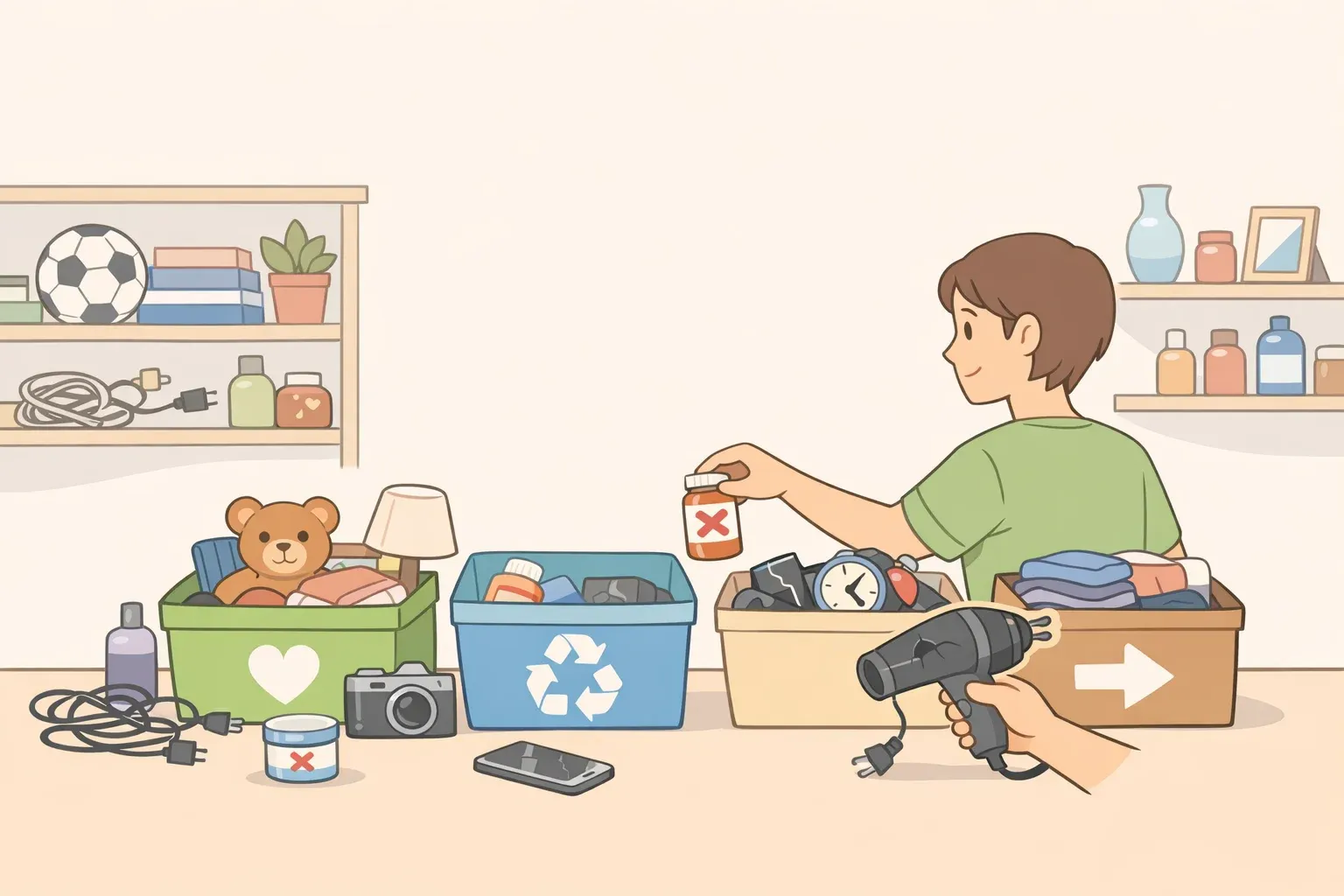
More than half of Americans say they feel overwhelmed by the amount of stuff in their homes, according to a Decluttr + NAPO survey published earlier this year. The striking part isn't the statistic; it's the mechanism. Almost none of that stuff arrived all at once. It accumulated item by item, decision deferred by decision deferred, until the weight of it became genuinely difficult to ignore.
Professional organizers don't usually start with sentimental keepsakes or the hardest rooms. They start with categories that have already failed their purpose: things that are expired, broken, duplicated past usefulness, or orphaned from any current owner or use. This guide teaches you the decision framework they apply to any room, then walks you through exactly which zones to check first. Before you begin, have a recycling bin, a donation bag, and access to a shredder.
Why these categories matter first
Clutter does more than make a space look messy. Research links it to distraction, mental fatigue, and higher stress levels. Americans also spend about 2.5 days each year looking for lost belongings, while replacing missing items costs more than $2.7 billion annually.
Start with expired products, broken items, duplicates, and belongings that no longer serve a purpose. These create clutter and make useful items harder to find. In one survey, Americans said about one-third of their household belongings no longer worked, while 13% were simply junk.
The framework organizers actually use before they touch a single room
Understanding why professional organizers move in a particular sequence makes the rest of this guide more useful than a list.
Organizing isn't fundamentally about getting rid of things. It's about identifying what currently matters, which shifts over time. That framing removes the binary pressure of keep-or-purge and replaces it with a more honest question: does this still matter now?
Sort by category before deciding what to keep. Pulling all items of one type together every bag, every container, every skincare product reveals duplication and condition problems that are invisible when things are spread across rooms. Seeing six reusable shopping bags or four half-empty bottles of the same moisturizer in one pile makes the decision nearly automatic, as Essential Organizing notes.
Organizer Liora Seltzer recommends beginning with low-emotion, obviously removable items before tackling anything sentimental. The KonMari Method deliberately saves personal mementos for last for a specific reason: you need practice making discard decisions before you reach the emotionally heavy ones, The Spruce reported earlier this year. Every category in this guide is chosen precisely because it requires almost no emotional negotiation.
The four-question filter, to apply in any zone:
Is it expired or past its useful life?
Is it broken, damaged, or incomplete?
Is it a duplicate beyond a reasonable quantity?
Is it orphaned: no current owner, device, or active use?
A yes to any of these means it goes. The filter gets faster with each pass.
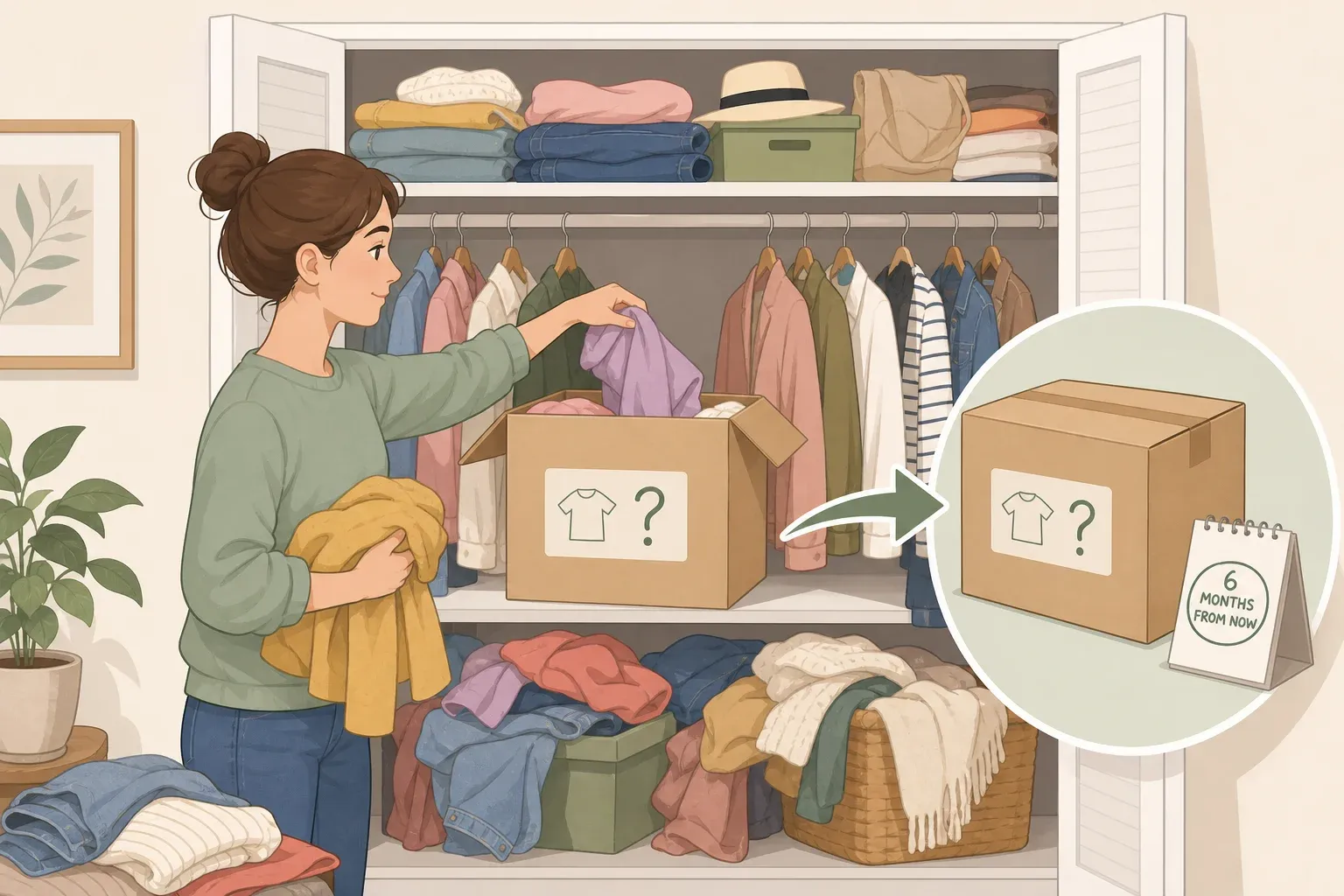
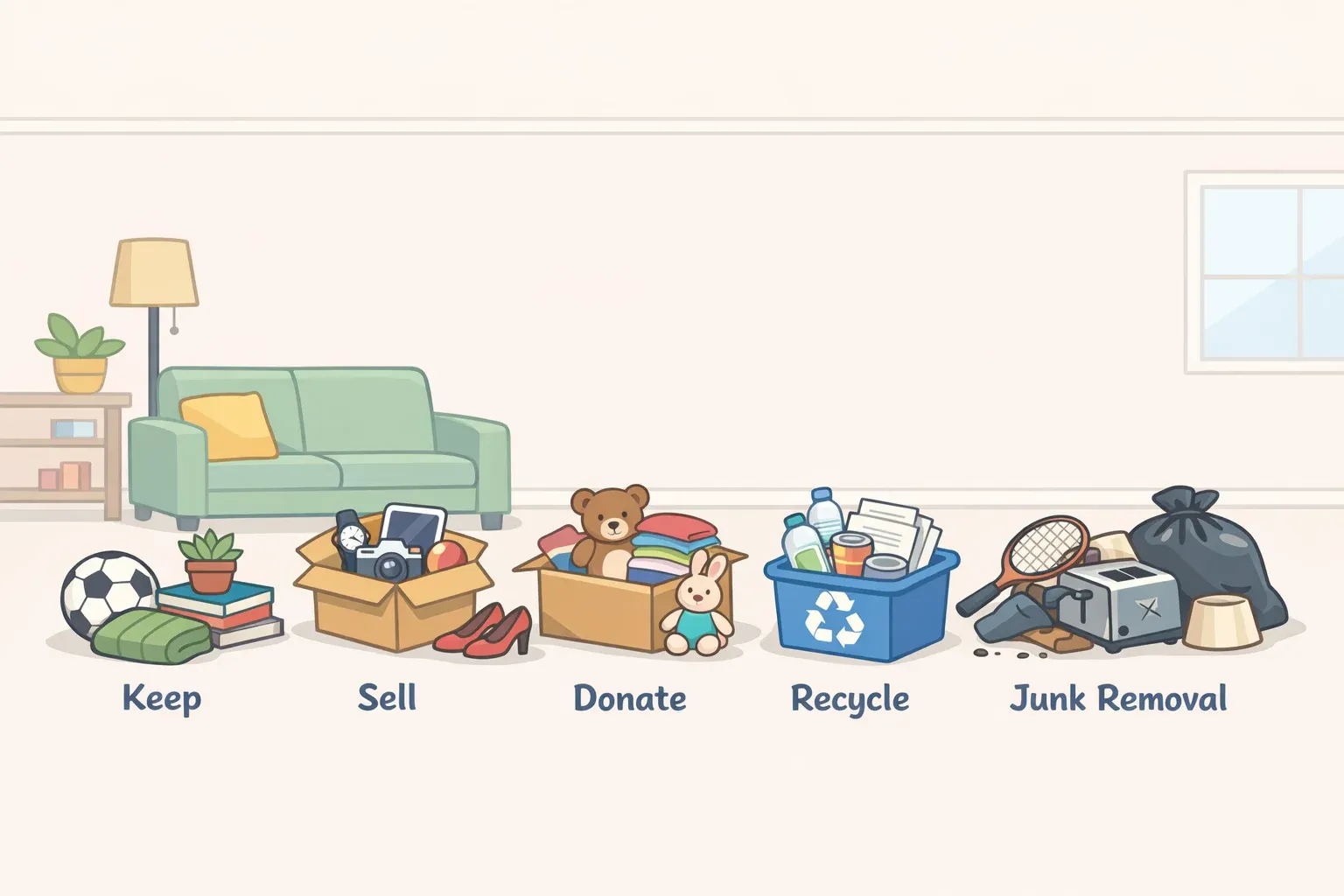
One more mechanism worth adopting: Essential Organizing recommends a "maybe" box for items that don't produce an immediate decision. Box them, write a date six months out on the lid, and donate the contents without reopening it when that date arrives. It's structured deferral with a built-in endpoint, not indefinite stalling.
Step 1: Expired and consumable items (kitchen, pantry, bathroom)
Expired products are the single lowest-resistance category in any home. No one actively decides to keep an expired bottle of hot sauce; they just never decide to remove it. Start here.
1. Pantry staples, condiments, and spices past their date. Pull everything from the fridge and cabinets and check labels. An overpacked refrigerator or overflowing spice rack is a reliable signal this category needs an edit. Clearing expired ingredients frees real space and eliminates a low-grade health risk.
2. Expired cosmetics, skincare, and medications. The cabinet under the bathroom sink is one of the most reliable accumulation zones in any home. Professional organizer Rachel Rosenthal of Rachel and Company flags it specifically as a hotspot for expired and unnecessary products. Pull everything out, check dates, and discard what's past its use. Medications should go through a pharmacy take-back program rather than the trash or drain.
3. Products you've stopped using but haven't removed. Skincare samples, hotel toiletries, half-used bottles of something that didn't work these have a practical expiration even without a printed date. Check the label rather than guessing; if it's expired or you can't remember acquiring it, it goes.
A fast test for this whole category: if you have to move things to reach what you actually use, it's overgrown its space. That's the trigger for a pass.
One common mistake before moving on: don't reorganize before you edit. Tidying expired condiments into a neater arrangement is rearranging the problem, not solving it. Edit first, then organize what's left.
Step 2: Items professional organizers always get rid of first
Damaged items represent the clearest discard decision in any home; they've already failed at their function. They persist only because removal requires a specific action nobody quite gets around to.
1. Stained or cracked food containers and storage missing lids. Sort kitchen storage and discard anything degraded. Organizers recommend recycling containers that haven't held up rather than keeping them on a "maybe I'll find the lid" basis.
2. Chipped dishes, cracked glasses, and broken kitchen gadgets. These occupy permanent cabinet space without functioning. Discard what's damaged; donate what works but isn't being used.
3. Torn or stained linens. Discard stained or torn sheets and towels. Gently used bedding that no longer fits your beds can go to local charities; old towels and worn bedding are routinely accepted by animal shelters. That's a useful disposal route worth knowing before you start sorting.
4. Kids' games, puzzles, and art supplies missing pieces. Discard puzzles with missing pieces, games with incomplete components, broken crayons, and dried-out markers. A puzzle with three missing pieces will not be completed by anyone.
Why people keep this stuff is straightforward: removal requires a specific action, and "deal with it later" is easier than making that trip to the recycling bin or charity drop-off. Recognizing that inertia is half the battle. If you notice yourself working around something, reaching past it, stacking on top of it, silently noting it's broken, it has already passed its exit date.
Step 3: Duplicates, overflow, and low-use items
Duplicate accumulation is the subtlest of the four clutter types because individual additions seem harmless. It only becomes visible when categories are pulled together, which is exactly why organizers sort by type before making decisions.
1. Clothing you don't currently wear. The operative word is "currently." Donating well-maintained clothing sooner rather than later means thrift and consignment stores can actually use it. As organizer Julie Stobbe of Mind Over Clutter explains, clothing stored for years degrades and frequently ends up in landfills rather than in circulation. Torn or damaged pieces should be discarded outright.
2. Shoes that are unworn, uncomfortable, or worn out. Remove sneakers past their useful life and any shoe you avoid because it doesn't fit well. Good-condition pairs can be donated. Organizer Rachel Rosenthal is direct on this point: don't keep shoes that hurt to wear.
3. Reusable shopping bags beyond a practical quantity. Organizers suggest a ceiling of roughly two to three bags per household member, with extras donated. These are among the fastest-multiplying items in any kitchen.
4. Finished books accumulating on surfaces or in closets. Donate books when you're done rather than letting them stack. Books in good condition are accepted at libraries, thrift stores, and book sales.
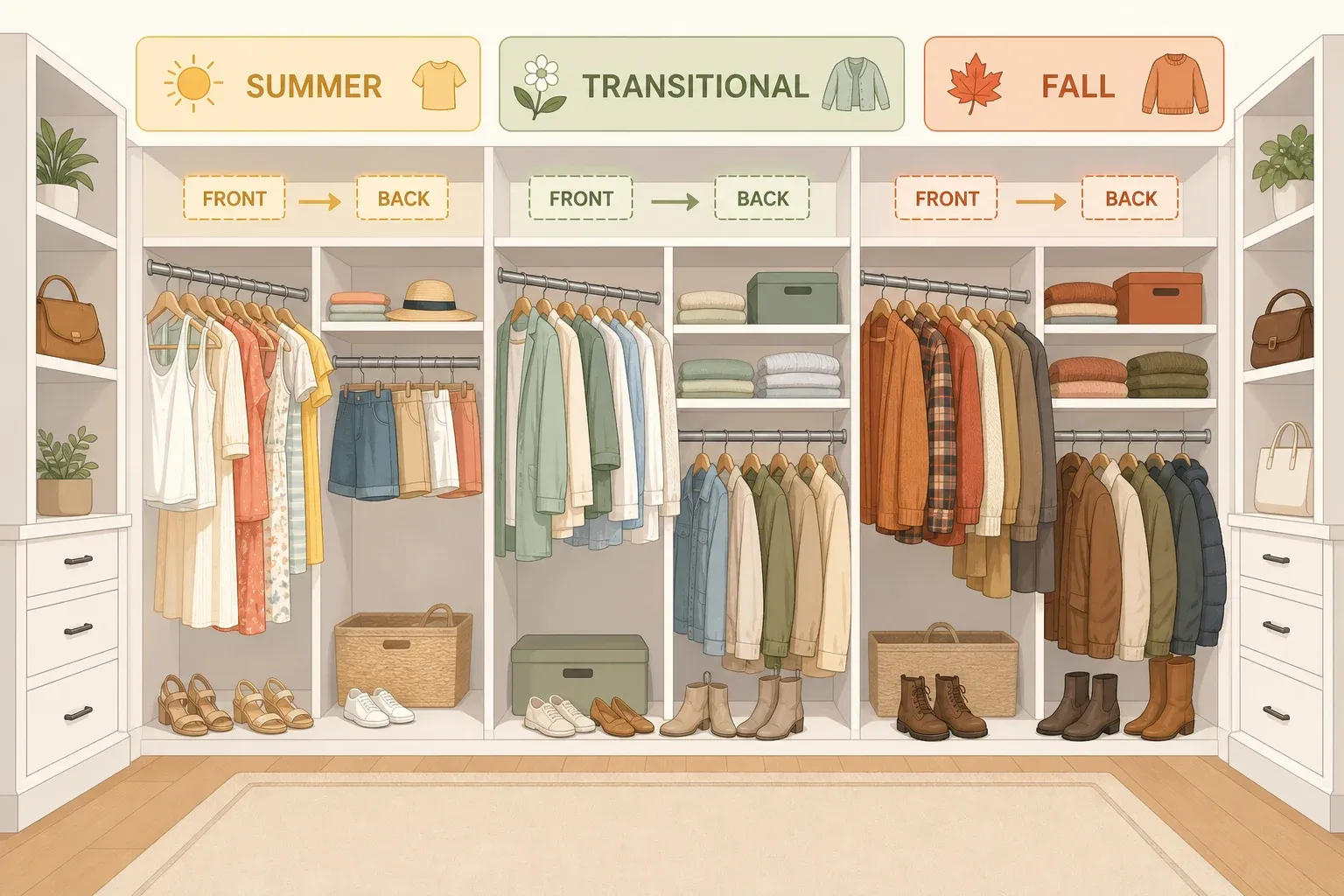
For maintaining a comfortable level once you've reached it: Mindy Godding, professional organizing expert and former president of the National Association of Productivity and Organizing Professionals (NAPO), recommends a one-in, one-out rule for contained categories like books and shoes, plus seasonal editing in closets, kids' rooms, and pantries. No minimalism required, just a ceiling.
When a category can no longer fit in its designated space, it has exceeded a functional quantity. That's the trigger for an edit, not a new storage solution.
Step 4: Orphaned items cables, mail, and outgrown belongings
Orphaned items have no current owner, device, or active purpose. All three subcategories below share that same quality: things that once had a clear use and no longer do. They accumulate through inaction rather than active decisions, which is precisely why they pile up faster than almost anything else.
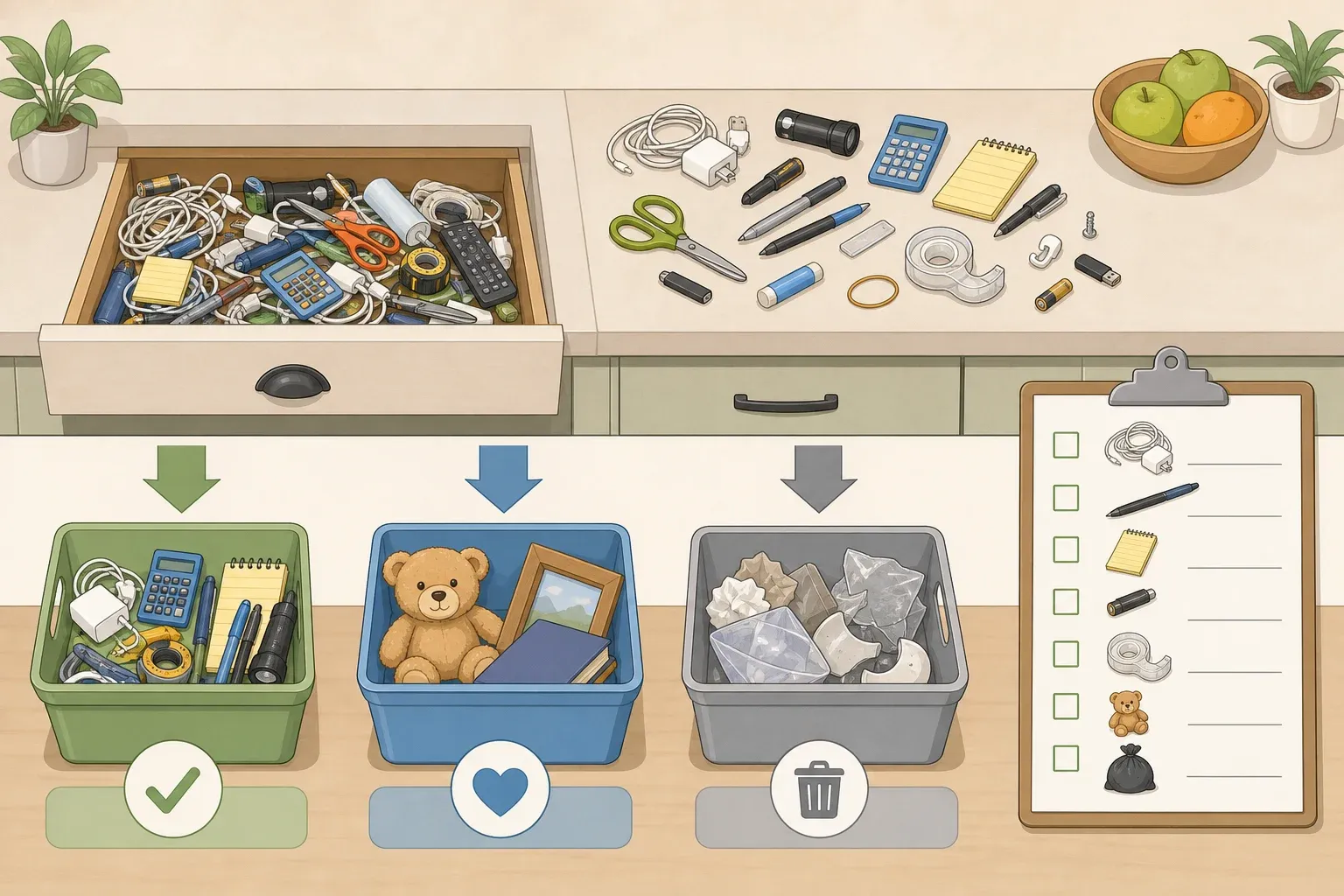
1. Unidentified cables and cords for devices you no longer own. Rosenthal's rule is direct: if you can't identify what a cord belongs to, it goes. Cords for retired devices serve no function and obscure the ones you need. Keep only what you can match to a device currently in use.
2. Junk mail, takeout menus, and paper with personal information. Recycle junk mail and menus immediately on arrival. Any paper carrying personal information, account numbers, medical records, or financial statements should be shredded before recycling. If a stack has already built up in a drawer or on a surface, work through it now rather than adding to it.
3. Kids' toys and items they've outgrown. Donate anything children have moved past: outgrown clothing, toys they no longer play with, books below their current level. Children's items have a predictable turnover timeline; letting them accumulate makes a room harder to use and harder to clean.
The test across all three: if you can't identify what something connects to, belongs to, or is being saved for, it's orphaned. That's sufficient reason to remove it.
What to get rid of to reduce clutter before it builds back up
The categories above refill. Expired products accumulate on a fixed timeline. Things break. Duplicates creep in. Orphaned items appear whenever a device is retired, or a child grows up. The question isn't whether these categories return; it's whether there's a habit in place when they do.
Decide where donations go before you start any future pass. Having a specific destination a charity with pickup service, a nearby thrift store removes the friction that causes bags to stall in a hallway for weeks. Essential Organizing recommends identifying your donation outlet at the outset of any organizing project, not after the sorting is done.
The goal is a functional home, not a bare one. Organizer Pamela Wilkie of Joyganize describes her standard as "intentionalism": knowing what you have, why you have it, and where it is, without being focused on owning as little as possible. That standard is sustainable in a way rigid minimalism often isn't, and it maps directly onto the four-question filter above.
The best place to start today: pick one zone from Step 1, grab a bag, and run the expired/broken/duplicate/orphaned filter. Once you recognize that the under-sink cabinet, the junk drawer, and the shoe pile are all expressions of the same four patterns, each subsequent pass gets faster. Same four questions. Different room.




Comments
Be the first, drop a comment!