



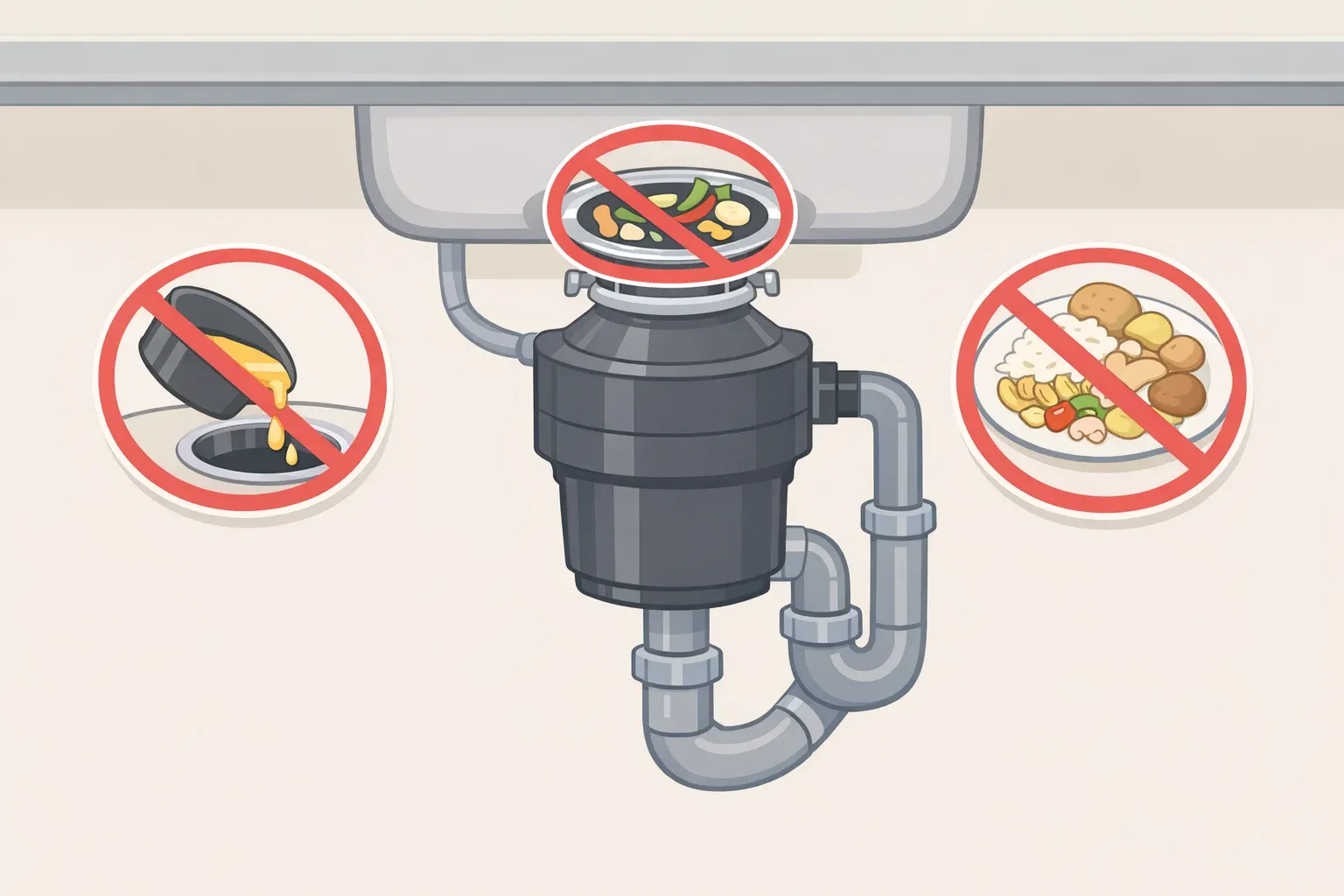
The garbage disposal that's been humming along fine for years isn't necessarily fine. It's possible the machine is doing its job perfectly, and the real problem is thirty feet downstream, where grease has been solidifying into a waxy plug on your pipe walls for months.
A Consumer Reports investigation updated last year found that every plumbing and wastewater expert consulted agreed on one thing: fats, oils, and grease should never go down any kitchen drain, disposal or not. A wastewater engineer quoted in that piece puts the scale plainly: grease is related to up to 65 percent of sewer overflows nationwide.
Understanding what not to put in a garbage disposal starts with recognizing that damage comes in two distinct forms. Some items physically strain or jam the grinding mechanism. Others sail through the disposal without complaint and cause damage later, in the pipes. A few do both. This guide organizes the most common offenders by the failure they cause, so the guidance makes sense rather than arriving as a disconnected list.
One mechanical correction first, because it clears up several myths at once: garbage disposals don't have blades. They use blunt metal impellers that spin and fling food against a stationary grinding ring, an action closer to a cheese grater than a blender, as Consumer Reports explains. Bones don't "shatter the blades." Eggshells don't "sharpen" anything. The motor, not a cutting surface, is what most mechanical failures actually damage.
What the manufacturer explicitly prohibits
The InSinkErator Evolution Series manual draws clear lines, and its prohibitions align consistently with plumber guidance and Consumer Reports findings across brands. It's a useful baseline regardless of what's under your sink.
The manufacturer's prohibited list:
Grease or fat poured into the disposer or drain
Hot water while grinding food waste (hot water between grinding cycles is acceptable)
Large whole bones
Clam or oyster shells
Glass, china, or plastic
Metal of any kind: bottle caps, utensils, tin
Caustic drain cleaners or similar chemical products
Non-food items deserve a separate note. Pioneer Plumbers documented service calls that recovered bottle caps, rubber bands, aluminum foil, and medication from disposal units. Non-food items can jam the motor, damage the grinding mechanism, or create electrical hazards. Medication warrants particular care: since everything ground up by a disposal enters the wastewater system. Unused pills belong in a pharmacy take-back program, not the drain.
Everything else, what the manual calls "normal household food waste," falls into a spectrum of safe, risky, and genuinely disputed. The next sections cover where that line runs and why.
Items that damage your pipes: grease, starches, and coffee grounds
The failure mode here is hydraulic, not mechanical. The disposal does exactly what it's supposed to. The problem is what the ground-up material does to the pipes over hours, days, or weeks.
Grease, oils, and fatty foods
Every expert consulted by Consumer Reports agreed: fats, oils, and grease, collectively called FOGs, should never enter a disposal or any drain. The mechanism is consistent across sources. Warm grease flows freely, then cools into a waxy coating on pipe walls. Each pass adds another layer. Greasy substances cool and solidify specifically inside the drain.
The InSinkErator manual explicitly prohibits grease and fat from both the disposer and drain, leaving no ambiguity regardless of model.
Consumer Reports flags a non-obvious extension of this: creamy foods like peanut butter, butter, heavy cream, and ice cream fall into the FOG category and carry the same pipe-coating risk. The fact that they don't look like cooking oil doesn't change how they behave once they hit cold pipe walls.
Let the grease cool and scrape it into the trash; wipe residual oil from pans with paper towels before washing. For larger volumes of cooking oil, experts suggest oil solidifier products or local recycling programs.
Starchy foods: pasta, rice, potato peels, oats, beans
Starchy foods create a different pipe problem: not a gradual coating, but a sudden, dense blockage. Pasta and rice keep absorbing water after they leave the sink. Even after the disposal grinds them, the particles can swell inside the P-trap into a paste-like mass that seals the pipe. Roto-Rooter's PR director specifically names rice, pasta, and potatoes as items that turn to mush and clog drains.
The same logic extends to oats, beans, and potato peels, the latter's starch content producing the same adhesive paste, per both Pioneer Plumbers and Perry Plumbing. Scrape pasta, rice, and potato peels into the trash or compost rather than rinsing them down the drain.
Coffee grounds
Coffee grounds resist breaking down in water, carry natural oils, and clump into a sticky, sludge-like mass inside pipes. Consumer Reports calls them a "double whammy" for exactly those two reasons. Pioneer Plumbers reaches the same conclusion independently.
Coffee grounds are, however, valuable compost or garden fertilizer, a considerably better destination than the drain.
Items that damage the motor: fibrous vegetables and the eggshell myth
The failure mode shifts here. Fibrous vegetables don't shred; they tangle. The motor keeps working against that resistance until the thermal cutoff trips or the motor burns out entirely. A disposal that runs but drains slowly may have a fibrous problem. One that hums but won't spin likely has something else going on.
Fibrous vegetables
Stringy vegetables, including celery stalks, onion skins, corn husks, asparagus ends, and artichoke leaves, wrap around impellers the way dental floss wraps around a finger, forcing the motor to work harder until it overheats. Perry Plumbing describes the same dynamic, calling it a "nest" formation that eventually burns out the motor.
Rhubarb, pumpkin innards, chard, and kale present the same risk. Thin peels, fruit, and vegetables alike introduce a related problem: InSinkErator's director of product management explains that thin peels often lack the mass to engage the grinding mechanism properly and slip through intact, where they ball up in downstream plumbing. That's a hybrid failure spanning both categories.
One practical caveat: Premium multi-grind disposals handle fibrous materials better than standard single-stage units. Higher-end models reduce, but don't eliminate, the downstream clog risk. For most households with a basic disposal, the compost bin is the safer call regardless of model.
The eggshell myth
The claim that eggshells sharpen disposal "blades" fails on two counts. Disposals have no blades. And the thin membrane lining the inside of an eggshell peels away and wraps around the impellers, reducing grinding efficiency and eventually causing jams rather than improving performance. Perry Plumbing adds that the gritty shell particles can settle in the pipes and trap passing debris, seeding a clog over time.
Eggshells belong in the trash or compost pile. Their value to a garden is real; their value to a disposal is a myth.
Where experts disagree: bones, hard pits, and shells
This is genuinely contested territory, and it deserves an honest treatment rather than a false resolution. The key distinction: what a disposal can grind and what the pipes can safely receive are different questions. That single point cuts through most of the conflicting advice.
Pioneer Plumbers takes the strict position: all bones go in the trash, no exceptions, citing damaged impellers, stripped gears, and replacement costs above $400. Mr. Rooter agrees, except for fish bones, and warns that harder bones can jam the flywheel.
Consumer Reports tested every disposal model it evaluated against beef rib bones and found all of them capable of grinding them. InSinkErator's product management director, quoted in the same piece, explains that impeller-based grinding doesn't "break" the way blade-based cutting would, and that higher-horsepower units, 1 hp or more, handle hard foods more quietly and effectively. Large fruit pits, corn cobs, and small bones fall into this same conditionally-manageable zone.
The critical caveat: bone and hard-food fragments can increase drain clog risk substantially in homes with older cast-iron pipes, even if the disposal itself handles them without issue. The InSinkErator manual draws a hard line at large whole bones and shellfish, regardless of model.
Use this framework to decide:
Basic disposal + older cast-iron pipes: put bones and hard pits in the trash
Premium 1 hp+ disposal + newer PVC pipes: small bones and fruit pits may be manageable
Large bones, clam shells, oyster shells: trash, regardless of equipment
Neither a premium disposal nor good intentions change what aging pipes can absorb.
Everyday habits that protect the machine and the pipes
Most of these are simple. The cold water rule surprises people most often, since hot water seems like it would clean better. It doesn't.
1. Run cold water before, during, and for 15 seconds after grinding. Cold water keeps trace grease solid inside the chamber so the disposal can grind and flush it rather than letting it liquefy and coat the pipes. Pioneer Plumbers recommends the 15-second post-grind run; Moen's senior disposal category manager confirms cold water is key for solidifying small amounts of residual grease. Hot water during grinding does the opposite: it melts grease into a liquid that re-solidifies further down the drain line.
2. Clean with ice and coarse salt monthly. Drop a handful of ice cubes and a tablespoon of coarse salt into the chamber, run cold water, and grind for about 30 seconds. Grinding lemon or lime peels occasionally handles odor; skip the rest of the citrus fruit.
3. Feed food scraps in gradually, not all at once. The disposal is designed for scraps that come off plates and cutting boards during normal prep and cleanup, not for clearing out the vegetable drawer in one session.
4. Never reach inside, even when it's off. Cut power at the circuit breaker before retrieving anything from the chamber. The wall switch is not sufficient protection. Use tongs or pliers for removing visible debris.
When something is wrong
A well-maintained disposal should last 8 to 15 years. Signs to watch for:
Humming without grinding: the flywheel is jammed. Most disposals ship with an Allen wrench for manually turning the mechanism from the base, plus a reset button on the bottom of the unit. Try both before calling a plumber.
Slow draining or water backing up: Mr. Rooter notes this can indicate either a drain clog or a damaged flywheel or shredder. A plunger is the first tool; if that doesn't clear it, call a plumber. Skip chemical drain cleaners, which are corrosive to pipes and frequently ineffective.
Loud rattling or grinding noises: a hard object, bone fragment, bottle cap, or shell piece, is probably loose in the chamber. Cut the power and retrieve it with tongs.
Persistent odors despite cleaning: trapped organic material, often from fibrous scraps or grease buildup. If the ice-and-salt method and citrus peels don't resolve it after a few cycles, the buildup may be in the pipes rather than the chamber, which is a job for a plumber.
Unit repeatedly tripping its reset button: the motor is overheating, typically from grinding fibrous materials or running without adequate water. Repeated tripping is a service call.
The practical rule
At the sink, one filter question covers most of the ground: is this greasy, starchy, stringy, hard, or not actually food? If yes to any of those, the trash or compost bin is the right call. It's not a perfect taxonomy, but it covers the categories that account for the vast majority of disposal and drain failures.
The grease problem extends well past any single household's plumbing. Grease is related to up to 65 percent of sewer overflows nationally. What goes down the drain at home doesn't stay local.
For a disposal already showing warning signs: check the owner's manual for the reset button location and Allen wrench procedure before calling anyone. For persistent slow drains, skip the chemical cleaners and call a licensed plumber. If bones and hard foods are a regular part of the household's cooking, the model's horsepower rating is worth checking. And for fibrous and starchy scraps, composting is the better long-term system regardless of what the disposal can technically handle.





Comments
Be the first, drop a comment!