



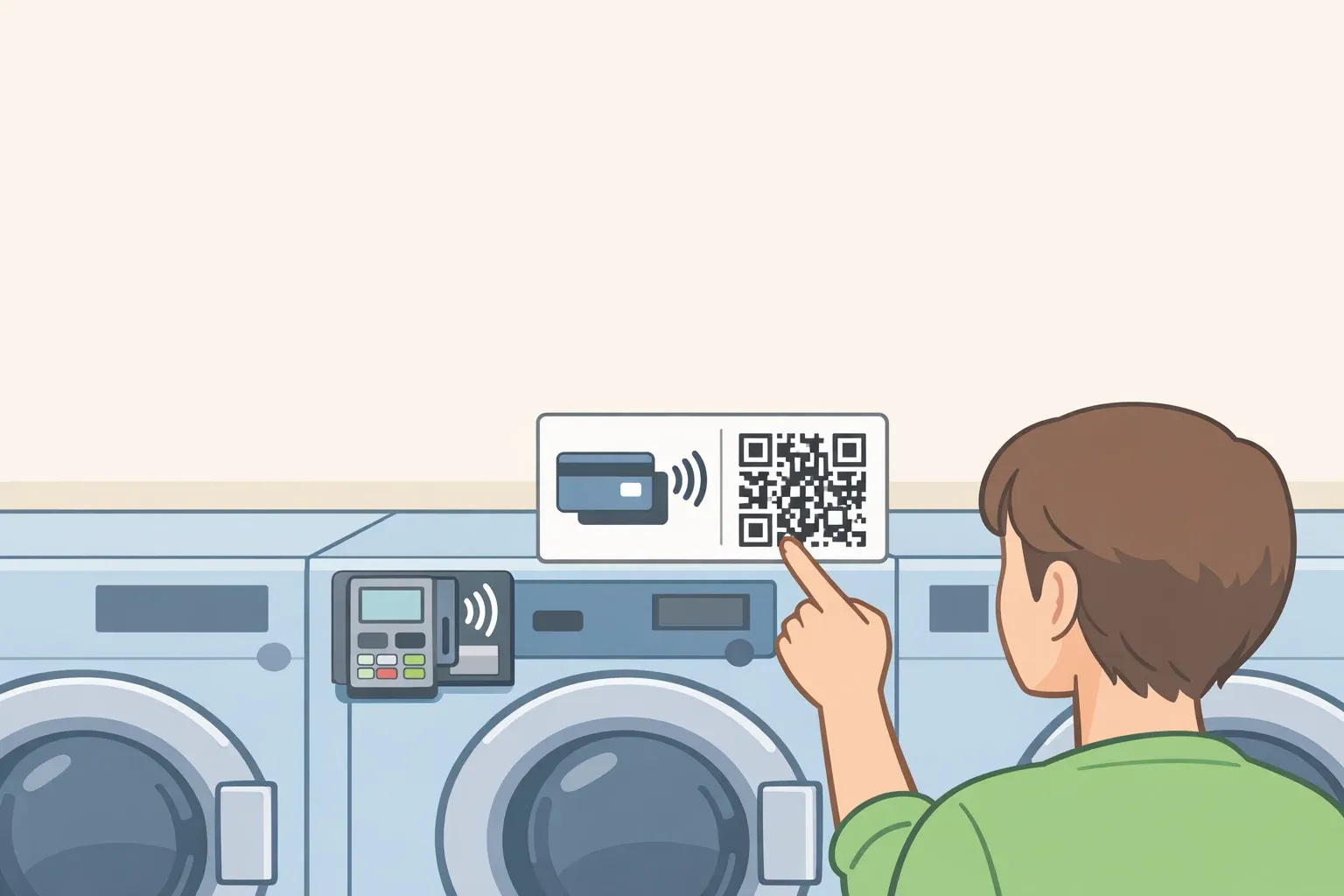
The fastest way to solve a quarter shortage is often to stop looking for quarters. Before touring convenience stores with a laundry bag over one shoulder, take a quick look at the machine in front of you and check whether it even needs coins anymore. Anyone searching for where to get quarters for laundry might be chasing a workaround a lot of modern machines simply don't require.
The order that saves the most time: check for a card reader or QR code first, try the on-site change machine if the machine really is coin-only, ask an attendant or property manager if that fails, then call a bank about a roll. Gas stations and retail counters are worth a call, not a first stop. This guide walks through each step, including where marketplaces like Amazon actually fit. Short version: a distant backup, not tonight's fix.
The quick check before you start hunting for coins
Look for a card reader, a QR code, or a small placard advertising an app near the machine. A beat-up-looking washer isn't proof it only takes coins: a retrofit reader can sometimes be installed on a machine as old as 30 years.
Machines generally sort into three categories. Open-loop systems take a standard credit or debit card directly, the way a gas pump does. Others run on a laundromat-issued stored-value card or a preloaded app wallet. PayRange is one example, and using one typically means registering or loading funds before the cycle starts.
Then there are hybrids that never gave up the coin slot. FasCard, for instance, layers card, loyalty-card, and mobile-wallet payment onto machines that still take quarters, though what a particular machine actually supports depends on the equipment and installation. The giveaway that a machine falls into one of these categories is sometimes just a sign taped near it, not anything visibly different about the slot itself.
An estimated 55% of U.S. laundromats now accept some form of card or mobile payment, up from roughly 30% in 2022. That still leaves a large share of machines coin-only or coin-friendly, so the check at the machine matters more than the national trend.
There's a pricing clue worth knowing, though it's a hint rather than proof. Coin-only machines are generally locked to 25-cent increments, so posted prices land on $2.00, $2.25, $2.50, and so on. Card-based pricing isn't limited that way, which is why a wash can be priced at something like $2.35. A price that doesn't divide evenly by a quarter can suggest the machine takes cards, but it's worth confirming rather than assuming.
Once it's clear the machine really is coin-only, calculate exactly what's needed instead of grabbing "a few dollars" and hoping for the best. Price the washer and dryer separately, since they're often different amounts. Divide each posted price by 0.25, then add the totals. A $2.25 wash and a $1.75 dry works out to 9 quarters plus 7 quarters: 16 total.
If a card or app attempt fails partway through, check for a posted support number before assuming the machine is coin-only after all. Some app-based systems skip Wi-Fi requirements for at least some deployments.
If the laundry room runs on a proprietary card instead of coins, quarters won't help at all. The fix there is getting the card loaded or reissued, not finding change, so it's worth asking a super or attendant which system is actually in place before assuming coins are the answer.
Where to get quarters for laundry today
Set one rule before doing anything else: if a load is actively running, don't leave it unattended to go hunting for change. In a public laundromat, ask an attendant to keep an eye on it. In an apartment or dorm, call property management or a neighbor before stepping out.
What's actually available depends entirely on the building, and there's no way to know without asking. Some laundromats have a staffed counter and an on-site change machine; some apartment and dorm laundry rooms have neither. Call ahead if it's convenient. If it isn't, treat every stop as an ask, not a sure thing.
If there's a change machine, try it first, and don't assume a jam or empty hopper means it's dead for good. Coin mechanisms are one of the most common failure points on commercial washers and dryers, so it's worth flagging to an attendant or checking a posted maintenance number before giving up on it. If the machine takes a bill but doesn't dispense any coins, or spits the bill back, treat that as broken rather than picky. Try a different bill or a smaller denomination before writing it off.
If there's no machine, or it's broken, a 24-hour convenience store or gas station is worth a try next, though whether they'll break a bill for quarters without a purchase depends entirely on who's behind the counter. During the day, grocery store service desks and big-box registers are worth a call too. Policy and willingness vary store to store, and none of this is documented anywhere as official practice; it's a personal long shot, not a guaranteed source.
On-site change machine
Try when: Always try this first.
What to ask: Nothing; it's self-service.
Call ahead? No.
24-hour convenience store or gas station
Try when: There's no change machine, especially at night.
What to ask: Whether they'll break a bill into quarters.
Call ahead? Optional; there's no guarantee without a purchase.
Grocery or big-box store service desk
Try when: During the daytime.
What to ask: Ask the cashier or service desk directly.
Call ahead? Optional; policies vary by store.
That covers tonight's load. Building a supply so this doesn't happen again is a different errand, and it starts with a phone call, not a special trip.
Building a backup: where to get a full roll
A bank or credit union may keep rolled quarters on hand, though whether a branch will hand them to a walk-in non-customer, and whether there's a limit, varies by location. A quick call before making a trip is worth it: ask if they carry rolled coin and whether holding an account there matters.
A few longer shots are worth one phone call each, not a special trip: casino cashier cages, bowling alleys, and hotel front desks sometimes keep coin on hand for their own machines. None of this is backed by a documented policy. It depends on the business and whoever answers the phone, so try it only after the more direct options above haven't worked.
Can you buy quarters on Amazon?
There's nothing here to confirm whether Amazon or similar sites reliably sell fairly priced, ready-to-use quarters. That's not proof it's a bad option, just that nothing backs pricing or reliability either way.
Anyone considering an online listing should check exactly what's being sold and the total cost after shipping before ordering, since listings can vary widely in what they actually include. Even a legitimate purchase still has to ship, so buying quarters for laundry online is a stockpiling move for next month, not a fix for tonight.
The more durable fix skips the coin question entirely. Retrofit readers that preserve the coin slot typically cost $200 to $2,100 per machine. That cost often pays for itself faster than operators expect: between 80% and 90% of customers prefer card systems once they're available, and most stores find dual coin-and-card setups unnecessary within three to six months. If a regular laundromat or apartment laundry room hasn't added this yet, mentioning it to the on-site manager is a conversation worth starting, not a project to price out alone.
The decision rule
Tonight's problem and next month's problem call for different moves. If there's a card reader, a QR code, or a price that doesn't land on a quarter, the machine already takes cards; use it. If it's genuinely coin-only, work through the on-site changer, then a staffed counter, before calling the laundry manager or a nearby bank.
For future loads, only keep a spare roll of quarters if the machine is confirmed coin-only for the long haul. Some locations are adding cashless options, but the machine in front of the reader tonight may still take coins for a while yet, so the check at the machine is worth repeating each time, not assumed solved once.





Comments
Be the first, drop a comment!