



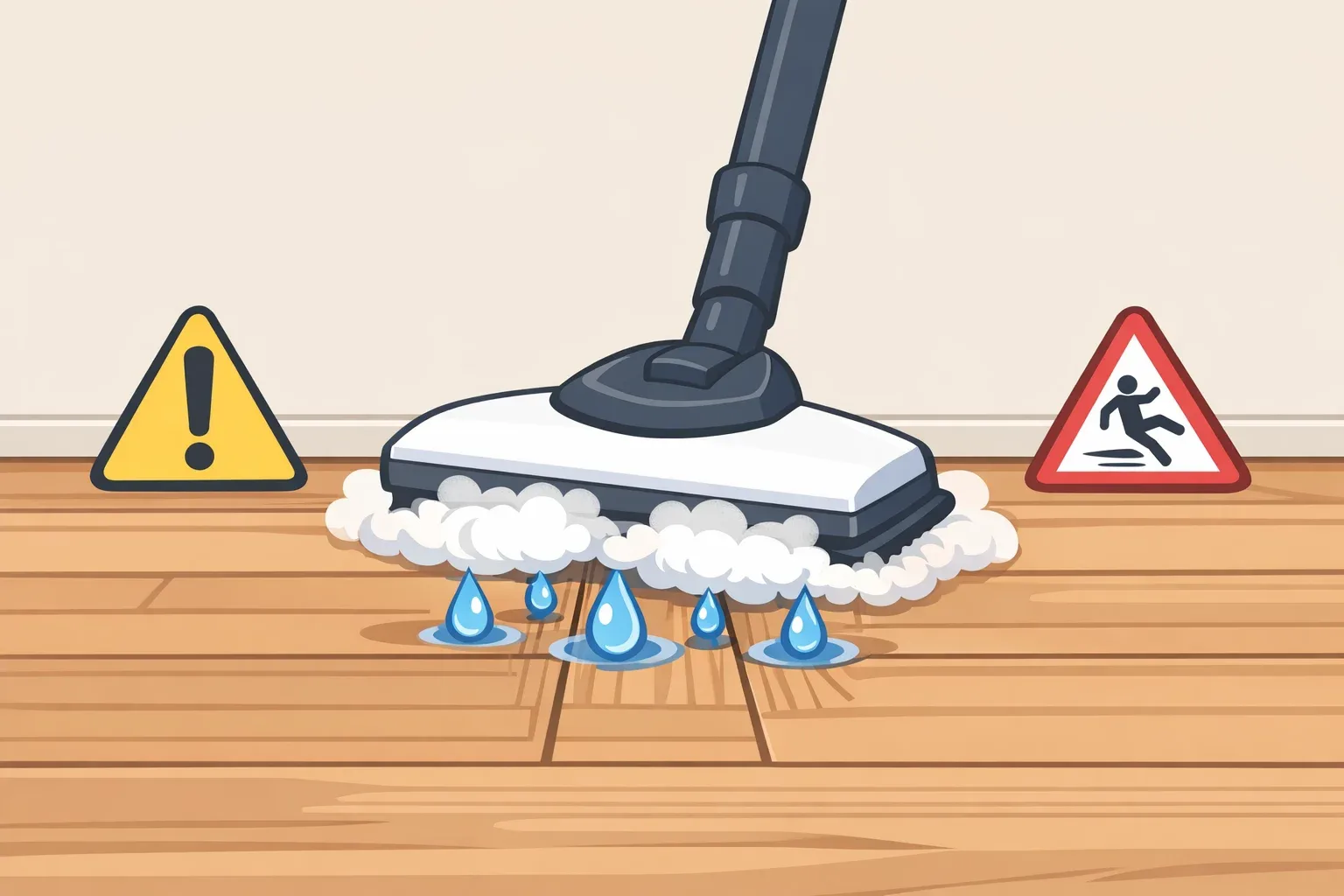
Steam mops are sold as the modern cleaning solution for nearly every surface in the house. The box art shows gleaming tile, sparkling grout, and often enough, hardwood floors. The instruction manual typically backs this up. So, can you steam hardwood floors? Technically, under very specific conditions, maybe. Practically, for most floors in most homes, no, and the gap between those two answers is where expensive damage happens.
Consumer Reports testing found that all steam mop models evaluated left residual moisture on surfaces after use, some considerably more than others. No steam setting eliminates this entirely. That lingering moisture is what does the damage, and floors ruined in the middle of conflicting instructions can lose warranty protection in the process.
Good Housekeeping reported that cleaning professionals broadly advise against steam on wood floors, even when the appliance's own documentation suggests otherwise. Consumer Reports reached the same conclusion, citing flooring industry expert Steve Stocki of Lumber Liquidators, who warned that drastic temperature changes and moisture may warp wood, and that the risk applies equally to solid hardwood, engineered wood, and bamboo.
What follows covers the physical mechanism of damage, why engineered hardwood does not get a pass, how to check whether your specific floor meets the narrow exception, and what a safe cleaning routine actually looks like.
Why steam damages wood, and why "sealed" is not a guarantee
Wood absorbs moisture and expands; when it dries, it contracts. Steam delivers both moisture and heat simultaneously, which accelerates that cycle. According to COIT, steam mops operate at temperatures ranging from 120°F to over 200°F, and that heat compounds moisture damage, speeding up swelling, warping, buckling, and discoloration that can require costly repairs or full floor replacement.
Steam is more dangerous than liquid water for one precise reason: it is far finer than water droplets and can penetrate hairline fractures in a floor's finish that liquid water cannot reach. As The Spruce explains, steam works its way down the sides of planks or up from underneath, attacking from every vulnerable angle simultaneously, not just the surface you can see.
The product literature for steam cleaners does include a safety condition: the floor must be "properly sealed." That qualifier sounds reassuring until it meets a real-world floor. Good Housekeeping quotes Carolyn Forté, executive director of the Home Care & Cleaning Lab, explaining that most floors in occupied homes are not perfectly or completely sealed. Foot traffic, pets, and ordinary wear create fine scratches and worn patches where steam and moisture find their way through.
Think of a floor's finish like a coat of paint on a car. Flawless from the factory, but no longer perfect after a couple of years of use. A fresh coat sheds water cleanly; one with fine scratches and worn patches lets moisture underneath. Once it's there, the damage happens out of sight until it surfaces, and by then it is usually too late to reverse.
The specific failure modes are worth naming. HomeImprovementWay and Good Housekeeping both document warping and buckling as planks swell unevenly, gaps forming as wood contracts inconsistently, dulling of the finish, discoloration, and mold or mildew from sustained moisture exposure. The marketing promise of steam-safe sealed wood is technically conditional. The condition — a perfectly intact seal across the entire floor is almost never met by the time someone reaches for a steam mop.
Is steam cleaning safe for hardwood floors? What your finish type tells you
Not all hardwood floors are sealed the same way, and the distinction matters for cleaning, even if it does not change the answer on steam.
Surface-sealed floors, the most common type in homes built or renovated over the last few decades, have a protective layer of polyurethane, urethane, or similar finish sitting on top of the wood. Consumer Reports recommends cleaning these with a broom, dust mop, or vacuum first, followed by a damp but not dripping mop. Penetrating-sealed floors, which use oil or wax finishes that soak into the wood grain rather than coating it, are more porous by nature. For those, Consumer Reports recommends a damp cloth only, not a mop at all.
Neither finish type is safe for steam. The distinction affects how cautiously you apply a damp cloth, not whether you reach for a steam mop.
To check your floor's current seal condition, The Spruce describes a simple test: drop a small amount of water onto the surface in several locations. If it beads up immediately, the seal is intact. If it spreads out or sinks into the wood, the seal has been compromised and needs to be reapplied before any cleaning method involving moisture becomes relevant.
Can you use a steam mop on engineered hardwood?
Engineered hardwood is constructed from a thin real-wood veneer — oak, maple, and similar species bonded over several layers of plywood or high-density fiberboard. That layered construction does make it more dimensionally stable than solid hardwood under normal humidity fluctuations. The marketing pitch is accurate. It describes normal conditions, not steam cleaning.
The wear layer on engineered hardwood protects only the top surface. Steam does not stay there. The Spruce notes that the wear layer provides no protection once steam finds a path to an edge or a seam. When moisture reaches the adhesive layers underneath, the layers can separate, a failure mode called delamination, and the veneer may begin to peel away from the core.
Consumer Reports states plainly that the warning against steam mops covers engineered wood and solid hardwood without distinction. The National Wood Flooring Association (NWFA) and the World Floor Covering Association (WFCA), cited by COIT, both warn against steam cleaners on hardwood and note that steam can break down the finish and allow moisture to penetrate the wood beneath. No major hardwood flooring provider recommends steam cleaners on their materials, according to The Spruce.
The warranty question deserves its own moment. Many hardwood floor warranties specifically exclude damage caused by moisture and heat, and using a steam mop can void that coverage, leaving the homeowner without recourse for what may be a significant repair bill. Before any cleaning decision, pull the flooring manufacturer's care documentation. The warranty language is where the real answer lives.
When steam might be allowed, and why that still does not make it a good default
A narrow exception exists. It applies only when all three conditions are true:
The flooring manufacturer explicitly permits steam cleaning in their care instructions.
The water-bead test passes in several locations across the floor, not just one spot, because seal integrity varies by area.
The lowest steam setting is used, with the mop kept continuously in motion. If the floor looks wet for more than a few seconds, stop immediately.
All three must be met, not just one or two. Many lived-in floors will not pass the seal-integrity test. That is what keeps this a narrow exception rather than a practical alternative.
How to clean hardwood floors safely, and what to do if you've already used steam
The guiding principle is minimum necessary moisture, applied only when the floor genuinely needs it. Good Housekeeping notes that over-washing hardwood does more harm than good; wet cleaning should happen only when the floor actually calls for it.
The safe cleaning sequence:
Start dry. Vacuum with suction only (brush roller off) or use a microfiber dust mop for daily and routine cleaning. Both remove fine debris without any moisture risk and should be the default.
When wet cleaning is needed, use a microfiber mop dampened to barely wet; it should not drip. For surface-sealed floors, Consumer Reports recommends a damp mop; for floors with a penetrating sealer, use a damp cloth only. Apply a hardwood-specific cleaner in sections of roughly three square feet to prevent over-wetting, wiping with the grain for routine cleaning and across the grain to lift debris from gaps between planks.
For spills, blot immediately with a soft dry cloth; wiping spreads the liquid. Follow with a second dry cloth to clear any remaining moisture, as HomeImprovementWay advises.
Skip entirely: vinegar dulls the finish over time due to its acidity; abrasive cleaners, waxes, furniture polish sprays, oils, and ammonia-containing products can damage both finish and woodg.
Quick decision checklist:
Identify your floor type. Solid hardwood, engineered, and bamboo all fall under the same guidance.
Pull the flooring manufacturer's care documentation and check warranty conditions before cleaning.
Avoid steam unless the manufacturer explicitly permits it.
Default to dry cleaning (vacuum or microfiber dust mop) for routine maintenance.
Use a barely damp microfiber mop with a hardwood-formulated cleaner only when the floor genuinely needs wet cleaning.
If you've already used a steam mop on hardwood floors: stop immediately. Look for early warning signs, including cupping or crowning of planks, visible dulling of the finish, soft spots, or gaps forming between boards. Dry the area thoroughly. Check the manufacturer's warranty documentation to understand what coverage, if any, may still apply. If damage is already visible, COIT notes that professional cleaners have the tools and knowledge to address floors thoroughly without causing further damage, so professional assessment is the right next step before the problem worsens.
One rule, consistently applied
For the overwhelming majority of hardwood floors, solid or engineered, steam cleaning is not worth the risk. The consensus from the NWFA, WFCA, Consumer Reports, Good Housekeeping, and flooring industry professionals has pointed in one direction across years of coverage, as The Spruce and COIT have documented.
Steam mops work well on tile, sealed stone, and other non-porous surfaces. The appliance itself is not the problem. Using it on wood is. Keeping that line clear protects a floor that, with the right routine, can outlast most other things in the house.
The water-bead test described by The Spruce is worth running regardless of the steam question. A floor that fails needs its seal reapplied before any moisture-based cleaning becomes relevant. One that passes is still better served by a barely damp microfiber mop than by steam, because even a perfect seal degrades with use, and the physics of steam do not change.






Comments
Be the first, drop a comment!