



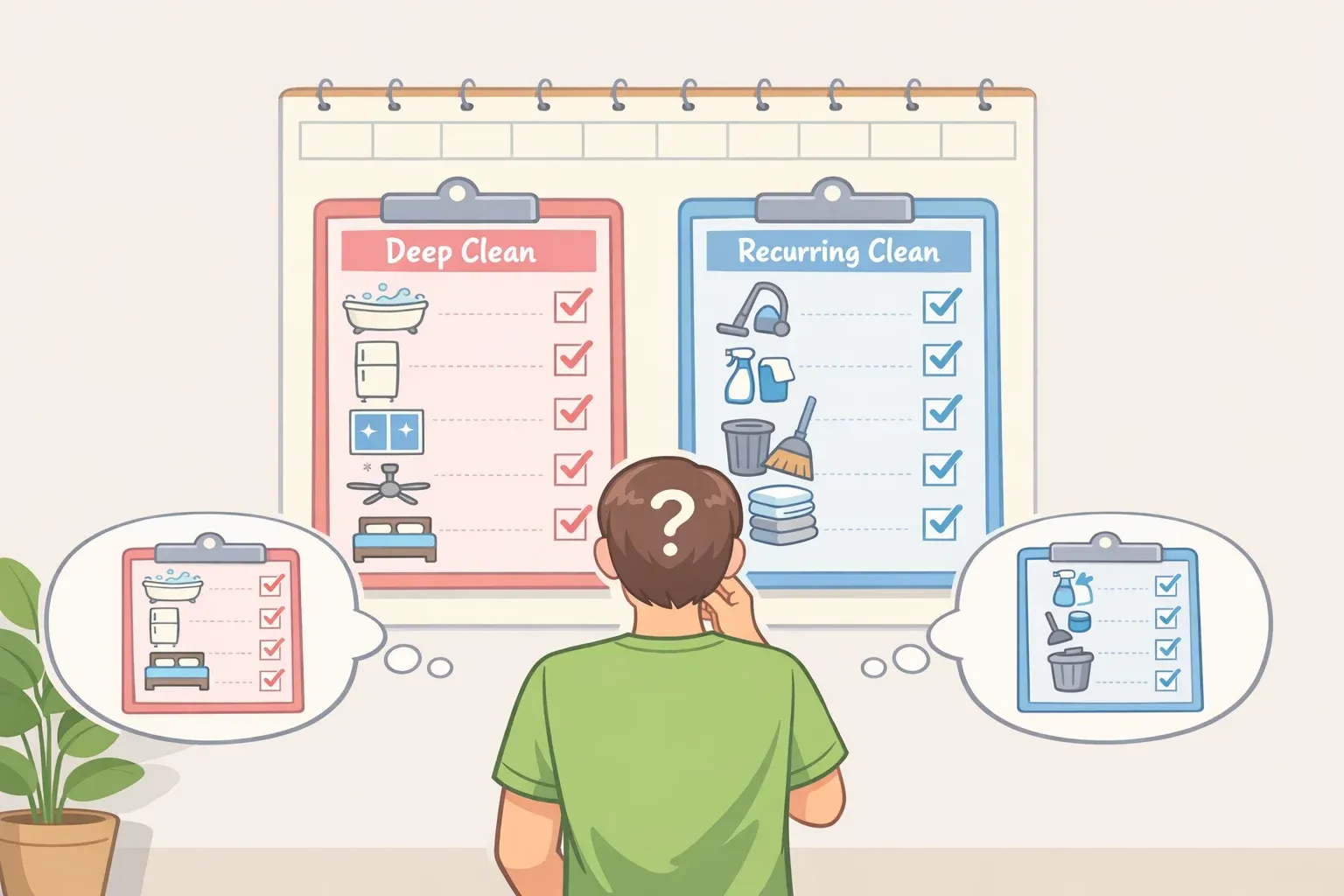
The question of deep cleaning vs recurring cleaning in Allen, TX, sounds like a choice between two competing services. It isn't. The real decision is narrower: stick with the current recurring cadence, move the next deep clean up on the calendar, or change what the service actually covers.
Deep cleaning resets a home to a genuinely clean baseline. Recurring cleaning keeps that baseline from slipping until the next reset comes due. One cleaning provider that services several metro communities puts it about as plainly as it can be put: deep cleaning is the reset, recurring cleaning is the maintenance.
Recurring visits handle everyday surfaces, floors, and bathrooms. Deep cleaning goes after the hidden grime and neglected corners that routine visits typically skip. There's a factor no schedule accounts for on its own, though: the American Cleaning Institute notes that a household's cleaning needs shift with health circumstances, not just the calendar, and that shift can matter more than any fixed interval.
None of the research behind this guide includes Allen-specific pricing or local service data. What follows is a scheduling framework built from provider observations and public health guidance, useful as a starting point but not a claim about Allen homes specifically. Confirm particulars with a local provider before booking anything.
What each service actually does
Deep cleaning tackles buildup and hard-to-reach spots: behind appliances, along baseboards, in corners a routine checklist never reaches. Recurring cleaning keeps floors, bathrooms, and everyday surfaces fresh in the weeks between resets. That's the difference between deep cleaning and regular cleaning in a sentence: one strips away accumulated grime, the other keeps it from building back up.
Combined, the two prevent buildup from accumulating, which makes each later visit faster, easier, and more effective than it would be otherwise.
Think of it like dental care. Recurring cleaning is brushing every day; deep cleaning is the checkup that catches what daily brushing can't reach. Neither replaces the other.
How often to schedule a deep cleaning with weekly, biweekly, and monthly cleaning services
The right interval depends on how much daily wear a home takes, not just how often the cleaning crew shows up. One provider's observations, drawn from homes it services, break down into four ranges:
High-traffic homes, large families, heavy-shedding pets, or heavy daily use: Every 2–3 months, based on provider observations.
Busy homes on a weekly recurring plan: Every 3–4 months, based on provider observations.
Smaller households using biweekly service with less buildup: Every 4–6 months, based on provider observations.
Homes using monthly recurring service: No reported interval; ask the provider and monitor buildup.
Any household: At least once a year, based on provider observations.
For weekly households, that middle range of 3 to 4 months is directly reported. If the household also runs hot with kids, pets, or heavy daily use, leaning toward the shorter 2-to-3-month category makes sense, though the source doesn't tie that category to weekly service specifically. Treat the pairing as a reasonable inference, not a reported finding.
The same caveat applies to biweekly households. The reported 4-to-6-month range assumes lower buildup. A biweekly home with heavy traffic or a shedding dog fits more naturally into the shorter 2-to-3-month category meant for high-traffic homes generally, but again, that's an editorial read on the source's categories, not a claim it makes about biweekly service by name.
Monthly service isn't addressed in the source at all, and inventing a number here would be guessing. What a monthly customer can reasonably do is inspect the kitchen, bathrooms, and any pet areas between visits, and ask the provider directly whether the monthly appointment is maintenance-only or already folds in some deep-cleaning tasks. If buildup shows up well before the next visit, that's a stronger signal than any interval borrowed from a different schedule.
Regardless of cadence, the source treats once a year as a floor, even for lighter-use homes. These ranges come from one provider's observations across Denver-area communities, including Denver, Arvada, and Broomfield, not a controlled study and not Allen-specific data. Use them as a starting point and adjust from there.
What to watch between cleanings
A handful of spots tend to show buildup before the rest of the house does. Checking them between visits, as a practical habit rather than a research-backed sequence, beats counting weeks on a calendar:
Grease film around stovetops, range hoods, and cabinet fronts
Grout lines and corners in bathrooms, where moisture collects fastest
High-traffic floor paths, especially entryways and hallways
Pet bedding and nearby corners, where odor and shedding build up
If any of these look worse than expected before the scheduled reset, that's a better signal than the interval itself.
Three triggers that should move your next deep clean
Schedules are a good default, but they're not the only signal worth watching. Illness is the trigger most often confused with a service decision, so it helps to separate the two.
Day-to-day disinfecting is a health measure a household handles immediately, not something that waits for an appointment. ACI recommends warm water and soap for routine cleaning, with periodic disinfection of frequently touched surfaces.
Households with young children or someone recovering from a respiratory illness, including colds, flu, or COVID-19, warrant closer and more frequent attention. When illness involves vomiting, diarrhea, or a weakened immune system, ACI recommends cleaning a surface first, then disinfecting it with an EPA-registered product and protective equipment such as gloves, followed by deep-cleaning floors and other surfaces to limit reinfection.
ACI's guidance covers household cleaning and disinfection; it doesn't say when to hire a professional service. Whether to hire a professional is a separate practical decision. Before booking, ask exactly which cleaning and disinfection tasks the provider performs, which products it uses, and whether the service follows the product label's directions.
Starting from zero changes the order things happen in. Move-ins, move-outs, and homes that have never had a professional deep clean have no existing baseline for recurring service to maintain. The sequence that follows from the reset-and-maintain logic above is a deep clean first, then a recurring cadence chosen by watching how quickly kitchens, bathrooms, floors, and pet areas show buildup over the following weeks. That's an extension of the framework already laid out, not a separately sourced claim, but it follows the same reasoning.
Buildup outpacing the calendar is the clearest signal of all. If grime, odor, or residue in moisture-prone areas reappears before the scheduled reset date, that tells a homeowner more than the interval itself does. It's a reasonable read on the buildup pattern already described, not a separate statistic, but it's the most practical trigger on this list: when a home signals it needs attention sooner, that signal wins over the calendar.
Before you book: the scope questions worth asking
A few scope questions affect price and outcome more than anything else on a checklist.
Ask whether the quoted service includes appliance interiors and exteriors, cabinet fronts, blinds, and baseboards. The source describes deep cleaning as covering neglected and hard-to-reach areas generally, but individual providers may define those areas differently.
If illness prompted the booking, ask whether disinfection is included and which product gets used, matching the request to ACI's guidance on when disinfecting, not just cleaning, is warranted.
For a move-in or move-out job, ask the provider directly how it scopes that kind of visit, including whether closets and appliance interiors are part of the base price or billed separately. The research doesn't specify how providers categorize these jobs, so confirming this ahead of time avoids surprises on the invoice.
Next steps
Three things matter more than memorizing a table. Start with whichever reported range above is closest to a household's recurring schedule and traffic level, even if it takes some inference to get there. Move the next deep clean earlier the moment buildup, grease, grout discoloration, or odor shows up before the scheduled reset. And before paying for anything, confirm scope directly with a local provider of recurring house cleaning in Allen, TX, since none of the ranges discussed here were measured in Allen homes.




Comments
Be the first, drop a comment!