



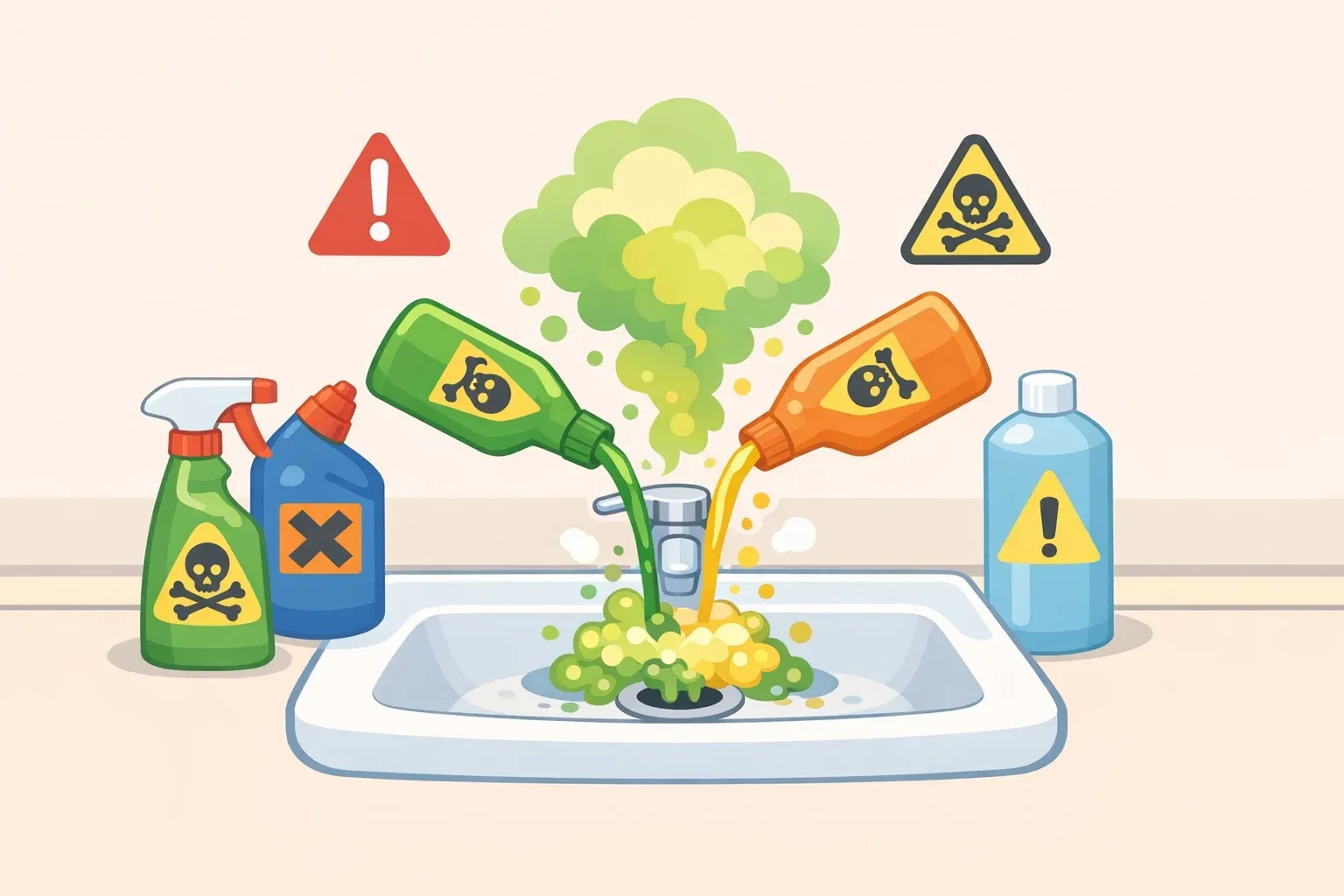
Nobody deliberately pours bleach into a bucket of window cleaner. The household cleaning products you should never mix aren't obscure industrial chemicals; they're under the sink right now. And the dangerous combinations rarely announce themselves.
A bathroom sprayed with one product, then another applied right after. Lemon juice squeezed into a bleach solution for a fresher scent. Two products used on the same drain an hour apart. The mixing happens without anyone realizing it's happening.
Alabama emergency rooms periodically treat patients for chemical exposures from bleach and other household cleaners, and the cause is frequently an accidental combination of products. Cleaning products consistently rank among the top ten substances responsible for harmful pediatric exposures in the United States, according to the Alabama Poison Information Center, and that's from normal household use, not industrial accidents.
Household cleaners are engineered formulations designed to work on their own. Label instructions assume exactly that: one product, one surface. When a second product enters the picture, the chemicals can react in ways the label never anticipated.
What follows covers the highest-risk pairings, the everyday scenarios that create them, what exposure looks and feels like, and the habits that prevent it. One point runs through all of it: mixing is the most acute risk, but ventilation matters even when a single product is used correctly.
What cleaning products should never be mixed
The most dangerous combinations rarely happen in a single container. They happen when one product is applied to a surface and a second is used shortly after residue from the first reacts with the active ingredient in the second.
Picture a bleach-based toilet bowl cleaner used in the bathroom, then ammonia-containing glass cleaner sprayed on the mirror, in a closed space with no airflow. The gases can reach harmful concentrations before anyone makes the connection, N.C. Cooperative Extension notes, and the CDC warns explicitly, that household ammonia can release dangerous gas when combined with other cleaning products.
What makes this so hard to catch: the gases produced are colorless and won't smell noticeably different from the cleaners themselves. No visible smoke, no dramatic odor change. By the time symptoms appear, exposure has already happened.
Bleach and ammonia. Combining sodium hypochlorite, the active ingredient in most household bleach, with ammonia produces chloramine gas, a toxic compound that can cause serious, long-lasting respiratory damage. This combination is easy to stumble into. Some glass cleaners and multi-purpose sprays contain ammonia; using one in a space where bleach has just been applied to a bathtub, toilet, or tile floor is a realistic accidental exposure scenario.
Bleach and acids. Mixing bleach with acidic substances, such as vinegar, lemon juice, and similar substances, releases chlorine gas. At concentrations produced by common household products, chlorine gas can irritate and damage the eyes, skin, and respiratory system. N.C. Cooperative Extension lists bleach and vinegar specifically as a combination to never make. The real-world trigger is often well-intentioned: people add lemon juice to a bleach solution for a fresher smell or extra cleaning power. Less obviously, using a vinegar-based cleaner on a surface that still carries bleach residue, or alternating a bleach drain treatment with a vinegar rinse, creates the same reaction.
Hydrogen peroxide and vinegar. Both appear constantly in DIY cleaning guides as gentle, natural alternatives. Combined, they can produce toxic fumes, a corrosive acid, or, in some conditions, spontaneous combustion. The specific conditions under which each outcome occurs are less thoroughly documented than the bleach-based combinations above, but the public-health warning is clear.
Bleach and rubbing alcohol. N.C. Cooperative Extension lists this as a combination to avoid. The specific byproduct isn't detailed in available public-health guidance; the warning stands regardless.
The through-line on that bottom half of the list is the "natural equals safe" assumption. Vinegar, lemon juice, and hydrogen peroxide are perceived as mild alternatives to harsh chemicals. They are reactive chemicals. Their origins don't make them inert, and that misperception is precisely what puts them in the same container as bleach.
Why bleach is the common denominator
Bleach keeps appearing at the center of these warnings because of what its active ingredient does. Sodium hypochlorite is a chlorine-releasing compound and a powerful oxidizing agent, which is exactly why it kills pathogens so effectively. That same reactivity drives the dangerous reactions: when sodium hypochlorite meets ammonia or an acid, it releases chlorine or chloramine as a gas rather than breaking down harmlessly.
The residue is the part most people miss. Bleach is applied to bathroom tile. The surface looks dry after a few minutes. A vinegar-based cleaner is sprayed on the same area. The bleach residue, still chemically active, reacts with the acid in the vinegar. Chlorine gas is released in a closed bathroom, with no signal that anything has changed until symptoms start.
The chemical reaction doesn't require deliberate mixing. It just requires two incompatible products on the same surface.
Think of it like two medications that are each safe on their own but interact badly when taken together. The problem isn't either ingredient in isolation; it's what happens when they meet. Manufacturers formulate commercial cleaners at tested concentrations, with stabilizers, at specific ratios designed for safety. A consumer combining two separate products at home is doing something categorically different, improvised, untested, and uncontrolled.
If exposure happens: what to recognize and what to do
Leave the area immediately and get to fresh air. That's the first move if exposure is suspected.
Poison Control (1-800-222-1222 in the U.S.) can advise on next steps based on the specific chemicals involved. Seek emergency care for severe or worsening symptoms, such as difficulty breathing, chest pain, loss of coordination, or changes in skin color.
Depending on the chemicals and degree of exposure, effects range from minor irritation to potentially fatal outcomes. Symptoms to watch for include:
Difficulty breathing, coughing, or chest tightness
Burning or irritation in the eyes, throat, or on skin
Headache or blurred vision
Dizziness, clumsiness, or loss of coordination
Cramps or diarrhea
Changes in skin color
The harm isn't always immediate. Repeated or high-level inhalation of these gases can cause lasting lung damage, trigger asthma, or contribute to chronic respiratory conditions over time. Even low-level exposure, repeated over months, carries that risk.
Because these gases are colorless and produce no dramatic odor shift, people often don't identify what happened until symptoms are already present. That gap between exposure and recognition is why getting out of the area fast matters more than stopping to figure out what went wrong.
Safer habits: cleaning without creating a dangerous reaction
One product per surface, finished before the next. Most dangerous combinations result from sequential use, not intentional mixing. The practical rule: complete one product, wipe or rinse the surface thoroughly before applying a second, and never reach for a second cleaner if the first is still wet or active. This matters especially for drain treatments, tile surfaces, and bathroom fixtures, where bleach products and acid-based cleaners are both commonly used.
Read the label before using the product, not after something goes wrong. Household cleaners come with specific instructions because they're engineered formulations, not interchangeable chemicals. The label is where to check whether a product can safely follow another.
Ventilation matters even when nothing is being mixed. A NIOSH-linked study found that even using one household cleaner as directed can create airborne exposure risks in an enclosed bathroom. During 20-minute sessions with a bleach-based spray, 65% of home care aides had peak chlorine exposure above OSHA's ceiling limit. Bleach, QAC-based, and "green" products all released volatile organic compounds, so ventilation matters. Open a window and run the exhaust fan while cleaning.
Storage and access. Keep different cleaner types stored separately to prevent accidental contact in the cabinet. Store all products in their original containers. In homes with children or pets, use safety locks. Cleaning products consistently rank among the top ten substances responsible for harmful pediatric exposures in the U.S., per Alabama public health data.
Protective equipment. Wear gloves when using bleach or spray cleaners. For spray products in enclosed spaces, especially bleach-based sprays, add eye protection, Alabama public health officials advise.
Start with what you're not going to mix
The two combinations with the strongest public-health documentation are bleach with ammonia, which produces chloramine gas, and bleach with acidic substances, including vinegar and lemon juice, which release chlorine gas. Hydrogen peroxide plus vinegar and bleach plus rubbing alcohol are also on the public-health warning list, with less mechanistic detail available in sourced guidance.
What most cleaning routines don't account for is the cleaner that gets left behind. Residue stays chemically active longer than a dry surface suggests. The second product meets that residue, not the clean tile underneath it.
Rinsing surfaces between products, keeping windows open, and reading labels before reaching for a second cleaner address most of that risk. For lower-risk starting points, the American Lung Association publishes cleaning formulas built around white vinegar, baking soda, and castile soap, though those ingredients should not be combined with other cleaning products either.
The habit worth building isn't memorizing a list of dangerous combinations. It's treating every product as something that works alone, by design, and leaves something behind when it dries.

Comments
Be the first, drop a comment!