



Should You Leave Your Ceiling Fan on All Day to Save Energy
Should you leave your ceiling fan on all day? Usually not unless someone is actually in the room. That single condition determines whether a ceiling fan saves money or quietly runs up your bill for no reason.
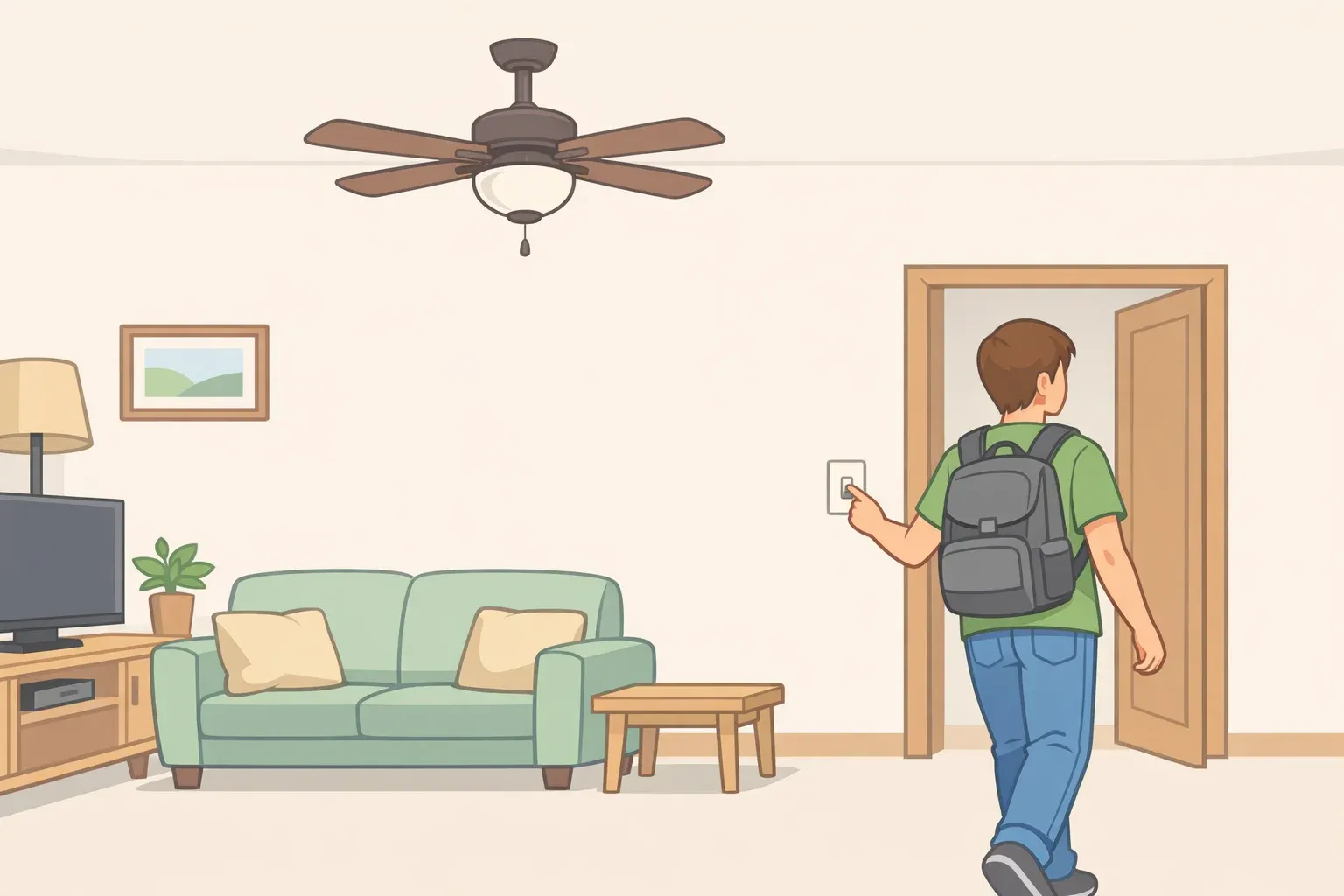
The core rule, stated plainly by the University of Florida's IFAS Extension: fans cool people, not rooms. A ceiling fan doesn't lower the air temperature. Turn it off when you leave, because the room won't be any cooler when you return. Running several fans continuously, especially in an unoccupied home, erases whatever efficiency advantage fans are supposed to provide.
When someone is present, the picture changes sharply. A 29-month field study across ten air-conditioned buildings found that automated ceiling fans staged alongside AC cut cooling-season compressor energy use by 36% overall and 41% during peak summer billing hours. The key was letting occupants raise the thermostat. That thermostat adjustment is where the savings actually come from, not the fan itself.
This framework works through four questions: when continuous fan use makes sense, what it costs to leave one running unnecessarily, how fan and AC efficiency interact, and which directional setting determines whether the fan is doing useful work at all.
The empty-room rule and what continuous use actually costs
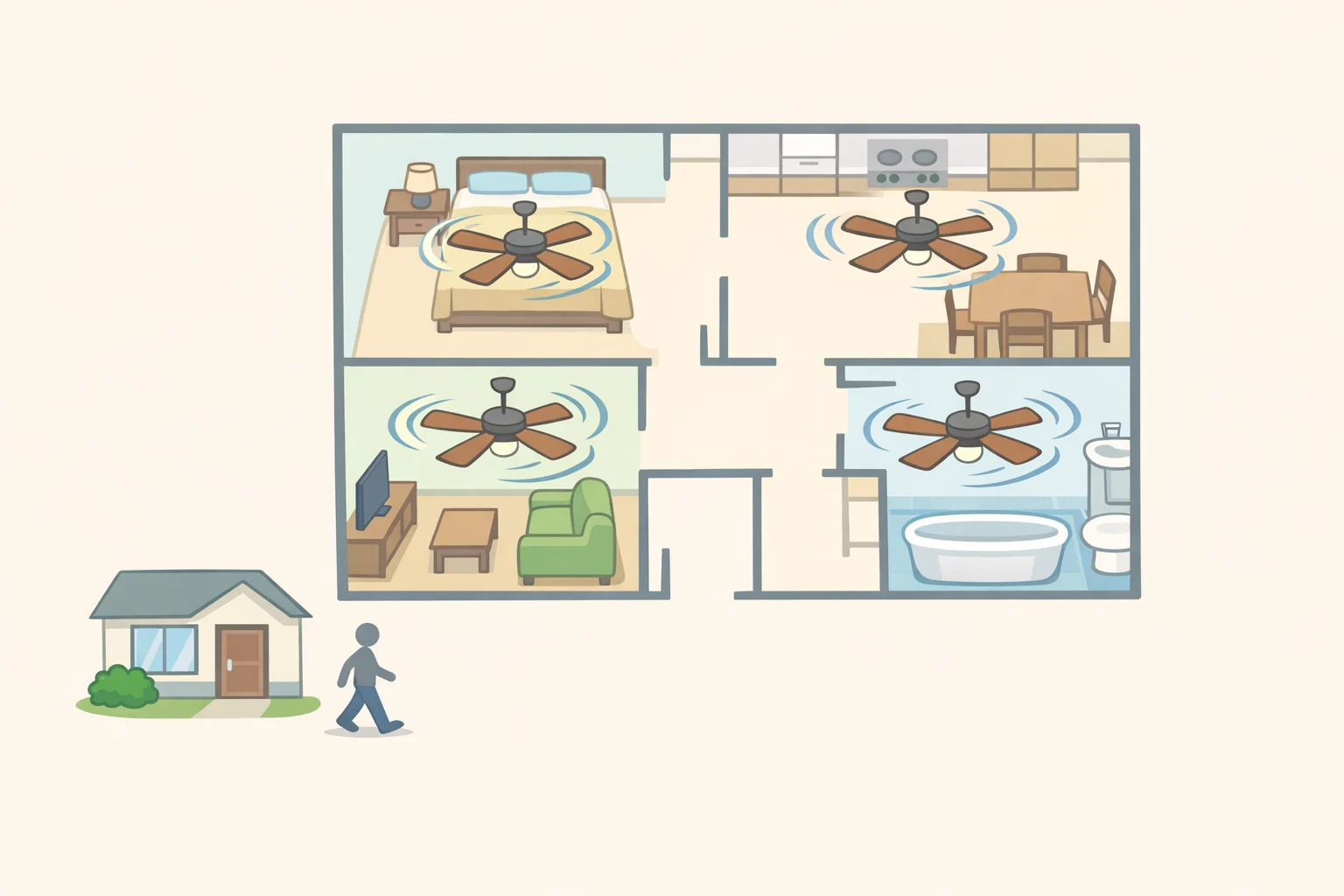
The first branch of any decision here is occupancy. No person or pet in the room means no reason to run the fan, and a real if modest cost to leaving it on.
Modern ceiling fans draw between 2 and 30 watts at gentle speeds, power consumption comparable to an LED bulb, according to the 2021 California field study. Small per fan, but it stacks up. Three 30-watt fans running around the clock consume roughly 2.16 kWh per day, about 65 kWh per month, moving air through rooms where nobody sits. The University of Florida's extension guidance puts it plainly: operating several fans continuously adds up quickly, especially when no one is home to benefit.
There's a durability angle worth knowing too. According to the same guidance, medium-grade ceiling fans are rated for no more than 12 hours of daily operation, and economy models for 8 hours or fewer. Running either beyond those limits exceeds design parameters, something to consider before treating a budget fan as an always-on appliance through a long summer.
Apply the occupancy rule consistently and the rest of this framework becomes about getting more out of a justified habit, not defending one that doesn't hold up.
Does leaving a ceiling fan on all day save energy? Only with one extra step
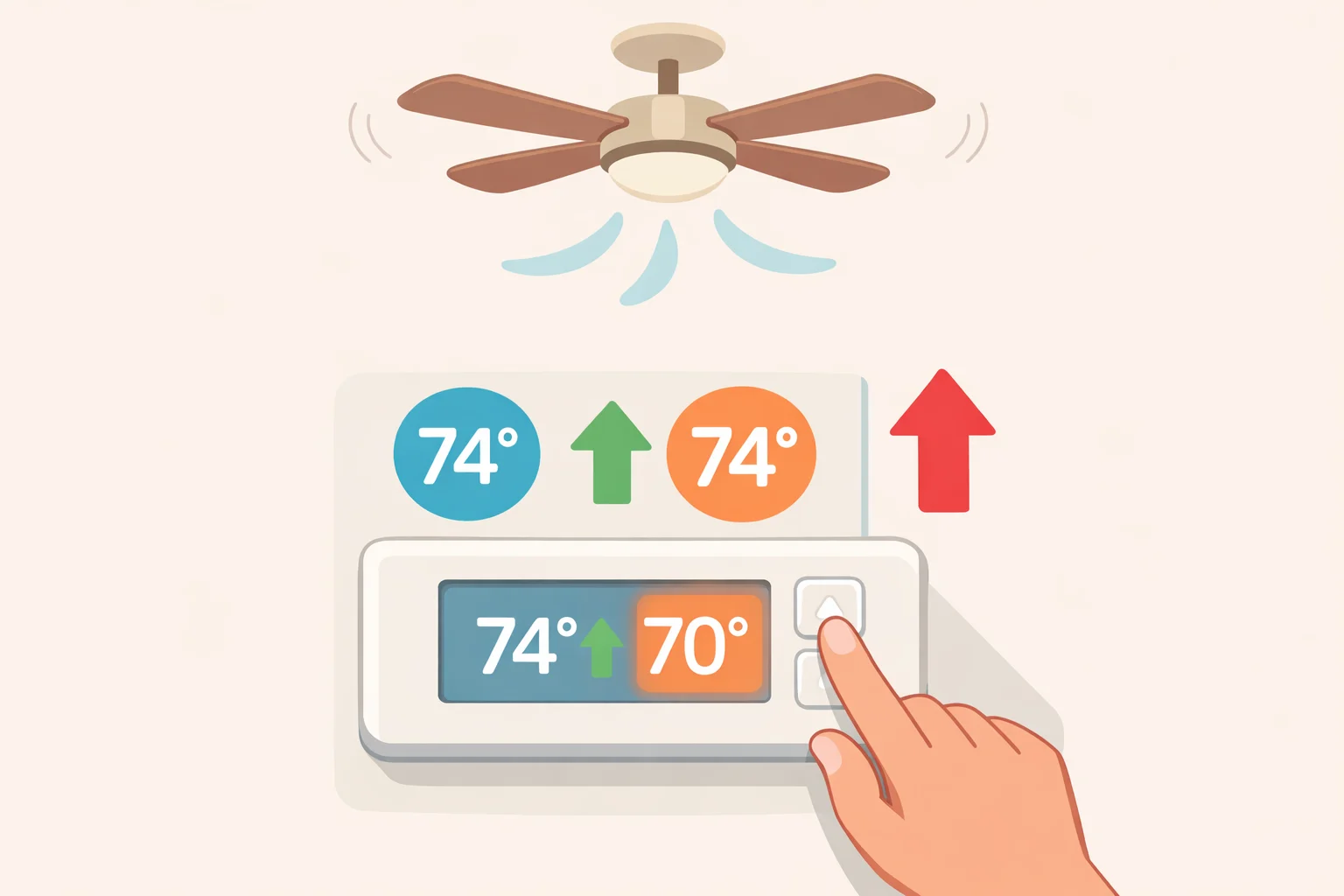
For occupied rooms during cooling season, the case for sustained fan use is solid. But it depends entirely on adjusting the thermostat upward when the fan goes on. Skip that step and you're running two systems where one would do.
The University of Florida's extension guidance offers a clean rule of thumb: a ceiling fan in summer lets occupants raise the thermostat by 4°F without any noticeable change in perceived comfort. A household that normally keeps the AC at 72°F can set it to 76°F. The AC cycles less, the compressor runs less, and the net energy draw drops despite the fan's addition to the bill. The fan earns its keep by reducing the AC's workload, not by cooling the room on its own.
The California field study puts real numbers on the combination. Over 29 months, automated fans staged to run before and alongside AC, allowing thermostat setpoints to rise in most zones, delivered 36% compressor energy savings across the full cooling season. Results across individual compressors ranged from a 24% increase to a 73% decrease, reflecting variation in occupancy schedules and building conditions; median normalized savings per compressor were 21%. The spread is wide. Residential results will vary based on how consistently the thermostat is adjusted and how much of the day rooms stay occupied.
The UC Berkeley Center for the Built Environment's Guidebook on Fans for Cooling People addresses this directly: the guidebook discusses how HVAC systems can be integrated with fans to derive maximum benefits for energy efficiency and comfort. Fan and thermostat working together, that's the savings case. Layering a fan on top of AC already running at the same setpoint adds load without benefit.
Common mistakes that eliminate the savings:
- Leaving fans on in empty rooms
- Running the fan and AC together without raising the thermostat
- Running the fan at high speed when the room is already cool (more on temperature limits below)
- Setting the blades to spin the wrong direction for the season
Ceiling fan on all day electricity cost: fan versus AC
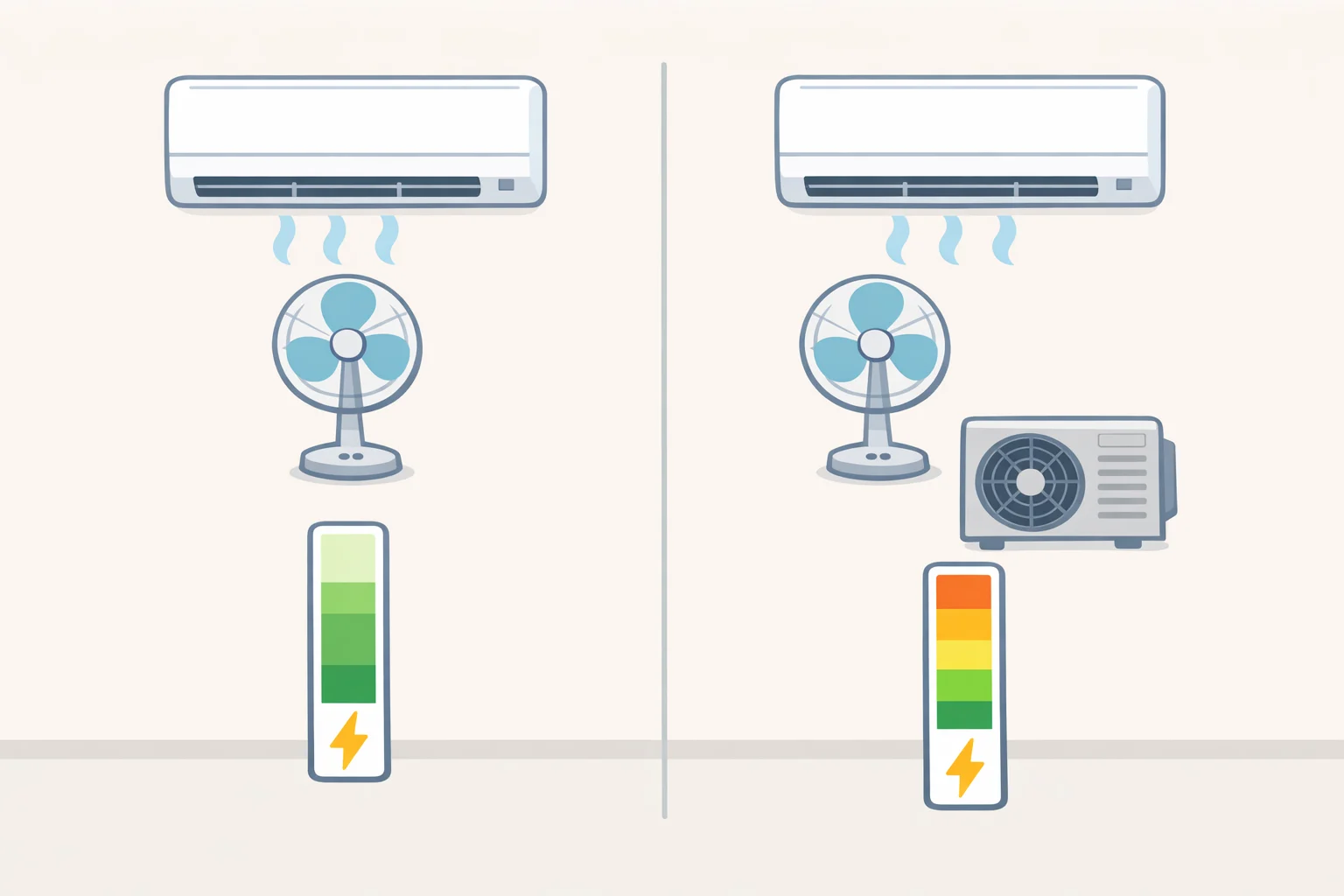
The energy picture is easier to grasp when you set the two systems side by side.
A ceiling fan drawing 15 to 30 watts at moderate speed uses a fraction of what a central AC compressor consumes. That small draw only pays off when it displaces some of that compressor runtime. Run both simultaneously at the same thermostat setting and you're adding the fan's load on top of an unchanged AC load, a net negative, however small.
The 2021 field study makes this concrete: staging fans to run before and alongside AC, with the thermostat raised to reflect the added comfort, cut cooling-season compressor energy by 36% overall. The fan's own electricity consumption is real but minor; the compressor savings dwarf it. Flip the scenario to three fans running continuously in empty rooms and you get roughly 65 kWh per month with no offset at all. That's when fans become a net cost rather than a net saving.
Cheap to run isn't the same as free, and it's definitely not the same as beneficial. The thermostat adjustment is what converts the fan's small draw into meaningful savings on the larger one.
Blade direction and the temperature range where fans actually work
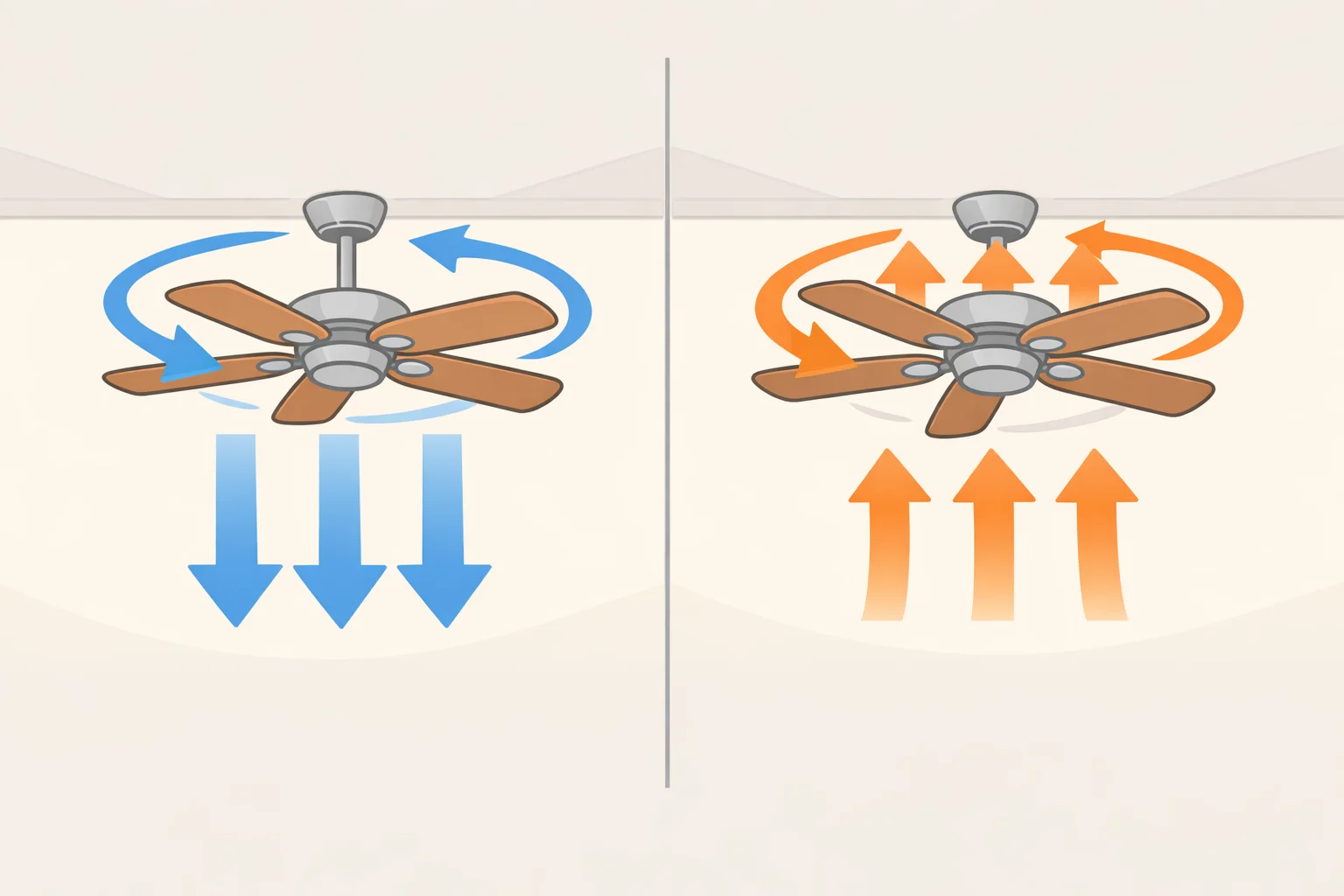
Two variables determine whether a fan delivers what it's supposed to: which way the blades spin, and what the room temperature already is.
Direction first. In summer, the fan should spin counterclockwise when viewed from below, pushing air straight down. That direct downward airflow creates the cooling sensation on skin. A residential chamber study published in Energy and Buildings earlier this year tested four operational modes across three temperature conditions with 30 participants. Downward airflow significantly outperformed reverse mode on thermal satisfaction at 29°C and 31°C (p < 0.05), and improved perceived air quality compared to no-fan conditions at every temperature tested. In winter, clockwise rotation recirculates warm air that collects near the ceiling without creating a cooling draft, but that's a separate question. Checking the direction is where to start before anything else in summer.
Temperature range matters too. Ceiling fans work across a real but finite window. Fluid dynamics modeling published in Buildings in 2022 mapped thermal comfort across operative temperatures from 21°C to 36°C (70°F to 97°F) at air speeds up to 2.5 m/s, and the research found that the workable range runs roughly from 21°C to 31°C (70°F to 88°F): within those bounds, fan airflow can bring occupants into comfortable thermal territory. Above 29°C, comfort becomes increasingly dependent on higher air speeds. Above 32°C (about 90°F), even maximum fan output shows limited capacity to offset heat. At 36°C (97°F), the modeling put dissatisfaction at 97 to 98% regardless of fan speed. At that point the physics don't favor fan-only cooling.
There's a lower boundary too, less often discussed. The same research found that below roughly 26°C (79°F), high fan speed can push occupants from comfortable to slightly cool, nudging dissatisfaction upward. Fan speed should match conditions; a mild day calls for a lower setting. Individual response also varies. A 2023 personalized fan study with 45 participants found that people in warmer conditions consistently selected higher airflow speeds to restore comfort. Fan speed should track how warm people actually feel, not be set once and left.
A decision framework you can apply right now
Four rules cover most situations.
Leaving the room? Turn the fan off. The room won't be cooler when you return whether the fan ran or not, and your bill will reflect the runtime either way. The University of Florida's extension guidance is unambiguous on this point.
Home and warm, AC running? Turn the fan on and raise the thermostat 4°F. That combination, not the fan alone, is what makes the efficiency case work. The California field study showed median cooling-season savings of 21% per compressor, with stronger results in consistently occupied spaces where the thermostat adjustment held.
Extreme heat, indoor temperatures above 90°F? Run the fan as a supplement to AC, not a substitute. The 2022 modeling research shows fan effectiveness deteriorates sharply above 32°C. It takes the edge off, but it won't carry the load on its own.
Check the blade direction before anything else. A fan spinning the wrong way in summer circulates air without delivering the skin-cooling effect. Counterclockwise (downward airflow) is the warm-weather setting; the 2025 chamber study confirms it substantially outperforms reverse mode for thermal satisfaction when temperatures are elevated.
Two adjustments account for most of the gap between fans that save money and fans that just run: turn them off when rooms are empty, and pair them with a higher thermostat setting when rooms are occupied. Everything else is refinement.
Readers who want to go deeper on fan sizing, placement, and HVAC integration can find both a 15-page practitioner summary and a full 70-page reference in the UC Berkeley CBE Guidebook on Fans for Cooling People (2023).








Comments
Be the first, drop a comment!