



The triangle stamped into the bottom of a yogurt cup or a laundry detergent bottle looks official, almost like a seal of approval. It isn't. To understand what recycling symbols on plastic containers mean, start by treating the triangle as a material label, not a recycling guarantee.
Here's the plain-language version: the number 1 through 7 tucked inside the triangle identifies which of seven plastic resin categories the container falls into, according to the Department of Energy's consumer guide. It says nothing about whether your local recycling truck will actually take it.
That distinction matters because the U.S. has not implemented a cohesive national recycling program, per a NIST report published in 2024. That's a structural reason accepted-materials lists look different from one community to the next. Packaging makes up 44.8% of plastic production in the global dataset summarized by that same NIST analysis, so how households sort these specific items carries real weight across the system.
This piece breaks down what the resin code is actually communicating, walks through what each of the seven numbers typically means for curbside pickup, and covers the format and cleanliness rules that matter just as much as the number itself.
What recycling numbers on plastic containers tell you
The number inside the triangle is a resin identification code, a manufacturing label that identifies which plastic the container is made from, according to the EPA. It is not a certification that the item is recyclable.
Part of the confusion is baked into the design. That resin number sits inside a triangle that looks very similar to the universal chasing-arrows recycling symbol. The resemblance blurs a distinction that actually matters: one triangle is about material, the other is about disposal, and they aren't interchangeable.
What the code actually does is help a consumer check whether an item is recyclable through their local program. It's a lookup aid, not an approval stamp, and the EPA is explicit that some resin types aren't accepted in community programs at all.
There is a rough pattern worth knowing, with a caveat attached. The Department of Energy groups plastics into seven categories and notes that, generally, higher numbers are harder to recycle than lower ones, per its consumer guide. That's a tendency, not a guarantee for any specific municipal program.
This is the fact that reframes how to read every container going forward: the number identifies the material, but it never decides the outcome. What decides the outcome is the list your own hauler publishes, which is why the next useful step is knowing what each number usually signals before you go check that list.
The seven plastic codes, one by one
Each number corresponds to a different resin, with its own recycling reality attached, according to the DOE.
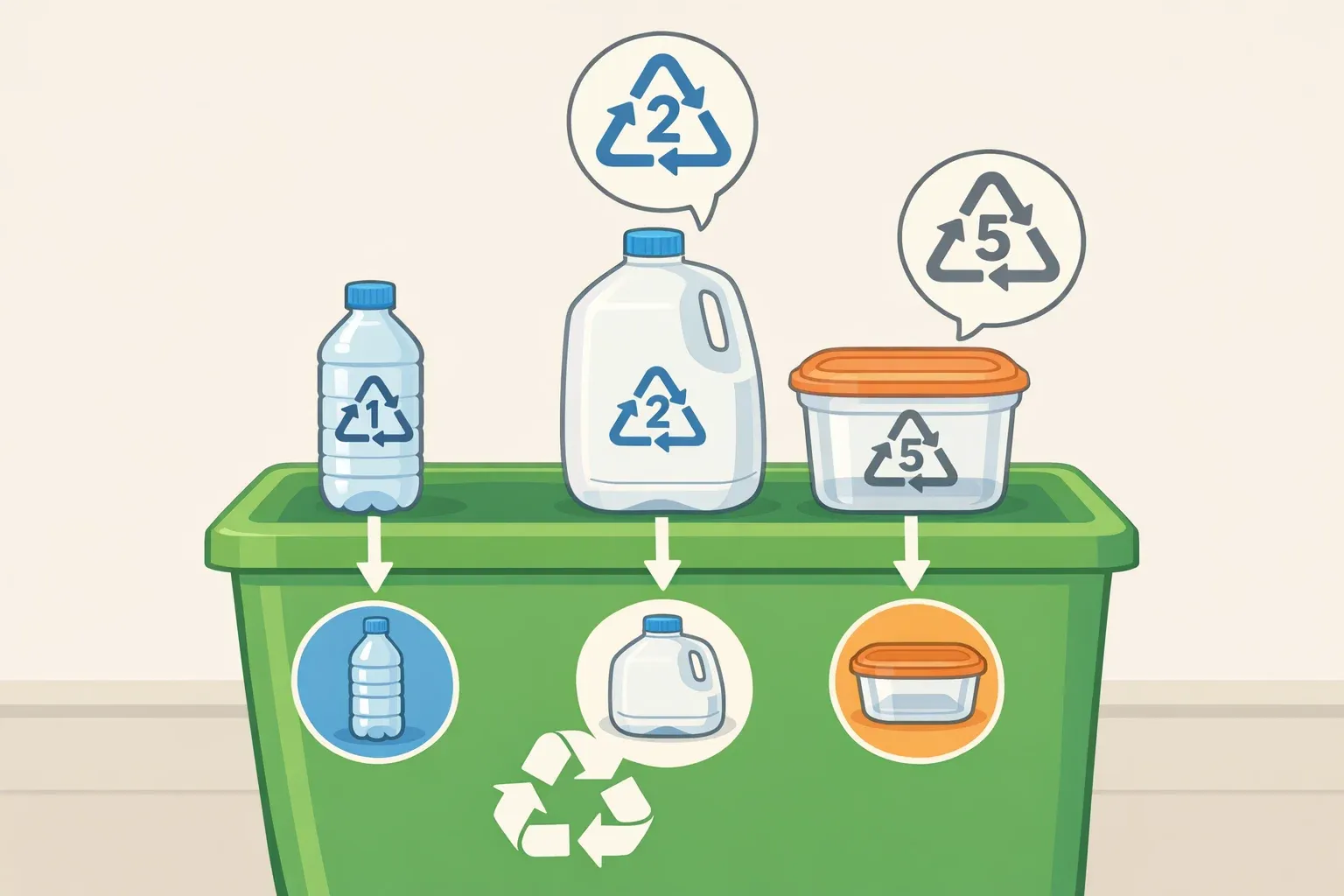
#1 PET/PETE: A common plastic the DOE describes as easy to recycle and accepted by most municipal programs. It shows up in water and soda bottles, plus some frozen-food containers. "Most" isn't "all," so a quick check of the local list is still worth doing before assuming curbside pickup.
#2 HDPE: A non-transparent plastic that's also widely accepted in municipal recycling programs, per the DOE. Common examples include household cleaner bottles, some food containers, and cutting boards. Wide acceptance is the general pattern here, but confirming against the specific list a program publishes is still the safer habit.
#3 PVC: The DOE notes that PVC is more difficult to recycle than either #1 or #2. It turns up in children's toys and in bottles for products like detergent and shampoo. Given that added difficulty, checking the local list before tossing a PVC item in the bin matters more than it would for the first two codes.
#4 LDPE: A soft, flexible plastic commonly used for thin bags and film, per the DOE. It can clog recycling machinery, so the guide recommends confirming local acceptance first. Grocery stores, though, often take qualifying plastic bags and film.
#5 PP: Found in straws, soft-drink cups, and certain food containers. The DOE says PP can be recycled, but availability depends on the local program, so confirming before recycling matters here as much as anywhere on this list.
#6 PS (polystyrene, or Styrofoam): Common in takeout containers and disposable cups. The DOE notes it's generally not accepted within recycling programs, which makes this one of the more predictable entries on the list, if only because the answer is usually no.
#7 Other: A catchall the DOE lists as covering BPA, polycarbonate, and bio-based plastics. Because the category groups together several unrelated materials, checking local guidance before placing a #7 item in the bin is the only reliable move.
The code narrows down what's in your hand. Only the local program's list turns that into a yes-or-no answer, and that gap tends to widen the further up the number scale a container sits past #2.
How to use your local list
Knowing the resin number is only half the job. Most municipal programs sort by format as much as by material, which means the shape of a container can matter as much as what it's made of.
A practical routine looks like this: note the resin number, note the format, whether it's a bottle, tub, film, foam, or utensil, then check both against the accepted-materials list your hauler or municipality publishes. A #1 bottle and a #1 clamshell can land in different categories on the same list, depending on how a program's sorting equipment handles shape.
This is also where store and drop-off programs earn their keep. Film and thin bags, for instance, aren't always accepted curbside even when a grocery store nearby runs a dedicated collection bin for the same material, per the DOE. Treating the resin code and the format as two separate questions, rather than one, is what actually gets an item into the right bin.
Why shape and cleanliness matter as much as the number
Format can override the resin code entirely. Plastic utensils are rarely recyclable, no matter what number, if any, is stamped on them, according to the EPA.
Compostable plastics deserve a separate mention because they get mistaken for a recycling shortcut. The EPA is clear that they aren't intended for standard recycling and can contaminate and disrupt the recycling stream if mixed in with regular plastics. If a community doesn't offer compostable pickup, the EPA's guidance is to contact the local waste or recycling company, or local government, to ask about drop-off options rather than defaulting to the recycling bin.
Consumer understanding still lags behind the actual rules. Survey data cited in the 2024 NIST report, drawn from a 2017 study, found that only about 60% of people correctly knew food residue is a problem for recycling. Roughly half believed plastic bags belonged in the curbside bin, even though bags and film can damage sorting equipment. Those figures describe attitudes from roughly a decade ago, not a current national snapshot.
Access to recycling itself is also uneven. That same 2017 data found 85% of single-family households had some form of recycling access, whether curbside or drop-off, compared with just 37% of multifamily households, according to the NIST report. Telling someone to "just check your program" assumes a program exists to check in the first place, and for more than a third of multifamily renters, that assumption doesn't hold.
The practical fix is simpler than any of that: follow the preparation instructions your specific program publishes, whatever they happen to be, rather than applying one universal rule to everything that passes through the kitchen.
Conclusion
A useful routine for sorting at home comes down to four steps: identify the item's format, whether it's a bottle, tub, film, foam, or utensil; check the local hauler's current accepted-materials list; prepare the item exactly as that program specifies; and reserve store or drop-off channels for items your curbside program doesn't list, such as film.
The number in the triangle is a starting clue, and now a decodable one. But it was never built to answer the question that actually matters at the curb. The code tells you what to investigate. Only your local program tells you what to do with it.




Comments
Be the first, drop a comment!