



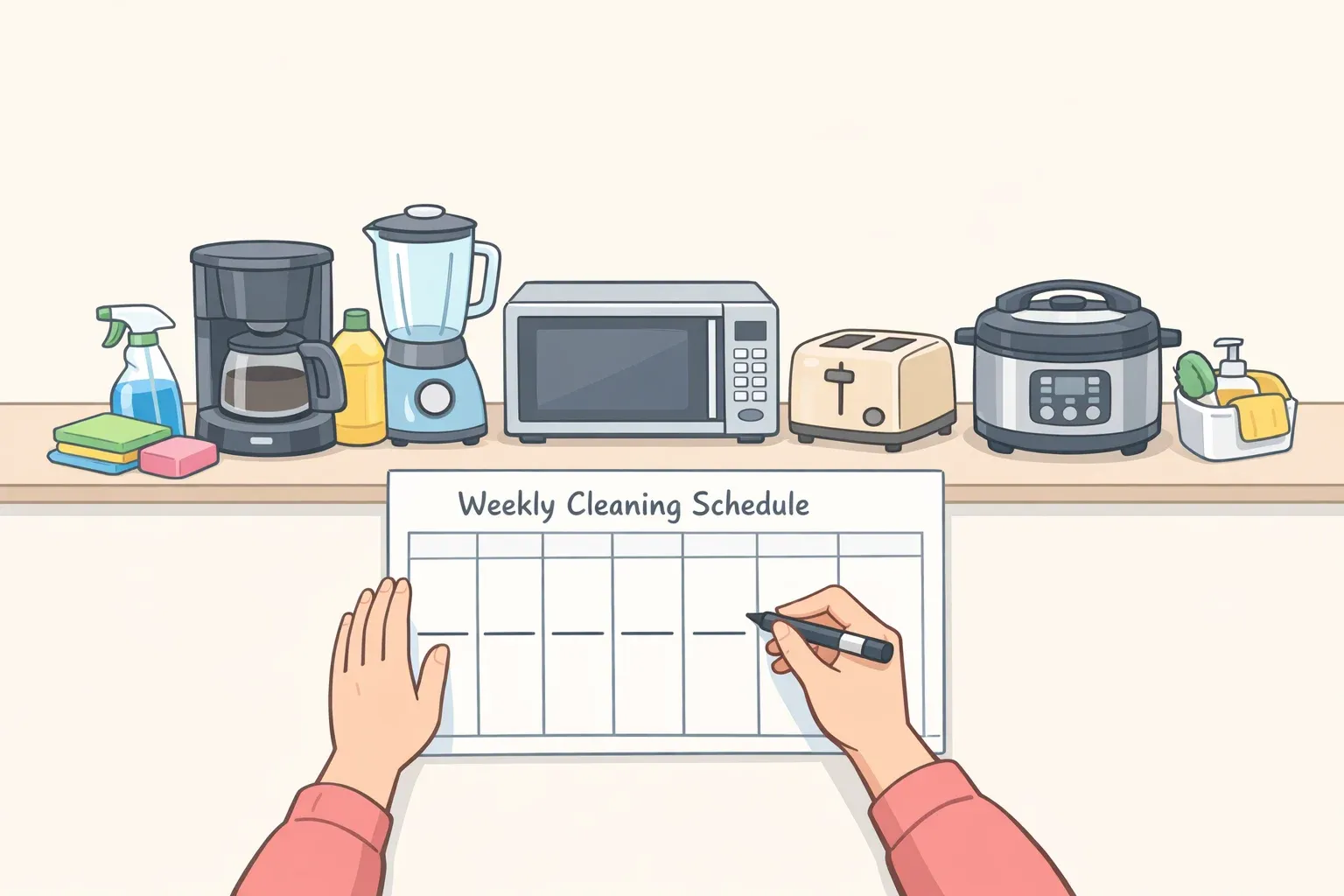
By the end of this guide, you'll have a clear, frequency-organized cleaning schedule for five household appliances: coffee makers, washing machines, ice makers, water filter pitchers, and air fryers. Each section covers the specific reasoning behind each interval, what buildup actually does inside that appliance, and step-by-step instructions for the tasks that trip people up most.
These five share a specific trait: the buildup that degrades their performance is invisible until it's already become a problem. That's different from a stovetop, where you can see the spatter, or a refrigerator shelf, where the evidence is obvious. Each of these appliances looks fine long after the cleaning interval has passed.
The washing machine adds a harder edge to the argument: a Frontiers in Microbiology study last year found measurable microbial loads persisting through standard wash and dry cycles, with front-loaders carrying higher bacterial and fungal burdens than top-loaders.
If you only do three things this week: Run your washing machine on a hot cleaning cycle, descale your coffee maker if it's been more than three months, and sanitize your ice maker if you can't remember the last time you did. The rest of this guide fills in the full schedule around those three.
After every use: air fryer and coffee carafe
Two kitchen appliances to clean after every single use. Not because the task is complex, but because residue compounds across uses in ways that change how each appliance performs.
Air fryer
Treat the basket and tray the way you'd treat a sauté pan: cooking in yesterday's grease is the problem, not a preference. Accumulated fat and food particles reheat with each subsequent use, causing uneven cooking results, persistent odor, and possibly smoking or fires.
Let the unit cool completely before handling.
Remove the basket and tray. Wash both with warm soapy water and a non-scratch sponge.
For stuck-on grease, soak in hot soapy water for 10 minutes before scrubbing. Don't use abrasive pads; they strip non-stick coatings.
Wipe the interior cavity with a damp cloth. Residue reaches the cavity walls on every use and burns over time if left there.
Dry everything fully before reassembling.
The cavity wipe-down is easy to skip because the interior is hard to see into. Don't. That surface gets no routine scrubbing, and it's where odor and smoke problems start.
Coffee carafe
Coffee oils cling to glass and stainless steel between uses and go stale. Washing after each use with warm, soapy water handles daily accumulation. This is essential, not optional upkeep.
Once a month, a deeper clean with a citric-acid product like Bottle Bright, or a small amount of uncooked rice swirled in warm soapy water, removes the oil staining that routine washing leaves behind. The carafe won't fail without it, but flavor and appearance both benefit.
Don't neglect the warming plate. Coffee drips burn onto it with each cycle, and the residue that burns on becomes harder to clean over time.
Weekly through quarterly: coffee maker care in full
The coffee maker has more cleaning intervals than any other appliance here: weekly, biweekly, and quarterly. Each interval addresses a different type of buildup, which is why this section runs longer than the others.
Why the coffee maker accumulates so much
Water minerals and coffee oils both deposit on internal surfaces with every use. The oils affect flavor; the minerals restrict water flow through the machine's internal components over time. Neither announces itself visually. The problem is particularly acute here because hot liquid contacts every internal surface on every single brew.
Weekly: plastic parts
The lid, filter basket, and carafe holder collect coffee residue between descaling sessions. A quick soapy wash weekly, two or three minutes at most, prevents that residue from reaching the cup and from hardening into the kind of buildup that eventually requires soaking to clear.
Every two weeks: water reservoir
Remove the reservoir.
Scrub with a bottle brush and soapy water, including the underside of the lid.
Rinse thoroughly.
Leave the lid open and let the interior dry completely before replacing it.
Trapping moisture inside the reservoir between uses contributes to internal buildup over time. The open-lid step takes no effort, but it matters.
Quarterly: full descale
This is the most important maintenance task on the coffee maker and the most commonly delayed. Do not wait for the machine to prompt you. By the time the descale indicator activates, mineral scale may already require multiple cleaning cycles to fully clear.
Set a calendar reminder every three months and run the descale regardless. That said, descaling when you notice flavor changes or when the machine prompts you is also a valid approach. The quarterly cadence is the more proactive standard; either works, but a calendar reminder beats waiting for symptoms.
Remove the charcoal water filter from the reservoir if there is one. Vinegar will damage it.
Fill the reservoir with equal parts white vinegar and water.
Start a brew cycle and run it until the "add water" indicator activates. Discard the carafe contents.
Let the machine sit for 30 to 60 minutes. This dwell time lets the acidic solution work inside the machine, not just the reservoir. Skipping it makes the descaling significantly less effective.
Rinse the reservoir, refill with clean water, insert a fresh paper filter, and run a full brew cycle until the "add water" indicator activates again.
Repeat the clean-water cycle until no vinegar smell or taste remains. Heavy buildup may require two or three rinse passes.
Replace the charcoal filter with a new one, soaked and rinsed per manufacturer directions.
The vinegar method works for most standard drip coffee makers. For pod machines and espresso machines, check the manufacturer's instructions first. Some require proprietary descalers, and some void warranties if vinegar is used internally.
Every two weeks and monthly: ice makers and water filter pitchers
These two appliances handle water continuously in enclosed environments. Mineral deposits and odor buildup are inevitable regardless of how clean the exterior looks.
Ice maker
Ice makers appear sealed and self-contained, which is exactly why they tend to go unmaintained. They're prone to buildup over time, and problems develop well before the ice starts tasting or looking wrong. The instruction is direct: clean your ice maker more than once a year, even if it looks fine.
The default schedule: descale and wash removable parts every two weeks; run a full sanitization monthly. If your machine has its own indicator or manufacturer guidance, follow that instead. Ice makers vary more by model than almost any other appliance on this list, and some have built-in schedules calibrated to their specific internal surfaces. Check the manual before establishing any cadence.
One distinction worth keeping straight: descaling uses an acidic solution to dissolve mineral deposits; sanitizing uses a food-safe sanitizer to reduce microbial load. These are different tasks that address different problems. Don't treat them as interchangeable.
Water filter pitcher
The filter replacement schedule, often up to six months per cartridge, says nothing about the pitcher or reservoir itself. Those need separate attention. Without periodic washing, the reservoir develops buildup, and the water starts to look murky.
Disassemble the pitcher and remove the filter.
Wash the reservoir, lid, and any removable components with warm soapy water every two weeks.
Rinse thoroughly, reinstall the filter, and reassemble.
Don't put the reservoir through the dishwasher unless the manufacturer explicitly approves it. Heat can warp the plastic housing or degrade the seal around the filter seat.
Monthly: the washing machine, where the evidence goes further
The washing machine is the one appliance here where the case for regular cleaning goes beyond taste, odor, and performance. Peer-reviewed research changes the nature of the recommendation.
A Frontiers in Microbiology study last year found that household washing machines carry significant microbial loads with user-specific communities, and that microorganisms persisted through both standard wash cycles and drying, with neither step producing significant reductions in bacterial or fungal recovery. Front-loaders showed higher overall microbial burdens than top-loaders. The findings suggest the machine does not reliably clear microbial load between loads.
What the research did and didn't show matters here. No bacterial or fungal taxa at the highest pathogenic risk level were detected in any sample. The concern is persistent opportunistic microorganisms and the inadequacy of standard cycles at reducing them, not confirmed dangerous pathogens in typical households.
The researchers also noted they didn't collect participant health data, which limits how far the findings can be extended. Consumer Reports has made a related point, noting that higher cleaning frequency hasn't been shown to prevent specific illnesses in average households. The risk is most clearly relevant for immunocompromised individuals, a point the study itself flags.
The practical case for monthly washing machine cleaning is maintenance, odor prevention, and contamination reduction.
Without regular cleaning, machines develop a film of detergent residue and laundry soil on internal surfaces. Front-loaders are particularly prone to odor because the rubber door gasket traps moisture in its folds between uses.
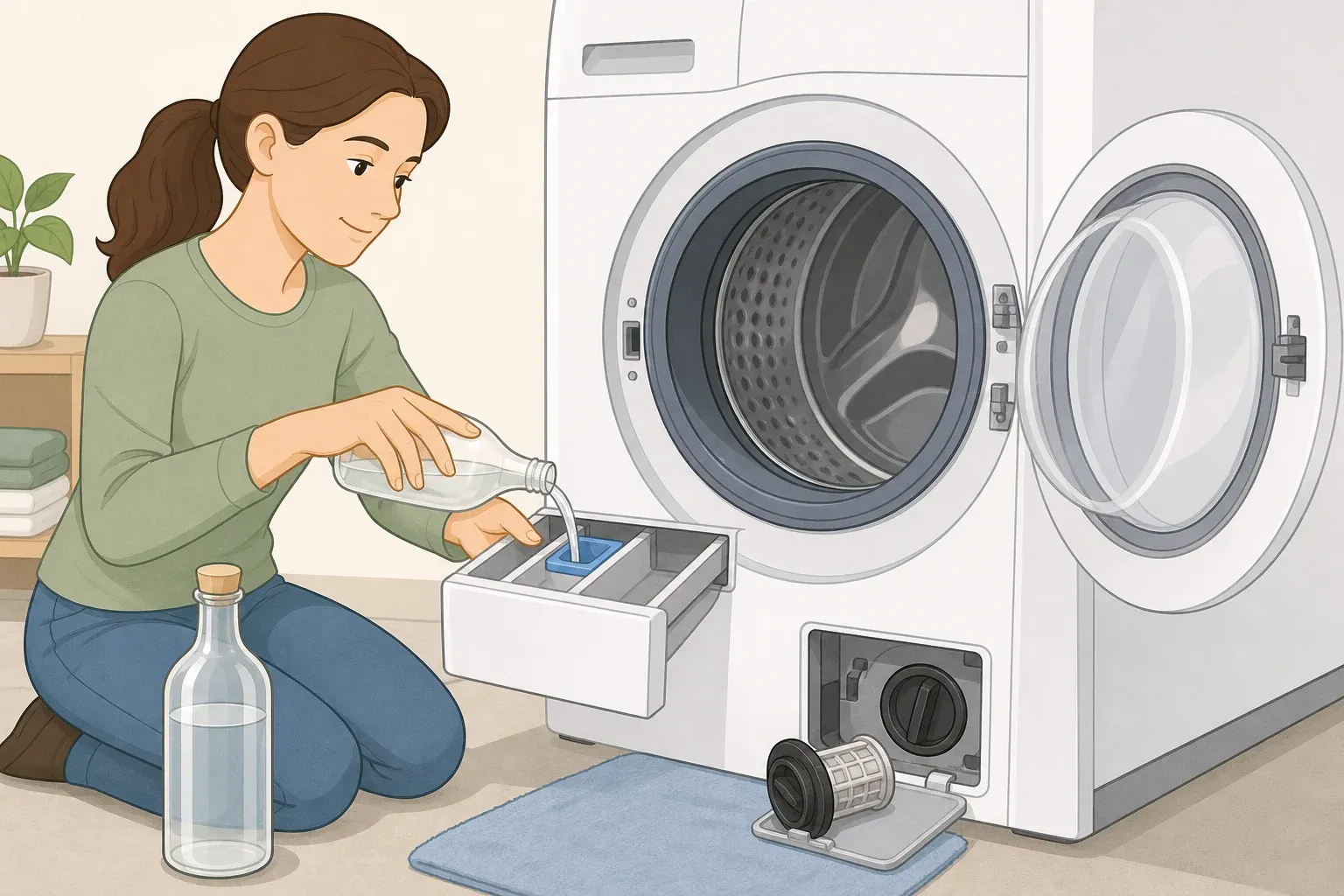
Check whether your machine has a dedicated cleaning cycle. If so, run it with the bleach dispenser filled or a cleaning tablet placed directly in the drum.
If there's no cleaning cycle, run a normal wash on the hottest available water setting with bleach or a commercial cleaner.
Follow with a rinse cycle to clear chemical residue from the drum.
Wipe down the door gasket folds, drum opening, and detergent drawer with a damp cloth.
That gasket wipe-down is worth doing after every wash, not just monthly. Moisture trapped in the folds between uses is the primary driver of front-loader odor, and a 30-second wipe after each load is more effective than trying to catch up once a month.
Stick to a calendar, not your eyes
Set reminders for the intervals that don't announce themselves: the quarterly coffee maker descale, the biweekly reservoir wash, the monthly washer cycle. Indicator lights are lagging signals. On the coffee maker specifically, the descale light activates after buildup is already significant enough to require extra cleaning passes to clear, which is why Bleyer's advice is to pre-empt it entirely.
For most households, the payoff is entirely practical: better-tasting coffee, clearer water, an air fryer that doesn't smoke, a washing machine that doesn't smell. For households with immunocompromised members, the washing machine schedule carries more weight. The Frontiers in Microbiology research specifically flags standard laundry practices as potentially insufficient for those populations, even when the machine appears to be running normally.
Dishwasher filters, refrigerator coils, range hood filters: the same principle applies. Buildup operates on a schedule, whether or not you do.






Comments
Be the first, drop a comment!