



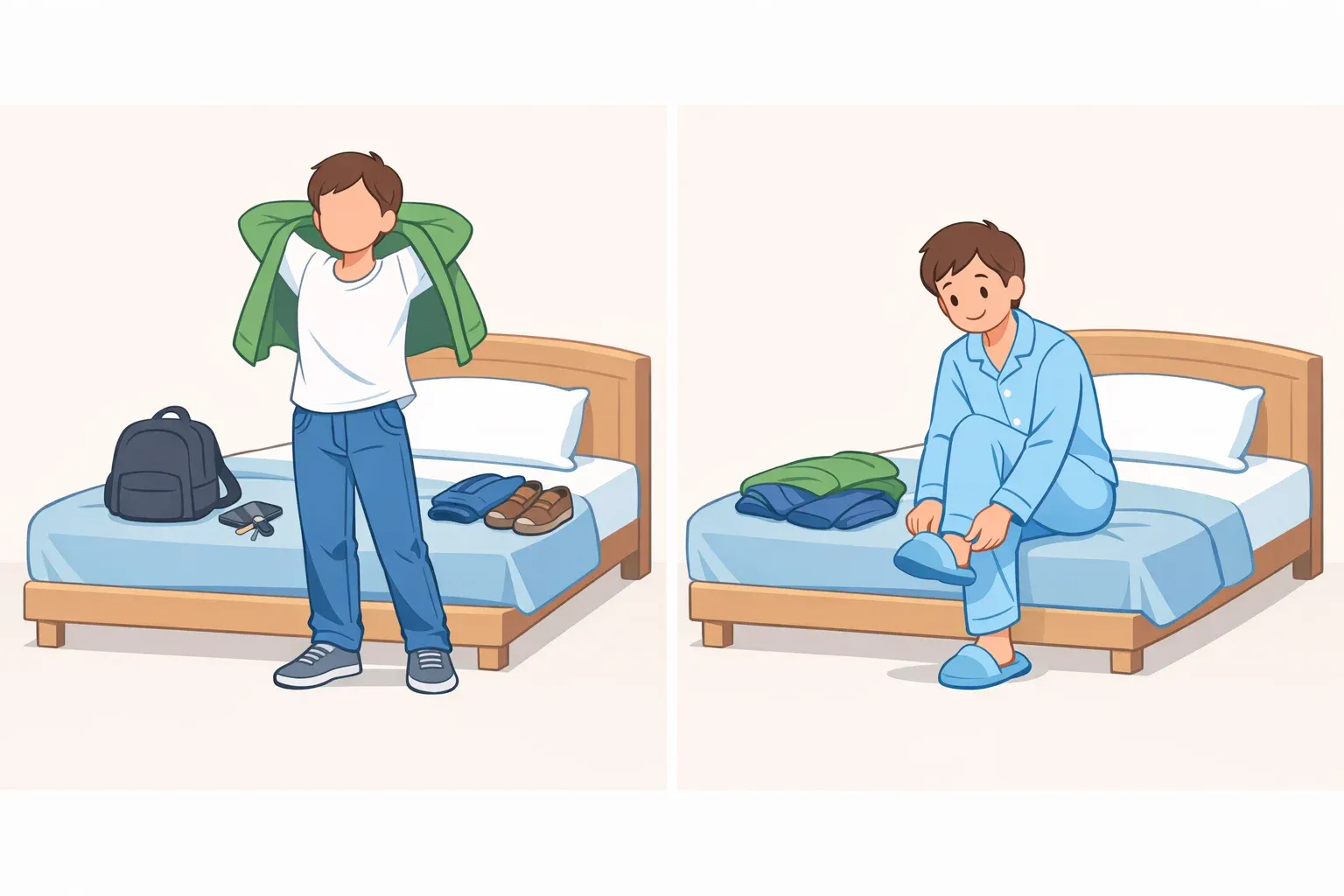
Is it bad to wear outside clothes in bed? Probably not in any dramatic sense, but that framing leads to the wrong conclusion. The better question is which clothes, from which places, are worth changing out of before you climb under the covers. The answer is more specific than "always" or "never," and considerably more useful than either.
P&G Fabric Care Scientist Kimberly Romine, via Good Housekeeping, puts it plainly: clothes worn outside carry dirt, dust, and odors that transfer directly to bedding. Carolyn Forté, executive director of the Good Housekeeping Institute's Home Care & Cleaning Lab, draws the same line: sitting on the couch in outside clothes is tolerable; getting into bed in them is not.
That distinction turns on where you've been. A drive to the pharmacy and a rush-hour subway commute are not equivalent, and the guidance reflects that.
Why the bed earns stricter treatment than the couch
The couch gets occasional vacuuming and intermittent contact. Sheets press against your face, hands, and skin for seven or eight hours straight. That difference in duration and intimacy is what puts the two surfaces in separate categories.
Sheets are already a busy surface before outside clothes enter the picture. They collect body oils, dead skin cells, bacteria, and anything else the body sheds through ordinary sleep. Dust mites feed on that shed skin, and their waste is a documented trigger for allergy symptoms. Body oils alone, given enough time, produce the kind of staining that survives multiple washes. Outside clothes don't create that problem; they accelerate it.
Think of it like a cutting board used every night. Each additional contaminant doesn't ruin it on contact, but accumulation is what eventually creates a real cleaning problem. The bed generates enough of its own without importing more from outside.
Romine's recommendation follows directly from that logic. Changing when you get home isn't a decontamination ritual. It's a simple default that stops the transfer before it happens and, she adds, keeps the sleep environment better-smelling.
Is it bad to wear outside clothes in bed? It depends where you've been
Where your clothes have been is the variable that changes the calculation. The expert guidance from Forté and Romine isn't a universal rule; it's a gradient based on exposure.
Low concern: errands by car, short neighborhood walks. These outings involve minimal contact with high-density surfaces. Forté says directly that running errands in your car or taking a quick walk around town doesn't make changing urgent. Extended to the bed, the marginal contamination added is small relative to what the body already brings to the sheets. Changing is still a better practice; skipping it once isn't a real problem.
Change immediately: transit, airports, gyms. Clothes worn on public transportation or in airports have spent extended time against high-density surfaces shared by many people. Gym clothes add sweat and direct skin contact from shared equipment. Forté is unambiguous: airports and public transportation are a different category entirely. A packed subway car and a drive to the grocery store are not equivalent situations and shouldn't be treated as such.
That distinction matters because the days when changing is most important are also the days you're most likely to get home exhausted and skip it. Building the habit on low-exposure days makes it automatic on the high-exposure ones.
A note on fabric. Research from hospital settings published in late 2025 found that fleece garments showed higher bacterial contamination rates than other fabric types, PMC/NIH found. Two caveats apply: the study could not establish that those bacteria caused any patient infections, and hospital conditions are far more intense than a typical commute. The finding is best read as evidence that fabric type affects what clothes pick up under high-exposure conditions, not as a direct warning about everyday life. Fleece worn regularly on transit is where it becomes relevant context.
What sheets actually accumulate between washes
Most people know sheets need regular washing. Few appreciate what's building up in the interval, which makes the weekly standard feel arbitrary rather than grounded.
Every night, sheets absorb sweat, body oils, and dead skin cells. Those oils work into the fabric over time and cause staining that outlasts multiple washes. Dead skin accumulation creates a food supply for dust mites; the waste those mites produce aggravates allergy symptoms. Bacteria follow the same trajectory: manageable in small quantities, a growing problem when allowed to accumulate over weeks.
Outside clothes add to that accumulation but don't change its fundamental nature. The bed would need weekly washing even if you changed into clean pajamas every night. What outside clothes do is shorten the window between necessary washes, pulling a surface that might hold two weeks closer to one.
The practical routine: clothes and sheets
When you get home:
Change out of outside clothes after any day involving transit, airports, gyms, or extended time in crowded spaces. Romine frames this as prevention: stop the transfer before it happens.
Wash clothes worn in crowded urban environments after a single wear, using a quality detergent.
Sheets:
Wash sheets weekly. Skipping a week occasionally is fine; going past two weeks is not.
Use warm water rather than hot. Hot water can shrink sheets in ways you won't notice until you're trying to wrestle them back onto the mattress.
Skip a top sheet and sleep directly against a duvet or comforter? That layer needs weekly washing too, since it's absorbing the same direct skin contact as a fitted sheet would.
Pillow protectors should be washed monthly. Without them, washing pillows every one to two months is the better standard.
For immunocompromised households:
Standard home laundering may not fully eliminate all pathogens. Research published in late 2025 found that typical washing cycles leave measurable microbial communities in household machines, and that machine drying did not significantly reduce those loads, PMC/NIH found. The same research noted that front-load machines carried significantly higher microbial loads than top-load machines. No highly pathogenic species were identified, but opportunistic microorganisms were present.
For most healthy adults, that's background noise. For households with medically vulnerable members, it supports the case for laundry sanitizing additives and keeping high-exposure clothes away from bedding until washed. Not a medical directive, just a tighter standard applied consistently.
Putting it together
Wash sheets every week, and don't push past two weeks. That one habit manages the baseline accumulation problem regardless of what you wore to bed the night before.
Everything else builds on that floor. If the day involved public transit, airports, gyms, or extended time in crowded spaces, change before bed and wash those clothes before wearing them again. If it was errands by car or a walk around the block, the risk is low, but the habit is still worth maintaining. Consistency is what makes it work on the days it actually matters.
The bed has more prolonged, direct contact with your body than any other surface in your home. That's not a reason for anxiety. It's a reason for a simple, repeatable default.




Comments
Be the first, drop a comment!