



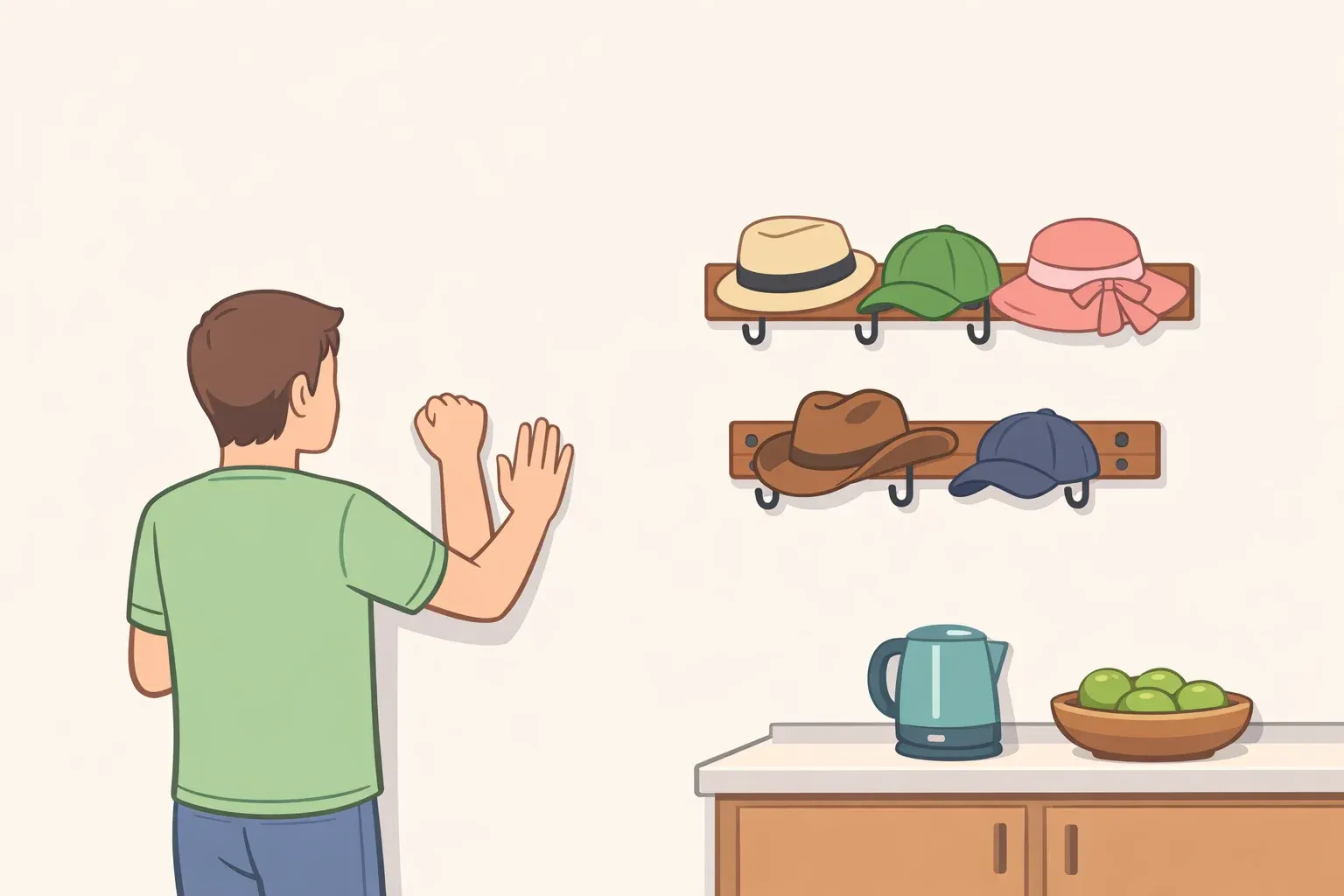
The question worth asking isn't whether a kitchen is a good place for hat storage. It's whether the specific wall you're considering behaves more like a dry, shaded corridor or an active cooking environment. That single distinction determines whether a wall rail is smart small-space thinking or a reliable way to ruin a straw hat.
By the end of this guide, you'll know whether your wall qualifies, which hats belong on it, and what to do with the ones that don't.
The "sounds greasy and risky" instinct is legitimate. Sweatbands trap oils that encourage mold and attract pests, as Laird Hatters noted. The argument here isn't that kitchens are fine for hats. It's that a specific wall in the right kitchen can be fine, and the difference is measurable.
The three environmental threats to hat materials are moisture, heat, and direct sunlight. Moisture causes mold and warping, heat shrinks natural fibers, and sunlight fades both straw and wool. Mold growth accelerates above 60% relative humidity; ideal storage conditions sit between 45 and 55%, Laird Hatters notes. This guide works through three passes: hat suitability, wall suitability, and setup.
Quick decision: use the rail or skip it
If you're in a hurry, here's the short version.
Use a kitchen wall rail if:
The wall is shaded, dry, and away from the stove, sink, and steam sources
The hats are casual, unstructured, and in active rotation
Skip it if:
The hats are felt, wool, vintage, or structured
The wall sits anywhere in the cooking arc
Humidity rises noticeably when you cook and stays elevated
Best alternative for everything else: a breathable box, hat stored crown-down, acid-free tissue inside the crown, desiccant alongside.
The sections below explain the reasoning behind each of those calls.
Step 1: Decide which hats can hang and which need a box
Before evaluating any wall, establish which hats belong on a rail at all. This is the first gate, and failing it makes everything else irrelevant.
A wall rail is everyday access storage for hats in active rotation. Not preservation. Any hat you haven't worn in three weeks, or won't reach for in the next three, belongs in a box rather than on a hook.
Reasonable candidates for hanging hat storage:
Casual straw hats and sun hats worn regularly during their season. Straw handles hang well in a stable, dry environment, but become brittle when too dry and grow mold when damp.
Unstructured cotton, linen, and packable hats without rigid internal shaping.
Any hat you reach for at least weekly and that can tolerate brief environmental variation.
Hats that belong in a box, not on any rail:
Structured felt fedoras and wool hats. Felt is sensitive to both pressure and humidity, and hanging stretches seams over time.
Vintage or heirloom pieces, which need breathable boxes with desiccants like silica gel or activated charcoal, protected from open air but not sealed in airtight plastic.
Any structured hat being stored off-season: position it crown-down in a hat box with the brim facing up, and stuff acid-free tissue inside the crown to prevent collapse under its own weight.
One common mistake: systems marketed specifically for baseball caps often use narrow bars or spring clips that grip directly on the crown and compress it. Don't repurpose one for any hat with a defined structure. The crown is the most structurally vulnerable part of any shaped hat; sustained pressure deforms it permanently.
With the right hats identified, the next question is whether the wall itself qualifies.
How to store hats in the kitchen: test the wall first
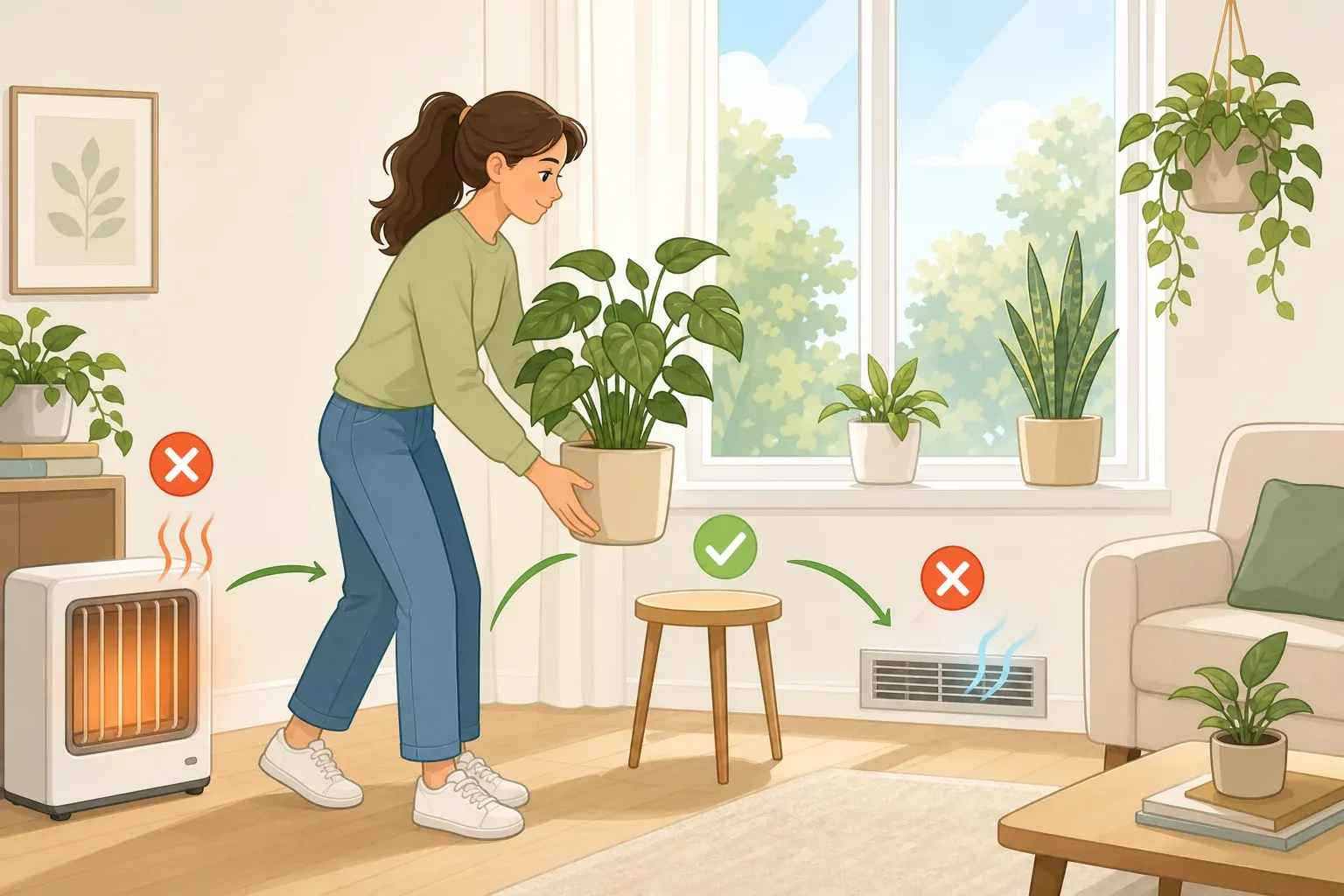
The kitchen is not a room category. It's a set of microclimates. Two kitchens in the same building can produce completely different storage conditions depending on airflow, appliance placement, window orientation, and ventilation.
A shaded breakfast nook wall with good cross-ventilation is a fundamentally different environment from a wall beside a kettle. The room label matters far less than the local air.
Automatic disqualifiers: any one of these fails the wall.
Within roughly three feet of the sink or any splash source (a practical buffer, not an exact cutoff)
Above, beside, or within radiant range of the stove or any heat-generating appliance
Facing a window that receives direct sunlight at any point during the day. Sunlight fades straw and wool, Hampui Hats confirms.
In the primary cooking arc: any wall that regularly receives steam from boiling water, a kettle, a rice cooker, or a pressure cooker
In a kitchen with poor ventilation where humidity climbs noticeably during cooking and stays elevated
To anchor the rule with a concrete contrast: a wall at the far end of a galley kitchen, shaded, away from appliances, with airflow from an adjacent room, passes. A wall two feet from the stove, facing a sunny window, directly above where a kettle sits, fails on three counts at once.
A practical self-test. Stand at the wall in question for ten minutes while cooking a normal meal. If you feel heat, notice condensation, detect steam, or observe the wall in direct light, it fails. This isn't a scientific threshold, but it's a reliable proxy for what hat-care guidance describes as ideal storage conditions: cool, dark, and dry.
Even a wall that clears those tests may still accumulate cooking grease over months. Sweatbands trap oils that encourage mold and attract pests, Laird Hatters notes, and a wall in the active cooking arc accelerates that process. A useful shorthand: if the wall is where you'd mount a spice rack, skip it. If it's where you'd hang a calendar, it's a genuine candidate.
Step 3: Set up the rail and keep the system working
Installing the rail
Use any wall-mounted rail with wide, rounded hooks. The hook shape is non-negotiable: rounded and wide enough to cradle the interior of the crown without pressing a point into it. Narrow or pointed hooks dent the crown slowly but reliably.
One compact option worth knowing about: the IKEA KUNGFORS is a stainless steel wall-mounted rod with five hooks, retailing at $22.99 with a temporary $2 discount running through August 2026. It requires wall mounting with screws and fittings not included. Reviewers have called it "high-quality and elegant" and noted it works well in small spaces, including RVs. It's being discontinued, so stock is limited, but any comparable rail with rounded hooks works on the same principle.
Measure clearance before drilling. The rod is roughly 16 inches long, but items hanging from it extend at least 10 inches below the mount. For wide-brim hats, confirm the brim won't rest against a countertop or adjacent wall surface.
Space hats so no brims overlap. Sustained brim-to-brim contact deforms shape over time, just as a bad hook does. If the rail can't hold your hats with clear spacing between each, use fewer hooks or a longer rail.
Before hanging each hat
Inspect before the hat goes up, not after a problem appears. Cup the crown and breathe gently into it: mustiness or a sour smell means something is already growing. Hold the hat under low-angled light and look for powdery or fuzzy patches. A hat that doesn't clear this check gets cleaned first.
Wipe down sweatbands and fixed linings with a barely damp cloth and mild soap before hanging. Sweat residue is the primary driver of mold and pest activity in stored hats.
The hat must be completely dry before it goes on the rail. Straw is especially unforgiving: prolonged moisture swells and splits the braids.
One handling note that applies at every stage: always pick up a hat by the brim, never the crown. Repeated crown-gripping deforms the hat before storage is even a factor.
Keeping the system working
Check hats every two to three weeks, with a quick smell and visual scan. If any hat shows new odor, discoloration, or surface spots, remove it immediately and isolate it in a breathable bag before it can affect the others, Laird Hatters advises. Two minutes of attention catch problems that would otherwise require a serious cleaning effort or, in bad cases, write off a hat entirely.
Hang here, don't hang here, box instead
A kitchen rail works for casual, actively worn hats on a dry, shaded wall outside the cooking zone, with wide rounded hooks, adequate spacing, and clean hats that go up completely dry. The room label is irrelevant; the microenvironment is everything.
Structured felt hats, wool hats, vintage pieces, and anything not being worn this season don't belong on any rail. Those go into breathable containers, not airtight plastic, which traps moisture, with a desiccant like silica gel or activated charcoal to stabilize humidity, per Laird Hatters and Hampui Hats.
When the season turns, straw hats come off the rail, get a quick inspection and clean, and move into a breathable box: crown-down, tissue inside the crown, desiccant alongside. That one seasonal step is what makes hanging hat storage a complete system rather than a warm-weather gamble.







Comments
Be the first, drop a comment!