



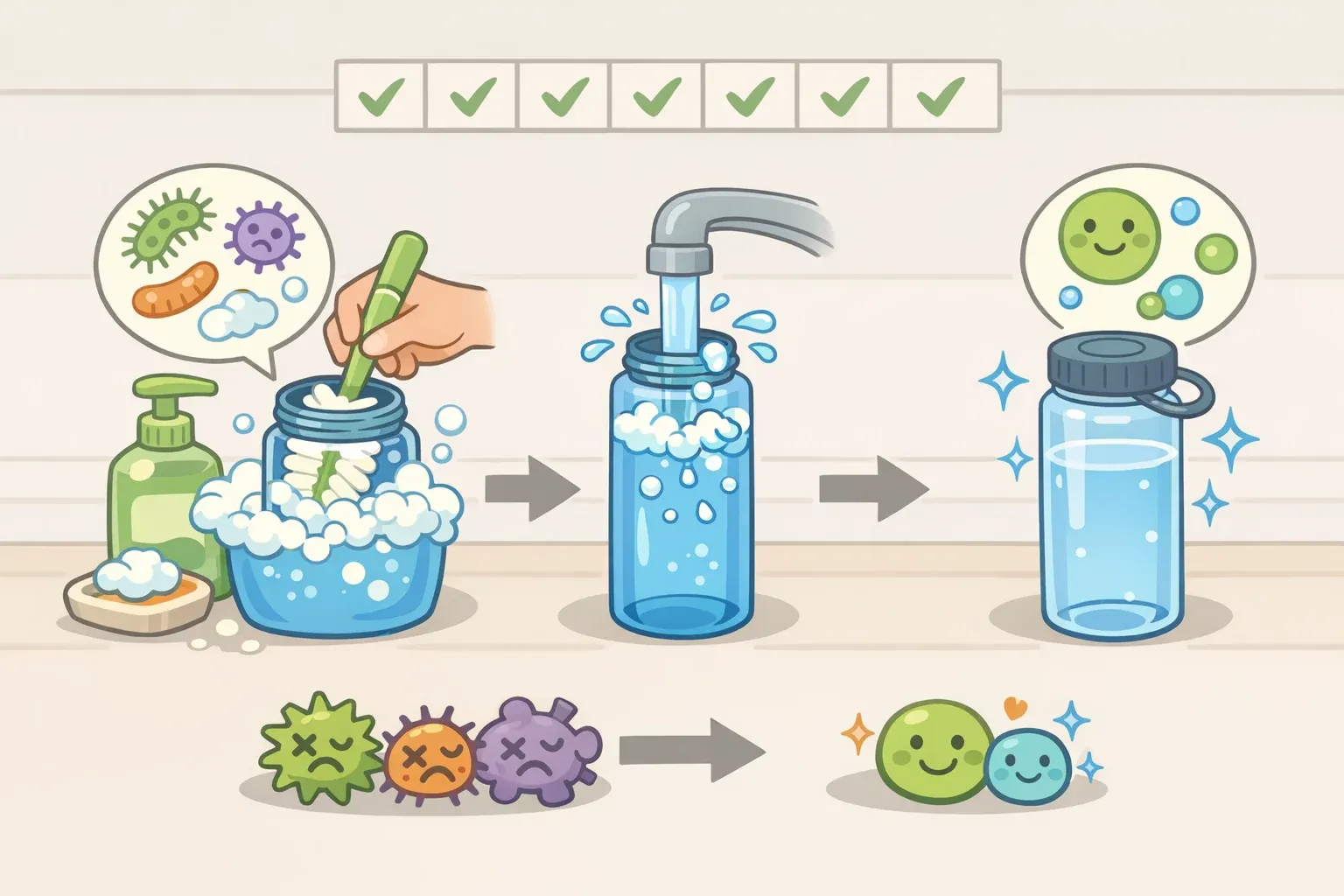
The answer is simpler than most people think: rinse daily, wash with soap after each use, and do a full, disassembled deep clean once a week. Those aren't arbitrary rules. They're recommendations from clinical sources, grounded in a body of microbial evidence that makes a clear case for why the schedule works and what happens when you skip it.
Worth noting upfront: the key studies here use small samples, 37 bottles in one, 30 in another. The evidence supports practical guidance. But the patterns across studies are consistent enough to be useful.
No official guidelines exist on how often reusable bottles should be cleaned. Researchers have flagged this explicitly as a gap in the literature, as per the Journal of Pharmacy and Bioallied Sciences via PMC. What exists instead is microbial evidence and clinical recommendations, and they point in the same direction.
A 2025 study of 37 student bottles at a Malaysian university found that 95% of participants knew their bottles could harbor microbial contamination. Those same bottles showed 78% exceeding the WHO's safe-consumption threshold for bacterial load, with a median bacterial count 31 times above that limit, according to the UTAR study. Knowing isn't the same as cleaning consistently.
This guide covers why contamination builds up faster than most people expect, how to adjust your washing schedule to how you actually use the bottle, and a step-by-step method that handles the parts most people miss.
Why your bottle gets dirty even when it's just water
A reusable bottle's interior stays dark, moist, and warm for most of the day, near-ideal conditions for microbial growth. According to Cleveland Clinic physician Dr. Sumego, every time someone fills, sips from, or caps their bottle, they introduce bacteria from their hands and mouth. Without regular cleaning, that accumulation forms a biofilm, a thin slimy film on interior surfaces that signals bacterial and mold buildup.
Microbial load doesn't hold steady; it climbs. A 2024 pilot study found that bacterial counts in plastic bottles rose approximately 70% after just three hours of use, while stainless steel bottles saw a roughly 23% increase over the same period. That time-based growth is one of the stronger arguments for a daily cleaning cadence rather than a weekly one.
The way you drink matters too. Bottles used with direct mouth contact carried nearly twice the microbial load of pour-style bottles. If the mouthpiece touches your lips, it's introducing oral bacteria with every sip.
The contamination is real and measurable. Whether it causes illness is a harder question. The UTAR study notes there are currently no documented outbreaks or confirmed illness cases tied specifically to water bottle hygiene, and high bacterial counts don't automatically mean the organisms present are pathogenic.
FGCU biology professor Dr. Nora Demers told WBBH that the bacteria found on unwashed bottles are often the same organisms already present in a healthy person's mouth, and in otherwise healthy people, they're unlikely to cause harm. The risk calculus shifts for people with weakened immune systems, respiratory conditions, or mold sensitivities, for whom Cleveland Clinic notes repeated exposure to mold and bacteria can trigger GI symptoms, allergic reactions, and respiratory issues.
Contamination builds reliably. The cleaning schedule below is calibrated to interrupt it before it compounds.
How often should you wash your water bottle? A decision framework by use case
The baseline for most people: Rinse with warm water after every use. Wash with soap and a bottle brush at the end of each day. Disassemble fully and deep-clean once a week. This is the convergent recommendation from the Cleveland Clinic.
Wash immediately after using the bottle during a workout, filling it with anything other than plain water, or sharing it with anyone else. Flavored drinks and sports drinks leave sugary residue that feeds microbial populations, and more frequent mouth contact accelerates buildup. These situations call for an immediate wash rather than waiting until the end of the day.
Deep-clean sooner than weekly if the bottle develops an off smell or taste, you can see any film or discoloration on interior walls, or the bottle has been sitting unused with liquid inside for more than a day.
A note on bottle material. The studies from 2024 and 2025 found much higher bacterial levels in plastic bottles than in stainless steel ones. The evidence is not strong enough for a firm recommendation, but plastic may need more careful cleaning because scratches can trap bacteria.
Replace the bottle when persistent odor or visible mold remains after a thorough clean, or the interior shows cracks or deep scratches. Damaged surfaces can't be cleaned reliably; bacteria colonize areas no brush can reach.
If you've been skipping washes for weeks, don't panic. The absence of documented illness outbreaks from bottle hygiene and Dr. Demers's "healthy person" nuance both apply here. Start the routine now, do a thorough deep clean as described below, and let the bottle dry fully before using it again.
How to actually clean a reusable water bottle: daily wash and weekly deep clean
What you'll need before you start: A bottle brush long enough to reach the bottom of your bottle, a narrow straw-cleaning brush or pipe cleaner, dish soap, white vinegar, and enough drying time to let all components air dry completely before reassembly.
Start with the parts most people miss. A 2025 Universiti Tunku Abdul Rahman (UTAR) study found that narrow-neck bottles, where a hand can't fit inside to scrub, were much more likely to harbor coliform bacteria. If your bottle has a narrow opening, a long-handled bottle brush isn't optional. Cleveland Clinic infectious disease specialist Dr. Frank Sumego also points to the silicone gasket inside slider-style lids as a common spot for bacteria to build up. It won't get clean unless you remove it before washing. Straws, flip-top hinges, and screw-on lid threads have the same problem.
Daily wash:
Empty the bottle fully. Don't leave water sitting inside overnight with the lid sealed.
Disassemble the lid completely. Pull out silicone gaskets, detach straws, and separate any moving parts. Washing a lid while assembled cleans only the outside of the problem.
Add dish soap and hot water to the bottle. Shake to coat the interior, then scrub all interior surfaces with the bottle brush, paying attention to the bottom and any seams.
Scrub each lid component separately with the narrow brush. Work the bristles into threads, around hinges, and through the inner channel of straws.
Rinse everything thoroughly with hot water until no soap residue remains.
Air dry with all parts separated and cap off. Upend the bottle on a rack. Reassembling before it's dry traps moisture exactly where you just cleaned.
Weekly deep clean:
Complete all daily wash steps, then fill the bottle with a 50/50 mixture of white vinegar and water. Let it soak for at least 10 minutes. Research cited by the Cleveland Clinic confirms vinegar's effectiveness at inhibiting mold growth. Rinse thoroughly with hot water afterward.
For persistent odors, mix one tablespoon of baking soda with a small amount of water to form a paste, apply it to the interior, scrub, and rinse completely.
Dishwasher option: Many glass and stainless steel bottles are dishwasher-safe; place the bottle and all disassembled parts on the top rack. Do not run plastic bottles through high heat, as it warps the material and accelerates surface scratching.
What the routine actually accomplishes
Washing your water bottle regularly works. A 2024 study found that a standard wash reduced bacteria to well within safe levels, showing that a simple cleaning routine can make a measurable difference.
The studies behind this guidance are small, and the evidence on actual illness outcomes is essentially absent. What the research does show clearly is that contamination accumulates in predictable ways, that certain bottle designs and materials make it worse, and that routine cleaning reliably reverses it.
The practical framework: rinse daily, soap-wash after each use, deep-clean weekly, disassemble every component, and dry completely before resealing. Adjust the cadence upward after workouts, flavored drinks, or any use by someone else. Five minutes a day, and the data shows it works.

Comments
Be the first, drop a comment!