



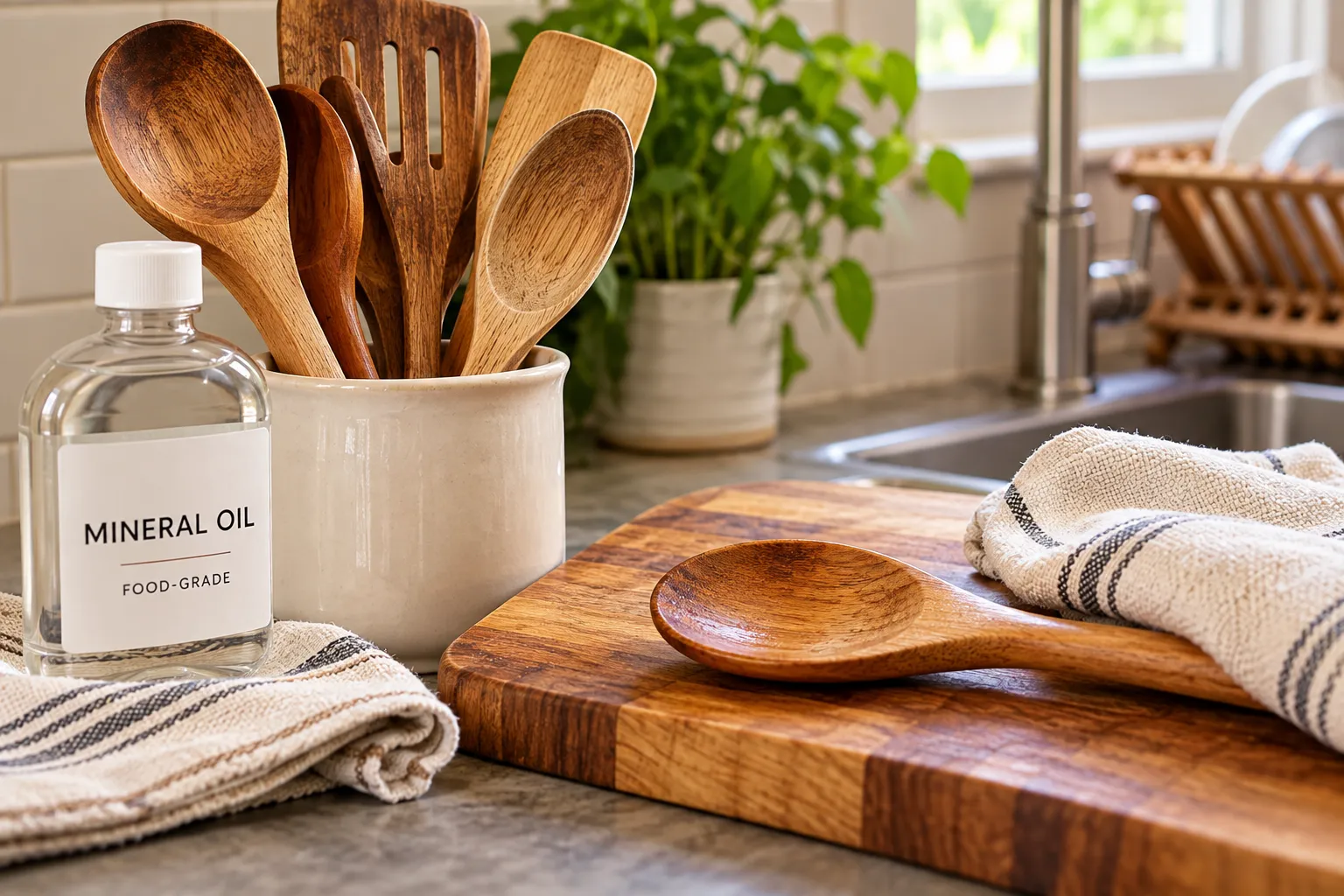
Wooden spoons, spatulas, bowls, and cutting boards can last for years, but a few common habits shorten their lifespan quickly. Repeated dishwasher cycles, long soaks in the sink, and the wrong conditioning oil can all leave wood warped, cracked, rough, or sticky.
The basic care routine is simple: hand-wash promptly after use, let the wood dry completely before storing it, and condition it occasionally with a food-safe product such as mineral oil rather than ordinary cooking oil.
Good Housekeeping's wooden-tool care guide says properly maintained wooden kitchen tools can last for decades. The biggest problems come from prolonged moisture, high heat, and putting the wood away before it has fully dried.
This guide covers the everyday wash-and-dry routine, when a cutting board needs sanitizing, how to tell when wood needs oil, and when a rough, cracked, or badly stained piece is better replaced.
Before you start: what ruins wooden utensils fastest
For most wooden kitchen tools, skip the dishwasher unless the manufacturer specifically says the piece is dishwasher-safe.
Good Housekeeping warns that the combination of prolonged moisture and high heat can cause wooden tools to swell, warp, crack, or dry out.
There is one nuance for cutting boards. USDA says some solid-wood cutting boards can be washed in a dishwasher, while laminated boards may crack or split. Manufacturer instructions therefore take priority for an individual board. (USDA)
For wooden spoons, spatulas, bowls, and most glued or laminated boards, hand-washing remains the safer general routine.
Don't soak wooden tools in the sink.
Standing water lets the wood absorb moisture and swell. Repeated wet-and-dry cycles can eventually contribute to warping and cracking.
The Strategist's woodworking source compares that repeated expansion and contraction with untreated outdoor wood repeatedly getting soaked and drying again. (The Strategist)
Also skip the viral trick of boiling wooden spoons.
Boiling combines prolonged heat with complete water exposure, exactly the conditions wooden utensils generally need less of, not more.
How to clean wooden kitchen utensils without damaging them
What you need: mild dish soap, warm water, a sponge or soft-bristled brush, a clean towel, and a dish rack or other well-ventilated drying area.
Difficulty: beginner-friendly.
Time: a few minutes to wash, plus enough time for the wood to air-dry completely before storage.
This routine is intended for ordinary food-safe wooden spoons, spatulas, bowls, and boards. Follow the manufacturer's instructions instead for painted, lacquered, glued, or specially finished pieces.
Wash promptly after use. Use warm water and a small amount of dish soap rather than leaving the utensil sitting in a sink full of water. Wash away food residue before it dries onto the surface.
Scrub without attacking the wood. Use a sponge or soft-bristled brush to remove food. You do not need to scour aggressively. The goal is to clean the surface without gouging it or wearing through an existing finish.
Rinse thoroughly. Remove soap and loosened food residue under clean running water.
Towel-dry the surface. Wipe away as much water as practical with a clean towel.
Let the utensil air-dry completely. Stand a cutting board upright or place utensils where air can circulate around them instead of stacking damp pieces together.
The University of Maine Cooperative Extension gives similar guidance for wooden cutting boards: wash after use with warm water and dish soap, avoid prolonged soaking, towel-dry immediately, then allow the wood to finish drying before storage.
Good Housekeeping also warns against putting damp wooden tools away because trapped moisture can encourage mold.
When to sanitize a wooden cutting board
Ordinary spoons and spatulas used during cooking generally need thorough washing with soap and water.
Cutting boards can need an extra step when they have contacted raw meat, poultry, or seafood.
USDA recommends:
Wash the board with hot, soapy water after use.
Rinse it with clean water.
Sanitize it when needed with 1 tablespoon of unscented liquid chlorine bleach per gallon of water.
Flood the board with the solution and let it stand for several minutes.
Rinse with clean water.
Air-dry it or pat it dry with clean paper towels.
Follow the bleach product's safety directions as well, and never mix bleach with other cleaners.
Another option is a food-contact sanitizer used exactly according to its label.
For routine home use, separating a board used for raw meat, poultry, and seafood from one used for bread, fruit, vegetables, and other ready-to-eat foods can also reduce cross-contamination risk.
How to oil wooden utensils to prevent drying and cracking
Don't oil wood purely by the calendar.
Condition it when the surface begins looking dry or pale or starts feeling noticeably rough.
How often that happens depends on the wood, how frequently the tool is washed, and how heavily it is used.
For cutting boards, the University of Maine suggests applying food-safe mineral oil or beeswax about once a month, or more often when the board looks dry.
The woodworker interviewed by The Strategist treats his own tools much less often, roughly every six months or whenever they begin looking like they need it.
Both approaches point to the same practical rule: use the condition of the wood as your guide.
What oil to use
Food-grade mineral oil is the simplest option for unfinished wooden kitchen tools and boards.
Look for a product specifically identified as suitable for food-contact wood, such as food-grade or USP mineral oil, or use a conditioner recommended by the utensil or cutting-board manufacturer.
Mineral oil does not oxidize and become rancid in the way many common cooking oils can.
The University of Maine specifically advises against conditioning cutting boards with oils such as olive or vegetable oil because they can become sticky and rancid over time.
Avoid assuming that any oil already in the pantry is suitable simply because it is edible.
How to oil spoons and spatulas
Make sure the utensil is clean and completely dry first.
Then:
Apply enough food-grade mineral oil to cover the surface evenly.
Rub it over all unfinished wood surfaces with a clean cloth.
Let the oil absorb for several hours or overnight.
Wipe away anything remaining on the surface with a clean, dry cloth.
The finished tool should feel smooth rather than greasy or slick.
For cooking spoons and spatulas, plain mineral oil is enough.
The Strategist's woodworking source uses mineral oil without beeswax on tools that regularly contact heat because beeswax can soften or melt when heated.
How to oil cutting boards and wooden bowls
Cutting boards and bowls can use the same mineral-oil treatment.
Apply the oil evenly to a clean, completely dry surface and let it absorb for several hours or overnight.
Very dry wood may absorb the first coat quickly. If the surface still looks dry afterward, another treatment can be applied once the first has soaked in.
There is no need to force a fixed number of coats onto every board.
Follow the conditioner manufacturer's directions and stop once the wood has taken up enough oil to look evenly conditioned without leaving a persistent slick layer on top.
A food-safe mineral-oil-and-beeswax board conditioner can also be used where appropriate.
Don't use olive or vegetable oil as wood conditioner
Olive oil, vegetable oil, and similar cooking oils are poor choices for conditioning kitchen wood.
These oils can oxidize over time and develop an unpleasant smell or sticky surface.
The problem is quality and durability rather than an immediate poisoning risk.
Once cooking oil has soaked into porous wood, removing the resulting odor or tackiness can also be difficult.
Using a purpose-made food-safe mineral oil from the start avoids that problem.
Fixing a rough wooden utensil
A lightly roughened spoon or board does not necessarily need replacing.
If the wood is otherwise sound:
Wash and dry it completely.
Lightly sand the rough area with fine-grit sandpaper.
Remove all sanding dust.
Wash or wipe the piece as appropriate.
Let it dry fully.
Apply food-safe mineral oil.
Keep the sanding light.
The goal is to remove raised fibers or a small splinter, not dramatically change the shape or thickness of the utensil.
If the roughness comes from deep cracking, splitting, or delamination rather than raised grain, replacement is usually the better answer.
What if you already used olive oil?
One accidental application of cooking oil does not automatically mean a wooden spoon or cutting board has to go in the trash.
Wash the piece thoroughly with warm, soapy water, rinse it, and let it dry completely.
Then check it over the next several uses.
Watch for:
A persistent sour or stale-oil smell
A sticky or tacky surface that returns after washing
Mold
Deep discoloration associated with deterioration
Cracks or damage that make the surface difficult to clean
Do not use woodworking solvents such as mineral spirits on a food-contact utensil unless the product manufacturer specifically provides a food-safe restoration procedure.
If a spoon or thin spatula remains sticky or smells rancid after repeated normal washing, replacement is usually simpler and more sensible than aggressively sanding away a large amount of wood.
A thick cutting board can sometimes be professionally resurfaced, but whether that makes sense depends on its construction and condition.
When a wooden cutting board should be replaced
All cutting boards eventually wear out.
USDA recommends discarding wooden or plastic boards once they become excessively worn or develop hard-to-clean grooves.
Those damaged areas can trap food residue and bacteria.
Replace a wooden board if it develops:
Deep cracks
Extensive splitting
Hard-to-clean knife grooves
Delamination
Persistent mold
Damage that prevents effective washing and sanitizing
The same common-sense test applies to wooden spoons and spatulas.
A small rough spot that can be smoothed is maintenance.
A deep split running into the working end of the utensil is damage.
What success looks like
A well-maintained wooden spoon, spatula, bowl, or cutting board should feel clean, dry, and smooth after washing, with no persistent food odor or tacky residue.
The routine is uncomplicated:
Wash promptly by hand.
Don't leave the wood soaking.
Dry it thoroughly.
Sanitize cutting boards when food-safety conditions call for it.
Apply food-safe mineral oil when the wood starts looking dry.
Replace pieces that become cracked, moldy, badly worn, or impossible to clean properly.
You don't need a rigid oiling schedule or a cabinet full of specialty products.
Keep the wood clean, keep prolonged moisture away from it, and condition it when the surface starts telling you it is dry.





Comments
Be the first, drop a comment!