



Here's what this guide will get you: a post-shower routine you can complete in under two minutes that meaningfully reduces how often your bathroom needs a real scrub. Five habits, each with a clear time cost and a specific payoff.
Do them consistently and the bathroom stays cleaner longer not because you're cleaning more, but because you're preventing the grime before it sets. These habits help slow buildup between deeper cleans; they do not replace regular cleaning or disinfecting of toilets, sinks, handles, and visibly dirty surfaces.
Much of the bathroom grime people notice is preventable. The key is controlling moisture before it lingers: the CDC recommends keeping indoor humidity no higher than 50 percent and using bathroom exhaust fans that vent outdoors, while the EPA says mold prevention starts with moisture control. This guide is built around the post-shower window, with one additional maintenance check for bathrooms that persistently fight back.
Two things drive much of the grime people notice. First, mineral deposits: when water evaporates on glass, tile, and fixtures, it can leave residue that looks like dirt even on otherwise clean surfaces. Second, lingering moisture: mold cannot grow without water or moisture, and bathrooms are especially vulnerable when steam, damp fabrics, or leaks keep surfaces wet.
What you'll need: A small shower-mounted squeegee, a microfiber cloth or designated wipe-down towel, and a functioning exhaust fan that vents to the outside. If you're not sure about the last one, that's the first thing to check.
The 90-second post-shower routine
These four habits work together as a single sequence. Run them after every shower and they address the main sources of bathroom grime: airborne humidity, surface water, and damp fabrics.
Habit 1: Run the fan before, during, and after your shower
Turn the exhaust fan on before you start your shower, and leave it running after you step out. The Home Ventilating Institute recommends running a bathroom fan for 20 minutes after use; if the room still feels damp after that, leave the fan on longer or use a timer switch. The CDC also recommends keeping indoor humidity no higher than 50 percent and using bathroom fans that vent outdoors.
One practical diagnostic: confirm the fan vents outdoors, not into an attic or enclosed space. Also check the grille. Dust buildup can reduce airflow, so vacuum the cover periodically and clean it whenever it looks clogged. If the fan does not clear steam from the mirror or walls after a normal shower, it may be undersized, clogged, or not venting properly.
No fan, or a fan that does not work well? Good Housekeeping suggests opening a window or leaving the bathroom door cracked after showering so moisture can escape. If you use a portable fan, keep the fan and cord well away from water and splash zones.
Habit 2: Squeegee shower walls and glass
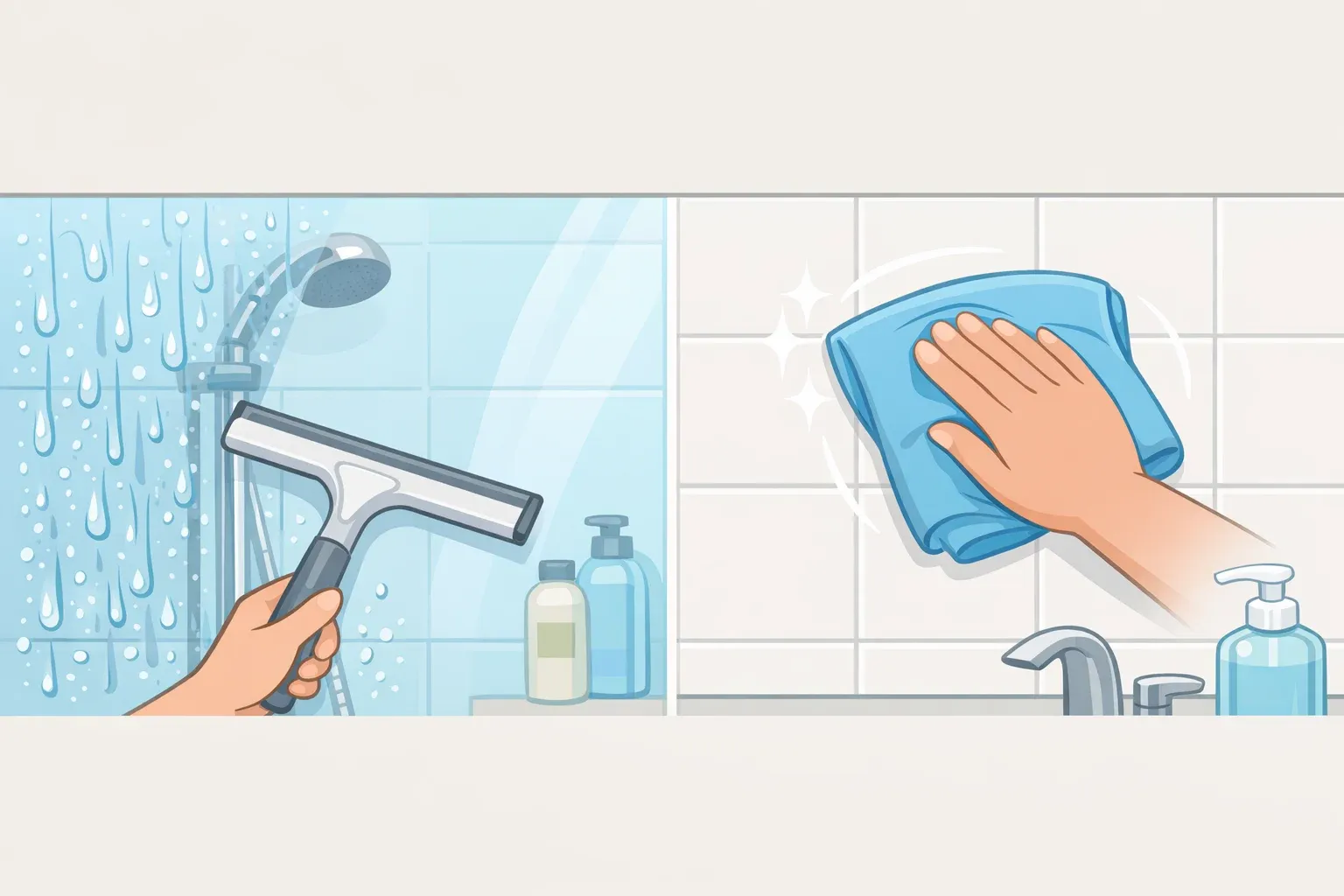
Before you reach for your towel, run the squeegee down the shower walls and glass panels, working from top to bottom in overlapping strokes. Removing water before it evaporates helps prevent new mineral spots and soap residue from drying onto the surface.
Benefit: fewer mineral spots. Time cost: about 30 seconds.
Habit 3: Wipe fixtures and dry floor puddles
Grab the microfiber cloth and quickly wipe faucets, the sink basin, and the outside edge of the shower door or tub. Then mop up any floor puddles near the tub, toilet, or door threshold so water does not sit under the bath mat.
Benefit: no water spots on fixtures, no moisture trapped under the mat. Time cost: about 30 seconds.
Habit 4: Let the curtain, towels, and bath mat dry
Damp fabrics are a common source of bathroom odor. After showering, spread the curtain so air can reach the folds, hang towels flat across a bar, and move the bath mat off the floor to dry over the tub edge or a rack. Wash towels and bath mats at least weekly, and launder a machine-washable shower liner about once a month.
Benefit: less odor, slower mildew development. Time cost: about 30 seconds.
Habit 5: Check monthly for leaks and recurring moisture
This habit is not part of the post-shower routine. Use it when the first four habits are in place but the bathroom still smells musty, develops spots quickly, or shows recurring mildew. At that point, the next thing to rule out is a hidden moisture source.
Once a month, check under the sink cabinet and around the base of the toilet. Look for drips, slow condensation, soft cabinet flooring, discoloration, or damp spots. The CDC recommends fixing leaks in roofs, walls, and plumbing so mold does not have moisture to grow.
Signs the problem may be bigger than daily habits include a musty smell that returns after cleaning, peeling paint near wall bases, or damp spots on walls or ceilings away from the shower. EPA guidance says mold can return if the moisture problem is not fixed, and a moldy smell can also point to hidden mold.
If consistent daily habits do not improve recurring odor, mildew, or dampness, the problem may require stronger ventilation, a leak check, or a deeper moisture inspection.
Where to start
Rather than taking on all five habits at once, match the habit to the problem you're actually dealing with:
If you have one minute: Start with the fan (Habit 1). It requires little active effort, especially if you use a timer switch, and HVI recommends running the fan for 20 minutes after bathroom use.
If spots on glass and fixtures are the main complaint: Add the squeegee and fixture wipe (Habits 2 and 3). If spots on glass and fixtures are the main complaint: Add the squeegee and fixture wipe. Hard water deposits that dry on surfaces can become harder to remove over time, and removing the water before it dries helps prevent new residue from forming.
If odor is the main complaint: Focus on Habit 4 first. A bunched shower curtain and towels that can't dry between uses are a common source of bathroom mustiness.
If the habits aren't working: Run the monthly check in Habit 5 and look for a structural moisture source: a drip, a fan venting somewhere other than outside, or a hidden leak behind the wall.
If you do only two things, run the fan longer and remove water from surfaces before it dries. Glass typically shows improvement first. Recurring odor or mold that returns after cleaning is the signal to stop adjusting the routine and start looking for a leak or ventilation problem.





Comments
Be the first, drop a comment!