



How to Reduce Dust in Your House During Summer: 3-Layer Strategy
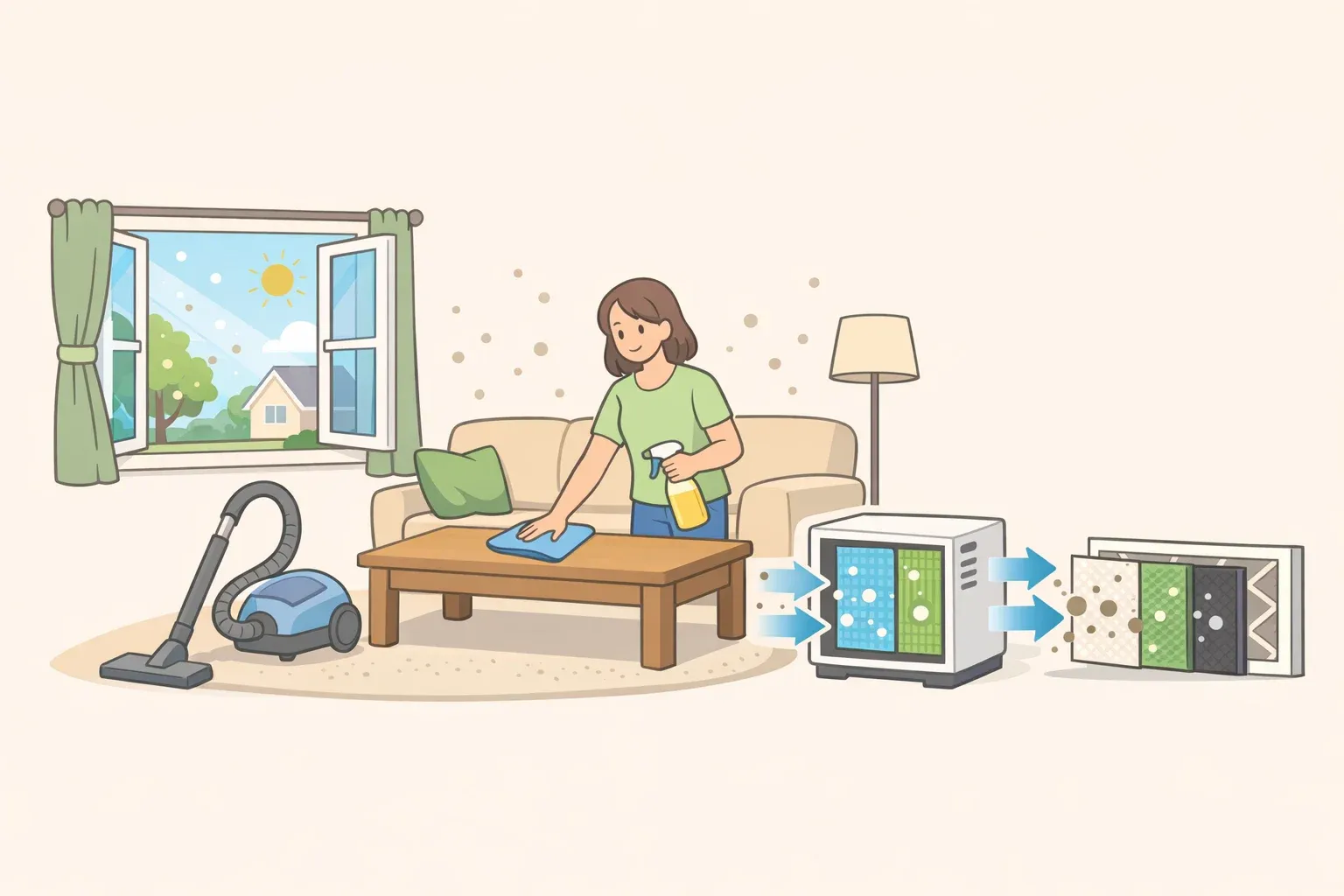
By late June in Rockwall, many homeowners are wiping the same surfaces every few days and still losing. The problem isn't effort. It's sequencing. Cleaning removes dust that's already settled; it does nothing about the sources still generating it or the entry points still letting it in. If you want to know how to reduce dust in your house during summer, the answer starts well before you reach for a cloth.
A useful distinction first: the gray film on your shelves and the fine airborne particles you breathe are related but not the same thing. Visible dust is mostly coarse material that settles quickly. Fine airborne particles, called PM2.5, stay suspended much longer and carry most of the health risk. The strategies in this guide target both, but the science supporting them comes primarily from research on airborne fine particles.
Research from the National Academies of Sciences found that outdoor and indoor sources contribute almost equally to indoor fine PM concentrations by mass, meaning roughly half of what's circulating in your air originates from activities inside the house (NCBI Bookshelf, 2024). That indoor half is dominated by cooking, candles, sprays, and the act of cleaning itself stirring settled particles back into the air. Layered on top of that, Texas summers bring an annual Saharan dust cycle: massive plumes of fine particles carried from the African desert across the Atlantic and straight through North Texas. TCEQ's senior meteorologist Weslee Copeland describes these events as a reliable seasonal pattern that "degrades air quality" and pushes AQI into moderate territory, with people who have asthma or chronic lung conditions most likely to feel it (TCEQ, 2021).
This guide covers how to reduce summer dust buildup indoors using a three-layer strategy, in the order that actually works: block outdoor dust first, reduce indoor generation second, use your HVAC and air filtration as the finishing layer. Each step reduces how hard the next one has to work.
What you'll need before starting: This guide is written for single-family homes with central HVAC. Steps in the filtration section involve replacing filters or buying a portable air purifier. Knowing the location of your HVAC's return air vents is helpful before you reach Step 3.
Priority guide for readers short on time:
- This weekend: Steps 1a–1c (entry sealing, doormats, window habits)
- This week: Steps 2a–2c (cooking, indoor sources, cleaning method)
- Before buying equipment: Steps 3a–3c (HVAC filter, purifier placement, when filtration matters most)
- During Saharan dust events: Keep windows closed, run filtration, check TCEQ's daily forecast
Layer one: how to keep dust out of the house in summer, starting at the entry points
The most cost-effective summer dust reduction strategy is intercepting particles before they cross the threshold. In Rockwall, outdoor infiltration comes from two sources: everyday wind-driven dust and soil, and periodic Saharan dust events that carry particles fine enough to be invisible to the naked eye.
Step 1a: Seal the gaps that let outdoor air in.
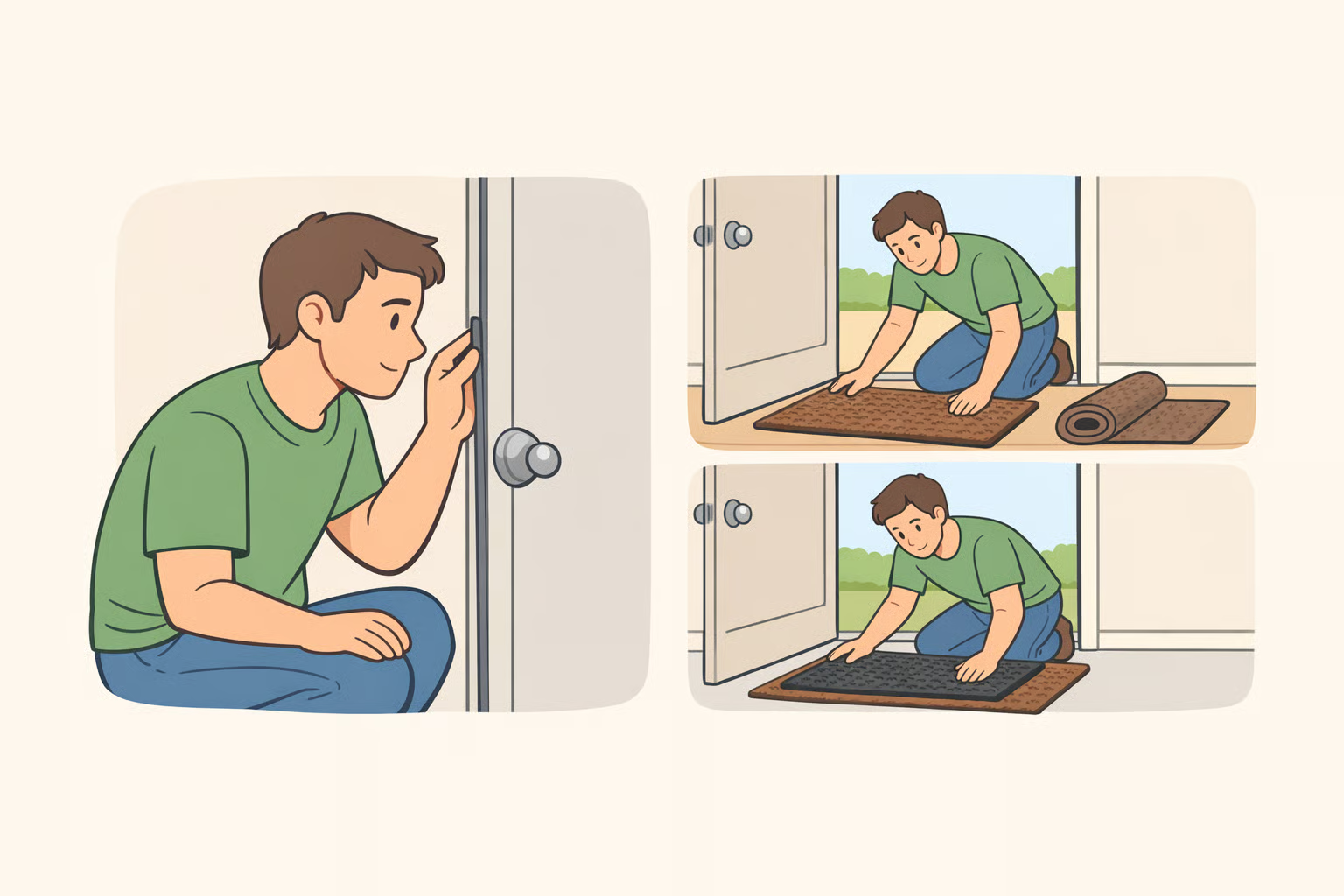
Check weatherstripping on all exterior doors. If you can feel outside air near the edges on a windy day, dust is moving through those same gaps. Door sweeps, foam weatherstripping, and caulking around window frames are inexpensive and serve double duty on dust and heat. The EPA notes that properly air-sealing and insulating the attic reduces outdoor air infiltration during extreme heat events (EPA, 2024); the same logic applies to dust control, since attic connections are one pathway uncontrolled outdoor air can use to enter the living space.
Step 1b: Use two-mat entry systems and consider a shoe-free policy.
Place a coarse-bristle mat outside each exterior door and an absorbent mat just inside. Together, they intercept tracked-in soil and coarse particles before they reach living areas. During periods of heavy outdoor dust, removing shoes at the door cuts one of the most direct transport paths for bringing outdoor grit inside.
Step 1c: Monitor TCEQ's air quality forecast and adjust window use accordingly.
Saharan dust plumes arrive in Texas each summer on trade winds, traveling at 10,000 to 15,000 feet before settling across the state. By the time they cross the Atlantic, most of the particles are smaller than what the naked eye can see (TCEQ, 2021). TCEQ publishes a daily air quality forecast; check it on days when the sky has a hazy orange cast or when AQI shows elevated particulate.
The EPA's guidance on extreme heat gives a practical rule for windows: if outdoor air is cooler than indoor air, open them; if it's hotter, keep them closed (EPA, 2024). Apply the same thinking to air quality as a rule of thumb. Both conditions can exist on the same day, so check temperature and AQI before deciding. A Saharan dust event at 3 p.m. is not the time to ventilate, regardless of outdoor temperature.
Layer two: stop generating indoor dust the section most guides skip
Outdoor dust gets blamed for everything. The research tells a more complicated story. Indoor sources, including cooking, candles, sprays, and disturbance of settled particles, contribute almost as much to fine airborne particle concentrations as outdoor infiltration (NCBI Bookshelf, 2024). For the very smallest particles, ultrafines under 0.1 micron, indoor sources dominate almost entirely. Cookstoves, burning candles, and aerosol products generate this fraction heavily.
Worth noting: many of these sources produce particles that never become the visible gray dust you wipe off a shelf. They circulate as fine airborne PM. The indoor dust reduction tips in this section address both what you see and what you don't.
Step 2a: Use your range hood during every cooking session, especially high-heat cooking.
Indoor cooking causes some of the steepest short-term spikes in fine particles, with high-temperature methods and high-fat foods generating more emissions than lower-heat cooking (NCBI Bookshelf, 2024). Countertop appliances matter here too. Toasters are identified in the same research as significant unvented PM2.5 sources that most households ignore entirely. A range hood vented to the outside removes particles before they circulate through the rest of the house. If yours recirculates internally, run it anyway and crack a window; it's better than nothing, but an exterior vent is worth prioritizing if you're planning a kitchen update.
Step 2b: Reduce or relocate candles, incense, and aerosol products.
Candles, incense, heated scent oils, spray cleaning products, and aerosol personal care products are all recognized indoor particle contributors (NCBI Bookshelf, 2024). In a North Texas summer when windows stay closed more often due to heat and dust, these sources have nowhere to go. Switch to low-emission or unscented alternatives in living and sleeping areas, or use them in rooms with active ventilation. The goal isn't elimination; it's not running them in the rooms where people spend the most time with the windows shut.
Step 2c: Change how you clean, not just how often.
Dry dusting with a feather duster or a dry cloth pushes settled fine particles back into the air, where they stay suspended long enough to be inhaled. Research confirms that resuspension from surfaces causes short-term particle spikes concentrated near whoever is doing the cleaning (NCBI Bookshelf, 2024). Use damp microfiber cloths on hard surfaces instead. Pay particular attention to ceiling fans and HVAC return-vent grilles, both of which accumulate dust over winter and early spring and release it in concentrated bursts when summer air circulation increases.
Anyone in the household with asthma, dust sensitivity, or chronic respiratory conditions should leave the room being cleaned and wait before re-entering. The particle spike from resuspension is temporary but real.
Layer three: HVAC filter for dust control and air purifier placement
Filtration is the backstop, not the foundation. Current EPA guidance describes portable air cleaners and higher-efficiency HVAC filters as supplements to source control and ventilation, not replacements for them (EPA). That sequencing matters. A high-end air purifier running in a leaky house with no doormats and a candle collection is compensating for problems that could be solved more cheaply upstream.
Step 3a: Select a suitable HVAC filter and inspect it monthly through summer.
For dust control purposes, many HVAC professionals recommend filters in the MERV 11–13 range for residential systems, balancing particle capture with the airflow most home equipment needs to operate. Before going higher, check your system's manufacturer documentation. Filters with very high MERV ratings are engineered for specialized environments and can restrict airflow enough to strain residential equipment not designed for them.
In a dusty North Texas summer, inspect filters monthly. A visible buildup of dust and debris around the grille of your return air vent may be a sign that the filter needs attention sooner than your usual schedule. A severely clogged filter can reduce airflow and compromise the system's ability to process air through the filter media at all. Check it before buying a portable purifier.
Step 3b: Add a portable HEPA air purifier in the rooms where you spend the most time.
A randomized crossover study found that HEPA-type and true HEPA portable air filtration units reduced median indoor PM2.5 concentrations by 58% and 65% respectively, and cut outdoor particle infiltration rates from 79% down to 61% and 51% (PubMed, 2023). Start with bedrooms. Cumulative overnight exposure in a closed room is where consistent filtration pays off most. Main living areas are the second priority.
Size the unit to the room. A purifier rated for a small bedroom running in a large open-plan living space will run continuously without keeping pace.
Two caveats worth stating: the study above was conducted in a senior residential facility, not a single-family home, so real-world results will vary by room size, layout, and how tightly the house is built. The National Academies of Sciences also notes that while filtration can significantly reduce indoor particle concentrations, evidence that this translates to measurable health improvements is inconsistent across households (NCBI Bookshelf, 2024). The particle-reduction numbers are solid. The health outcome benefit is real but not guaranteed in every situation. Buy filtration to reduce particle levels, not as a medical intervention.
Step 3c: Run filtration during and after high-particle activities.
Cooking and vacuuming both cause short-term indoor particle spikes even after outdoor dust is controlled. Running a portable air purifier during cooking and for a period after vacuuming captures particles while they're still airborne, rather than waiting for them to resettle on surfaces.
When to call an HVAC professional
Most summer dust problems respond to the steps above. Some don't. Persistent dust buildup despite regular filter changes, entry sealing, and improved cleaning habits is a sign the issue is structural rather than behavioral.
Indicators that a professional HVAC inspection is worth scheduling: visible dust accumulation returning within days of a thorough cleaning, a significant unexplained jump in filter buildup compared to previous years, dust coming from registers when the system starts up, or rooms that consistently show heavier dust than others despite similar habits. These patterns can point to duct leakage, attic air bypasses, or return-air imbalances, problems that no filter upgrade or portable purifier will fix.
Current EPA guidance puts source control first because it is the most effective and cost-efficient starting point (EPA). An HVAC system drawing uncontrolled attic air into the living space is a source control failure at scale.
The short version: what to do this summer
The three-layer approach works in a specific order for a reason. Seal the house first, so you're not fighting a constant flood of outdoor particles. Then reduce what you're generating inside, because half the airborne fine PM in a typical home comes from cooking, candles, and the cleaning methods most people already use. Filtration comes last, deployed where it pays off most: bedrooms overnight, main living areas during cooking and cleaning, and whole-house HVAC filters checked monthly rather than whenever you remember.
That sequence is the same priority order recommended by both the EPA and the National Academies of Sciences (NCBI Bookshelf, 2024; EPA).
Two things worth doing before anything else: bookmark TCEQ's daily air quality forecast so Saharan dust events don't catch you with windows open, and pull your HVAC return-vent grille this week to see what the current filter actually looks like. Both take five minutes. Both tell you exactly which layer needs the most work first.



Comments
Be the first, drop a comment!