



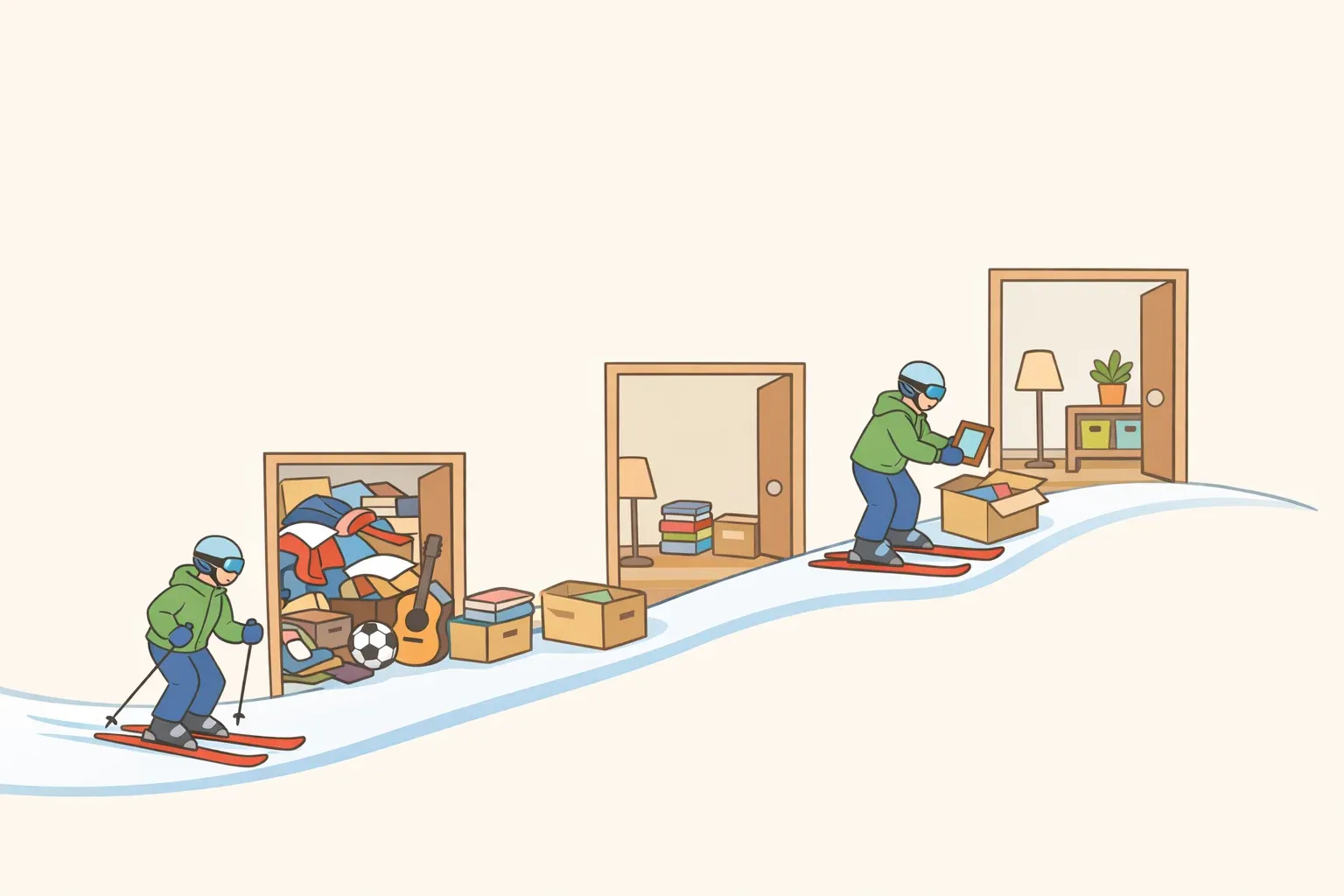
Ski Slope Decluttering Method Explained: When It Works
This guide walks you through the ski slope decluttering method step by step: what it is, why it works, exactly how to do it, and where it breaks down including when not to use it at all.
Most decluttering advice assumes the problem is motivation. It isn't. For a lot of people, the problem is standing in the doorway of a messy room and feeling the whole thing land on them at once every unresolved item, every deferred decision, the full weight of it. The usual response is to turn around and come back later. The ski slope method was built specifically for that moment.
Who this is for: Anyone who has stalled on a cluttered room not because they lacked time or desire, but because the task felt too large to start. It's particularly useful in busy households where uninterrupted cleaning time is rare and starting something you can't finish feels worse than not starting at all.
What this method is (and isn't) doing
Before the steps, a short explanation. Understanding the mechanism makes you better at applying it.
The ski slope method was developed by Anita Yokota, a therapist and interior designer, out of practical necessity. With a newborn, a preschooler, and a school-age child at home, she needed something that worked in the gaps between interruptions. She drew on her clinical background to build what she describes as a mental tool for breaking large, daunting tasks into manageable steps a physical path through the room that removes the central obstacle: not knowing where to start (Anita Yokota, October 2024).
The method works by reducing cognitive load, not physical effort. When you're standing in a cluttered room, your brain registers dozens of unresolved items simultaneously, each competing for attention. Yokota notes that visual and physical overwhelm directly drain decision-making capacity, which is why people freeze, and why decisions made late in a cleaning session tend to be worse than ones made early (Good Housekeeping, March 2026). A 2011 Princeton University study reported secondarily by Mircode in mid-March 2026 found that participants in cluttered environments were slower and less accurate on tasks than those in tidy spaces. The effect is modest in isolation, but it compounds over hours.
The zig-zag path solves this by narrowing focus to one bounded zone. Shifting from "I'll never finish this" to "I can handle this one corner" directly mirrors what clinicians call behavioral activation. ColumbiaDoctors (April 2024) describes chunking large tasks into smaller, achievable segments as standard technique in both cognitive behavioral therapy and depression treatment.
One important distinction before starting: this method covers surface decluttering the floor, furniture surfaces, and accumulated items in a room. Deep storage (drawers, closets, cabinets) involves a different scale of decisions and a different time commitment. More on that at the end.
How to use the ski slope method for decluttering, step by step
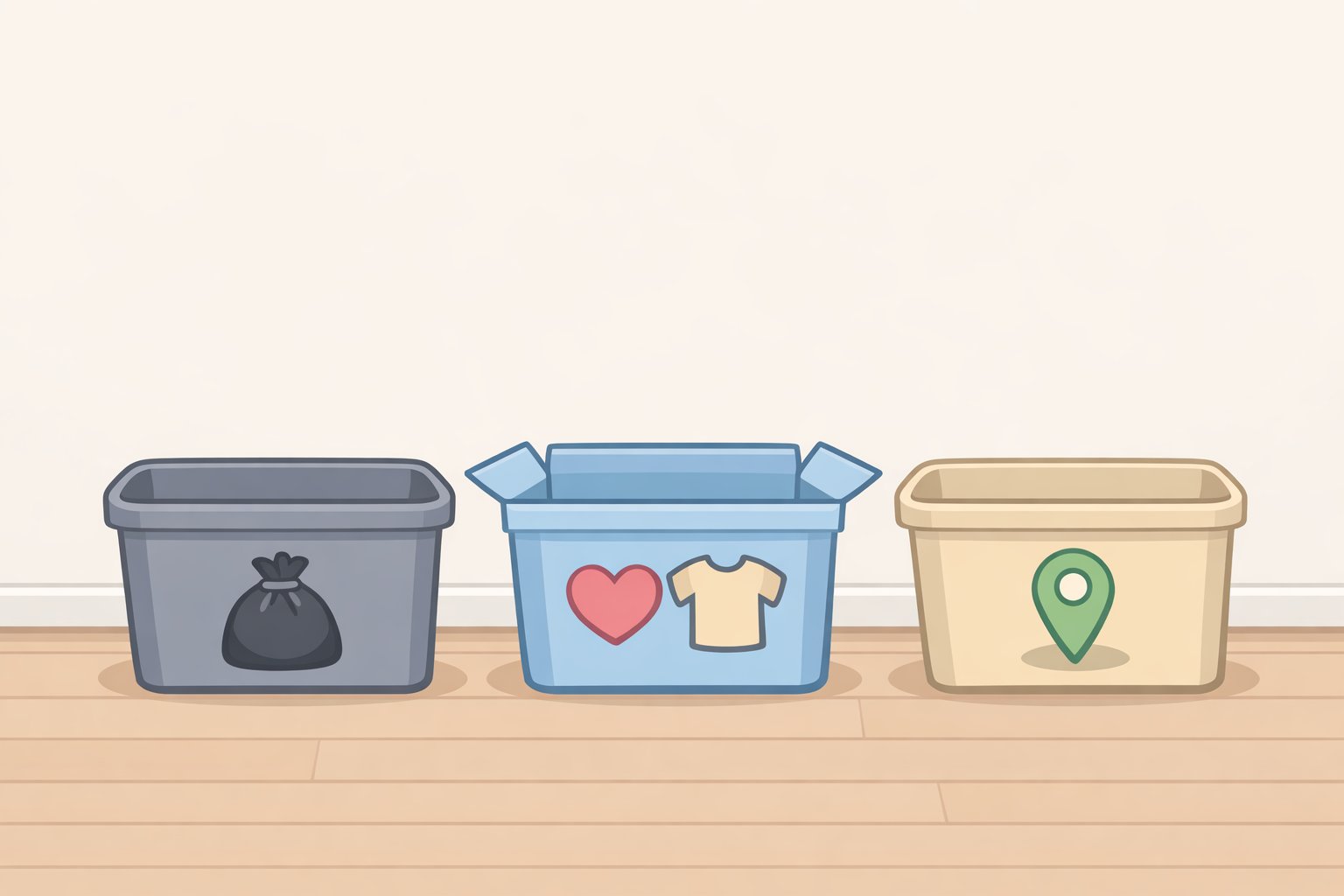
What you need before touching anything:
Set out three containers: one for trash, one for donations, one for items that belong elsewhere in the house. The Simplicity Habit (March 2026) recommends this setup specifically because the "belongs elsewhere" bin is what keeps you from carrying a stray sock to the bedroom and returning ten minutes later having lost the thread. Items leave the room only after the session ends.
Set a time limit. You don't need to finish in one session that's a feature of the design, not a limitation.
Step 1: Walk to the far corner of the room.
Choose either the far left or far right corner. Walk directly to it. Don't scan the whole room first, don't make a mental plan, don't decide where you'll stop. Just walk to the corner. The path is the plan.
Gotcha: Don't open with your most complex zone. A Good Housekeeping UK reviewer started with a bedside table stuffed with old cables and receipts and spent well over an hour on it; her attention and decision quality had dropped noticeably by the time she reached the wardrobe. Start with surface clutter. Deep storage is a separate project.
Step 2: Define the triangular zone you're working in.
Think of your zone as a triangle: the corner itself, plus roughly an arm's length in both directions along the walls. In a small room, that might be a corner with a nightstand and two feet of floor. In a larger room, it might include part of a couch. Keep it tight the zone should feel completable in 10 to 20 minutes, not 45.
In very large or irregularly shaped rooms, zone edges can get fuzzy. Be deliberate about where each zone ends before you start it. That clarity is what produces the contained-section feeling that makes the whole approach work, as Good Housekeeping UK noted in their February 2024 review.
Step 3: Fully resolve every item in the zone before moving on.
This is where the distinction between tidying and decluttering matters. For each item:
- Trash goes in the trash bin.
- Donations go in the donation bin.
- Items belonging elsewhere in the house go in the "belongs elsewhere" bin not carried to another room, not set in the hallway.
- Items that belong in this room get put away in their actual home, not stacked somewhere "for now."
When you finish, the zone should be clear and organized. Not approximate done. House Digest (June 2025) describes this as what makes the momentum real: seeing a completed zone an area that is genuinely finished is what produces the motivation to start the next one.
Step 4: Zig-zag diagonally across the room to the opposite side.
Move across to the other side of the room. Don't go forward yet go sideways, traversing like a skier crossing a slope. Define a new triangular zone on the opposite side. Repeat Step 3.
Each pass across moves you slightly toward the entrance. The zig-zag pattern ensures full coverage of the room's width, and because you're working toward the door, when you complete the final zone, you step out of a clean room.
Gotcha on coverage: Don't forget the center of the room. In spaces where furniture clusters along the walls, the middle floor area is easy to skip. Include it deliberately in one of your zones Good Housekeeping UK specifically flagged this as the most common blind spot.
Step 5: Stop at any completed zone without losing ground.
This is the method's most practical advantage. Because each finished zone stays tidy, stopping after any zone leaves the room in better shape than it started. Not back at square one better. Yokota frames this explicitly as a design feature: "guilt-free breaks" are built in, not a concession, as she described in her October 2024 post.
Fatigue note: The Good Housekeeping UK reviewer found her decision quality dropped in later zones the wardrobe got less thorough treatment than the bedside table. Two 30-minute sessions will produce better results than one 60-minute session where the second half runs on fumes. Stop at a completed zone, not mid-zone.
Step 6: Distribute the "belongs elsewhere" bin last.
Once the room is done for the session, take items to their correct rooms. Doing this at the end rather than mid-session keeps you mentally and physically inside the room while you're working. It also gives you a visible final task that signals completion.
When the zig-zag decluttering method works, when to adapt, and when to skip it entirely
Best fit: High-traffic spaces that accumulate clutter steadily. Good Housekeeping (March 31, 2026) identifies these as Yokota's intended targets: family rooms, playrooms, home offices, bedrooms, and catch-all spaces that never quite get reset. A Kitchn writer (February 2026) applied it to a butler's pantry over a full weekend in short sessions and described the incremental approach as what made the project manageable rather than daunting crediting the momentum from each completed section as what kept her going.
If the room is large: Pay close attention to zone boundaries and do a final walk-through before calling the room complete. Larger spaces are where coverage gaps appear, and the center of the room is the most consistent blind spot.
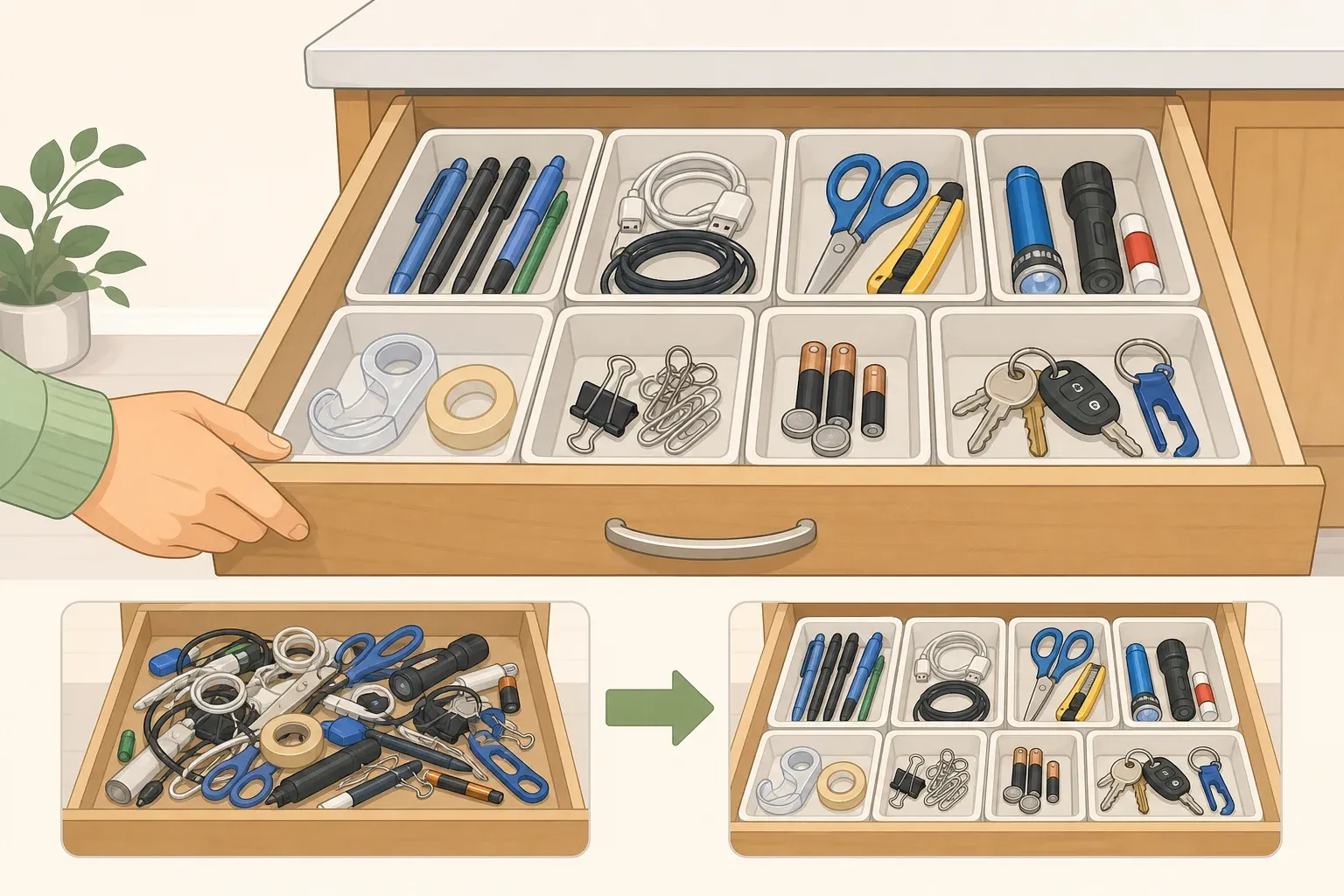
For deep storage: Drawers, cabinets, and closets involve a different order of decision and a different time investment. Don't fold them into a surface-level pass. Plan a dedicated session and apply the same zone logic vertically: one shelf or one drawer, fully resolved, before moving to the next.
For ongoing maintenance: The method functions as a reset system, not just a one-time intervention. The Simplicity Habit (March 2026) recommends pairing it with a 10-minute evening tidy to prevent rooms from reaching the point of needing a full reset. Penn State PRO Wellness (February 2026) notes that short, regular cleaning habits not marathon sessions are what reliably reduce anxiety, improve mood, and sustain a sense of control over your environment.
This decluttering method for overwhelmed people has real limits here's where it doesn't fit
The ski slope method is a surface-level spatial tool. That's its strength, and its constraint. There are situations where applying it will produce frustration rather than momentum.
Sentimental sorting. The method moves fast by design one zone, resolved, then the next. Items with emotional weight (inherited furniture, boxes of childhood objects, a deceased parent's belongings) don't respond well to that pace. ColumbiaDoctors (April 2024) notes that people often hold onto things because of anxiety or fear of moving on, not because they've failed to organize. That kind of work requires slower, more deliberate decision-making than the ski slope framework encourages. Set it aside for a separate session with a different approach.
Paperwork-heavy rooms. A home office where the real problem is two years of unsorted documents isn't a surface clutter problem. Each piece of paper demands a decision file, shred, action, archive and those decisions don't benefit from being rushed through a 15-minute zone. Trying to fold paper sorting into a ski slope pass will either slow the whole session to a crawl or produce a pile of "dealt with later" that defeats the method's core promise.
Rooms where the problem is lack of storage, not accumulation. If a room is cluttered because there's genuinely nowhere to put things, the ski slope method will surface that problem without solving it. You'll move items to their "actual home" and discover there isn't one. That's useful information, but the answer is a storage solution not another pass through the room.
In all three cases, the better move is to identify the constraint first, address it on its own terms, and then apply the ski slope method to what's left.
One corner, then the next
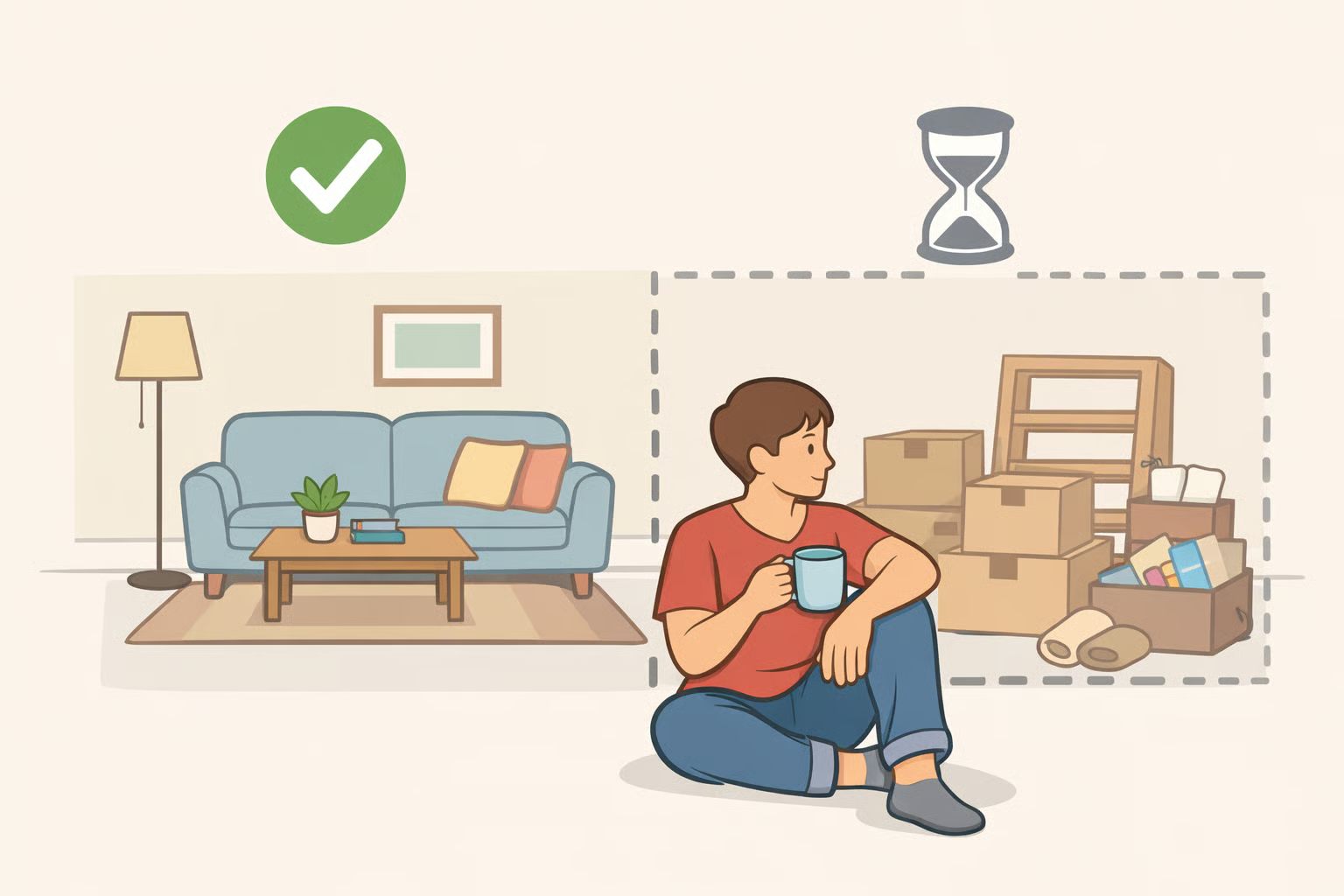
The ski slope method's value is precision, not novelty. It gives people who freeze in front of a messy room a path to walk, a point to stop that doesn't feel like failure, and visible progress that makes starting the next section easier than stopping.
The clinical grounding is real. ColumbiaDoctors (April 2024) describes chunking overwhelming tasks into bounded, completable segments as a clinical standard this method gives that principle a physical form you can move through. Penn State PRO Wellness (February 2026) cites research showing that the act of cleaning separate from the finished result reduces anxiety and restores a sense of control. The method makes starting easier, which means more people actually get those benefits.
For a first run: pick the room that bothers you most when you walk in. Set a 20-minute timer. Go to the far corner. Do one zone. Decide what comes next from there.



Comments
Be the first, drop a comment!