



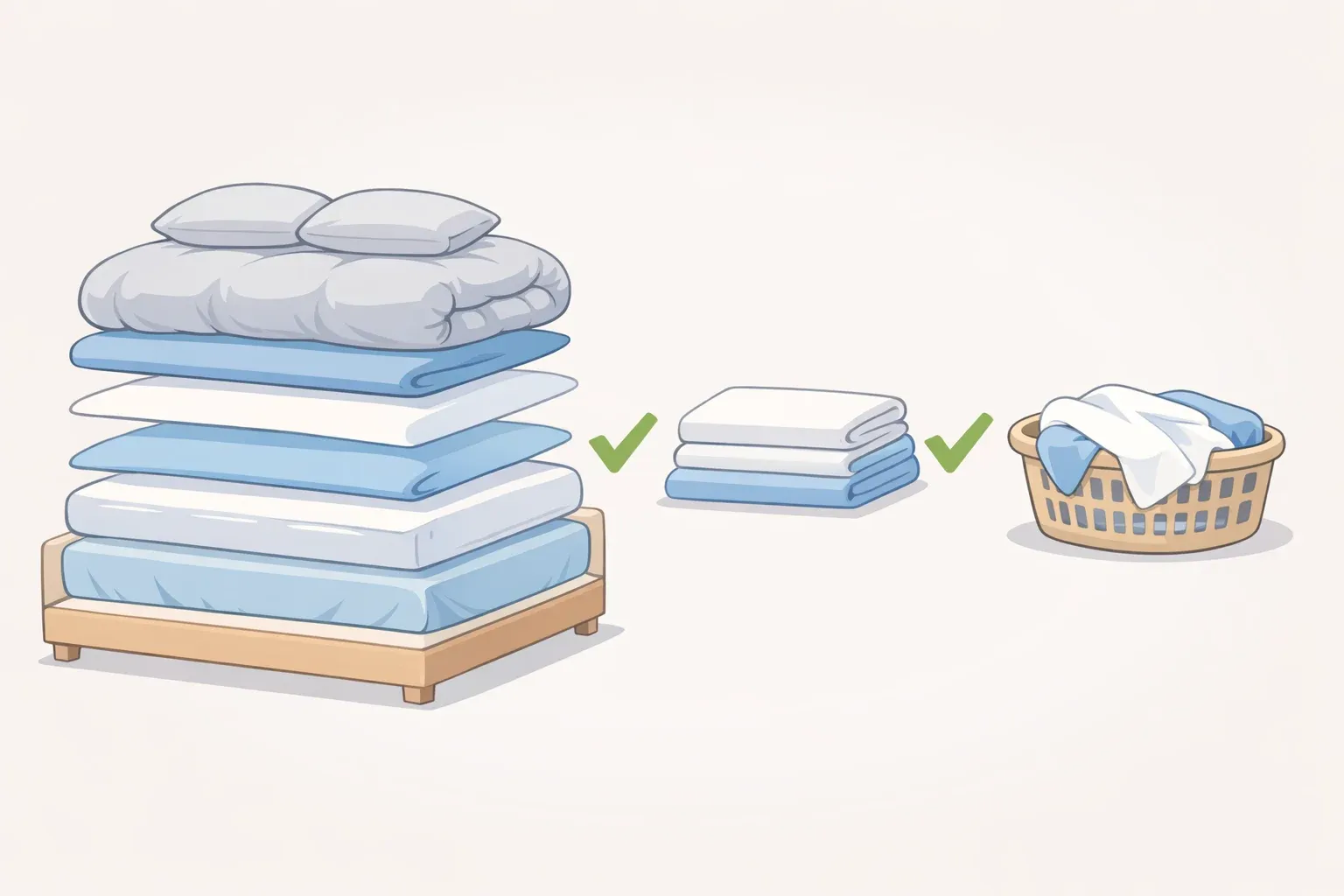
The top sheet debate has been framed as a generational identity question for years. It isn't. It's a laundry logistics question.
Whether you need a top sheet comes down to one thing: you need some washable layer in direct contact with your body, cleaned at least weekly. Whether that layer is a top sheet or a duvet cover is genuinely your call. But something has to play that role, and if your current setup doesn't have a clear answer, that's the actual problem to solve.
A 2019 Casper survey of 1,000 Americans found that 58% considered a top sheet essential, while 18% of adults aged 18 to 24 said they were strongly opposed to using one. The generational framing stuck. The hygiene framing is more useful.
This piece covers what a top sheet actually does, when skipping one is reasonable and when it isn't, how to match your wash routine to your specific setup, and a few practical habits that reduce the burden of the whole system.
What a top sheet actually does
Think of your bedding as a layered system, each layer with a different washability profile. A fitted sheet protects the mattress. A top sheet, if you use one, protects the comforter or duvet above it. A duvet cover does the same job, but only if it's being washed at the same frequency.
The practical case for top sheets is largely about what sits above them. Many comforters and duvets are genuinely difficult to launder; some are dry-clean only, others are technically machine-washable but too bulky for a standard home washer. A top sheet keeps those items cleaner longer and extends their lifespan by absorbing what would otherwise accumulate directly in the fill, as the Sleep Foundation explains.
The key variable is direct skin contact. A duvet cover your body never touches directly doesn't need weekly washing. Remove the top sheet, though, and the duvet cover becomes the direct-contact surface, inheriting the same hygiene requirements as a sheet. As one bedding expert notes, a duvet cover not in direct contact with skin doesn't need to be changed as frequently. The reverse is equally true.
Top sheets have long been standard in the U.S. but are uncommon in much of Europe, where the duvet-only approach is the norm, according to the Sleep Foundation. That setup works fine, provided the duvet cover is washed as frequently as a sheet would be. The mechanism differs; the hygiene logic doesn't.
Top sheet vs. duvet cover: Should you use a top sheet with a duvet?
The real question isn't which bedding you prefer. It's whether the layer touching your body every night is getting washed often enough.
A top sheet is cheap, lightweight, and strips off in seconds. That ease is the point. Swapping it out weekly costs almost no effort, which is why it remains the default for setups where the outer bedding is bulky, expensive, or otherwise difficult to launder. The duvet-cover-only approach is equally valid, but only if you're actually pulling the cover off and washing it every week, not just in principle, but in practice.
Here's how the two compare across the variables that matter:
Washability: A top sheet goes straight in the machine; a duvet cover requires removing it from the insert first, which adds friction and reduces how often people actually follow through
Skin contact: Both serve as the direct-contact barrier, but only when used consistently
Outer bedding protection: Both protect the comforter or duvet from accumulating sweat and skin cells, as long as they're being washed regularly
Hot sleepers: Even a thin sheet may be one extra layer too many for people who overheat at night; the duvet-cover-only approach removes it, but the washing commitment stays identical
The Sleep Foundation also notes that top sheets don't always stay in place, which can undermine their protective function. If you regularly wake up with the sheet balled at the foot of the bed, a well-fitted duvet cover you actually wash weekly is probably the better system.
Do you need a top sheet? What actually determines the answer
The decision comes down to one question: can you wash your outer bedding layer easily and often enough?
If your comforter or duvet is bulky, dry-clean only, or rarely laundered, the case is clear. Dr. Kelly Reynolds, a public health professor at the University of Arizona, is direct: if washing your comforter isn't practical, a top sheet becomes "absolutely essential" as the layer that collects microorganisms and can actually be cleaned regularly, she told Today. Bedding that doesn't cycle through the wash accumulates bacteria, mold spores, dust mites, and allergens in the fibers, a buildup that can eventually contribute to skin irritation and respiratory reactions in sensitive individuals.
If your duvet cover is easy to remove and you'll actually wash it weekly, skipping the top sheet is defensible. University of South Australia microbiologist Rietie Venter describes the hygiene benefit of a top sheet as only "slight" for most healthy adults, noting that typical bedding contaminants may not cause illness in people who aren't immunocompromised. Her practical signal: watch for rashes or skin irritation. Those point to a wash routine that needs attention, not necessarily a missing sheet.
If you use a washable blanket as your top layer, that blanket is now the direct-contact surface. It needs to be washed at least once a week.
If you sleep hot and can't stand extra layers, skipping the top sheet is reasonable. The condition stays the same: your duvet cover needs weekly washing. The top sheet doesn't create the hygiene requirement. Direct skin contact does.
A quick decision matrix:
Bulky or dry-clean comforter, top sheet is essential
Easy-to-wash duvet cover, willing to wash weekly, top sheet optional
Duvet cover washed less than weekly, add a top sheet, or commit to the schedule
Washable blanket as top layer, wash it weekly regardless
The disagreement between Reynolds and Venter isn't irreconcilable. Reynolds is describing the high-risk scenario: hard-to-launder outer bedding with no washable buffer layer. Venter is describing healthy adults with reasonable hygiene habits. Both are right. Your setup determines which scenario applies.
How often to wash bed sheets and duvet covers: frequency and technique
Whatever touches your skin directly, whether that's a fitted sheet, top sheet, or duvet cover, should be washed roughly once a week, or at most every two weeks. Comforters and duvets not in direct skin contact can be refreshed every two to three months.
Bump that to every three to four days if any of these apply:
Sweat heavily at night
Sleep with pets in the bed
Are currently sick
Have allergies, asthma, or sensitive skin
Notice rashes or skin irritation
Pillowcases deserve separate attention. They're in sustained, direct contact with your face, hair, and airways, which means they accumulate bacteria faster than other bedding. When bedding company Amerisleep collected samples from volunteers, pillowcases harbored up to 5 million colony-forming units per square inch after a single week of use. That figure reflects relative contamination levels rather than a clinical health benchmark, but the directional point is hard to dismiss. Many experts recommend changing them every few days, separate from the full sheet rotation.
On wash temperature, the guidance genuinely diverges. Dr. Reynolds recommends hot water plus a sanitizing agent, whether bleach, hydrogen peroxide, or a sanitizing detergent, for meaningful microbial reduction. Fabric-care specialists advise using cold or warm water to prevent shrinkage and preserve quality. Others split the difference by material: cotton can handle hot water; silk and satin require lower temperatures. Check the care label and calibrate based on your priorities.
A few technique details that reduce wear and improve results:
Wash sheets separately from clothing and towels; zippers and agitation cause abrasion
Use gentle, fragrance-free detergent; avoid fabric softeners and harsh chemicals that degrade fabric and leave residue against your skin
Tumble dry on low
Keep a second set of sheets so washing doesn't require stripping and immediately remaking the bed, which also reduces wear from high-frequency washing
Showering before bed meaningfully reduces the oils, bacteria, and allergens that transfer to bedding each night, effectively extending the useful time between washes
The part that's still up to you
The actual settled point in this debate is narrower than the headline version: wash whatever directly contacts your body at least once a week, and make sure something in your bedding system can fulfill that role without friction. That's the consensus.
Whether that layer should be a top sheet depends on your outer bedding. Bulky comforter, expensive duvet, anything that rarely sees the inside of a washing machine: a top sheet is the most practical solution available, cheap, lightweight, and designed for exactly this purpose. Easy-to-remove duvet cover you'll actually wash weekly? The top sheet is optional.
The more forward-looking version of this question isn't really about top sheets at all. It's about whether people ditching the top sheet for a cleaner, more minimal aesthetic are actually committing to weekly duvet-cover washing. The hygiene logic only holds if they are. Given that many households already wash less often than experts recommend, a low-friction system, one where the barrier layer strips off and goes straight into the machine, is worth keeping around if that commitment isn't realistic. The generation you belong to is irrelevant. The laundry schedule isn't.









Comments
Be the first, drop a comment!