



Front-Load vs Top-Load Washer Efficiency: Which Uses Less Energy
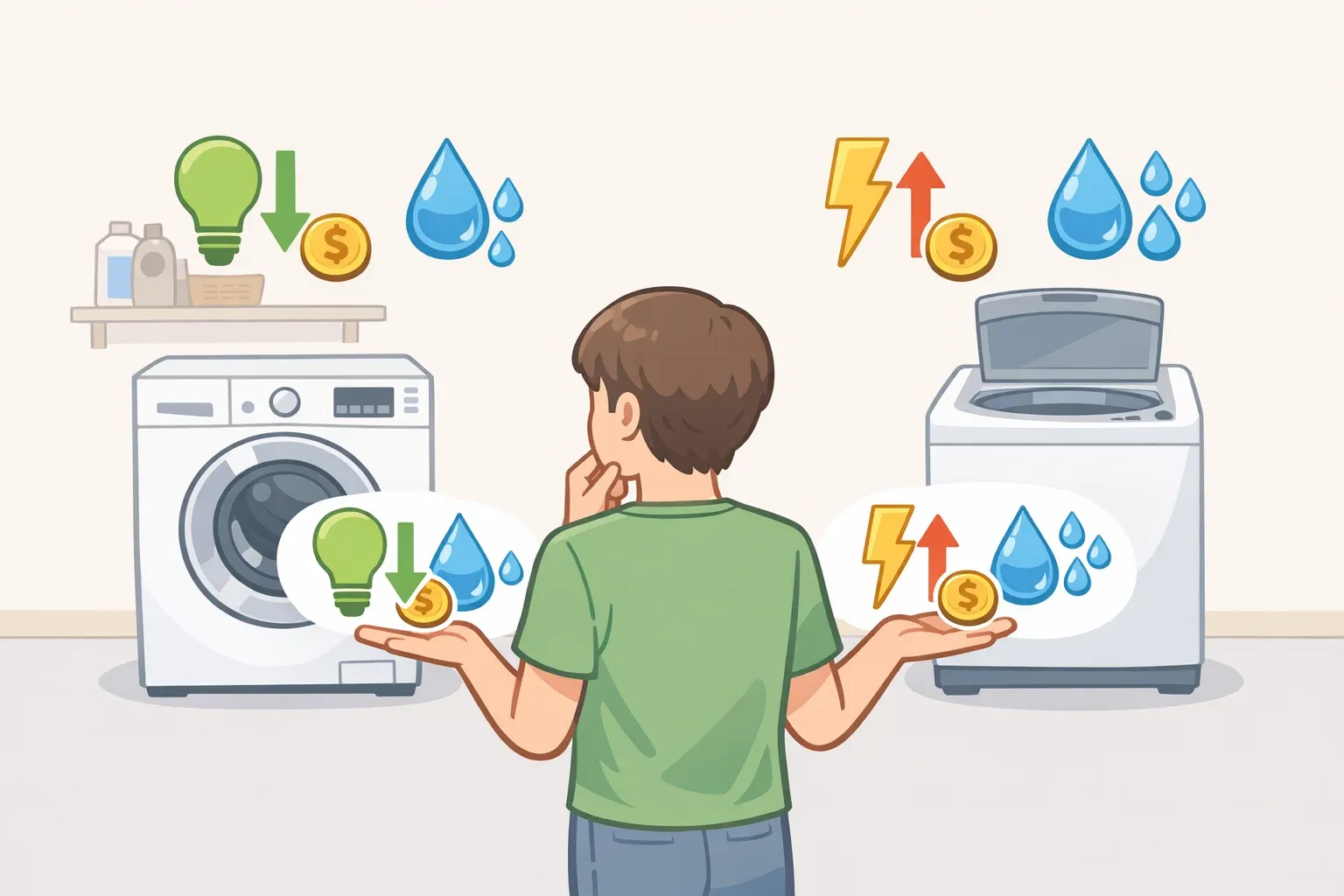
Front-load washers win. That's the short answer. For anyone replacing an appliance and wondering which washing machine uses the least water and energy, the hierarchy is clear: front-loaders sit at the top, HE (high-efficiency) top-loaders are a meaningful step up from older machines but fall short, and conventional top-load agitator washers are the least efficient option by every available measure.
The gap is not marginal. Front-load washers use an estimated 3,452 gallons of water per year compared to roughly 8,552 gallons for a conventional top-loader, a difference of more than 5,000 gallons annually, according to CNET's cost analysis published in February 2026. Those figures reflect modeled household assumptions rather than every real-world usage pattern, so treat them as directional benchmarks. The order of magnitude, though, is consistent across sources. ENERGY STAR reported in early 2024 that certified front-loaders use about 45% less energy and 50% less water than top-load agitator machines.
This piece explains how each machine type works, why front-loaders achieve their efficiency edge, where those savings show up on a utility bill, and what the real tradeoffs are before spending $700 or more on a new machine. Think of it as a decision tool, not just a verdict.
What the three washer types are and how each one cleans
The numbers make more sense once you know how each machine actually cleans. There are three categories worth distinguishing.
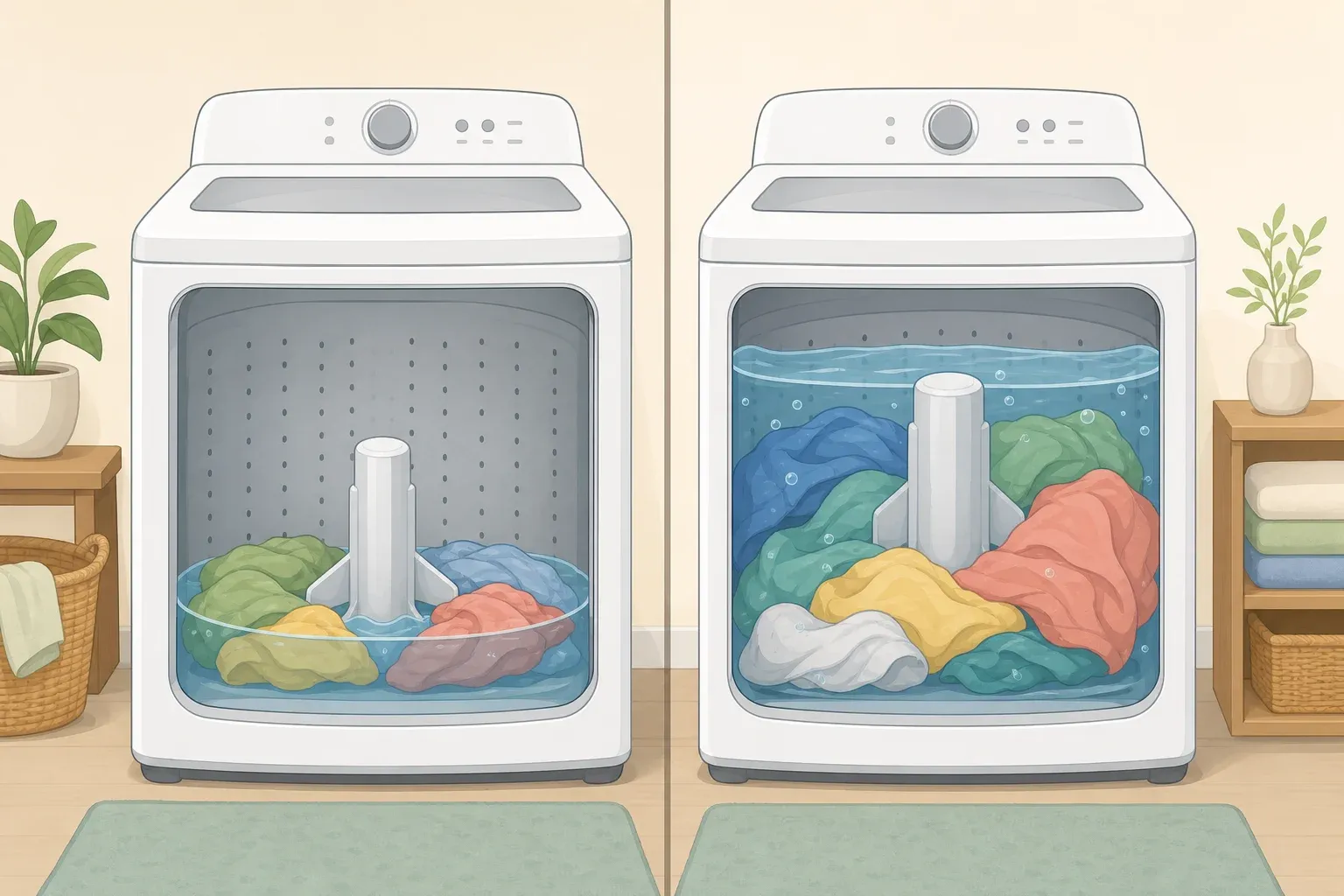
Conventional top-load agitator machines fill the drum almost entirely with water and use a tall central post to push and pull clothes through it. They're the machines most people grew up with. HE top-loaders replace that central post with a low-profile impeller, a disc or plate at the drum's base, and use noticeably less water while still loading from the top. Front-loaders rotate a horizontal drum, tumbling clothes through a shallow pool rather than a full tub.
The front-loader's design is where the efficiency edge originates. Side paddles lift clothing up and drop it repeatedly through a small amount of water; ENERGY STAR explains that gravity handles much of the cleaning work. For rinsing, the machine sprays water directly onto the load rather than soaking it in a refilled tub. Less water in means less water to heat, pump, and drain, and less energy consumed at every stage of that chain.
Efficiency here isn't a tradeoff against wash quality; it's a feature of how the machine works. Consumer Reports' buying guide awards front-loaders its highest energy and water efficiency rating. Their Green Choice designation, the most efficient tier, goes to models using no more than 10 gallons per load for a standard 8-pound load, averaging about 0.236 kWh of electricity per cycle, roughly 4 cents' worth. Angi's overview from August 2025 also notes that front-loaders are highly efficient and gentler on fabrics than agitator machines.
HE top-loaders occupy legitimate middle ground. Consumer Reports puts their water use at roughly 13 gallons per load, a real improvement over the 20 gallons a conventional agitator machine uses, but still above the 10-gallon benchmark of the most efficient front-loaders. That 3-gallon-per-load difference compounds across hundreds of wash cycles per year.
The ranking order: front-loaders, then HE top-loaders, then conventional agitators. The gap between first and third is large. The gap between first and second is real but smaller.
Front-load vs top-load washer efficiency: where the savings actually come from
The savings show up in a predictable order: less water, less hot water, less drying time. Here's how that translates into dollars.
Water volume is the primary lever, and hot water is where money disappears. Because front-loaders use far less water per load, they also need far less of it heated. CNET's analysis is direct: heating water is the single most expensive part of doing laundry. Cut the water volume and you cut the most expensive input. Annual water costs for a front-loader run roughly $58; for a conventional top-loader, roughly $144, a difference of about $86 per year on water alone, per the same CNET figures from February 2026.
The electricity numbers follow the same pattern. Front-loaders consume an estimated 74 kWh per year on the wash cycle itself, versus around 240 kWh for conventional top-loaders, translating to roughly $12 versus $40 annually in electricity costs, per CNET's analysis.
The savings extend beyond the washer itself. Front-loaders spin at higher speeds and extract more moisture before the cycle ends, which means shorter dryer runs. The total energy benefit is a laundry-system gain, not just a machine specification.
CNET calculated a payback period of roughly 6.5 years for a front-loader over a top-loader, based on combined utility savings. Households that wash more often or pay higher utility rates will see faster payback; those doing fewer loads or washing primarily in cold water will see slower returns. The direction of the savings is consistent; your actual timeline depends on usage patterns and local rates.
One gap worth flagging: where front-loaders beat HE top-loaders specifically by annual dollar amount is less precisely documented in the available research. ENERGY STAR confirmed in 2024 that front-loaders hold a 25% efficiency advantage even over HE impeller machines, not just agitator models. But a side-by-side annual cost comparison between those two tiers wasn't available. What the data supports clearly is the ranking order and the mechanism behind it.
The practical decision: front-load, HE top-load, or neither
That still doesn't make the front-loader the right buy for every household. Several factors complicate a straightforward recommendation, and a side-by-side comparison helps clarify where each machine type wins.
| | Front-loader | HE top-loader | Conventional agitator | |---|---|---|---| | Water per load | ~10 gal (Green Choice models) | ~13 gal | ~20 gal | | Upfront cost | From ~$700 | From ~$350 | From ~$350 | | Typical cycle time | 60–120 min | Faster; interruptible | Varies | | Loading access | Bend to load; door needs clearance | Stand upright; easy mid-cycle access | Stand upright; easy mid-cycle access | | Best for | Long-term savings, staying in one home | Budget-conscious buyers, busy households, ergonomic constraints | Replacing like-for-like; tight budget | | Worst for | High-volume laundry days, tight upfront budgets | Maximizing efficiency | Any household where water or energy costs matter |
Source data: Consumer Reports, Angi, CNET
The upfront cost gap is real and substantial. Entry-level top-load machines start around $350; front-loaders start closer to $700, per Angi's overview. Utility savings recover that $350 difference, but only after several years of regular use. Buyers replacing a machine on a tight budget, or planning to move within a few years, may find the HE top-load a more defensible choice even if it's the less efficient option.
Cycle time is a real-world friction point that efficiency numbers don't capture. Front-loaders typically run 60 to 120 minutes per cycle, Angi notes, and can run longer on heavy-duty settings. For households running five or more loads in a single day, that stacks up. HE top-loaders are generally faster and can be interrupted mid-cycle.
On reliability, the evidence is limited and mixed, and it deserves honest treatment. Angi notes that front-loaders have more components, can be prone to door-seal leaks, and suggests their lifespan runs shorter than top-loaders. CNET puts the around 12–13 years, according to CNET estimates, long enough to comfortably surpass the 6.5-year payback period. Angi is a useful consumer resource but not a primary source for failure-rate data; independent reliability comparisons across brands aren't available in the research. Treat repair risk as a real but unquantified variable.
A practical framework for buyers:
Choose a front-loader if long-term operating cost is the priority, the machine will run through its full lifespan in one location, and the higher upfront price is manageable.
Choose an HE top-loader if you want a meaningful efficiency improvement over an old agitator machine, prefer lower upfront cost, need faster cycles, or have ergonomic or laundry-room constraints that favor top-loading.
Avoid conventional agitator top-loaders if efficiency matters at all. Consumer Reports puts them at around 20 gallons per load and rates their energy and water efficiency as the weakest of the three types, roughly twice the water consumption of an HE top-loader.
The short version, the qualifier, and where to go next
If the goal is the most energy efficient washing machine type, front-loaders still come out ahead. That finding is consistent across ENERGY STAR, Consumer Reports, and CNET's independent cost analysis. The 6.5-year payback period assumes typical usage patterns. Your actual timeline depends on wash frequency, temperature settings, and local utility rates.
HE top-loaders remain a legitimate second choice. At roughly 13 gallons per load, they're a substantial improvement over the 20 gallons a conventional agitator machine uses. The efficiency ceiling is lower than a front-loader, but starting price, cycle flexibility, and loading convenience may matter more than closing the last 25% gap, particularly for the best washer for saving water and electricity within a fixed budget.
One development worth noting for buyers on a longer planning horizon: new federal efficiency standards take effect March 2028. The DOE's 2024 rule projects that washers sold under those standards over a 30-year window will collectively save 1.89 trillion gallons of water. The floor for all washer types is rising.
Until then, ENERGY STAR certification is the most reliable proxy for current best-in-class efficiency across both front-load and HE top-load categories. Look for it on the label before comparing price tags. ENERGY STAR's certified product list filters by washer type and efficiency score; Consumer Reports' model ratings add reliability context; and many utility companies offer rebates on efficient appliances that can meaningfully narrow the upfront price gap on a front-loader.








Comments
Be the first, drop a comment!