




Downsizing fails in predictable ways. Not because people get rid of too much or too little, but because they start without constraints, sort with the wrong criteria, and then spend their way back to where they started. The mistakes to avoid when downsizing aren't random; they follow a sequence. So does fixing them.
This guide walks through five of the most common decluttering mistakes to avoid, in the order they typically happen, so you can move through the process once without circling back.
A quick note on scope: this is primarily for people facing a concrete reduction in living space — a move to a smaller home, a major life transition, or the task of clearing out a family member's house. The advice applies more broadly, but the examples and stakes are drawn from that context.
The numbers are worth knowing. Roughly 51 percent of retirees ages 50 and over end up moving into smaller homes, yet 64 percent of seniors say they plan to stay put, according to SeniorLiving.org data from late last year.
That gap suggests that when downsizing does happen, it often catches people off guard rather than arriving as a planned event. Families come to it through different doors: an upcoming move, a parent's death, or simply running out of room. The trigger varies. The mistakes tend not to.
Done well, a smaller home means fewer rooms to heat and cool, lower maintenance expenses, and oftentimes lower taxes. That upside disappears fast if the process creates a second wave of rushed decisions and replacement purchases. Which is exactly what these five mistakes produce.
Mistake 1: Starting without a floor plan or a timeline
Most people start late because downsizing is reactive. A lease ends, a health situation changes, a family home suddenly needs clearing. The timeline compresses, and decisions get rushed. Starting two to three months out is a common recommendation, and the reason is structural. Working backward from a fixed deadline, with monthly and weekly targets assigned to specific categories, turns an overwhelming project into a manageable one.
The floor plan step is what most people skip, and it's what makes everything else harder. Before sorting a single item, get accurate dimensions of your new space and estimate what percentage of your current belongings will physically fit, room by room. That number — 25 percent less space? 50 percent? — tells you how aggressive you need to be before sentiment or habit gets a vote. Map your largest furniture pieces first. These have the least flexibility and the highest cost if you get them wrong.
Note every room in your current home that has no equivalent in the new one: a guest room, a garage, a dedicated home office. Everything in those rooms needs an active decision. There is no default "keep."
One gotcha worth naming: multifunctional furniture is often reached for as a planning substitute rather than a planning outcome. It is good to have pieces like a fold-out loveseat or an ottoman with storage when a guest room disappears. That's sound advice when you've done the sorting first. Buying three storage ottomans because you haven't sorted yet is just spending money on the problem.
Before you touch a box:
Write down the hard deadline and work backward
Get the floor plan with real measurements
Assign categories to specific sessions "Saturday: basement shelving, one hour" beats "I'll do the basement this weekend"
Mistake 2: Sorting by feel instead of by function and values
The question "does this spark joy?" is not useless. It's just less useful than "does this support how I actually live?" That distinction is the core of what the research calls values-based sorting, and it produces better outcomes meaningfully.
A 2024 study found that taking a values-based approach to decluttering helped older adults with hoarding disorder reduce household clutter more effectively and increased their positive affect a state of mind characterized by feelings of joy and contentment.
The study was conducted by a licensed clinical psychologist and involved clinicians visiting participants' homes weekly for six weeks, using motivational interviewing to guide sorting decisions, per The Conversation. The study population matters: these were older adults receiving structured clinical support, not general consumers sorting on their own. But the underlying framework transfers.
The practical version: before opening a single drawer, write down two or three things you genuinely want your new space to do for you. Not how it should look, but what it should enable. Cooking with family. A clear workspace. Room for a grandchild to stay. Use those statements as a tiebreaker on anything ambiguous.
What the research also found: challenging yourself on why you're keeping something tends not to work well. It's more effective to focus on reasons to let go and goals for the new space. "Does keeping this help me live the way I described?" holds up better under pressure than "do I love this right now?"
Start with the low-friction categories: duplicate tools, worn-out work clothes, extra linens. It is recommended to keep two good sets of sheets and towels and let the overflow go. These early wins build momentum without the emotional weight that slows things down later.
Values-based sorting is not aesthetic sorting. Chasing a "minimal look" is a different project entirely and one that the research doesn't support. If the sorting criterion is "does this look clean?", that's a design decision, not a life decision.
Mistake 3: Treating aesthetic purging as a strategy and the replacement trap it creates
There's a version of downsizing that feels productive but costs more than doing nothing. It goes like this: purge functional items to achieve a cleaner look, feel a brief sense of order, realize the new arrangement doesn't actually satisfy, purge again. What started as a movement toward intentional ownership has often been hijacked by marketing.
Trends like capsule wardrobes and perpetual decluttering push people to discard perfectly usable things, only to buy new "minimal" replacements. Instead of reducing consumption, it creates a cycle of buying, purging, and rebuilding.
This is the buy-purge-rebuild trap, and it erases the financial case for downsizing your home. A smaller home means fewer rooms to clean and less to heat and cool, per United Van Lines. None of that matters if you immediately replace what you got rid of.
One question cuts through it: if you discarded this item, would you buy a replacement? If the honest answer is yes, you still need the thing. You just want a different version of it. That's a style preference, not a downsizing decision.
Hold a 30-day purchasing pause after moving in. Live in the space before deciding what it actually lacks. The distinction worth making: a real gap (you got rid of the only can opener) versus a comfort purchase (a throw blanket in the right color for the new walls). Both feel necessary in the first week. Only one is.
When replacements are genuinely needed, buy secondhand first. It's slower, which is a feature.
The furniture version of this mistake is especially expensive. Selling a functional couch to buy a smaller, better-looking one costs the price difference plus the time to list, sell, wait, and take delivery. Repeat that pattern twice, and you've spent your moving savings.
Mistake 4: Trying to outrun the emotional weight, especially with inherited items
Treating downsizing as a purely logistical exercise tends to stall it. The emotional dimension isn't noise to route around; it's part of the process, and acknowledging it tends to move things forward faster than pushing through cold.
Research published in PLOS One in 2023 found that people with higher hoarding traits showed more intrusive thoughts, greater emotional distress, and more difficulty tolerating separation from valued possessions. The study was conducted with participants specifically selected for elevated hoarding features, so the findings don't map directly onto typical downsizing. But the underlying dynamic that possessions carry emotional weight that doesn't respond to logic applies well beyond that population.
Matt Paxton, who spent two decades professionally clearing homes, draws a sharp distinction that anyone who's helped a parent move will recognize: people can often release their own belongings with practice, but a deceased parent's belongings are categorically harder; they carry a different kind of grief. His framing is direct: you can get rid of the stuff while keeping the memory. Photograph items before they leave if it helps make the separation real.
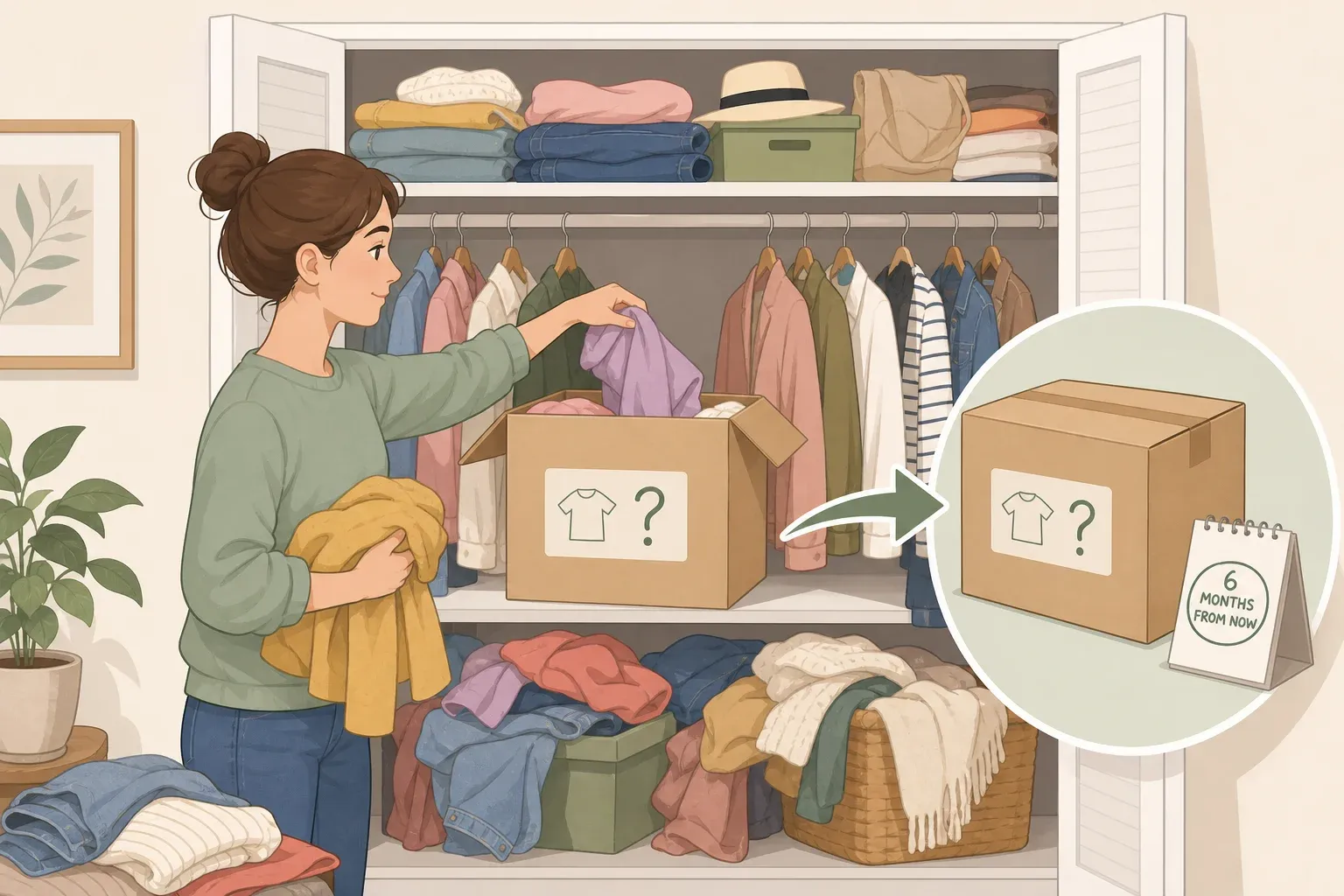
Give sentimental categories their own session, a separate day, with enough time to actually stop and remember. Rushing through inherited items alongside kitchen duplicates produces decisions you'll revisit for years.
The values framework from Mistake 2 works here, too. Shifting from "why are you keeping this?" to "what do you want your life to look like?" changes how people engage with the process. Defense is harder than aspiration. If you're helping someone else downsize a parent, a sibling, or a partner, their reasons for keeping something don't have to make sense to you. Stay curious, not corrective.
Mistake 5: Skipping a disposal strategy and getting stuck at the exit
Deciding what goes is only half the job. Getting it out of the house is where many downsizing projects actually stall. Boxes accumulate in hallways for months not because people changed their minds, but because the logistics weren't figured out in advance.
Donate or sell first, recycle where possible, trash only what can't be reused. Trash is the last resort, not the default when you're tired. Donation tends to move faster than selling it doesn't require photographing, listing, negotiating, and waiting. That friction is real, and for most items it's not worth it. For high-value items (collections, instruments, antiques), the math changes. Research the right buyer or consignor early; these take longer and shouldn't be decided in the final week.
Set up a designated outbox, a specific area of the house where sorted items land before they leave. Once something goes in, it doesn't come back out for reconsideration.
Check local disposal regulations before putting anything unusual in the bin. Electronics, paint, appliances, and certain textiles often have specific requirements. Getting this wrong at the end of a long process is an avoidable frustration.
The full workflow, in order
The sequence matters. Each mistake in this list tends to enable the next one: no spatial constraints lead to bad sorting criteria, which opens the door to emotional bottlenecks, which creates disposal friction, which produces replacement spending. Address them in order, and the later ones become easier.
Get the floor plan and set the timeline, working backward from the hard deadline
Write your values before you open a single drawer, what you want the new space to do, not how it should look
Sort by function and values, starting with low-friction categories
Schedule a separate session for sentimental and inherited items
Identify disposal routes before they become bottlenecks
Move in, wait 30 days, then assess what the space actually needs
One last thing, and it's the piece that tends to get left out: downsizing is easier when you treat it as a buying habit problem, not just a sorting problem. The reason most people end up with too much stuff in the first place is that acquiring things carries almost no friction, while getting rid of them takes real effort. The habits that make downsizing go well, buying less, keeping what earns its place, pausing before replacing, are the same habits that keep it from having to happen again at the same intensity. The goal isn't a lighter move. It's a lighter default.








Comments
Be the first, drop a comment!