



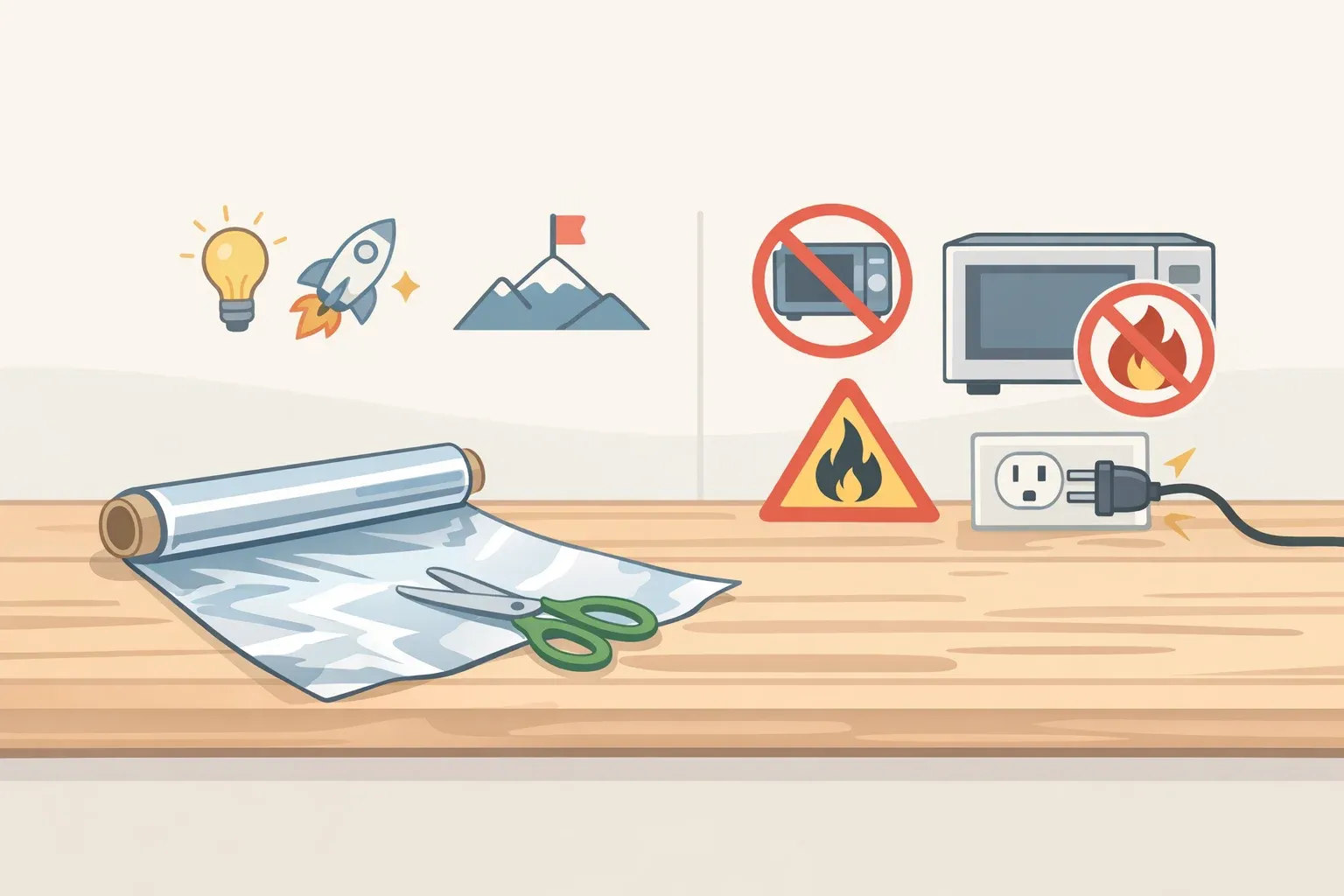
The most widely shared aluminum foil hack online is cutting through several folded layers of foil to sharpen dull scissors. It circulates constantly, gets passed along confidently, and produces just enough of a temporary improvement that people believe it worked. It didn't. Understanding exactly why it didn't is the most useful thing to grasp about foil before a single legitimate tip appears.
Foil works when you use it for what it physically does: reflect heat, seal in moisture, and survive temperatures that would destroy most other materials in your kitchen. It fails when people treat it as something it isn't. That logic governs everything that follows. By the end, you'll have three functional categories of aluminum foil hacks, the conditions under which each one performs well, the cases where foil makes things worse, and a calibrated read on the safety question that doesn't traffic in false reassurance or needless alarm.
Two physical properties explain most of foil's legitimate kitchen applications: it withstands the highest temperatures found in most home ovens, and it reflects heat to help food cook more evenly. The body absorbs only around 0.1% of ingested aluminum through the intestinal tract, which is why casual foil use in normal cooking conditions generally stays within international safety thresholds for most adults, though cooking conditions and food chemistry can shift that picture, per a literature review published earlier this year.
Useful aluminum foil hacks for cleanup, moisture control, and grilling
Category 1: Cleanup — line the pan, not the oven floor
Line a baking pan with foil before adding food. Because foil conducts heat directly to the pan's surface, it produces crispier, browner bottoms on baked goods, and the pan requires no scrubbing afterward. For cookies, brownies, and roasted vegetables, that conductivity is doing real work.
Use foil here when you want faster cleanup and crisper results. Skip it when parchment is the better fit: for delicate items or recipes where the goal is a clean, non-stick release rather than browning, parchment performs differently and doesn't conduct heat the same way.
One misuse deserves a direct warning. Do not line the oven floor with foil to catch drips. Most oven manufacturers recommend against it because the intense heat near the appliance floor can cause foil to melt and permanently bond to the surface. If catching spills is the goal, place a foil sheet on the rack directly below the pan, extending only an inch or two beyond the pan's edges to preserve airflow. Foil above the floor is fine. Foil on the floor is a repair bill.
Category 2: Browning and moisture control — loose and tight are two different tools
Laying foil loosely over a casserole or roast lets steam escape while shielding the surface from direct heat. The foil intercepts radiant energy from above before it reaches the food, slowing browning without trapping moisture.
Crimping foil tightly around food does the reverse: the sealed environment traps steam, which raises the effective cooking temperature inside the packet and keeps the interior moist. Foil packet meals typically cook at around 450°F because the oven temperature must be high enough to penetrate the sealed layers. Lower temperatures work but require more time.
Use foil when cooking neutral or low-acid foods: root vegetables, fish, poultry. Minimize or avoid it with highly acidic ingredients, such as tomato-based sauces or citrus marinades, where prolonged direct contact between acid and foil is worth avoiding. The chemistry behind that caveat is covered in the safety section.
A lid does much of what a tight foil seal does, with less contact between food and the material. For long braises or dishes heavy on acid, a lid is the lower-risk option.
Foil also works as a short-term storage barrier, blocking light, air, and microbes that cause spoilage. The same caveat applies: highly acidic food sitting in direct contact with foil for extended periods is worth avoiding.
Category 3: Grilling — a workable substitute for a grill basket
Lay foil across the grill grates to cook vegetables, small fish fillets, or anything prone to falling through or sticking. The foil creates a surface that prevents contact with the grate and makes post-session cleanup considerably easier. Foil handles grill temperatures without issue and functions as an effective heat conductor in this context.
Use it when you don't have a grill basket and are cooking smaller or delicate items. Skip it when you want grill marks or high-char flavor directly on the food. The foil barrier insulates food from the grate and changes the result, which is a tradeoff, not a flaw, depending on what you're making. The acidic-food note applies here too: avoid extended contact between foil and heavily acidic marinades.
The scissors myth
Most scissors' "dullness" is not a blade problem. The most common culprit is a loose pivot screw: when the joint loosens, the blades splay under pressure and allow material to slip between them rather than being cut. Tightening the pivot screw resolves most complaints immediately. Wiping the blades with a small amount of oil helps, too.
Why doesn't foil sharpen? Its friction coefficient is around 0.23, which means cutting through it produces almost no abrasive force on the blade. It may temporarily nudge superficial surface burrs back into rough alignment, which is why people think it worked, but the effect is cosmetic and short-lived. True sharpening removes metal from the blade to recreate its cutting geometry. That requires a whetstone rated between 800 and 1,200 grit, or a professional sharpening service. Foil's low friction makes that kind of metal removal physically impossible.
The scissors hack persists because it occasionally produces a temporary improvement, which people interpret as confirmation.
The safety picture: what the research says
Never put aluminum foil in the microwave. Foil causes arcing and presents a fire and appliance hazard, Reynolds Kitchens states. Full stop.
Never line the oven floor. Covered above the melting risk, permanent appliance damage.
Aluminum is the third most abundant element in the Earth's crust and is already present in drinking water and everyday foods, including spinach, oats, potatoes, and tea. The intestinal absorption rate of roughly 0.1% is why routine aluminum exposure from typical cookware use generally remains within tolerable intake thresholds for most healthy adults, according to a peer-reviewed literature review published earlier this year.
To put that in concrete terms: research cited in that review found that daily coffee prepared in an aluminum kettle contributed only about 0.36% of the established tolerable weekly intake for an adult. Negligible.
The picture changes at the edges. Regular consumption of 500 ml of acidic drinks, such as apple juice or tea, daily from aluminum containers could approach the weekly tolerable intake for an adult and exceed it for a child weighing 15 kg, with one scenario calculating exposure at 871% of that child's weekly limit. Elderly individuals may face an elevated risk. For households with young children or elderly members, the precautions around acidic food and aluminum contact are worth taking more seriously.
One more finding worth placing carefully. A peer-reviewed study published in MRS Advances by Springer Nature found that old, worn aluminum and stainless steel cookware released substantially higher levels of nickel and chromium into food than new cookware, particularly with acidic foods like tomatoes, and that estimated daily intake in several test cases exceeded WHO/FAO limits.
That study measured pots, not foil sheets, and its findings don't transfer directly to occasional foil use. The relevant inference: the same chemistry that drives higher leaching from worn aluminum pots acidic food, degraded surface logically applies to extended direct contact between acidic ingredients and foil. But the magnitude of that risk for foil specifically isn't established, and it would be misleading to present cookware leaching data as proof of a foil hazard.
Practical guidance from the evidence: avoid prolonged direct contact between foil and highly acidic foods; replace worn aluminum bakeware periodically, as the literature review recommends; apply these precautions with more care when cooking for children or elderly household members.
The short version
Foil earns its place in the drawer for three things: easier cleanup, precise moisture control (loose to slow browning, tight to trap steam), and flexible grill cooking. In each case, specific physical properties, such as heat conduction to the pan surface, radiant heat reflection above food, high temperature tolerance, or a steam-trapping seal, are doing the actual work.
Two things foil should never do: go in the microwave, and line the oven floor. Both risk appliance damage; neither is worth the convenience.
The scissors trick is instructive precisely because it's wrong in a revealing way. Foil's reputation has outrun its actual capabilities. The real variable for anyone thinking about longer-term kitchen decisions isn't whether to use foil on a baking pan tonight, it's whether worn aluminum cookware is spending a lot of time in contact with acidic food. That's where the MRS Advances research points. Contact time, acidity, and cookware condition are the factors that move the needle. Foil, used as described here, is not the problem.






Comments
Be the first, drop a comment!