



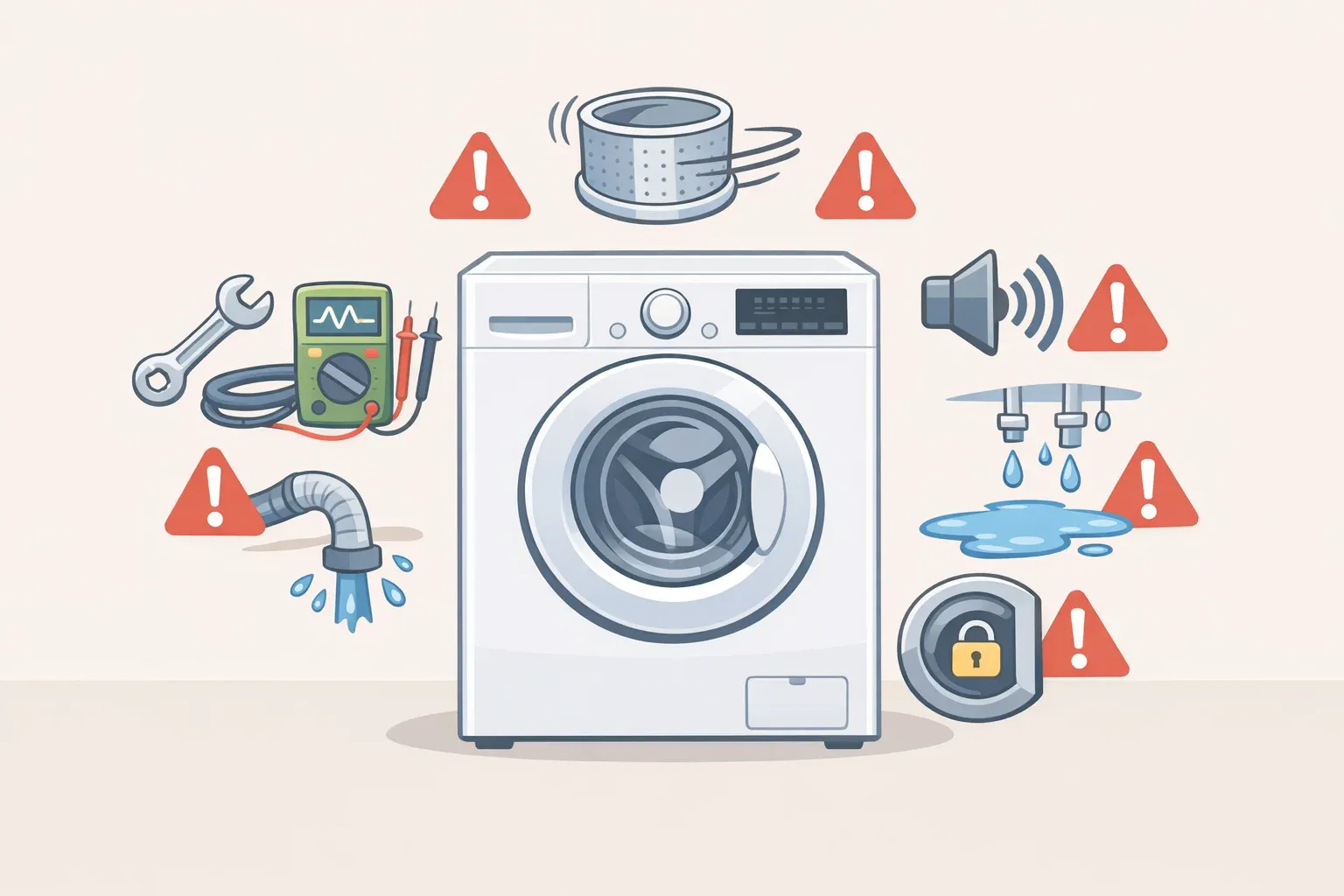
LG washers can be reliable, but when they do have problems, the same issues tend to show up again and again: draining, filling, leaks, too many suds, spin-balance trouble, and door or power errors. That predictability helps because many problems can be narrowed down with the error code on the display and a few safe checks before calling a technician.
This guide covers six common LG washing machine problems owners can often troubleshoot at home. Each section explains what the symptom usually means, what to check first, and where DIY ends.
A quick note on scope: Problems 1 through 3 — draining, filling, and leaking — show up often on front-load washers, though the same diagnostic logic may apply to some top-load models. Problems 4 through 6 can affect both front-load and top-load machines, with one exception: the door-lock steps in Problem 6 are specific to front-loaders. If your model's manual gives different steps, follow the manual first.
Start with a safe reset. Power off the washer, unplug it or flip the breaker, hold START/PAUSE for five seconds while the power is off, then restore power and try the cycle again. If the symptom returns, move to the problem-specific checks below. Stop the machine and contact LG support immediately if you detect a burning smell, water that will not stop, or a code that keeps reappearing after the correct fix.
LG washer error codes: quick reference
LG washers display specific codes when something goes wrong. The table below is based on LG's current washer error-code guidance. Treat each code as a starting point, not a final diagnosis.
CodeWhat it meansFirst checkCovered inOE / E03 / E21Washer cannot drainCheck the drain hose and drain pump filterProblem 1IE / E02 / E10Washer cannot fillCheck supply valves and inlet hosesProblem 2AEPossible internal leak or safety-switch issueCheck inlet hose connections and reset onceProblem 3 / Problem 6SUD / SudToo much foamUse HE detergent and reduce the doseProblem 4UEUnbalanced loadRedistribute laundry and restartProblem 5LETub or motor cannot spin properlyReduce the load, check for foreign objects, and resetProblem 5dE / dE1 / dE2 / E01 / E30Door is not closed or locked properlyCheck for laundry caught in the gasket and resetProblem 6PFPower failureReset and check the outlet or breakerProblem 6CLChild Lock is active, not an errorHold the Child Lock button or button combinationProblem 6
Problem 1: Washer won't drain — OE, E03, or E21
An OE, E03, or E21 code means the washer cannot drain properly. The usual first checks are a kinked drain hose, a clogged drain pump filter, or excess suds that interfere with draining.
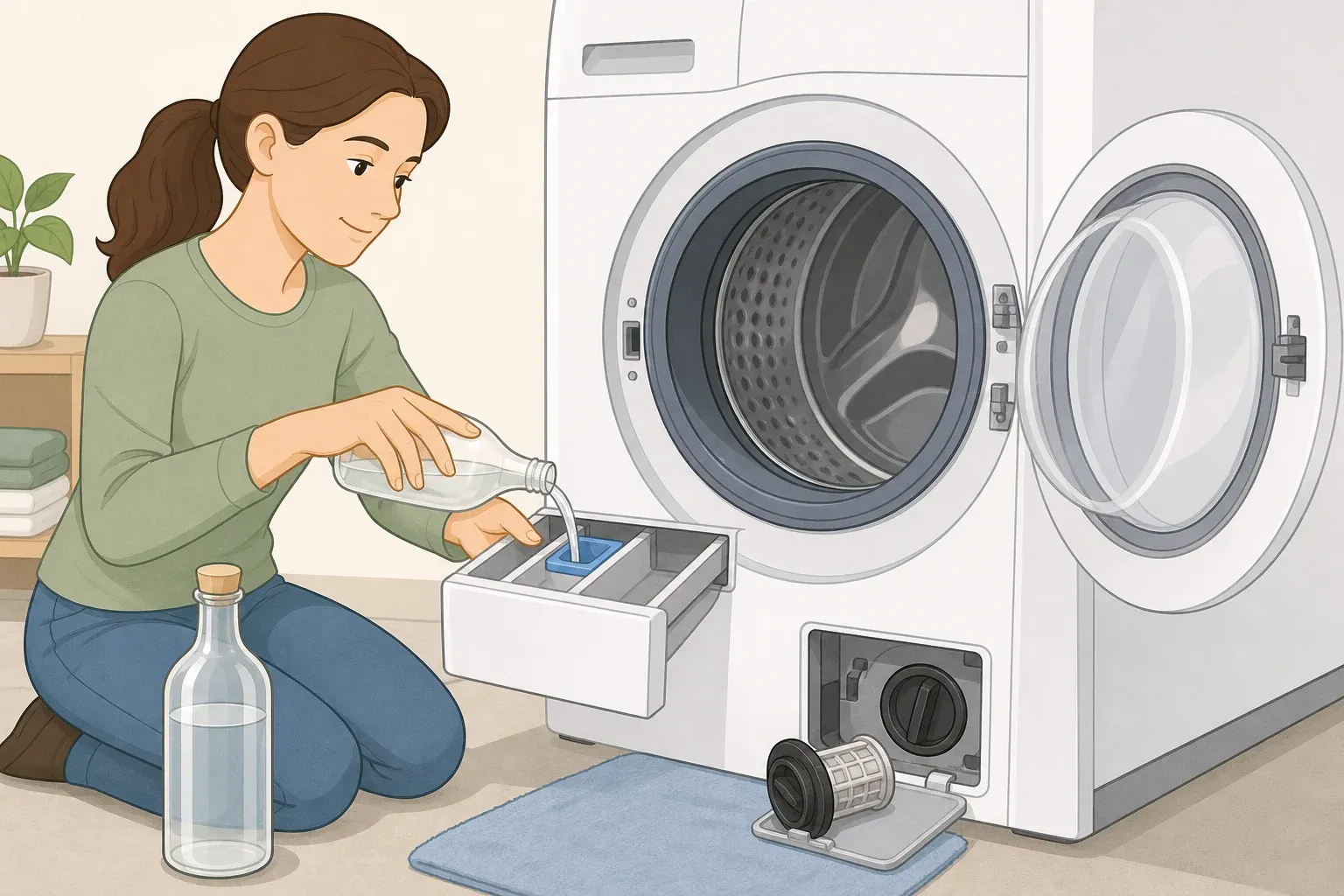
On many LG front-loaders, the drain pump filter sits behind the small access panel at the lower front of the machine. Small items, lint, hair, and debris can collect there and slow or stop draining. Washing small items in mesh laundry bags can help prevent repeat blockages.
Before opening the pump cap, prepare towels or a shallow container and make sure the water in the tub is not hot. LG's draining instructions warn that residual water can spill during filter cleaning and hot water can cause burns.
Check in this order:
Clean the drain pump filter of lint and trapped items.
Confirm the drain hose is not kinked, crushed, or pushed too far into the standpipe.
Check whether oversudsing is interfering with draining.
Test the household drain by pouring water into the standpipe. If it overflows, the clog is in the plumbing, not the washer.
Reset the washer and run a Rinse + Spin cycle.
Where DIY ends: The drain code returns after the filter is clean, the hose is clear, the standpipe drains properly, and detergent suds have been ruled out.
Problem 2: Washer won't fill — IE, E02, or E10
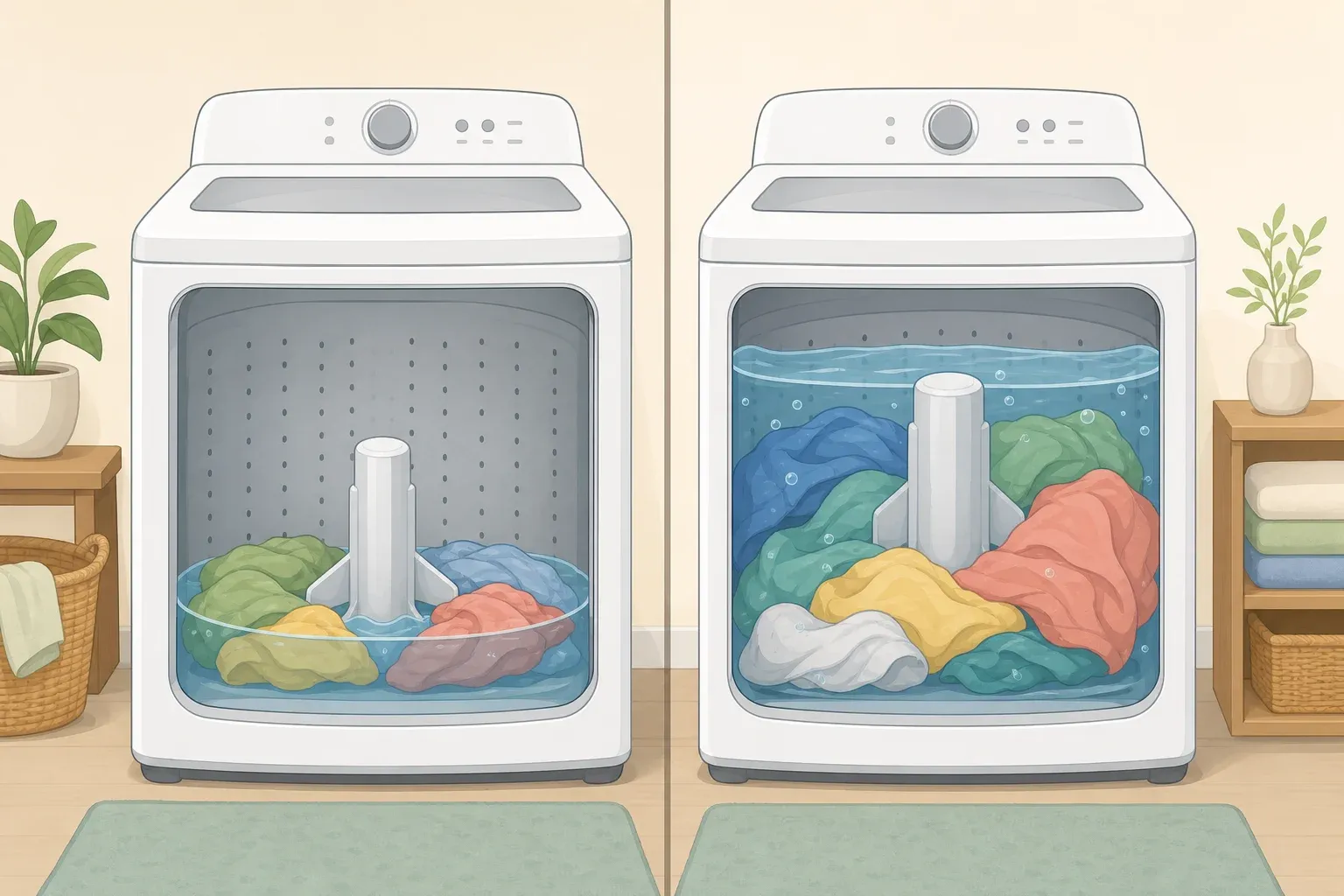
An IE, E02, or E10 code means the washer did not fill to the required level within the expected time. Most fill problems start outside the machine: closed supply valves, kinked inlet hoses, clogged inlet filters, or low household water pressure.
This applies to both front-load and top-load LG washers. If the machine cannot get enough water through the inlet hoses, it may stop before the wash cycle begins.
Check in this order:
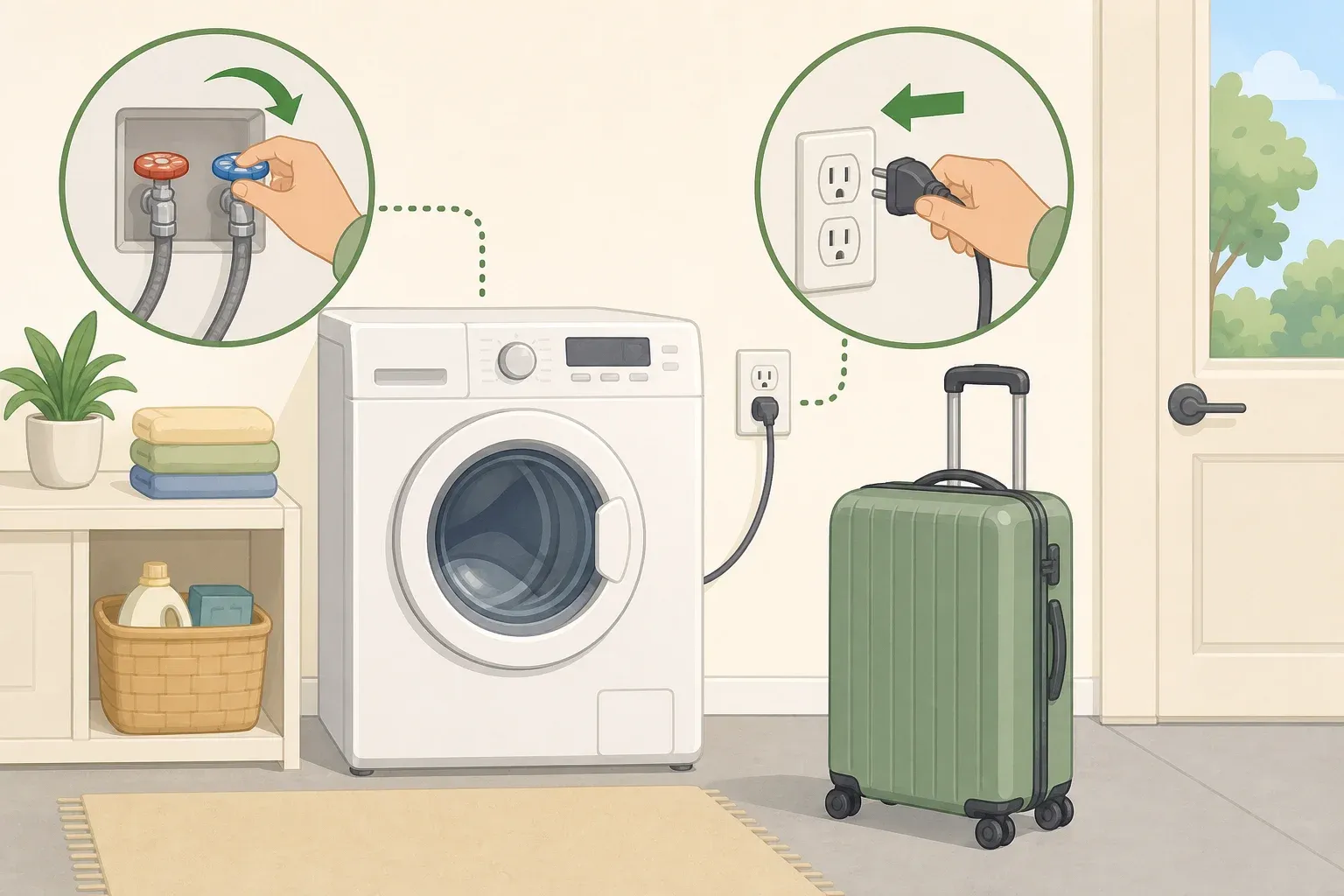
Confirm both hot and cold supply valves behind the washer are fully open.
Straighten the inlet hoses if they have bends, twists, or kinks.
Turn off the water, unscrew the inlet hoses from the back of the washer, and rinse the small mesh filters inside the connection ports.
Confirm the household water pressure is adequate.
Reset the washer and restart the cycle.
Where DIY ends: The fill code persists after the valves, hoses, inlet filters, and household water pressure have all been checked.
Problem 3: LG washer leaking
A leak is not one single problem. It is a symptom, and the fix depends on where the water is coming from.
On front-loaders, leaks near the drain filter area are often caused by a loose manual drain hose cap or a filter that is not seated correctly. Leaks behind the washer usually point to inlet hose connections, worn hose washers, damaged hoses, or a standpipe that is backing up. Leaks near the dispenser drawer or safety air vent can point to too much detergent or the wrong type of detergent.
Check in this order:
Locate the water: near the front, behind the washer, under the machine, or near the dispenser area.
If the leak is near the front, check that the drain pump filter cap and manual drain hose cap are fully closed.
If the leak is behind the washer, inspect the inlet hose connections at the wall and at the back of the machine.
Check connector washers for cracks, corrosion, or wear.
Test the standpipe by pouring water directly into it. If it overflows, the problem is in the household drain.
If the leak appears near the dispenser area, reduce detergent use and check Problem 4.
Where DIY ends: Leaking continues after the drain filter, inlet hoses, hose washers, standpipe, and detergent use have all been checked. A persistent leak at the front door seal may indicate a damaged boot seal that requires service.
Problem 4: Too many suds or detergent residue
The SUD or Sud alert means the washer has more foam than it can manage. When this happens, the washer may pause, add rinse time, or stop spinning until the suds go down.
There are two common causes. The first is using regular detergent instead of HE detergent. Front-load and high-efficiency top-load washers use less water than older machines, so regular detergent can create foam the washer cannot rinse away. The second is using too much HE detergent. Some concentrated formulas require only a small amount per load, so filling the dispenser to the max line may still be too much.
Too much fabric softener can create similar buildup issues. If residue is already inside the washer, run the Tub Clean cycle. If the washer has not been cleaned in a while, repeat the cycle as needed according to your manual.
Immediate fix and recovery:
Switch to HE detergent if you are not already using it.
Check the detergent label for the correct dose instead of relying on the dispenser's max line.
Use less detergent for small or lightly soiled loads.
Avoid overfilling the fabric-softener compartment.
Run Tub Clean to clear residue from the drum.
Where DIY ends: SUD alerts continue after switching to correctly dosed HE detergent and running the cleaning cycle.
Problem 5: Washer won't spin or shows UE
A UE code means the washer detected an unbalanced load and could not spin properly. This can happen with an overloaded drum, an underloaded drum, or one heavy item sitting on one side of the tub. A single bath towel, blanket, or pair of heavy jeans can be enough to throw off the spin cycle.
The related LE code is different. It means the tub or motor cannot spin properly. That may happen after an overload, when a foreign object is stuck, or when the washer needs service.
Check in this order:
Open the door and redistribute the laundry by hand.
Remove items if the drum is overloaded.
Avoid washing one heavy item by itself. Add a few lighter pieces so the drum can balance.
Use mesh laundry bags for small items so they do not cluster on one side.
Make sure the washer is level and all feet are firmly on the floor.
Reset the washer and run Rinse + Spin.
Where DIY ends: UE persists after redistributing the load and leveling the washer. LE returns after a reset with a properly loaded drum.
Problem 6: Door won't lock or washer won't power on
A dE-family code means the washer cannot confirm that the door or lid is properly closed and locked. The washer will not run without that confirmation. On front-loaders, the first place to check is the rubber gasket fold around the door opening, where socks, fabric edges, or debris can get trapped.
Check in this order:
Look inside the gasket fold for trapped clothing or debris.
Wipe the gasket and door area clean.
Close the door firmly.
Reset the washer and try the cycle again.
Where DIY ends: The door code returns after a clean, unobstructed door close and a reset. A worn latch or failed lock assembly requires service.
If the washer appears dead, check for simpler causes before assuming a control-board failure. A panel that does not respond may have Child Lock enabled. A PF code points to a power failure, while an AE code points to a possible internal leak or safety-switch issue, so the two should not be treated the same way.
For no power, check in this order:
Confirm Child Lock is not active.
Make sure the power cord is fully seated.
Test the outlet with another appliance.
Check the circuit breaker.
Reset the washer.
A PF code that returns after a reset, any burning smell, or any no-power symptom after checking the outlet, breaker, cord, and Child Lock status is a hard stop. For AE, inspect the inlet hose for loose fittings or visible damage, reset once, and request service if the code returns.
Maintenance habits that prevent LG washer problems
Most LG washer problems are easier to prevent than repair. The habits are simple:
Clean the drain pump filter regularly, especially if you wash pet items, small garments, or heavily soiled laundry.
Run the Tub Clean cycle at least once a month, or as directed by your manual.
Use HE detergent and measure it according to the detergent label.
Do not use the dispenser's max line as your default detergent amount.
Wash small items in mesh laundry bags.
Leave a front-loader door ajar between loads so moisture can evaporate.
Wipe the door gasket regularly to reduce residue and odor.
Do not overload the drum.
Check pockets before washing clothes.
Odor and mold in front-load washers usually come from trapped moisture and residue. Leaving the door open, wiping the gasket, and running Tub Clean regularly can prevent most of it.
Some LG models support Smart Diagnosis through the LG ThinQ app, which may help LG support narrow down a recurring problem. It should not replace the basic checks above.
If the same code returns after the relevant checks, or if you notice a burning smell, uncontrolled water, or a leak that does not stop after basic troubleshooting, turn the washer off and contact LG support or a qualified appliance technician. For supported models, LG's Smart Diagnosis feature in the ThinQ app may also help support narrow down a recurring issue, but it should not replace the safety checks above.

Comments
Be the first, drop a comment!