



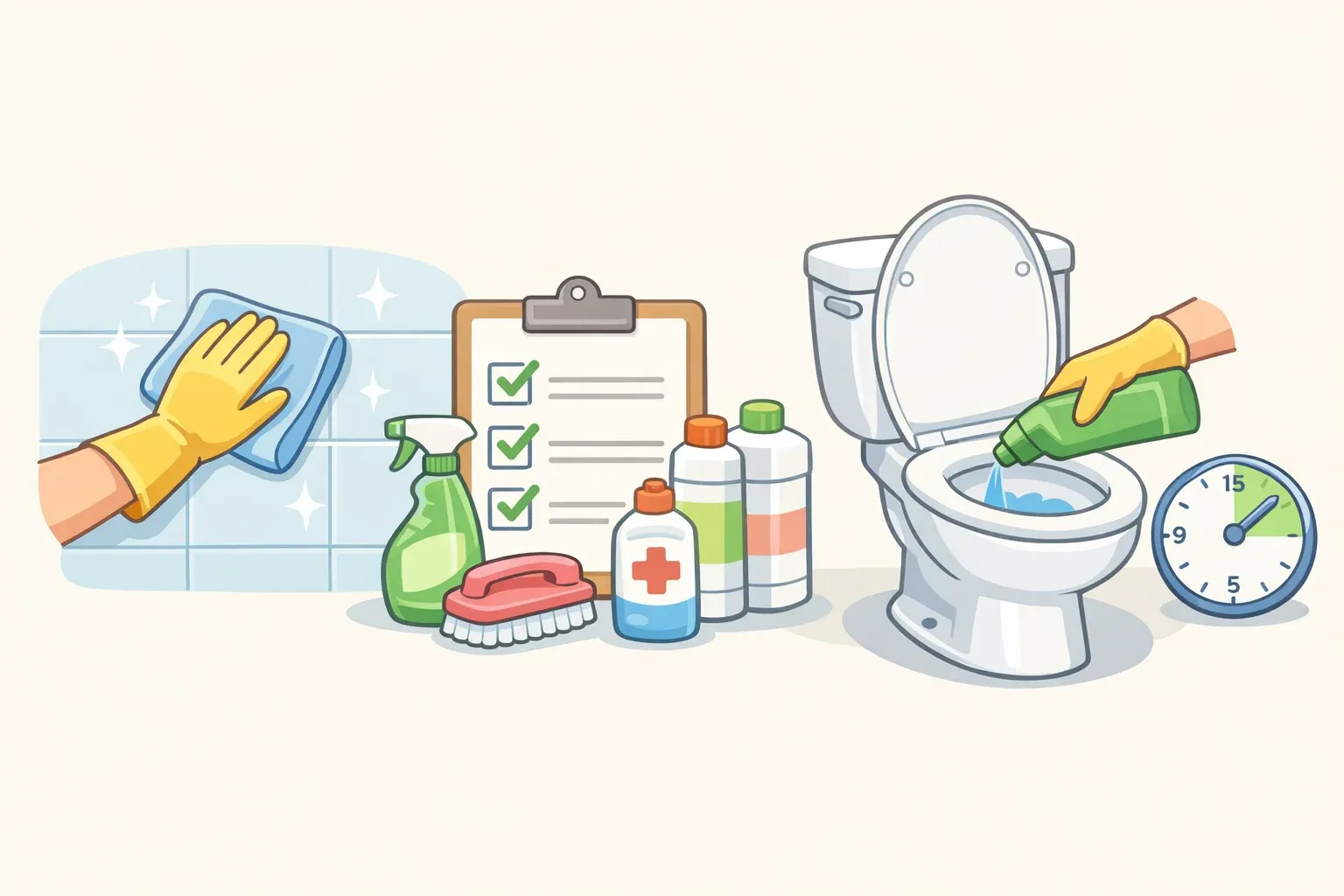
Bathroom cleaning checklist: daily, weekly & deep clean
This bathroom cleaning checklist breaks the job into daily tasks that take five minutes, a weekly routine that runs under half an hour, and a monthly deep clean that handles what regular upkeep misses. It also settles a question that gets muddled by product marketing: when does disinfecting actually matter, and when is plain cleaning enough?
Before the first step, gather your supplies. You'll need an all-purpose bathroom cleaner, toilet bowl cleaner, glass cleaner, a toilet brush, microfiber cloths or paper towels, rubber gloves, and a mop or floor cloth. Open a window or turn on the exhaust fan before uncapping anything.
One framework shapes everything that follows. The CDC distinguishes three distinct tasks: cleaning physically removes most dirt and germs using soap or detergent with water; sanitizing reduces germs to safer levels; disinfecting kills remaining germs on surfaces. Cleaning always comes first, every time (CDC, 2022). For a healthy household, regular cleaning handles most of the work. Disinfecting is for specific situations, addressed in Step 4.
Step 1: Safety rules before you uncap anything
Bathrooms concentrate fumes fast. Turn on the exhaust fan or open a window before touching any product — not as an afterthought, but as the literal first step.
Wear gloves for every task involving a dedicated bathroom cleaner, toilet bowl cleaner, or bleach-based product. Eye protection is worth adding when scrubbing the toilet or shower. The New Jersey Department of Health recommends gloves, safety glasses, and adequate ventilation as baseline protection when using cleaning products (NJ Dept. of Health, July 2025).
Never mix cleaning products, especially anything containing bleach. Combining bleach with toilet bowl cleaner, mildew remover, vinegar, rubbing alcohol, or drain cleaner can release toxic gases. The NJ Department of Health hazard alert documents a fatal case: a restaurant worker opened a dishwasher and was overcome by chlorine gas produced when a lime-scale remover and bleach had been used in the same machine (NJ Dept. of Health, July 2025). Spraying a vinegar-based cleaner over a surface still wet with bleach carries the same chemistry.
"Natural" does not mean safe to combine. Bleach mixed with vinegar or lemon juice releases chlorine gas. Hydrogen peroxide combined with vinegar forms peracetic acid, which irritates the eyes, skin, and lungs (NJ Dept. of Health, July 2025). The rule: finish one product, rinse the surface with water, then apply the next.
Keep products in their original containers. Labels carry what to do in case of accidental exposure; decanted cleaners get misidentified. If an exposure happens, the national Poison Control hotline is 1-800-222-1222 (NJ Dept. of Health, July 2025).
Quick-reference: combinations to avoid
Don't mixReactionBleach + ammonia (found in many glass cleaners)Toxic chloramine gases: coughing, chest pain, lung damageBleach + vinegar or lemon juiceChlorine gas: eye, throat, and respiratory irritation; fatal at very high levelsBleach + rubbing alcoholChloroform: dizziness, nausea, loss of consciousnessBleach + toilet bowl cleanerChlorine gas: most bowl cleaners are acidicBleach + mildew removerChlorine gas: some mildew removers already contain bleachBleach + drain cleanerChlorine gas with potential for lasting health effectsHydrogen peroxide + vinegarPeracetic acid: irritates eyes, skin, and lungsDifferent brands of drain cleanerUnpredictable dangerous reactions
Source: NJ Dept. of Health Hazard Alert, July 2025
Daily bathroom cleaning checklist (5 minutes)
These tasks prevent buildup that later requires hard scrubbing. None of them require disinfectant under normal household conditions; soap, water, and a cloth do the job.
Wipe the sink basin and faucet handles with a damp cloth and a small amount of all-purpose cleaner. Rinse. This removes toothpaste, soap residue, and surface grime before it hardens.
Wipe the toilet seat, lid, and flush handle with a damp cloth and a drop of all-purpose cleaner, or a pre-moistened bathroom wipe. Routine soap-based cleaning is what the CDC's cleaning guidance prescribes for regular upkeep in a healthy household; disinfecting wipes are not the default (CDC, 2022). Save those for illness-response cleaning covered in Step 4.
Wipe down or squeegee shower walls after the last use of the day. Removing surface moisture limits the conditions under which soap scum and mildew develop. No product needed; this is mechanical moisture removal, not cleaning.
Swap out hand towels every one to two days, or sooner if visibly soiled. Replace bath mats weekly.
Weekly bathroom cleaning checklist (20-30 minutes)
Work top to bottom throughout. Dust and product drips fall, so floor surfaces get cleaned last.
Apply toilet bowl cleaner at the start of this sequence. Let it sit while you work through everything else. Do not add a second product to the bowl while the first is active. Scrub and flush as the final task before mopping.
Mirrors and glass. Spray glass cleaner, wipe with a lint-free cloth from top to bottom. Check the label: many glass cleaners contain ammonia, which means they cannot go on the same surface right after any bleach-based product without rinsing first.
Sink, faucet, and countertop. Apply all-purpose cleaner, scrub, rinse thoroughly. Note what product you used before reaching for anything else on the same surface.
Shower and tub. Apply a dedicated soap scum remover or all-purpose bathroom spray. Scrub with a stiff brush; product alone won't clear grout lines. Rinse completely — meaning no residue remains.
Toilet exterior. Wipe the tank, base, and exterior bowl with an all-purpose cleaner and a cloth used only for toilet surfaces. Then scrub the interior bowl the cleaner applied at the start has had its dwell time flush, and rinse the brush.
Gotcha: Use a separate cloth or paper towels for the toilet that never touch the sink or tub. Cross-contamination between surfaces defeats the purpose of cleaning.
Light switch plates, door handles, and baseboards. These get skipped in most routines. A damp cloth with a small amount of all-purpose cleaner is enough; no heavier product needed.
Floor: sweep or vacuum first, then mop. All debris from previous steps settles here. Use a separate floor mop or cloth, not the tools used on sink and toilet surfaces.
The top-to-bottom sequence matters. Mop first and you'll watch dust and drips from the mirror and counter settle back onto a clean floor.
Bathroom deep cleaning checklist (monthly)
These tasks don't need to happen weekly, but skipping them indefinitely produces buildup that resists routine cleaning. Schedule a deep clean roughly once a month, or when visible buildup, mildew, or grime appears.
Grout lines. Use a stiff-bristled brush with a suitable tile or grout cleaner. Scrub, let sit per product label, rinse.
Shower curtain or liner. Check the care label; most fabric curtains and vinyl liners are machine-washable. Visible mildew is a prompt to wash or replace, not spray over.
Exhaust fan cover. Remove and wipe or vacuum dust accumulation. A clogged fan moves less air, which undermines ventilation during cleaning and every time someone showers.
Drain area. Clear hair and debris from the drain opening. A drain snake handles slower-than-normal drainage. Do not follow a drain cleaner with a second product of a different brand; the combination can react dangerously (NJ Dept. of Health, July 2025).
Behind and beneath the toilet. The floor behind the base collects dust and moisture. A flat-head mop reaches where an upright one doesn't; use your regular floor cleaner.
Cabinet fronts and drawer pulls. Wipe with a damp cloth. Check underneath the sink for any product leaks or standing moisture.
When to add disinfection to this deep clean: The CDC recommends stepping up to disinfection when someone in the household is currently sick or when a household member has a compromised immune system (CDC, 2022). The CDC's healthcare disinfection guidance describes a "targeted hygiene concept" identifying situations and surfaces where transmission risk exists as a reasonable framework for deciding when disinfection is appropriate, rather than treating every surface on a fixed schedule (CDC, 2024). Focus on high-touch points: toilet handles, faucet handles, door hardware.
When disinfecting, clean the surface first. Disinfectant applied over visible grime is less effective. After cleaning and rinsing, apply an EPA-registered disinfecting product or a freshly prepared bleach solution. For maximum potency, CDC guidance recommends preparing bleach solutions fresh at the time of use or daily, though studies show that weekly preparations can work as well (CDC REACH, May 2025).
How to clean a bathroom step by step: quick-reference summary
Daily (5 minutes)
Wipe sink basin and faucet handles
Wipe toilet seat, lid, and flush handle with soap-based cleaner
Squeegee or wipe shower walls to remove moisture
Rotate hand towels; replace bath mat weekly
Weekly (20-30 minutes)
Apply bowl cleaner first, let it dwell, flush last
Work top to bottom: mirrors, sink and countertop, shower and tub, toilet exterior, light switches and door handles, floor
Use a dedicated cloth for toilet surfaces only
Monthly deep clean
Grout lines, shower curtain or liner, exhaust fan cover, drain, behind-toilet floor, cabinet fronts
Add targeted disinfection on high-touch surfaces if someone in the household has been ill or is immunocompromised
If only 10 minutes are available, prioritize the toilet, sink, and floor in that order. Those three surfaces see the highest contact and the fastest visible deterioration. Everything else can wait for the next full weekly session without meaningful consequence.
On the bleach-versus-commercial-disinfectant question: a freshly prepared bleach solution is cheaper and, when made correctly, effective. An EPA-registered commercial disinfectant is simpler one product, fixed instructions, no mixing math. Some EPA-registered disinfectants may have lower odor or irritation profiles than bleach-based solutions. Neither is universally better; the right choice depends on what you'll actually use consistently and correctly.

Comments
Be the first, drop a comment!