



Most people approach organizing the same way: something reaches a breaking point, they buy a cart full of bins and drawer dividers, spend a weekend reorganizing, and feel briefly victorious. Six weeks later, the surfaces are buried again.
The bins weren't the problem. The approach was.
Home organizing systems that actually last aren't built around aesthetics or bursts of motivation they're built around how a household actually functions. This guide walks through a four-step framework: diagnosing why current systems fail, reducing volume before building structure, designing around real habits, and installing the lightweight maintenance rules that keep everything from collapsing within a season.
Before starting, it helps to understand the scale of the problem. A University of Georgia Cooperative Extension guide revised late last year found that people generally use fewer than half the items in their homes, which means the majority of what sits on shelves and in drawers is potential clutter in waiting. Research from UCLA's Center on Everyday Lives of Families connects that accumulation directly to elevated stress, particularly among working adults.
Lasting organization isn't a personality trait or a gift for minimalism. It's a system design problem, and that makes it solvable.
Step 1: Understand why most home organizing systems fail
Two distinct failure modes trip people up, and applying the wrong fix to the wrong problem wastes significant time and energy.
The first failure mode: confusing tidying with decluttering. Research published in the Journal of Consumer Research identifies two conceptually separate forms of household disorder: things out of place versus simply too much stuff. Tidying and moving misplaced items back to their designated spots addresses the first problem effectively.
It does nothing for the second. When a home holds more than it can comfortably contain, clutter returns no matter how often it gets tidied. The same research notes that managing household disorder is both pressing and persistent: disorder clogs the flow of objects and people through a space, and even after significant cleanup effort, tends to come back.
Genuinely Organized frames the related failure plainly: organizing without context fails quickly. A system designed around an idealized household routine rather than how that household actually moves through a day won't survive contact with real life.
The second failure mode: treating decluttering as a discipline problem. A University of Iowa Tippie College of Business study published earlier this year found that the ability to let go of possessions isn't primarily about willpower. It's about cognitive framing. People who think in concrete, personal terms about objects find it significantly harder to part with them than people who think categorically.
University of New Mexico consumer psychologist Catherine Roster, whose research on clutter spans nearly two decades, adds another layer. "Anticipated regret is a compelling reason people keep things they don't use," Roster told the UNM Newsroom. People recall a past instance of discarding something they later wished they'd kept, and that memory becomes the justification for keeping every borderline item. Those things migrate into drawers and closets and stay there for years.
Understanding which failure mode is actually operating is the prerequisite to fixing it. The remaining steps address each one in sequence.
Step 2: Declutter before you organize anything
No storage system survives the volume it wasn't designed for. Organizing too much stuff doesn't solve the problem; it relocates it.
Start small and timed. The University of Georgia Extension recommends beginning with focused 20-minute sessions on a single surface: a countertop, a drawer, one shelf. Small wins build momentum without depleting decision-making energy. Roster reinforces this directly: "Don't try to tackle the whole elephant," she told the UNM Newsroom. Set a goal of one closet, or one shelf in that closet, not the entire house in a weekend.
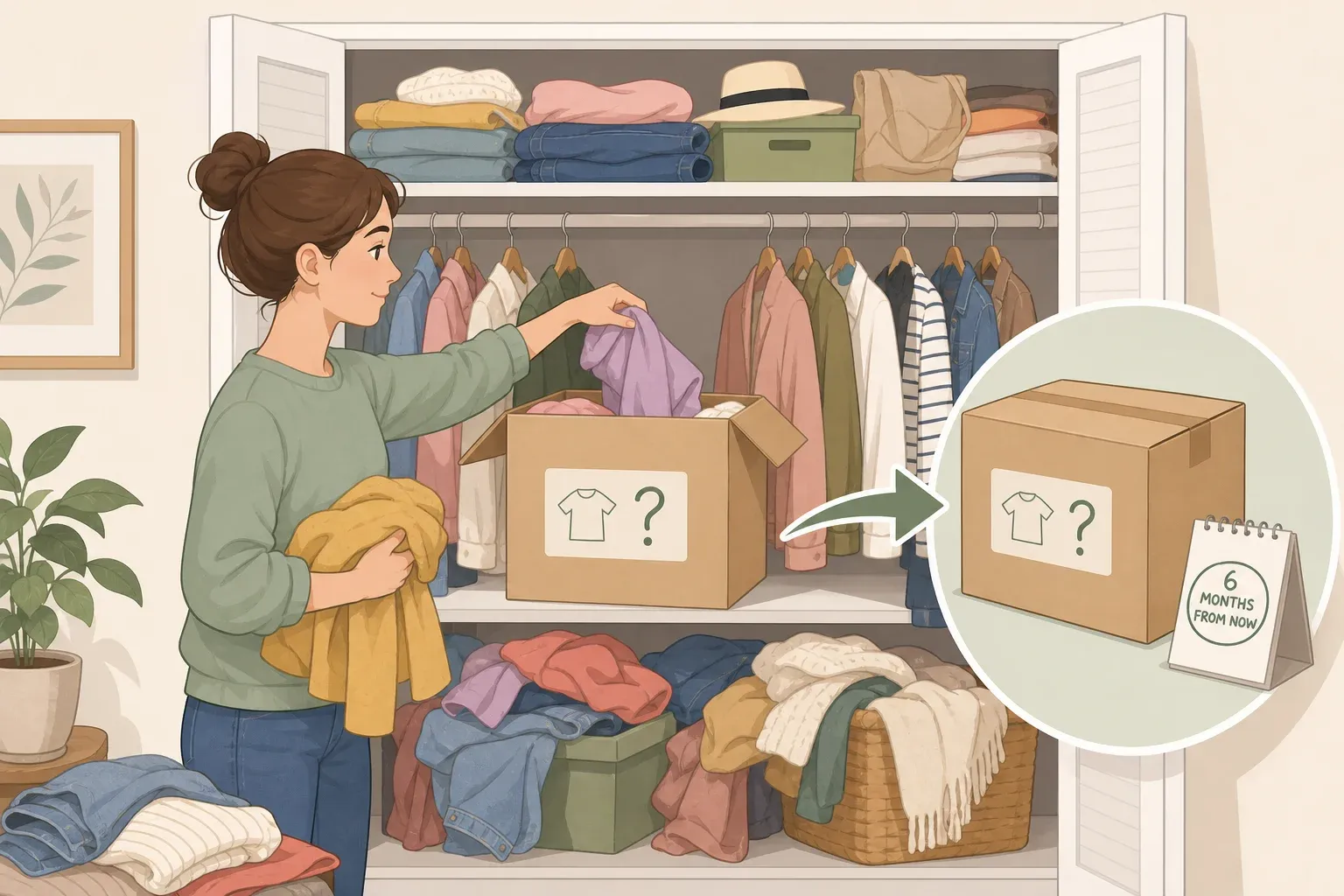
UGA Extension recommends sorting items into five categories: keep and put away now, repair within two months, donate, discard, or relocate. Anything boxed for "maybe later" that goes untouched for six months should leave the house, whether sold, donated, or discarded.
Use the cognitive reframing technique. The University of Iowa Psychology and Marketing study offers a practical technique: mentally zoom out and see belongings as categories rather than unique personal objects. A coat that hasn't been worn in two years is easier to release when thought of as "a coat" rather than "the one from before the Paris trip." Marketing professor Alice Wang, the study's co-author, explains it this way: people who think abstractly see categories instead of one-of-a-kind objects, which makes items feel less irreplaceable and easier to let go.
Supporting strategies from the same research include photographing sentimental items before letting them go, using a temporary "purgatory box" before making a final decision, and starting with the lowest-emotion items, such as duplicate kitchen tools, expired pantry goods, and excess paperwork, before working toward objects with personal significance.
One important caveat: Wang's research also notes that for some people, possessions substitute for social connection, particularly those experiencing loneliness. Letting go of objects can feel psychologically similar to losing a relationship. This isn't a character flaw. It explains why decluttering stalls even when someone genuinely wants to clear out, and naming it matters before dismissing the difficulty as a motivation problem.
Step 3: How to create organizing systems at home that are easy to maintain
Once volume is reduced, the work shifts to designing storage and workflows that match how the household actually behaves. This is where most DIY systems fall short: they're designed for how a household should run, not how it does.
Design for frequency and flow, not for appearance. Genuinely Organized describes the professional approach as evaluating how a home is used day to day, then building around frequency of use, physical ability, and daily movement patterns. Labels, bins, and layouts are chosen for function first. Genuinely Organized cites a study by the National Association of Productivity and Organizing Professionals finding that customized systems are significantly more likely to be maintained long-term than generic storage solutions.
The practical translation: items used daily belong at eye level and arm's reach. Seasonal or rarely accessed items go high, low, or into secondary storage. High-traffic zones, the kitchen, the entryway, and the bathroom counter deserve the most careful design because that's where organizing systems collapse first.
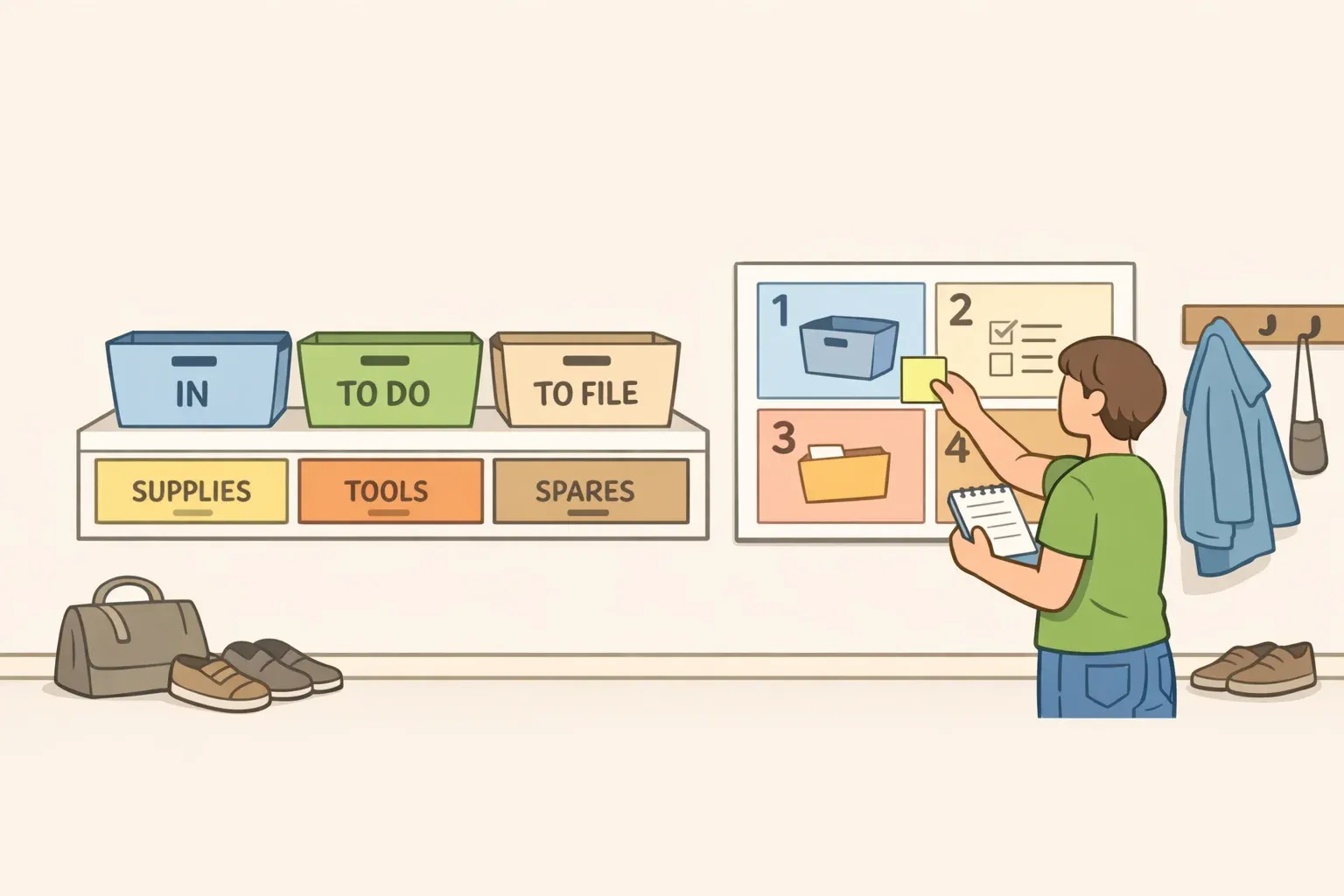
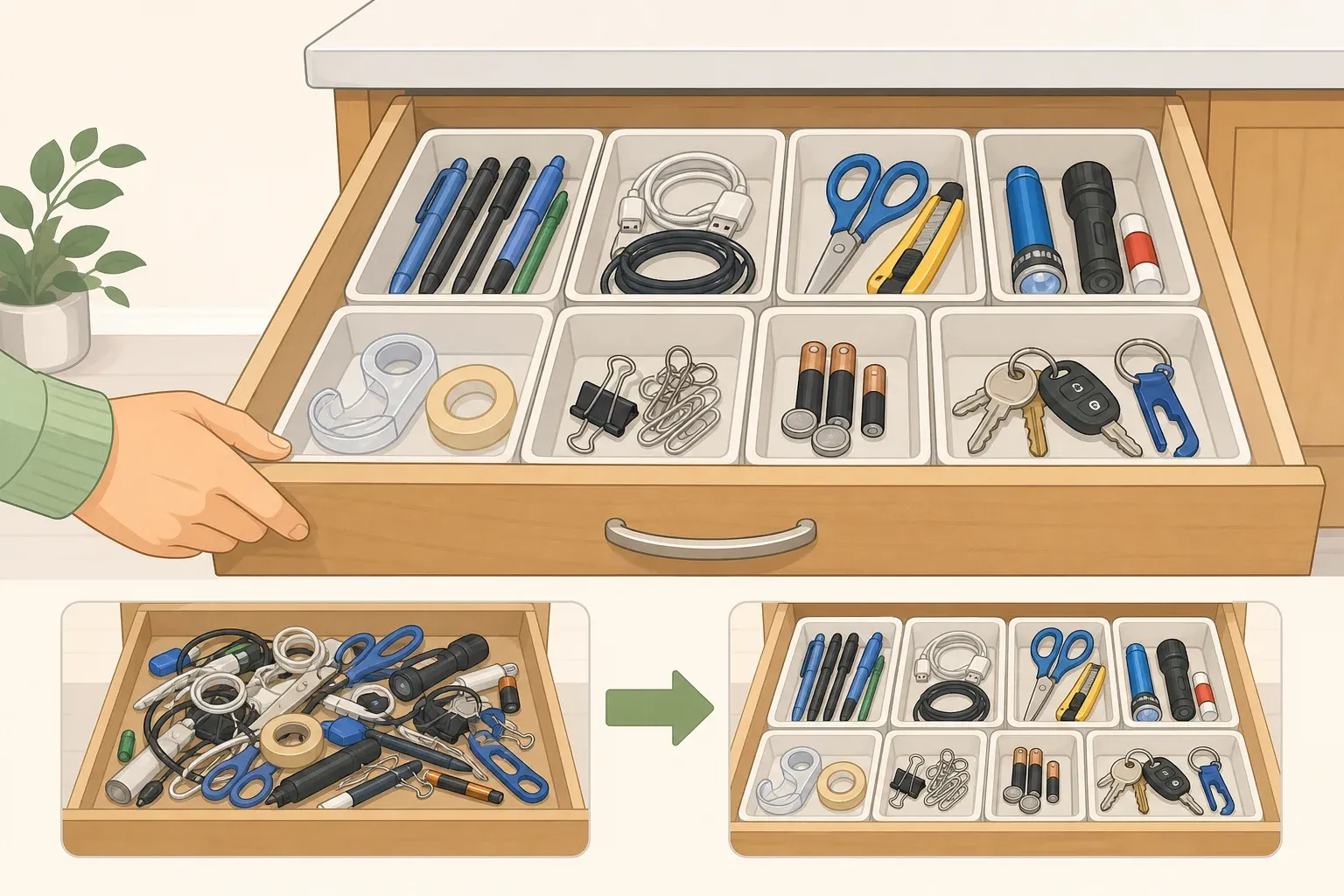
Assign one home per category, then make the right action the easiest one. This is the principle that separates systems that last from systems that slowly drift back to chaos. For each category of item, there should be exactly one designated place. No ambiguity, no "wherever there's room." When the decision of where something goes has already been made, maintenance takes almost no thought.
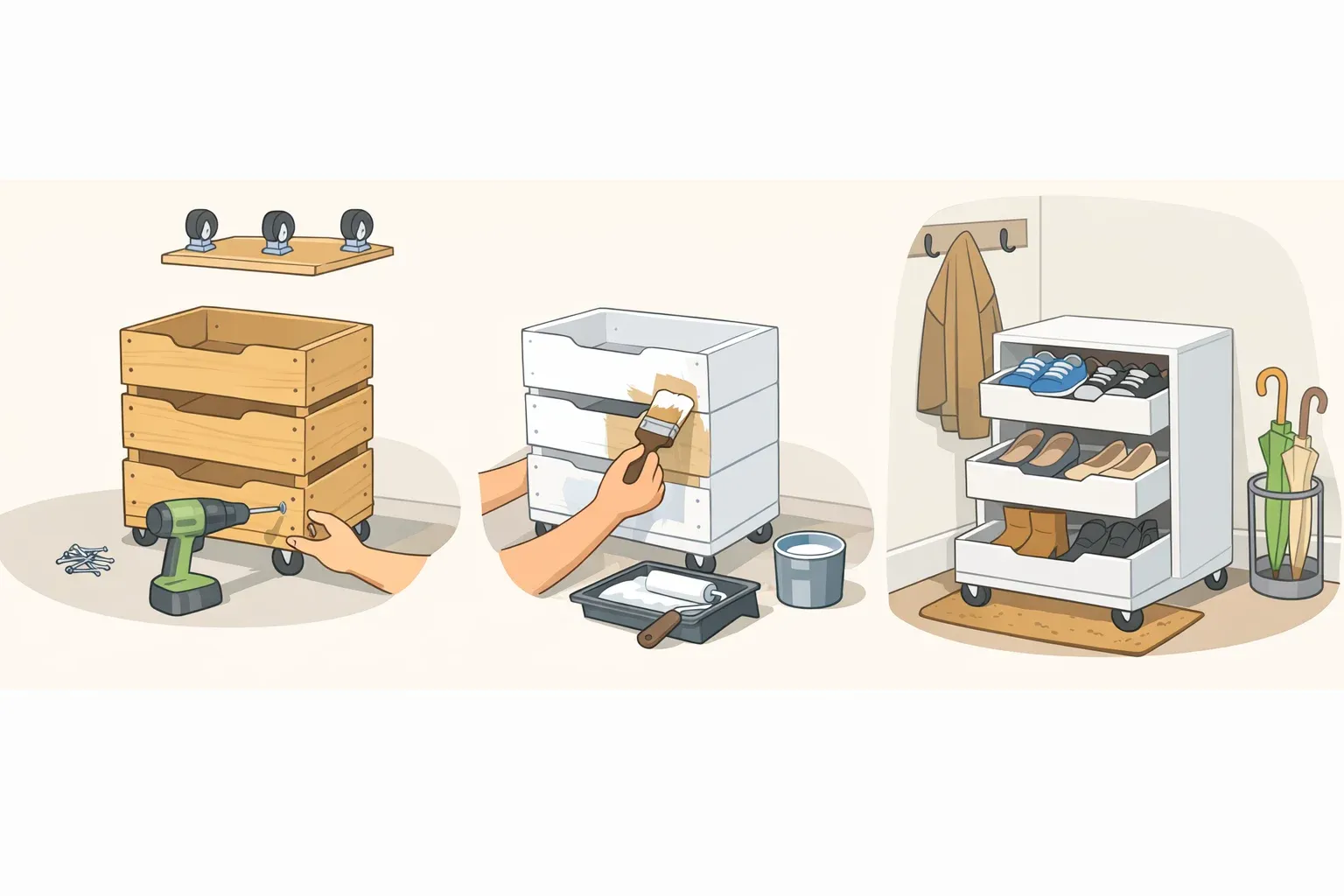
Start with the zone that causes the most daily friction. In an entryway, that typically means shoes need open access near the door, not a lidded bin two feet away. Keys need a visible landing spot at eye level, not a drawer that requires opening. School bags need a low hook or dedicated shelf where they can be dropped without a second thought. Every physical barrier between an item and its home is a reason the system eventually gets ignored.
Genuinely Organized frames the goal clearly: long-term order that fits into busy routines, not a system that requires everyone to behave differently than they actually do.
Organizing systems for busy families: start with the highest-friction zones. For households with kids, the priorities are usually school materials, sports equipment, and the morning routine. Dedicated zones for each, with a clear purpose everyone understands, remove the daily decision of where things belong. Genuinely Organized specifically notes that organizing services for families focus on high-traffic areas, including kitchens, playrooms, closets, and entryways, because that's where daily friction concentrates.
Sustainable home organization systems work because they reduce decision fatigue, not because they demand more discipline. Fewer choices involved in maintaining a space mean a higher likelihood that maintenance actually happens. As Roster put it to the UNM Newsroom: "When you put items back in their place, it doesn't get lost in chaos. It leads to productivity for the family when everyone knows where things go."
One critical mistake to avoid: designing a system around how the household should run. Any system built for an idealized routine will be abandoned by whoever finds it inconvenient. Get input from everyone who lives in the space before finalizing any layout.
Step 4: Install simple maintenance habits to keep systems from collapsing
Setup is the straightforward part. What separates home organizing systems that actually last from those that revert within months is what happens on an ordinary Tuesday.
The 60-second rule. If an item takes under 60 seconds to put away, put it away immediately rather than setting it down temporarily. The University of Georgia Extension identifies this as the single most effective daily habit for preventing re-accumulation. One realistic expectation: it takes approximately two weeks for any new routine to feel automatic. Until then, it requires conscious effort, which is normal.
The one-in, one-out rule. Every new item that enters the home displaces an existing one. UGA Extension frames this as the primary defense against re-cluttering after a full declutter. Applied consistently, it keeps total volume stable without requiring periodic overhauls. Applied inconsistently, clutter returns within a season.
Household-wide accountability. A system maintained by one person in a multi-person household will fail. Both Roster's research and the UGA Extension guide emphasize that everyone living in a home needs to understand where things go and be held responsible for putting them there. For families, this means making the rules explicit and visible, posted and discussed, not assumed.
Schedule periodic resets. Genuinely Organized notes that life changes faster than organizing systems do, especially in households with children. A brief review, one to two hours, one room at a time, every three to six months, catches drift before it requires a full overhaul. Think of it as routine maintenance, not evidence that the system failed.
What actually changes when the system works
Pick the one zone that causes the most daily friction and redesign only that space this week. Not the whole house. One zone. Getting a single space working well builds the confidence and momentum to extend the framework elsewhere, and it's far more likely to stick than a whole-home overhaul that runs out of steam by Sunday afternoon.
Once that zone is running, the downstream effects become concrete. According to a Pixie consumer survey, the average American spends the equivalent of 2.5 days per year searching for misplaced items. A well-designed system doesn't eliminate that friction by adding effort; it eliminates it by removing the conditions that create the problem in the first place.
The longer-term case for treating decluttering as an ongoing routine rather than a one-time event is well established. People who make it a regular habit report higher levels of positive emotion, a stronger sense of control over their environment, and feelings of liberation, according to Roster's research. The health stakes extend beyond mood: the University of Georgia Extension links excess accumulation to elevated stress and anxiety, increased fall risk, and respiratory issues from dust, mold spores, and pet hair collecting on piles.
Start with one zone. Apply Steps 2 through 4. Room-specific guides for kitchens, entryways, and bedroom closets can take the framework further once the foundation is in place.


Comments
Be the first, drop a comment!