



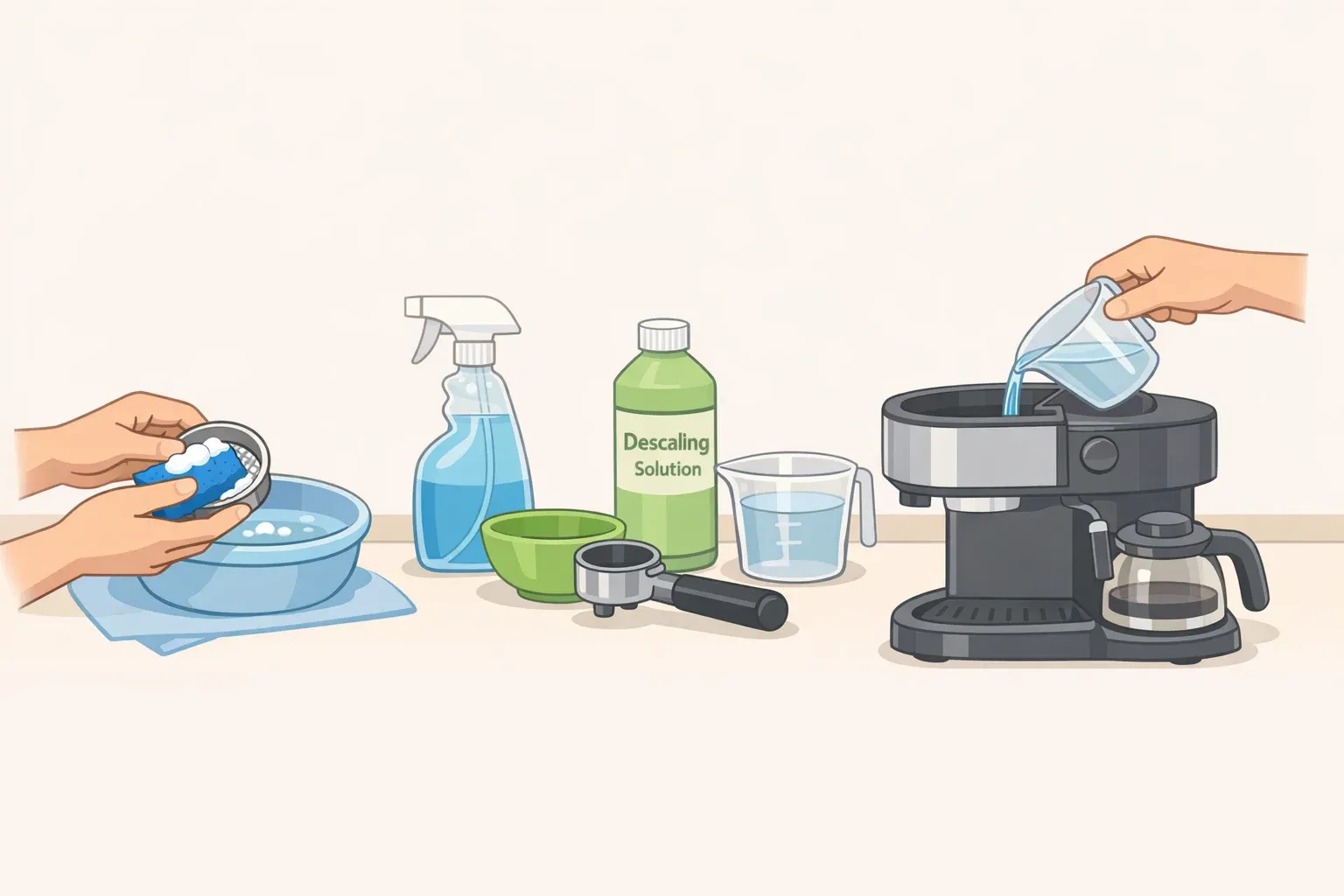
How to clean a coffee maker: descaling, mold, and more
Start with one distinction: washing removable parts and descaling the internal system are two different jobs. They solve different problems and require different methods. Skip either one and the machine will show it slower brews, flat flavor, and over time, the kind of bacterial biofilm that forms invisibly in warm, damp reservoirs, per Time for Espresso (earlier this year).
This guide covers how to clean a coffee maker from the outside in: drip machines and pod brewers, including Keurigs. A brief section at the end covers what changes for espresso machine owners.
Before you start:
- Unplug the machine.
- Remove any used pod or grounds and discard them.
- Pull out the water filter before washing the reservoir or running any descaling solution through the machine leaving it in will damage or contaminate the filter cartridge, per CNET (this month).
- Check your user manual for model-specific disassembly; needle placement and reservoir attachment vary by model.
Part 1: Routine cleaning what to wash and how often
After every brew
- Remove the used pod or grounds immediately. Leaving a spent K-Cup in the holder even overnight promotes mold growth the warm, moist grounds are effective incubators, per CNET (this month). For drip machines, tip the basket over the trash and rinse it under hot water.
- Wipe down the exterior. Keurig itself recommends a daily wipe-down of all outer surfaces, per CNET (this month). Takes about 20 seconds.
- Empty and rinse the drip tray. Coffee accumulates here faster than anywhere else. Warm water and dish soap don't leave it until tomorrow, per CNET (this month).
How often to clean a coffee maker: the weekly tasks
- Disassemble and wash all removable parts. Water reservoir, drip tray, pod holder or brew basket, and all lids. Hand wash with warm soapy water, or run dishwasher-safe components through a cycle. Good Housekeeping (last month) recommends this weekly interval regardless of how often you brew.
- Empty the reservoir entirely and refill with fresh water. Topping off standing water is not the same as changing it. Even a tank that looks clean can harbor biofilm a bacterial slime layer that forms in rarely emptied reservoirs and won't clear without a deliberate empty-and-wash, per Time for Espresso (earlier this year).
- Prioritize the pod holder or brew basket above everything else. This is where grounds, coffee oils, and residual moisture concentrate after every brew. CNET (this month) is direct: if you only clean one part, make it this one. Run it under hot water and scrub with a soft brush. For Keurig owners: there's a puncture needle in this area, so handle it carefully. Use a straightened paperclip to clear the exit needle hole when grounds have clogged it and unplug the machine first before touching the needle, per Time for Espresso (earlier this year).
How to clean a Keurig for mold: what actually works
Mold in a pod brewer isn't a sign of unusual neglect it's a predictable outcome of warm, damp conditions and irregular cleaning. CNET (this month) reports that illness linked to mold in pod brewers, sometimes called "Keurig sickness," is a documented phenomenon confirmed by Snopes.
The pod holder is the highest-risk zone, given the concentration of moist grounds and residual oils after every brew. The water reservoir is second, particularly when water sits undisturbed for days. Both are addressed by the weekly routine above. Fully emptying the reservoir not just topping it off is the step most people skip, and the one that matters most.
Part 2: How to descale a coffee maker when and how
Calcium carbonate, the mineral residue that hard water deposits inside the heating element, internal tubing, and flow path, is invisible until it causes real problems. Slower brewing, lower water temperature, coffee that tastes flat or bitter despite no change in beans or grind these are scale symptoms, per Time for Espresso (earlier this year).
Descale now if you notice any of these:
- Your machine brews noticeably slower than it used to.
- Coffee tastes flat or bitter without any change in beans or grind.
- You see white mineral crust on your kettle, fixtures, or showerhead a practical sign of hard water at home.
How often:
- Daily drinkers: every three months, per Good Housekeeping (last month).
- Occasional users (a few times a week): every six months.
- Hard water homes: stay at the shorter end of either interval. Water above 250 ppm total dissolved solids accelerates both scale buildup and flavor degradation, per Roast Coffee Company (this month). Visible mineral residue anywhere in your home is a practical trigger.
Step-by-step:
- Remove the water filter from the reservoir and set it aside.
- Prepare your descaling solution and pour it into the reservoir. (The next section covers which agent to use and at what ratio.)
- Run half a brew cycle with no pod or grounds, then pause. Let the solution sit inside the machine for 30 to 45 minutes a single pass will only partially dissolve heavier deposits, per Good Housekeeping (last month). For machines that haven't been descaled recently, lean toward the longer end.
- Complete the brew cycle and discard the liquid.
- Refill with fresh water and run a full plain-water rinse cycle. Repeat at least once more. With citric acid, two rinse cycles are sufficient, per Time for Espresso (earlier this year). With vinegar, plan for considerably more see below.
- Replace the water filter. Good Housekeeping (last month) recommends changing filter cartridges every two to three months the same schedule as descaling, so doing both together makes sense.
On water quality: Coffee is 98 to 99% water, per Roast Coffee Company (this month). Filtered tap water is the right baseline for both brewing and rinsing. Avoid distilled water it lacks the minerals needed for proper extraction. A carbon filter pitcher handles most city tap water adequately.
Part 3: Citric acid vs. vinegar which descaling agent to use
"Just run vinegar through it" is the default advice you'll find almost everywhere. Vinegar works. It's not the best option, and for anyone descaling regularly, the difference is worth understanding.
Both agents dissolve calcium carbonate scale. Where they diverge is in how thoroughly they work, what they leave behind, and how they affect machine components over time.
The case for citric acid:
In a comparative test of four cleaning methods, Apartment Therapy (earlier this year) gave citric acid the only perfect score 5 out of 5, based on overall effectiveness, convenience, and time. It removed the most visible debris, eliminated lingering odors, and produced a measurable improvement in brew speed, a sign that internal flow paths had actually cleared. Vinegar scored 2.5 out of 5 in the same test, with significant debris remaining after a full cleaning cycle.
The chemistry explains the gap. Time for Espresso (earlier this year) notes that citric acid acts as a chelating agent, binding calcium ions and pulling them out of deposits rather than dissolving them slowly on contact. It's also low-odor and rinses cleanly in two cycles.
Vinegar, by contrast, can embed into plastic tubing and reservoirs. Good Housekeeping (last month) recommends running up to 12 rinse brews after a vinegar descale to fully eliminate residual taste and that count is specific to vinegar, not a general descaling requirement. Time for Espresso (earlier this year) also notes that repeated vinegar use may be hard on rubber gaskets and O-rings, though this comes from a specialist source without broad independent corroboration; treat it as a supporting reason to prefer citric acid, not an established danger.
How to use citric acid:
- Mix 2 tablespoons of food-grade citric acid into 1 liter (about 34 oz) of warm water, per Time for Espresso (earlier this year). Stir until fully dissolved.
- Pour into the reservoir and follow the descaling steps above.
- Two plain-water rinse cycles clear all residue.
If you prefer vinegar:
- Use a 50/50 mix of white vinegar and water never full strength, which increases both odor retention and the risk of gasket wear, per Time for Espresso (earlier this year).
- After the vinegar cycle, run a baking soda flush: 2 teaspoons baking soda dissolved in 1 liter of water. This neutralizes residual acetic acid, per Time for Espresso (earlier this year).
- Follow with two plain-water rinse cycles, though Good Housekeeping (last month) recommends up to 12 rinse brews to fully clear vinegar taste. That number alone makes a reasonable argument for switching.
For heavy mineral buildup visible white crust inside the reservoir or brewing that has slowed noticeably a commercial descaler such as Durgol (rated 4 out of 5 in the same Apartment Therapy test) may be worth using once to clear stubborn scale before returning to citric acid for regular maintenance.
A note for espresso machine owners
Espresso machines follow the same two-category logic routine cleaning of accessible parts, periodic descaling of internal components but the frequency and specific tasks are more demanding.
The steam wand needs attention after every single use: purge it with a brief burst of steam, then wipe immediately with a damp cloth before milk residue hardens. A daily backflush with water clears coffee oils from the group head. Good Housekeeping's Breville guide (earlier this year) recommends a deeper group head backflush with a cleaning tablet every one to three months, plus descaling on the same interval monthly for hard water homes, every two to three months with soft water. Water filter cartridges should be replaced every three months, sooner if the water is harder.
The steps differ enough from drip machine maintenance that espresso owners should follow their manufacturer's guide rather than adapting these instructions.
Your maintenance schedule
| Frequency | Task |
|---|---|
| After every brew | Remove pod/grounds; wipe exterior; empty and rinse drip tray |
| Weekly | Wash all removable parts; empty and refill reservoir |
| Every 2 to 3 months | Replace water filter; run full citric acid descale |
| Hard water homes | Descale monthly or when brewing slows or flavor drops |
The daily tasks add nothing to a morning routine worth measuring. The weekly wash is a few minutes of actual attention. The quarterly descale is the only step that requires real time the 30-to-45-minute soak built into the process and with citric acid, two rinse cycles afterward and you're done. A machine kept on this schedule brews better coffee and gives you fewer Monday morning surprises.






Comments
Be the first, drop a comment!