



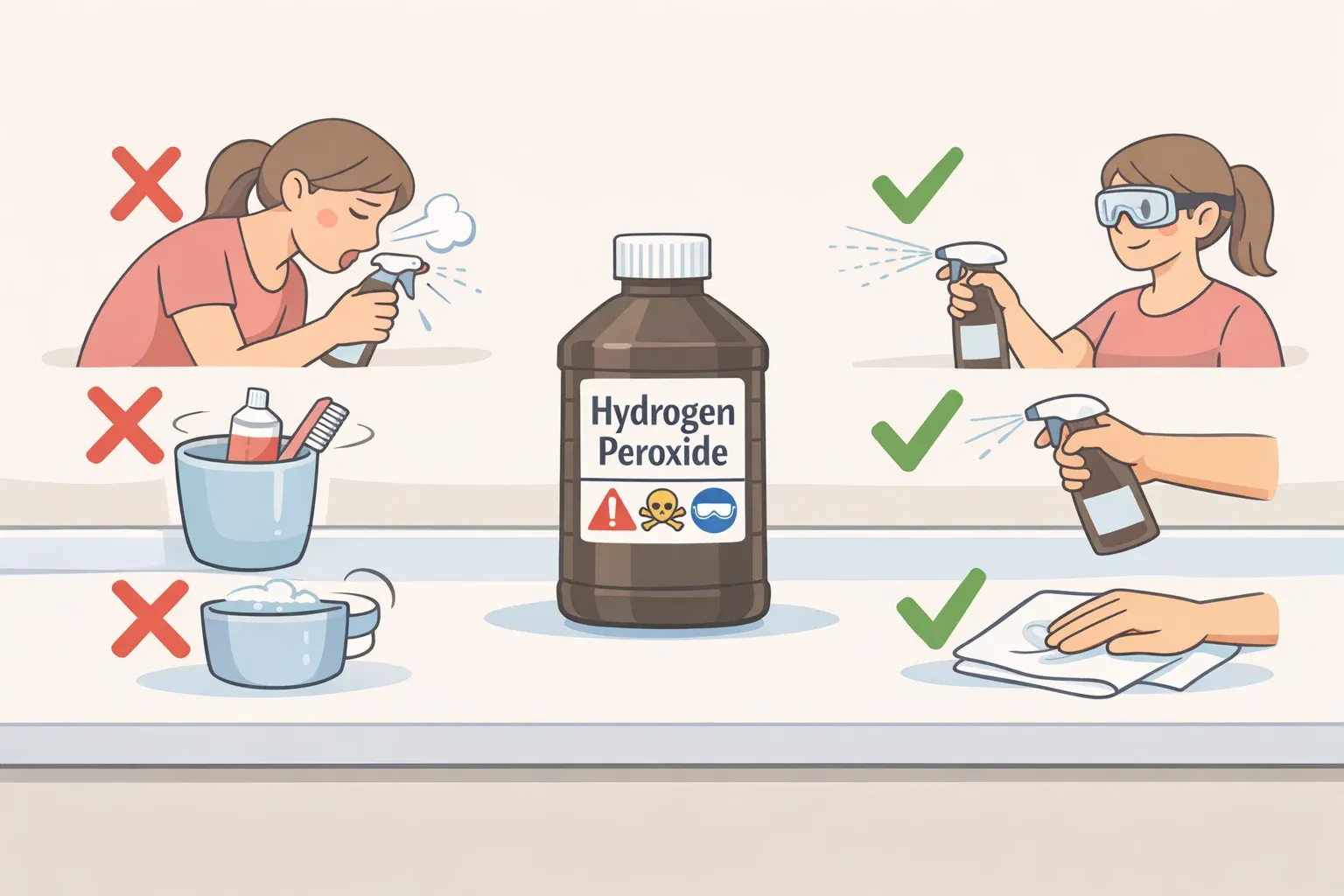
The brown bottle under most bathroom sinks earns its place. The CDC's disinfection guidelines confirm that standard 3% hydrogen peroxide is a stable, effective disinfectant for hard, inanimate surfaces: countertops, sealed tile, and toilet seats. That's the lane. The five hydrogen peroxide mistakes below are all versions of leaving it.
Concentration is what separates a useful cleaner from a genuine hazard. Industrial formulations range from 27.5% to 70%, and at those levels, hydrogen peroxide is classified as caustic, capable of chemical burns on contact and significantly more dangerous through any other route of exposure, according to StatPearls/NCBI. That's not a gradient. It's a category difference.
This guide covers five specific, correctable mistakes: wrong concentration, wrong surface (including body use), unprotected spray application, skipped contact time, and mixing hydrogen peroxide with other cleaners on the same surface. Each comes with a clear behavior change. The safe-use rule runs through all of them: 3% concentration, on hard inanimate surfaces, for the labeled contact time, in a ventilated space, stored in the original bottle.
How to use hydrogen peroxide safely: what "safe" actually means
Standard 3% hydrogen peroxide has a well-established surface disinfection record. The CDC guidelines confirm it is effective on hard, inanimate surfaces, and found it effective for spot-disinfecting fabrics in clinical settings. Hard surfaces. Inanimate. Those two qualifiers do most of the limiting work in this article, and every mistake below is a departure from one of them or from the conditions that make the chemistry work.
"Effective" is also conditional on execution. The CDC is explicit: both the correct concentration and the correct exposure time must be matched to the task; following product label directions is what makes disinfection work in practice, not simply the presence of the product on a surface. A surface that is sprayed and immediately wiped has been cleaned. It has not been disinfected. The gap between those two things is where most of the mistakes in this article live.
Mistake #1: Using the wrong concentration, including products sold as "food-grade"
The pharmacy bottle is approximately 3% hydrogen peroxide in water. Industrial formulations typically range from 27.5% to 70%, are classified as caustic, and cause significant damage through skin contact, ingestion, and inhalation alike. This is not a matter of degree. It is a category difference.
Some of these concentrated formulations reach consumers through wellness channels under the label "food-grade," marketed as purer or more potent than the drugstore version. The clinical record doesn't support that framing. One documented case involved a two-year-old boy who accidentally ingested roughly 120 to 180 mL of 35% hydrogen peroxide; imaging revealed air throughout the mediastinum and the entire right ventricle, and he did not survive.
A second case: a two-year-old girl who drank just "two sips" of 35% hydrogen peroxide while visiting a dairy farm; autopsy found diffuse alveolar damage, tracheal erosion, and gaseous distension throughout the gastrointestinal and respiratory tract. "Food-grade" describes a manufacturing purity standard, not a hazard level. The risk is the concentration.
Standard 3% peroxide stored at room temperature loses less than 2% of its potency per year, per the CDC guidelines. Buying a concentrated product to compensate for perceived degradation has no practical basis.
What to do instead: Buy 3% from a pharmacy. If a product shows a higher concentration or uses the term "food-grade," treat it as a hazardous chemical. Store it locked away from children in its original container, away from heat and direct light, and never transfer it to an unmarked bottle.
Mistake #2: Applying it to wounds, skin, or anywhere on the body
Hydrogen peroxide kills microbes by generating free radicals that break down proteins, DNA, and cell membrane lipids. That chemistry does not distinguish between a bacterial cell and human tissue. Mucous membranes are more vulnerable than skin; internal tissues more so. The same mechanism that makes peroxide useful on a countertop makes it actively harmful in a wound.
When hydrogen peroxide contacts living tissue, it reacts with a naturally occurring enzyme called catalase and releases oxygen gas. That gas can cross into the bloodstream and cause air embolism, including cerebral embolism, with outcomes similar to a stroke. The clinical literature documents permanent neurological damage as a result. There is no antidote.
Even dilute 3% peroxide causes problems when it contacts internal surfaces. The CDC guidelines document an outbreak of severe intestinal inflammation in seven patients traced to inadequately rinsed 3% hydrogen peroxide residue on endoscopy equipment, not ingestion, but residue on surfaces contacting gut tissue. The "3% is safe" claim holds for hard, inanimate surfaces. It does not extend to the body.
Concentrated formulations have also been marketed as treatments for serious illness. StatPearls/NCBI is direct: these uses are not supported by research and have caused significant harm and death.
What to do instead: Hydrogen peroxide is a surface disinfectant. For wound care, ask a pharmacist for a clinically appropriate alternative. Any internal wellness protocol involving hydrogen peroxide, regardless of claimed dilution or purity, warrants a direct conversation with a clinician before trying it.
Mistake #3: Spraying it without protecting your eyes or ventilating the room
Eye contact with 3% hydrogen peroxide causes immediate pain, tearing, and inflammation. It can injure the cornea and conjunctiva; depending on severity, vision loss may be temporary or permanent, StatPearls/NCBI notes. Prognosis for eye exposure is generally good, but only when decontamination is prompt and thorough. The time between contact and rinsing is what determines the outcome.
Inhaled peroxide vapor causes airway irritation and tissue injury. In serious cases, it can compromise the airway itself, and the damage can progress quickly, according to StatPearls/NCBI. Spray application in enclosed bathrooms and kitchens concentrates that exposure significantly.
Research on cleaning-product exposure in older adults with asthma found that those with very poorly controlled asthma had meaningfully higher exposure scores, cleaning more frequently with higher-concern products in ways that increased respiratory contact, as NIH/PMC data shows. Spray format in confined rooms is where that exposure accumulates.
Step-by-step: safer spray application
Open a window or run the exhaust fan before applying, especially in bathrooms. Ventilation is the most direct way to reduce inhalation exposure in enclosed spaces.
Where possible, apply peroxide to a cloth first rather than spraying directly at surfaces in a confined room.
Leave the room briefly after applying and let any mist settle before returning to wipe.
If peroxide contacts your eyes, rinse immediately with large amounts of clean water, remove contact lenses if they come out without resistance, and call Poison Control (1-800-222-1222 in the US) or seek emergency evaluation. Corneal damage may not be immediately apparent.
Note for readers with asthma or reactive airways: Spray application is where inhalation exposure concentrates most. Apply by cloth, ventilate first, and consider whether hydrogen peroxide is the right disinfectant for high-frequency cleaning in poorly ventilated spaces.
Mistake #4: Wiping the surface too soon
Disinfection requires adequate contact time. The CDC guidelines are explicit: both the correct concentration and the correct exposure duration determine whether a disinfectant actually works. Spraying and immediately wiping cleans a surface visually. It does not disinfect it.
Contact time, the number printed on the product label, is the minimum duration the surface must remain visibly wet for the disinfectant to kill pathogens. Most people wipe well before that point. The label is the only thing separating cleaning from disinfecting in practice, and most spray-and-wipe routines never cross that line, regardless of what product is being used.
Surface compatibility matters here, too. Hydrogen peroxide is appropriate for sealed tile, porcelain, and similar hard surfaces. Certain materials, such as natural stone, copper, and some metals, can be damaged by repeated peroxide application. Before applying to any surface for the first time, check the product label and, when in doubt, test a small inconspicuous area. For food-contact surfaces or areas regularly accessible to children, rinse with water after the contact time has elapsed.
What to do instead: Read the contact time on the label before cleaning. Apply enough product to keep the surface visibly wet for that duration, then wipe. Everything shorter is surface cleaning only.
Mistake #5: What not to mix with hydrogen peroxide
Two common household cleaners that should never go on the same surface: hydrogen peroxide and vinegar. Both turn up constantly in natural-cleaning content, which is exactly what makes the combination routine.
The problem is the chemistry. StatPearls/NCBI notes that hydrogen peroxide works by oxidizing and that acid disrupts its stability. Beyond destabilizing the peroxide, the CDC guidelines reference peracetic acid, a more corrosive and more irritating compound, as a distinct chemical disinfectant that forms when hydrogen peroxide and acetic acid combine. Don't combine them to make it on your kitchen counter. The practical rule is simpler: unless a product label explicitly tells you to pair two cleaners, don't. Each product performs better when used separately, for the task it's designed for.
The reaction doesn't require deliberately mixing the two in a container. Spraying vinegar on a surface still wet from hydrogen peroxide is enough. Sequential use with a brief interval carries the same risk if the first product hasn't fully dried.
What to do instead: Use hydrogen peroxide and vinegar for different tasks, never back-to-back on the same surface. If a surface has been cleaned with one, let it dry fully before applying the other. They don't need to be paired.
Keeping it in its lane
Hydrogen peroxide is a useful, well-evidenced surface disinfectant. The five mistakes above are all departures from a narrow but clear safe-use rule: 3% concentration, on hard inanimate surfaces, for the contact time on the label, in a ventilated space, stored in the original bottle, per the CDC guidelines. The severity of harm scales with how far the departure goes, sharpest of all with concentration and route of exposure, as the clinical literature makes clear.
Before reaching for the bottle, run a quick three-point check: Is this the 3% drugstore formulation? Is this a hard, inanimate surface? Does the label confirm compatibility? If any answer is no, that's the signal to stop or choose a different product. When the label doesn't specify the surface, the concentration, and the dwell time, don't improvise.
Hydrogen peroxide is one tool among several. A practical next step: comparing 3% hydrogen peroxide to diluted bleach and alcohol-based disinfectants by surface type, contact time, and appropriate use case, to give a clear basis for matching the right product to the right task.

Comments
Be the first, drop a comment!